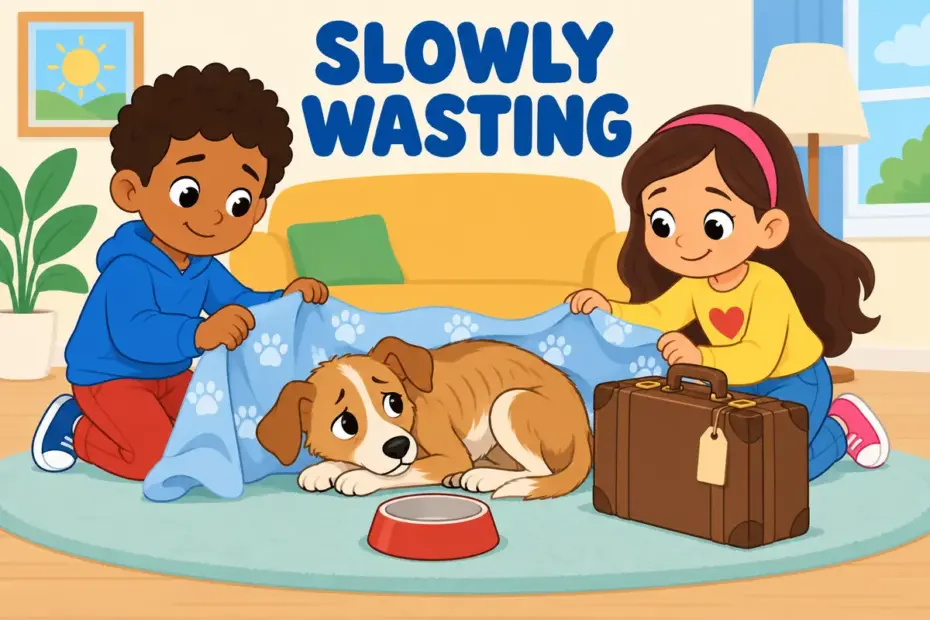
Pine away is an intransitive phrasal verb meaning to grow weaker and waste away, especially through grief or longing. To use pine away in a sentence, put the longing first and the decline second: “The old dog pined away after the move.” It describes visible wasting, not a passing sadness.
Pine away at a glance
- Pine away is intransitive and inseparable; it never takes a direct object.
- Its forms are pine away, pines away, pined away and pining away.
- It is usually followed by for, in or to nothing, naming the cause or the end point.
- It belongs to literary and formal writing more than casual speech.
- The usual error is confusing pine away, meaning waste away, with pine for, meaning long for.
What does pine away mean?
Pine away is an intransitive phrasal verb meaning to become gradually weaker and waste away, usually through grief or unsatisfied longing. The Cambridge entry for pine away captures the slow decline, and the verb keeps that single sense. To languish is the nearest plain synonym, while to yearn names the longing itself rather than the wasting it causes.
| Sense | Plain meaning | Example sentence |
|---|---|---|
| Waste through grief | Grow weak after a loss | He pined away after his brother left home. |
| Waste through longing | Fade while wanting something absent | The dog pined away for its old garden. |
| Fade in confinement | Decline in a closed or lonely place | The bird pined away in the small cage. |
One limitation is worth stating plainly. Pine away does not mean to grieve openly, and it does not name the wish itself. A person who weeps at a funeral is grieving, not pining away; the phrase belongs to a long, quiet decline that others can see in the body. When the longing is the point, English uses pine for or yearn for.
How do you use pine away in a sentence?
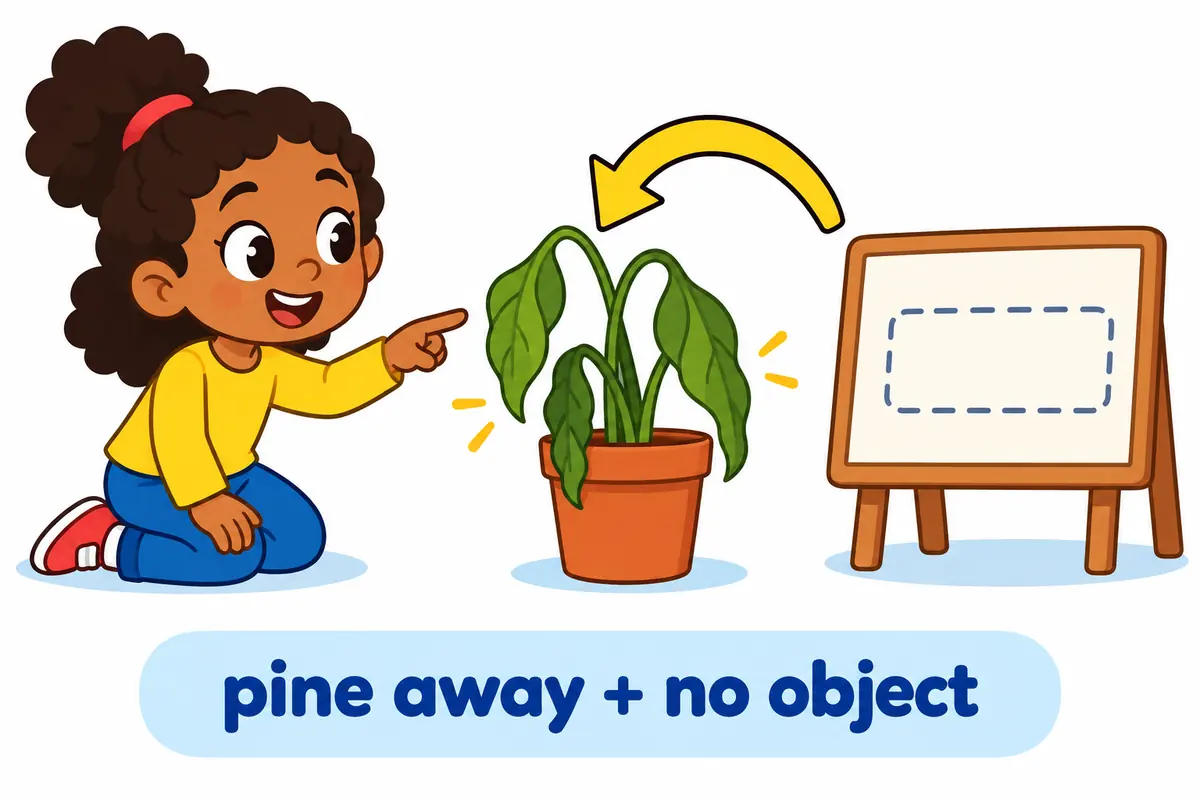
Pine away is intransitive and inseparable, so the subject wastes and no object sits between the verb and the particle. The usual companions are for, naming what is missed, and in, naming the place; a following to nothing marks total decline.
| Pattern | Example | What it signals |
|---|---|---|
| subject + pine away | The prisoner pined away within a year. | A slow, visible decline with no stated cause. |
| pine away for + person | He pined away for the friends he had left. | Names the longing behind the wasting. |
| pine away in + place | The old horse pined away in the empty stable. | Locates the decline in a lonely setting. |
| pine away to + end point | She pined away to nothing over the winter. | Stresses the completeness of the decline. |
| contrast: pine for + object | They pine for the long summer holidays. | Names a wish but implies no physical wasting. |
Pine away in a sentence: examples across contexts
Pine away carries a quiet, elegiac tone that suits stories as much as reports. The nine sentences below each make the decline visible, which is the detail that keeps the verb from sounding sentimental.
| Context | Example sentence | Why this works |
|---|---|---|
| Classroom story | The classroom plant pined away once the blinds were closed. | A concrete subject shows that the verb suits living things. |
| Workplace writing | After the merger, the small team pined away one member at a time. | Turns a slow loss into a visible timetable. |
| News feature | Residents say the village pined away when the factory closed. | Attributes the observation to named speakers. |
| Literary writing | In the novel, the widow pines away in a house full of clocks. | The setting carries the sense of stopped time. |
| Animal care | A young parrot may pine away if it is left alone for weeks. | Conditions the risk with may, keeping the claim careful. |
| History essay | The walled city pined away as the trade routes shifted east. | Extends the verb to a place without personifying it. |
| Letter home | I have pined away for the sea since we moved inland. | The first person suits the intimacy of a letter. |
| Sports writing | The veteran striker pined away on the bench for a season. | The specific place explains the decline. |
| Conversation | She has been pining away since her best friend emigrated. | The casual frame keeps the tone tender, not grand. |
Pine away vs yearn
Pine away and yearn share the feeling of longing but differ in what they describe. Yearn names the ache of wanting; pine away names the visible wasting that the ache produces over time. Other verbs draw the decline differently: a plant may wither, interest may fade, and a crowd may dwindle, but only pine away implies a living creature wasting through longing.
| Attribute | pine away | yearn |
|---|---|---|
| Core idea | Waste away gradually | Feel an intense longing |
| Focus | The visible decline | The inner desire |
| Transitivity | Intransitive only | Intransitive; takes for |
| Typical subject | People, animals, sometimes places | People only |
| Register | Literary and elegiac | Literary and emotional |
Verdict: choose yearn when the feeling is the point, and pine away when the longing has begun to wear the subject down.
Word forms and grammar of pine away
Pine away follows the regular verb pine and keeps the particle fixed. The table lists the inflections and the related forms, and marks the one that learners wrongly treat as a synonym for pine for.
| Form | Part of speech | Example |
|---|---|---|
| pine away | phrasal verb, base form | Some birds pine away in small cages. |
| pines away | verb, third person | He pines away whenever she travels. |
| pined away | verb, past and past participle | The old cat pined away after the move. |
| pining away | verb, present participle | She spent the winter pining away in the hills. |
| pine for | phrasal verb, different sense | They pine for the coast, but nobody is wasting away. |
| pine away as a transitive verb | non-standard | Write she pined for her home, not she pined away her home. |
Common mistakes with pine away
- Incorrect:
She pined away her old school friends.Correct: She pined for her old school friends. Rule: Pine away is intransitive; when the object is the thing missed, use pine for. - Incorrect:
He pined away to see the sea again.Correct: He pined to see the sea again. Rule: Longing for something takes pine or pine for, not pine away. - Incorrect:
The garden pined away the roses.Correct: The roses in the garden pined away. Rule: The subject is whatever is wasting, not the cause. - Incorrect:
She was pineing away all term.Correct: She was pining away all term. Rule: The present participle is pining, with the e dropped. - Incorrect:
I pined away for a coffee.Correct: I fancied a coffee. Rule: Pine away describes a deep, lasting decline, not a small daily want.
Practice using pine away
Work through the six items, then read the reason with each answer.
- Fill the gap: Without company, the rescue dog began to ______.
- Choose the better word: After the move she (pined away / pined) for her old neighbourhood.
- Correct the error: The sailor pined away the harbour lights.
- Build a sentence: use pine away about a plant left in a dark room.
- Spot the register: which belongs in a novel — the widower pined away beside the empty chair, or the guy got super sad and stuff?
- Rewrite with the time span: The captive grew weaker over two years. Use pine away.
Answers
- pine away — the dog is wasting from loneliness, which is the intransitive sense.
- pined — the object of the wish is named, so the bare verb pine fits better here.
- The sailor pined for the harbour lights — pine for names the object, while pine away cannot.
- Model answer: The fern pined away in the dark corner until we moved it to the sill.
- The widower pined away beside the empty chair — a novel keeps the literary register.
- The captive pined away over two years in the tower — the phrase needs the time span to show the slow decline.
The bottom line
Use pine away in a sentence when someone, an animal or even a place grows weaker through grief or longing, and make the decline visible. The two nuances that decide most sentences are these: the verb is intransitive, so the thing missed follows for rather than sitting as an object, and it describes slow wasting, not a brief sadness. Where the feeling is the point and no decline is meant, grieve or yearn is the more exact verb.
Frequently asked questions about pine away
Is pine away still used?
Yes, though it belongs to literary and formal writing rather than everyday speech. In conversation people more often say someone is moping or wasting away. A novelist, an obituary or a nature writer can still use pine away, and it reads as tender rather than old-fashioned when the context suits it.
What is the difference between pine away and pine for?
Pine for takes an object and names what is missed, as in pine for the sea. Pine away is intransitive and describes the resulting decline, as in the sailor pined away. One describes the longing, the other the wasting that the longing causes over time.
Can you pine away for a person?
Yes. Pine away for is a common pattern when the person is missed and the decline is visible, as in she pined away for her brother after he emigrated. The for phrase names the cause, while the verb itself still describes the wasting rather than the wish.
Is pine away formal or literary?
Pine away is a literary, faintly old-fashioned phrase that appears in fiction, poetry and careful feature writing. It is not wrong in speech, but a plain alternative such as waste away or mope usually sounds more natural in casual conversation. Register decides which fits a given sentence.
Have you ever heard the expression “pine away” and wondered what it means? “Pine away” is a phrase that refers to feeling intense and prolonged longing or grief for something or someone.
This expression is often used to describe someone who is experiencing deep sadness, yearning, or a sense of loss. It conveys a feeling of wasting away or languishing due to unfulfilled desires or unrequited love.
7 Examples Of Pine Away Used In a Sentence For Kids
- Pine away means to miss someone or something very much.
- When I pine away, I feel sad because I miss my friends.
- It’s okay to pine away for a little while, but soon you will feel happy again.
- When we pine away, our hearts feel heavy with sadness.
- Remember, even when we pine away, there are people who love us and care for us.
- Let’s draw pictures of the things we pine away for to help us feel better.
- We can talk to our parents, teachers, or friends when we are pine away.
14 Sentences with Pine Away Examples
- As exams approached, many students started to pine away from lack of sleep.
- Even with all the assignments due, some students still found time to pine away over their crushes.
- The thought of being away from home made some students pine away for their families.
- With the stress of choosing a major, many students began to pine away from indecision.
- Pining away for home-cooked meals, some students struggled with dining hall food.
- As the semester dragged on, some students began to pine away for a vacation.
- Pining away for a break from their studies, a few students started planning a weekend getaway.
- Some students couldn’t help but pine away for the carefree days of high school.
- Feeling overwhelmed by upcoming projects, a few students started to pine away in fear.
- Pining away for better study habits, some students sought out time management workshops.
- Missing their hometown friends, a couple of students started to pine away for a reunion.
- Pining away for some real coffee, a student longed for a trip to their favorite cafe.
- The thought of graduation made many seniors pine away for the familiar routines of college life.
- With the pressure of job interviews looming, some students began to pine away from nerves.
How To Use Pine Away in Sentences?
To use Pine Away in a sentence, simply follow these easy steps:
-
Identify a feeling of longing or yearning that you want to express in your sentence. This could be a strong desire for someone or something that you miss or wish for.
-
Insert the phrase Pine Away into your sentence in a way that accurately conveys this feeling of longing. For example, “Ever since she moved away, he would pine away for her every day.”
-
Make sure to use Pine Away as a phrasal verb in your sentence, which means it should be followed by the preposition “for” and the object of your longing. For instance, “He would pine away for his favorite childhood toy.”
-
Remember that Pine Away is a more poetic and expressive way to convey longing or yearning, so try to use it in a context where you want to emphasize the depth of your feelings.
-
Practice using Pine Away in different sentences to become more comfortable with incorporating it into your writing. Experiment with various scenarios and subjects to fully grasp the versatility of this phrase.
By following these simple steps, you can easily incorporate Pine Away into your vocabulary and add depth and emotion to your sentences.
Conclusion
In conclusion, the phrase “pine away” is commonly used to describe someone suffering from longing or grief, particularly in romantic contexts. It conveys a sense of melancholy and withering away due to unfulfilled desires or unrequited love. This expression taps into the emotional depth of yearning and the slow decline of one’s well-being, emphasizing the pain of unattainable connections.
Whether in literature, poetry, or everyday conversations, “pine away” serves as a poignant reminder of the heartache that can result from unfulfilled longing. It captures the essence of emotional suffering and the toll it takes on individuals who are unable to reconcile their feelings, resonating with those who have experienced the bittersweet struggle of unreciprocated affection.


