30 Positive Adjectives That Start With Y
English has relatively few everyday adjectives that begin with Y, so a useful list needs to distinguish familiar words from rare ones and from descriptive phrases. The guide below focuses on 30 real adjective forms or transparent compound descriptors; it does not count animal names, nouns, or adverbs as adjectives. Some entries describe a pleasant quality directly, while others become positive only in the right context.
Everyday and familiar choices
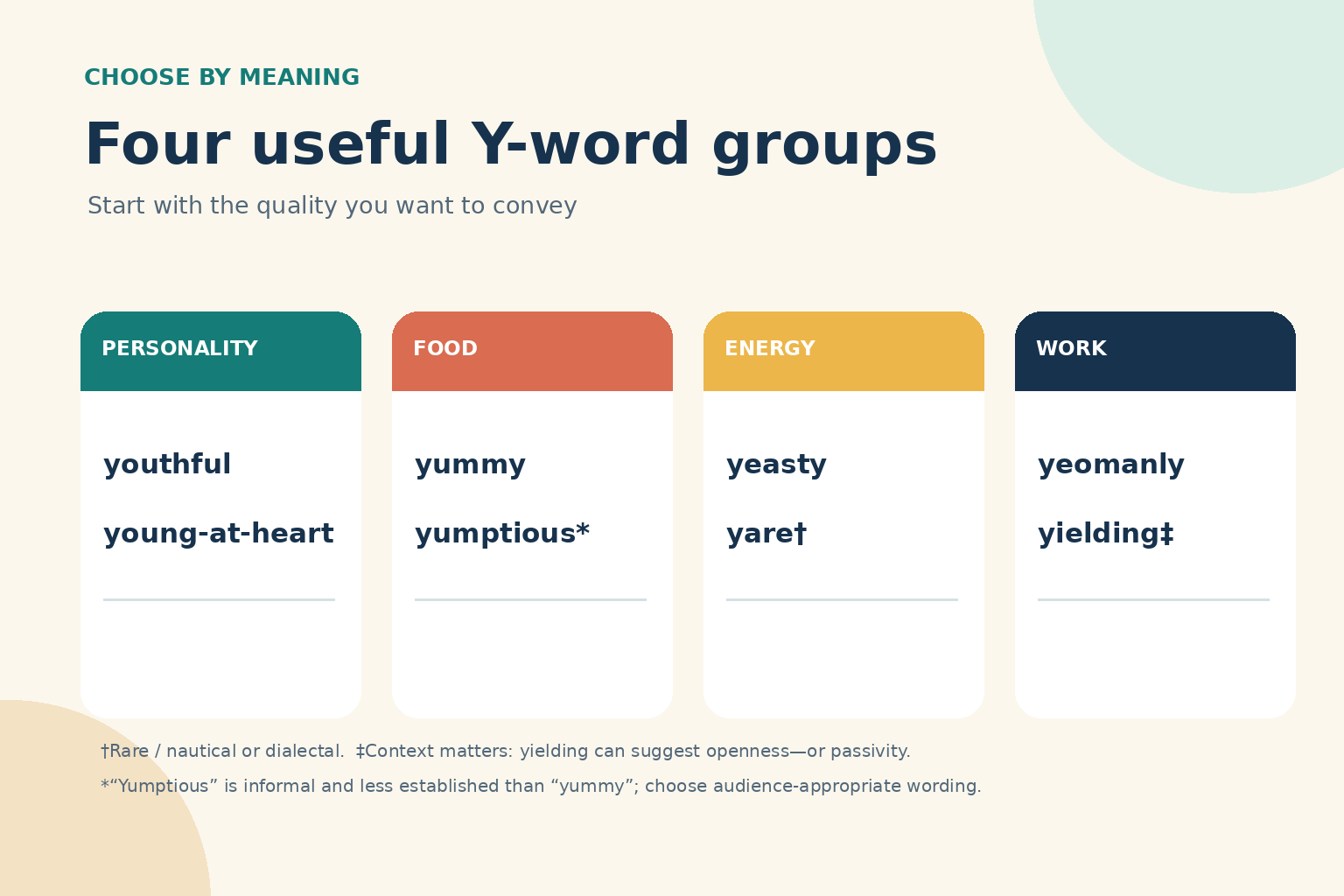
- Young — in its literal sense, at an early stage of life or development. It can also describe a fresh organization or field: “The young studio was already attracting imaginative designers.” Its tone depends on the subject and context. Cambridge Dictionary defines young as an adjective for early age or development.
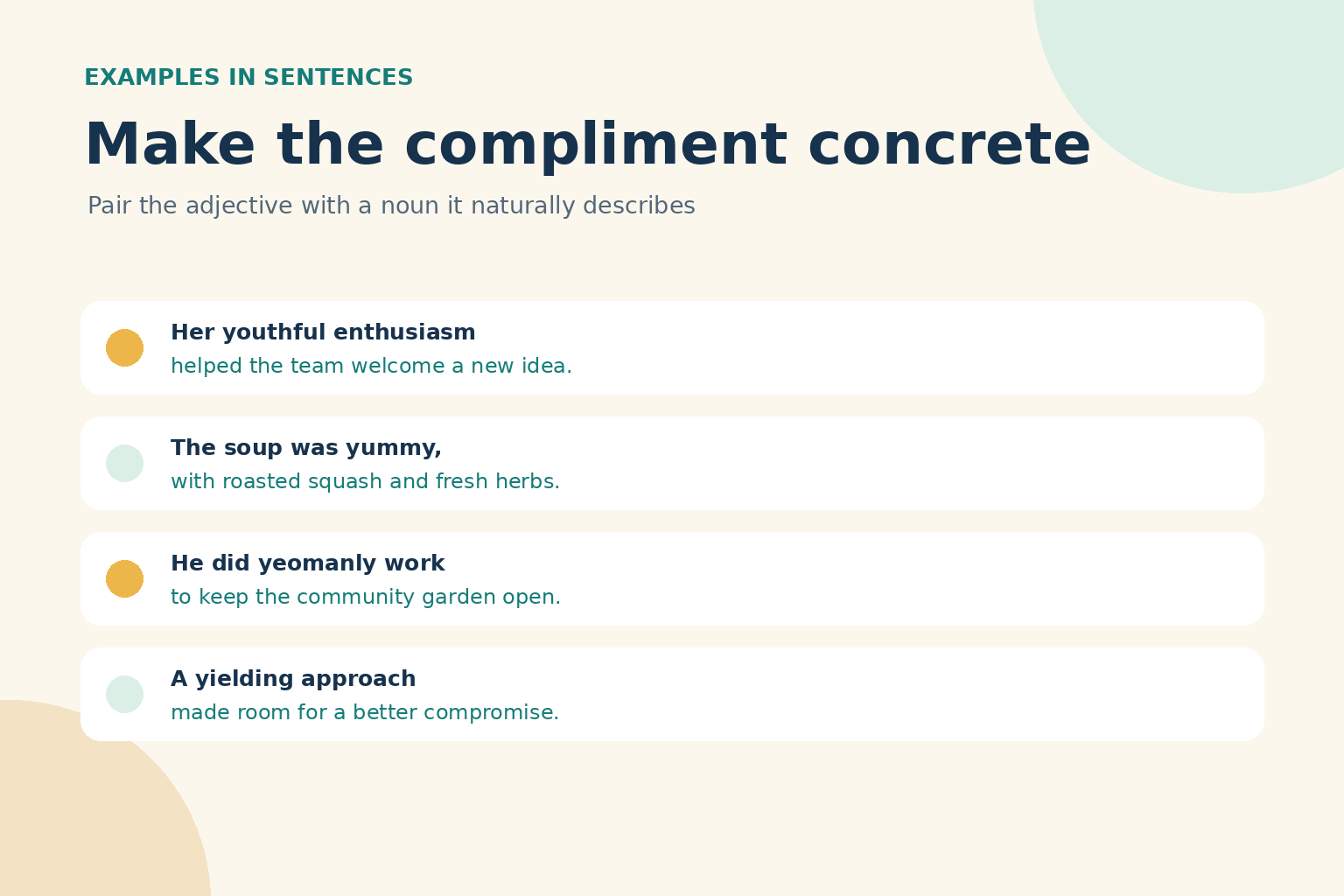
- Youthful — having qualities associated with youth, such as energy, freshness, or enthusiasm. “Her youthful curiosity turned the museum visit into an afternoon of questions.” It is commonly approving, but avoid using it to imply that older people must appear young. Cambridge Dictionary marks a sense of youthful as approving.
- Youngish — fairly or somewhat young; the suffix -ish softens the claim. “The youngish team brought a new perspective to the project.” Use it only when an approximate age impression matters.
- Young-at-heart — cheerful, curious, or open to new experiences, regardless of age. “My young-at-heart neighbor joined the beginner’s dance class.” It is a friendly, informal compound phrase.
- Young-looking — appearing younger than one’s age or looking fresh. “The well-rested traveler looked young and alert.” In sensitive contexts, praise someone’s energy or style instead of their appearance.
- Yummy — delicious or appealing in taste; informal and playful. “Those yummy lemon bars disappeared before the picnic ended.” Cambridge lists yummy as an adjective, especially for food that tastes good.
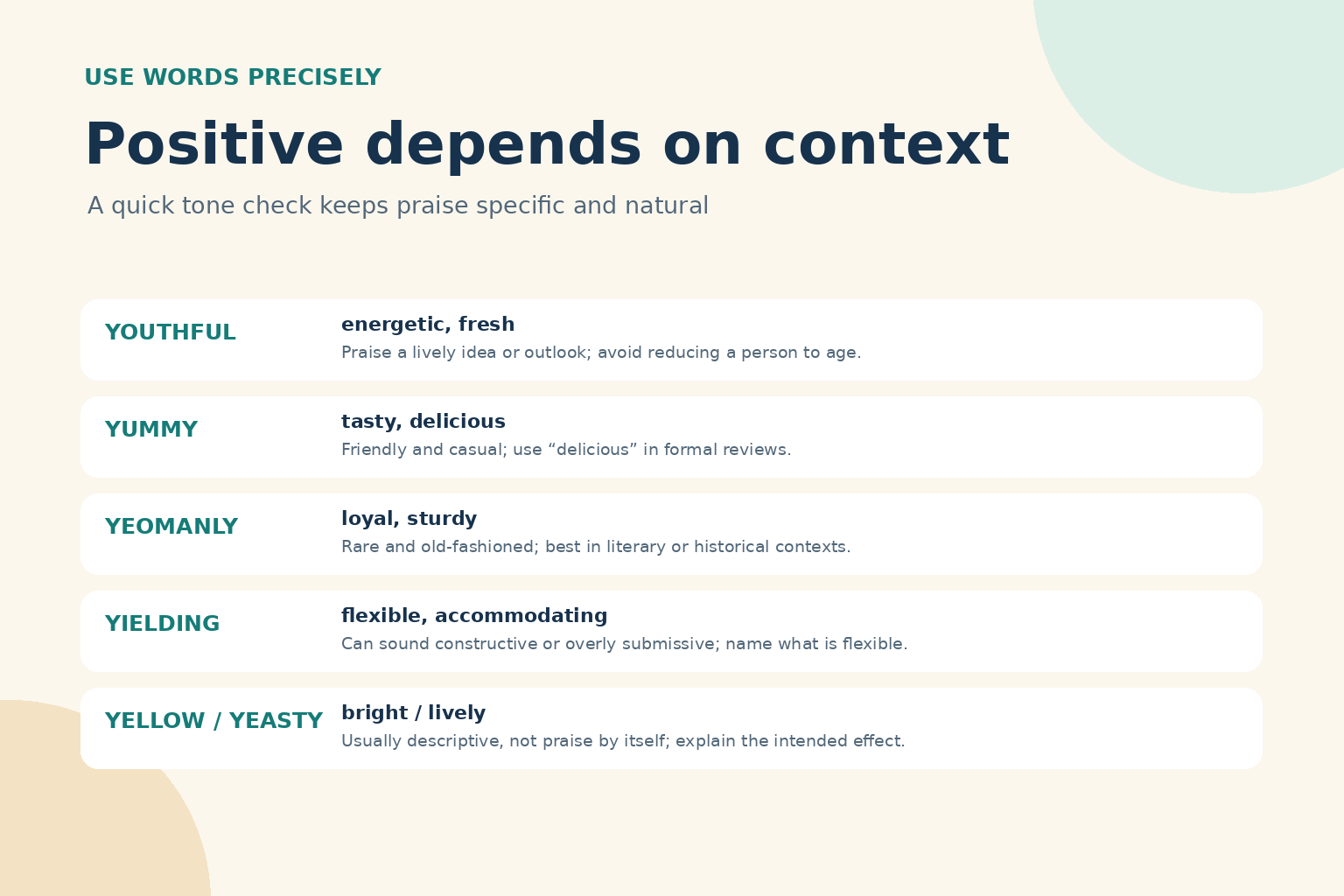
- Yielding — flexible, responsive, or willing to give way. “The yielding fabric moved comfortably with each step.” When describing a person, it can sound like praise for cooperation or criticism for being too compliant, so clarify what the person yielded on.
Rare, literary, or specialized choices
- Yare — ready, nimble, or responsive; now rare and most familiar in nautical or dialectal use. “The yare little sailboat turned smoothly in the harbor.” Collins labels yare mainly dialectal, so explain it if your readers may not know it.
- Yeomanly — sturdy, loyal, or characteristic of a yeoman; uncommon and old-fashioned. “The volunteers did yeomanly work repairing the trail.” Collins records yeomanly as an adjective with senses including staunch and loyal.
- Yeomanlike — resembling or characteristic of a yeoman; another rare, historical-sounding form. “Her yeomanlike service kept the small archive open.” Because it is unfamiliar to many readers, choose a plain synonym such as steadfast in everyday writing.
- Yeasty — literally, resembling yeast or fermentation; figuratively, lively, vigorous, or bubbling with ideas. “The essay has a yeasty energy that keeps its argument moving.” Its literal sense can also suggest a smell or flavor, so surrounding words determine whether it sounds complimentary. Merriam-Webster notes both literal and figurative senses.
- Yogic — relating to yoga or its practice. It can describe a calm, disciplined routine, but it is a topical descriptor rather than a general synonym for “good”: “She began the day with a short yogic breathing practice.”
Color and time descriptors that can sound positive in context
These adjectives are descriptive rather than automatically flattering. They fit when color, duration, or continuity is part of the praise.
- Yellow — having the color between green and orange. “The yellow wildflowers made the path feel sunny.” Yellow is a color adjective; it is the sentence, not the color word by itself, that adds a positive impression.
- Yellow-gold — a warm yellow with a golden cast. “The yellow-gold light filled the reading nook.”
- Yellow-green — a color between yellow and green. “Fresh yellow-green leaves brightened the courtyard.”
- Yellowish — somewhat yellow in color; it can be neutral, complimentary, or suggest illness depending on what it describes. “A yellowish glow from the paper lanterns made the room cozy.”
- Yearly — occurring or produced once a year. “The yearly scholarship supports first-generation students.” The adjective describes frequency; the positive meaning comes from the scholarship.
- Yearlong — lasting for a year. “Their yearlong mentoring program gave new teachers steady support.”
- Year-round — continuing throughout the year. “The year-round garden supplies fresh herbs in every season.”
Youth-focused compound descriptors
The final 11 entries are understandable adjective phrases built from youth plus a familiar modifier. They are useful in education, community, and policy writing. Treat them as transparent compounds, not as a claim that every form has a separate dictionary entry.
- Youth-friendly — welcoming or easy for young people to use: “The library added youth-friendly study tables.”
- Youth-focused — centered on young people’s needs or interests: “The youth-focused survey asked students what support they wanted.”
- Youth-oriented — designed or directed toward young people: “The museum opened a youth-oriented media lab.”
- Youth-led — planned or directed by young people: “A youth-led committee chose the neighborhood mural theme.”
- Youth-centered — organized around young people’s experiences and needs: “The youth-centered program offers flexible meeting times.”
- Youth-serving — providing services for young people: “The youth-serving nonprofit expanded its tutoring hours.”
- Youth-driven — shaped or propelled by young people: “Youth-driven research helped the city redesign the bus stop.”
- Youth-inspired — influenced by young people or youth culture: “The youth-inspired exhibit features student artwork.”
- Youth-inclusive — making room for young people to participate: “The youth-inclusive consultation offered both online and in-person sessions.”
- Youth-empowering — helping young people gain agency, skills, or confidence: “The youth-empowering workshop let participants run the final presentation.”
- Youth-positive — recognizing young people’s strengths and contributions: “A youth-positive approach invites teens to help solve community problems.”
How to choose the right positive Y adjective
- For energy or freshness, try youthful; for literal age, use young.
- For food, yummy is conversational; delicious is more neutral and formal.
- For loyal, substantial effort, yeomanly is vivid but rare. In most everyday writing, dedicated or steadfast will be clearer.
- For openness to change, yielding can work, but flexible or accommodating may avoid a submissive implication.
- For color and time words such as yellow, yearlong, or year-round, identify what makes the thing admirable instead of treating the adjective itself as praise.
- For a less familiar word such as yare, add enough context to make the meaning clear or select a familiar synonym.
Quick examples: “Her youthful approach kept the workshop lively.” “The yellow roses brought a sunny note to the table.” “They gave yeomanly support during the long renovation.” “A flexible, yielding schedule helped the volunteers stay involved.”
Words often mistaken for positive Y adjectives
Some intriguing Y-words belong to other parts of speech. Yarely is an adverb (roughly, “in a brisk or ready manner”), yokefellow is a noun for a companion or associate, and yearning is most often a noun or a participle in phrases such as “a yearning look.” Yūgen names a Japanese aesthetic idea rather than a standard English adjective. Yesable and yummylicious are informal or uncommon coinages, so do not present them as everyday standard vocabulary without a clear register label.
Likewise, animal names such as yellow anaconda, yellow warbler, and yeti crab contain a color modifier or a proper/common noun; they are not positive adjectives. The older list in the original article below is preserved as source material, but it should not be used as a list of adjectives. The curated entries above are the practical reference for this page.

Original Article (Preserved Source)
The original article content follows unchanged for source preservation. Its older animal-name list has been superseded by the curated adjective guide above.
Welcome to yet another enlightening dive into the world of words. Today’s article is focused on a unique and sometimes overlooked part of the English language: positive adjectives that start with ‘Y’. As the penultimate letter of the alphabet, ‘Y’ often finds itself in the shadows of more commonly used letters. Yet, it yields a rich harvest of adjectives that are not only positive, but also vibrant, meaningful, and distinctly expressive.
Whether you’re a writer seeking to enrich your lexicon, an English learner aiming to enhance your vocabulary, or just a lover of words, this exploration of ‘Y’ adjectives will undoubtedly inspire and educate. From words that describe the youthful to those expressing yearning, these adjectives offer a surprising breadth of descriptive capacity.
So, join us on this journey as we yonder into the youthful, yeasty, and yes-worthy realm of ‘Y’. Let’s celebrate the charm and value this underappreciated letter brings to our language, as we unpack the positive adjectives that start with ‘Y’.
Positive Adjectives That Start With The Letter Y
While not as common as some other letters, the letter ‘Y’ in the English language plays host to an array of positive adjectives that can add a distinctive flavor to our conversations and writings. These adjectives can help us express positivity, praise, and admiration in a unique and engaging way. In this article, we’ll explore a comprehensive list of positive adjectives that start with ‘Y’, their meanings, and how they can be used in various contexts.
Youthful
Youthful describes something or someone possessing the characteristics of youth, such as vitality, energy, freshness, or appearance. It often implies a lively and spirited demeanor.
Example: “Despite her age, she maintained a youthful spirit, always ready for new adventures.”
Yummy
Yummy is a casual, fun adjective used to describe something that tastes extremely good or is very appealing to the taste buds. It’s often used when talking about food and drinks.
Example: “The strawberry cheesecake was so yummy, I couldn’t stop at just one slice.”
Yare
Yare is an adjective with roots in Old English, primarily used in nautical contexts. It describes something that is ready, quick, agile, or easy to handle. By extension, it can be used to describe people or other entities that demonstrate a high level of efficiency or readiness.
Example: “The team was yare, ready to adapt to any changes that came their way.”
Yearning
Yearning is used to describe a strong, often wistful or melancholic desire for something. In a positive light, it can reflect passion, determination, or aspiration.
Example: “His yearning for knowledge was evident in his constant pursuit of learning.”
Yeomanly
Yeomanly describes actions that are diligent, faithful, and hardworking. It is derived from the term ‘yeoman’, referring to a free man who cultivates his own land, historically in the context of British feudal society.
Example: “He did a yeomanly job in taking care of the farm all by himself.”
Yielding
Yielding can be used to describe someone who is flexible or willing to concede or adapt. It reflects a personality trait that values cooperation and understanding.
Example: “Her yielding nature helped in resolving conflicts and maintaining peace in the team.”
Yarely
Similar to ‘yare’, yarely describes something done in a ready, brisk, and lively manner. It is an old term not commonly used today, but can add an antique charm to language when used appropriately.
Example: “The soldiers yarely prepared for the impending challenge.”
Yesable
Yesable, a modern informal adjective, describes a proposition, request, or idea that is likely to be accepted or approved. It reflects feasibility and agreeableness.
Example: “Her proposal was yesable, taking into account all concerns and presenting viable solutions.”
Yugen
Yugen is a concept borrowed from Japanese aesthetics, which roughly translates to “a profound, mysterious sense of the beauty of the universe… and the sad beauty of human suffering”. It is used as an adjective to describe art, experiences, or any phenomenon that evokes a deep, subtle, and mystic appreciation of beauty.
Example: “The twilight painting had a yugen quality that stirred emotions of awe and melancholy.”
Yummylicious
A playful amalgamation of ‘yummy’ and ‘delicious’, yummylicious describes something that is extremely tasty and appealing. It’s often used in casual and jovial contexts related to food.
Example: “The homemade apple pie was absolutely yummylicious!”
Yokefellow
Originally used to refer to someone who was closely connected with another in a job or task, yokefellow can be employed to describe someone who is a helpful companion or associate. It signifies camaraderie and teamwork.
Example: “He was more than a colleague, he was a true yokefellow, always ready to assist or cooperate.”
List of Positive Adjectives Starting with Y
| Yabby | Yacare Caimans | Yak |
| Yaki | Yakutian Laika | Yarara |
| Yellow Anaconda | Yellow Aphids | Yellow Baboon |
| Yellow Backed Duiker | Yellow Bass | Yellow Bellied Glider |
| Yellow Bellied Marmot | Yellow Bellied Sapsucker | Yellow Bellied Sea Snake |
| Yellow Bellied Weasel | Yellow Belly Ball Python | Yellow Billed Cuckoo |
| Yellow Billed Hornbill | Yellow Breasted Chat | Yellow Bullhead Catfish |
| Yellow Cobra | Yellow Collared Lovebird | Yellow Crazy Ant |
| Yellow Crowned Night Heron | Yellow Eyed Penguin | Yellow Faced Bee |
| Yellow Faced Honeyeater | Yellow Footed Antechinus | Yellow Footed Green Pigeon |
| Yellow Footed Rock Wallaby | Yellow Fronted Canary | Yellow Ground Squirrel |
| Yellow Headed Amazon | Yellow Headed Blackbird | Yellow Headed Caracara |
| Yellow Jacket | Yellow Jacket Wasp | Yellow Legged Gull |
| Yellow Legged Jerboa | Yellow Mongoose | Yellow Necked Field Mouse |
| Yellow Nosed Cotton Rat | Yellow Perch | Yellow Pine Chipmunk |
| Yellow Rumped Warbler | Yellow Sac Spider | Yellow Spotted Amazon River Turtle |
| Yellow Spotted Lizard | Yellow Spotted Millipede | Yellow Striped Armyworm |
| Yellow Tailed Woolly Monkey | Yellow Tanager | Yellow Tang |
| Yellow Throated Marten | Yellow Throated Vireo | Yellow Throated Warbler |
| Yellow Warbler | Yellow Winged Bat | Yellow Winged Cacique |
| Yellowfin Tuna | Yellowish Bat | Yellowish Cuckoo Bumblebee |
| Yellowjacket | Yellowtail | Yellowtail Snapper |
| Yeti Crab | Yokohama Chicken | Yoranian |
| Yorkie Bichon | Yorkiepoo | Yorkshire Terrier |
| Yucatan Squirrel | Yucca Moth | Yuma Myotis |
Conclusion
While ‘Y’ might not be the most populated letter when it comes to adjectives, the words it does offer are unique and full of character. By incorporating these positive adjectives that start with ‘Y’ into your vocabulary, you can add a novel touch to your expressions, making your conversations and writings more engaging and vibrant. From conveying deliciousness with ‘yummy’ to expressing admiration for someone’s hardworking nature with ‘yeomanly’, these adjectives carry the power to make your language more positive and exciting. So go ahead, embrace these ‘Y’ adjectives, and give your language a youthful and yummy twist!
Positive Adjectives That Start With
A | B | C | D | E | F | G | H | I | J | K | L | M | N | O | P | Q | R | S | T | U | V | W | X | Y | Z


