
Prop up is a phrasal verb meaning to hold something steady with a support, or to keep a person, business or price from collapsing. The object tells you which: you prop up a sagging shelf with a plank, and a government props up a failing bank with money.
Prop up at a glance
- Prop up is a separable phrasal verb; its parts are prop and up, and a pronoun must sit between them.
- Its senses divide into physical support and figurative rescue from collapse.
- The usual subjects are people, and the usual objects are shelves, tents, banks, currencies and prices.
- The verb implies weakness: what is propped up would fall without the support.
- The commonest error is placing a pronoun after up, as in prop up it, which is never correct.
What does prop up mean?
Prop up is a phrasal verb meaning to support something physically with a prop, or to keep a person, institution or price from failing. The Cambridge entry for prop up records both the physical and the figurative senses, and the split matters because one describes wood against a wall while the other describes money against a collapse.
| Sense | Plain meaning | Example sentence |
|---|---|---|
| Physical support | Hold something steady with a prop | They propped up the broken gate with a plank. |
| Financial rescue | Keep a business or currency from failing | The bank propped up the currency for a week. |
| Political support | Keep a weak leader or party in power | Two small parties propped up the government. |
| Lean for support | Support your own body on something | He propped himself up on one elbow. |
| Hold a price | Stop a price from falling | Buyers propped up the price of grain. |
One limitation is worth stating. Prop up never means strengthen for its own sake; it means stop from falling, and the support is usually temporary. Where a structure is made genuinely stronger, reinforce the frame is the better verb, because it names the improvement rather than the rescue.
How do you use prop up in a sentence?
Prop up is separable, so the object may follow the whole verb or sit between its two parts. A pronoun must go in the middle: prop it up, never prop up it. The passive is common in financial reporting, where the rescuer is named with by.
| Pattern | Example | What it signals |
|---|---|---|
| verb + object + up | They propped the gate up. | Object in the middle; the normal choice for a pronoun. |
| verb + up + object | They propped up the gate. | Object after up; common with longer noun phrases. |
| prop it up | Prop it up with this brick. | Pronoun between the parts; the only correct order. |
| be propped up by | The currency was propped up by the central bank. | Passive, used when the rescuer matters more than the rescue. |
| prop yourself up | She propped herself up on a cushion. | Reflexive; the subject and object are the same person. |
The physical sense takes with for the prop and against for the surface, as in propped it up with a brick against the wall. In the figurative sense the support is money, troops or votes, and the same prepositions rarely fit.
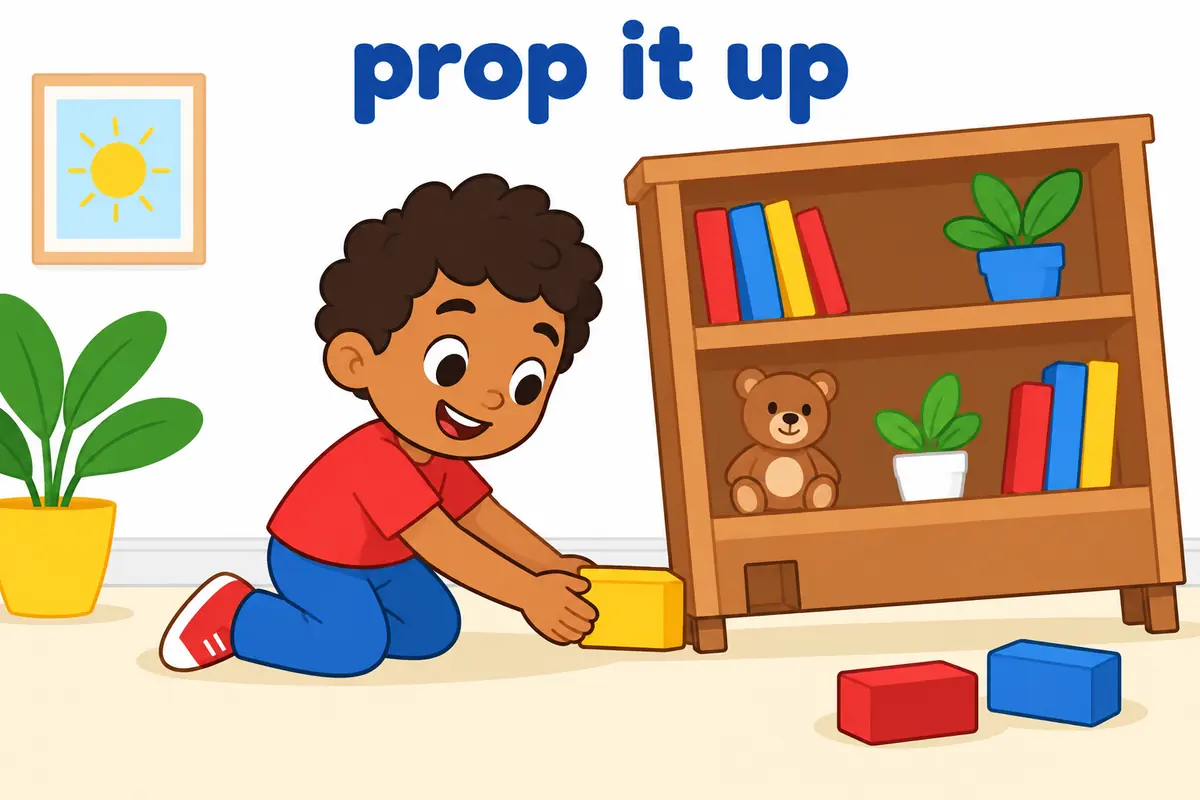
Prop up in a sentence: examples across contexts
Prop up moves easily between a garden and a finance page. The nine sentences below keep the same phrase while the support changes from timber to money to votes.
| Context | Example sentence | Why this works |
|---|---|---|
| Classroom | The children propped up their model bridge with two rulers. | A visible prop makes the physical sense clear. |
| Workplace email | We propped up the display stand before the parents arrived. | A quick physical fix suits the informal tone. |
| News report | The treasury propped up the currency during the panic. | An institution and a market term select the financial sense. |
| Political writing | Two small parties propped up the coalition for a year. | The plural subject shows support that keeps a body in power. |
| Gardening | She propped up the young apple tree with a bamboo cane. | A living thing and a cane make the support literal. |
| Home repair | He propped the loose step up with a folded cloth. | The temporary fix matches the word’s built-in idea of fragility. |
| Academic prose | Subsidies propped up unprofitable farms for a decade. | A measurable span signals deliberate, temporary policy. |
| Sports page | A late goal propped up a defence that had struggled. | Figurative use inside a match report. |
| Conversation | We propped the tent up with a spare pole. | Everyday objects keep the sense physical. |
Notice that only the rescue rows imply weakness. When a friend defends your account of events, the right phrase is to back up a teammate, which carries no hint that you were about to fall.
Prop up vs shore up
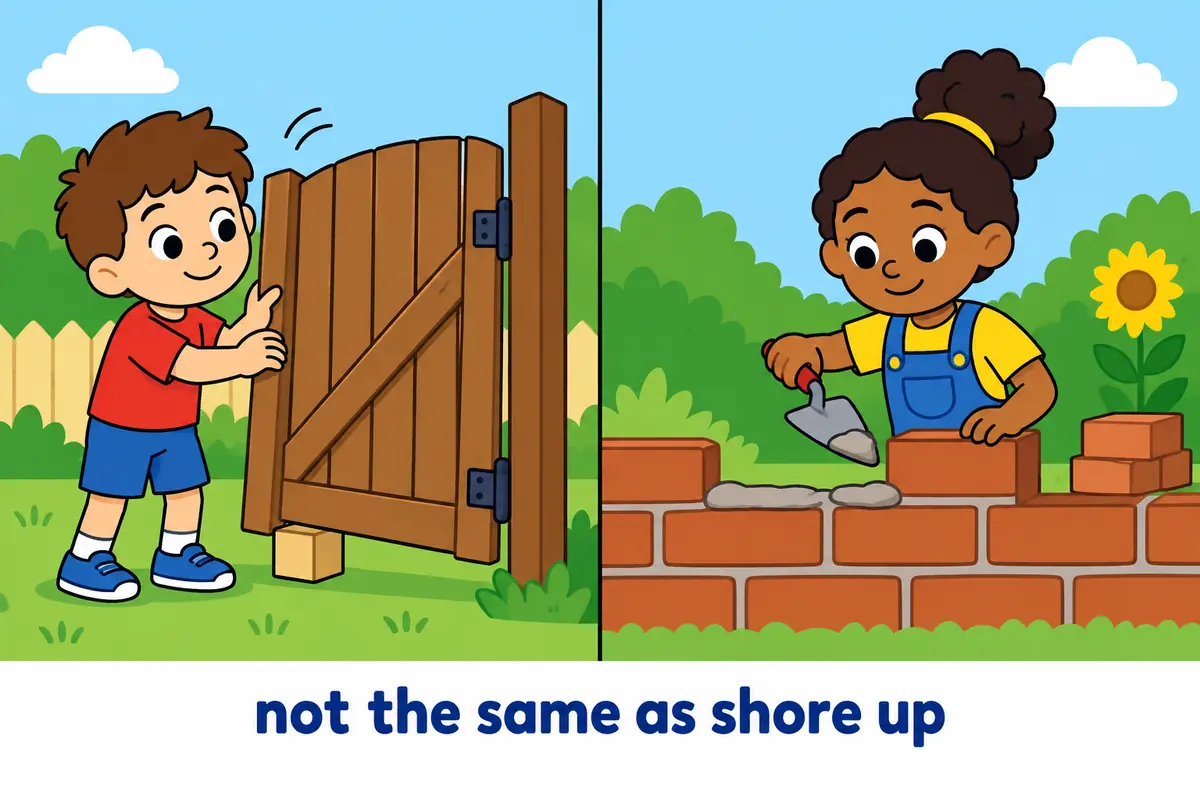
Prop up and shore up the dam both mean support, and the difference is one of permanence and register. Prop up suggests a stopgap that holds something upright for now; shore up suggests deliberate strengthening of something that has begun to give way. bolster the figures belongs to the same family but often implies making something look better than it is.
| Attribute | prop up | shore up |
|---|---|---|
| Core job | Stop something from falling now | Strengthen something that is weakening |
| Form | Separable phrasal verb | Separable phrasal verb |
| Register | Neutral, common in news and speech | Slightly formal, common in analysis |
| Typical object | A gate, bank, currency, leader | A wall, currency, balance sheet |
| Implied duration | Short, often temporary | Longer, aimed at stability |
| Implies weakness | Strongly | Moderately |
Verdict: choose prop up for a quick support that keeps something standing for the moment, and shore up when the aim is to make it strong again. Courts and committees uphold a ruling rather than prop it up, because they confirm it instead of merely holding it in place.
Word forms and grammar of prop up
Prop up inflects regularly, and its parts double as nouns. The table also lists the spelling learners reach for by mistake.
| Form | Part of speech | Example |
|---|---|---|
| prop up | phrasal verb, base | Prop up the shelf before it falls. |
| propped up | phrasal verb, past and participle | They propped up the shed with a beam. |
| propping up | phrasal verb, -ing | He is propping up the fence with a spade. |
| prop | noun | The bean plants need a strong prop. |
| prop-up | noun or adjective, hyphenated | The loan was a prop-up measure. |
| proped up | non-standard past | Marked wrong: prop doubles the p, so the past is propped. |
Keep the noun prop and the phrasal verb apart. A prop is the object that holds something, while prop up is the action. A related expression, to bear up under pressure, describes enduring a load rather than supporting something else.
Common mistakes with prop up
- Incorrect:
Prop up it with a brick.Correct: Prop it up with a brick. Rule: A pronoun must sit between the verb and the particle. - Incorrect:
They propped up the fence by a plank.Correct: They propped up the fence with a plank. Rule: The thing doing the supporting takes with, not by. - Incorrect:
The currency was propped up from the central bank.Correct: The currency was propped up by the central bank. Rule: A passive agent takes by. - Incorrect:
She propped up on one elbow.Correct: She propped herself up on one elbow. Rule: The body-support sense needs the reflexive pronoun. - Incorrect:
The team propped up the trophy.Correct: The team held up the trophy. Rule: Prop up means prevent collapse, so it cannot mean display.
Practice using prop up
Work through the six items, then check the reasoning rather than only the answer.
- Fill the gap: The government ______ the failing airline with a loan.
- Choose the better word: The wall needs (propping up / propping) before winter.
- Correct the error: Prop up it with this cushion.
- Build a sentence: use prop up about a leaning bookshelf.
- Spot the register: which belongs in a finance report — the bank propped up the currency, or we propped the tent up?
- Rewrite in the passive: The central bank propped up the currency. Begin with the currency.
Answers
- propped up — the airline is rescued from collapse, so the past form fits.
- propping up — the wall would fall, and up completes the phrasal verb.
- Prop it up with this cushion — the pronoun must sit between prop and up.
- Model answer: We propped up the leaning bookshelf with two bricks.
- The bank propped up the currency — a report keeps the market sense and avoids the tent.
- The currency was propped up by the central bank — the passive names the rescuer with by.
The bottom line
Use prop up in a sentence when a support keeps something or someone from falling, whether the support is a plank, a loan or a vote. The two details that decide most sentences are separability and implied weakness: a pronoun always goes between prop and up, and the verb always hints that the thing supported would otherwise collapse. Where the aim is to make something strong again, sustain the effort and shore up are the more precise choices.
Frequently asked questions about prop up
Is prop up one word or two?
The verb is always two words, as in prop up the gate. Only a derived noun or adjective is hyphenated, as in a prop-up loan. Keep the two spellings apart, because the hyphen is the only signal that the word is naming a measure rather than an action.
Does prop up always mean financial support?
No. The physical sense is just as common, as in they propped up the broken gate with a plank. The financial and political senses are figurative extensions, where money or votes do the supporting. The object tells you which sense a sentence carries.
What is the difference between prop up and shore up?
Prop up suggests a quick stopgap that holds something upright for now. Shore up suggests deliberate strengthening of something that has started to give way. Both take an object, but shore up carries less of a hint that the thing supported is about to fall.
Can you prop up a person?
Yes, in two ways. Physically, an injured walker props herself up on a stick. Figuratively, a weak leader is propped up by allies who keep them in office. Both uses carry the same quiet hint that the person would struggle to stand without help.
Ever wondered how to effectively support or maintain something in a raised position or keep it in a specific posture? This task can be accomplished by the action known as “prop up.” When you “prop up” something, you are providing the necessary support or assistance to keep it steady or upright.
Whether it’s using physical objects like books to prop up a wobbly table, or providing emotional support to prop up a friend going through a difficult time, the concept of “propping up” something is universally applicable in various situations. In this guide, we will explore different ways and contexts in which the term “prop up” can be used both literally and figuratively.
7 Examples Of Prop Up Used In a Sentence For Kids
- Prop up your book with a pillow while reading.
- Use a block to prop up your toy car ramp.
- Let’s prop up the tent with sticks and blankets.
- Prop up your drawing on the wall for everyone to see.
- Can you prop up the box with some books?
- Use a ruler to prop up the paper during art class.
- We need to prop up the umbrella at the beach.
14 Sentences with Prop Up Examples
- Could you help me prop up this heavy bookshelf in the dorm room?
- I need someone to prop up my poster during the college fair.
- Let’s prop up the whiteboard for the group study session.
- Can you help me prop up my chair, it keeps wobbling?
- We need to prop up the projector screen for the presentation.
- I’m going to prop up my laptop on some books for better ventilation.
- Could you please prop up the mattress on one side for better air circulation?
- Let’s prop up the Mason jar with some books to create a makeshift lamp.
- It’s a good idea to prop up your phone while studying for better visibility.
- I like to prop up my feet on a stool while working at the desk.
- Can you help me prop up this heavy backpack on my shoulder?
- I’m going to prop up my textbook with some pens to create a makeshift stand.
- Let’s prop up the white sheet as a backdrop for our college event.
- I need to prop up my posture with better support for my back.
How To Use Prop Up in Sentences?
Prop Up means to support or bolster something physically or metaphorically.
Here’s how you can use Prop Up in a sentence:
-
Physical support: “I needed to prop up the bookshelf with some books to prevent it from wobbling.”
-
Metaphorical support: “Her encouraging words helped prop up his confidence before the big presentation.”
Remember to place Prop Up before the object that is being supported. You can use it in various situations to convey the act of providing assistance or reinforcement.
Conclusion
In conclusion, the use of sentences with “prop up” often involves supporting or sustaining something, whether it be an argument, an idea, or a physical object. These sentences typically emphasize providing assistance or reinforcement to maintain the stability or strength of the subject in question. By using this phrase in writing, speakers and writers effectively convey the concept of bolstering or shoring up their points to make them more convincing and robust.
Overall, sentences with “prop up” serve as a literary device to enhance clarity and coherence in communication by illustrating the act of reinforcing or upholding a statement or position. This phrase adds depth and structure to writing, enabling the conveyance of a sense of support or maintenance in a succinct and impactful manner.