
Proselytize means to try to persuade someone to join a religion, a belief or a cause. To use proselytize in a sentence, name the persuader and the target: “The volunteers proselytized on campus for a week.” The verb takes a direct object, as in proselytize students, or the preposition to.
Proselytize at a glance
- Proselytize is a verb; its forms are proselytizes, proselytized, proselytizing and proselytizer.
- British writing spells it proselytise, and both spellings are standard in their own region.
- It takes either a direct object (proselytize a neighbour) or the preposition to (proselytize to students).
- The usual subjects are missionaries, campaigners, recruiters and volunteers.
- The word often carries disapproval, because it suggests pressure rather than an open invitation.
What does proselytize mean?
Proselytize is a verb meaning to try to convert someone to a religion, a belief or a cause. The Cambridge entry for proselytize places the religious sense first and adds the wider use for any cause. The word can be neutral in a history book and critical in a news report, because it names active recruitment rather than quiet example.
| Sense | Plain meaning | Example sentence |
|---|---|---|
| Religious recruitment | Try to convert someone to a faith | The monks proselytized along the trade route. |
| Cause or movement | Recruit people to a belief or party | The organisers proselytized for the new party. |
| Pressure (negative) | Push a view on people who did not ask | Managers should not proselytize at work. |
One limitation matters here. Proselytize is not a neutral synonym for teach or inform, because it always signals that the speaker wants a change of allegiance. In many contexts it also carries a criticism of pressure applied to people who never asked. Where someone simply explains a faith or a policy, advocate, explain or share are the fairer verbs.
How do you use proselytize in a sentence?
Put the recruiter as the subject and the person or group being recruited as the object, or add to before an audience. The verb is transitive in the direct pattern (proselytize students) and intransitive in the to pattern (proselytize to students). American writing keeps the -ize ending where British writing uses -ise.
| Pattern | Example | What it signals |
|---|---|---|
| proselytize + object | The team proselytized new members. | Direct recruitment of a named group. |
| proselytize + to | She proselytized to anyone who listened. | An audience rather than a set of named converts. |
| proselytize + for | They proselytized for the reform. | Advocacy for a cause rather than a faith. |
| be proselytized | New staff were proselytized relentlessly. | Passive; the target of the pressure is the focus. |
| proselytizing (gerund) | Proselytizing is banned on campus. | The activity itself is named and judged. |
The gerund is the single most useful form, because a rule or a report almost always discusses the activity rather than one convert. Reach for the noun proselytizing whenever the sentence needs a subject for a policy.
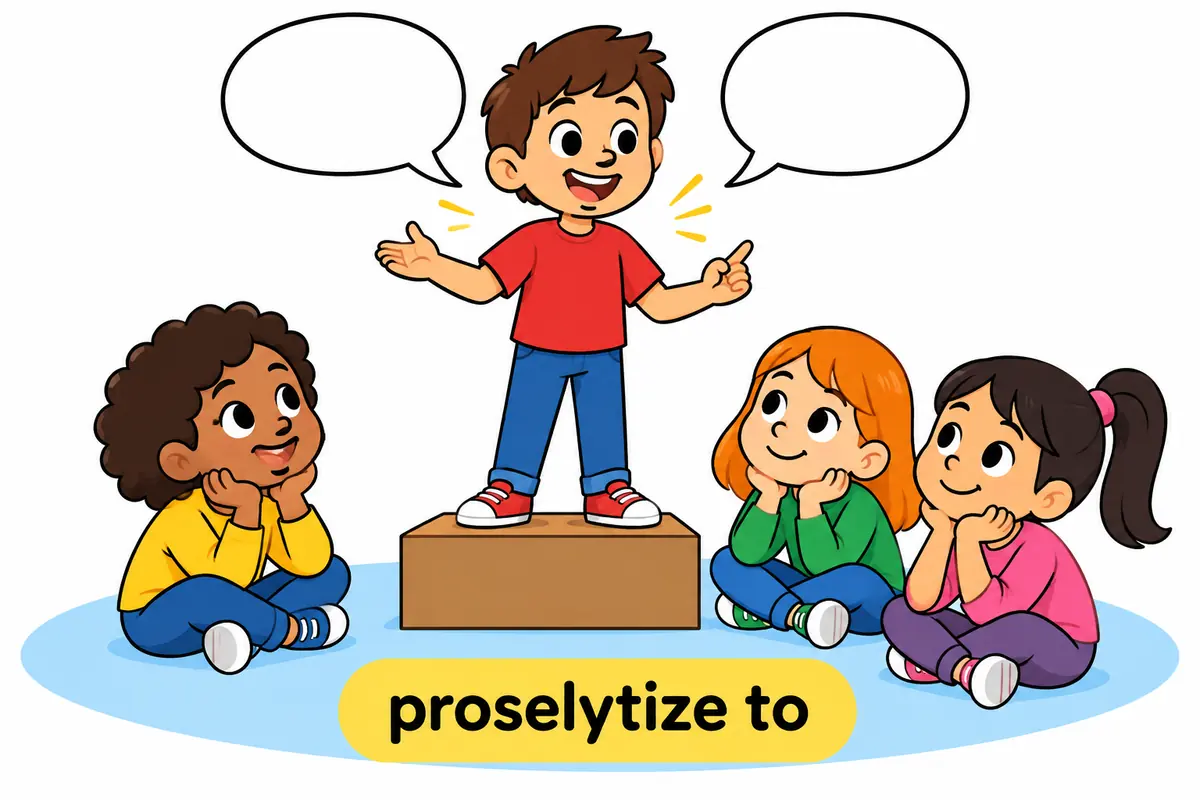
Proselytize in a sentence: examples across contexts
Proselytize shifts register more than it shifts meaning, so the nine sentences below move from a history lecture to a workplace policy. Each one names the group being recruited, which is what makes the verb do its work.
| Context | Example sentence | Why this works |
|---|---|---|
| History lecture | Missionaries proselytized along the trade routes for centuries. | A broad group and a long frame suit the formal register. |
| News report | The group was accused of proselytizing inside refugee camps. | The participle after of names the activity under criticism. |
| Religious writing | The disciples were sent out to proselytize every nation. | Uses the infinitive of purpose, common in devotional prose. |
| Workplace policy | Staff must not proselytize to colleagues during working hours. | Places the rule inside a formal code of conduct. |
| Political commentary | The party proselytized for its candidate in every market town. | The for pattern marks advocacy rather than faith. |
| Travel writing | A patient monk proselytized to anyone who stopped to listen. | The to pattern names an audience, not named converts. |
| Conversation | He keeps trying to proselytize his flatmates about that diet. | Shows the informal, disapproving everyday use. |
| Academic prose | Early modern states both sponsored and restricted proselytizing. | The gerund lets the writer treat the practice as a subject. |
| Campus notice | Proselytizing is not permitted near the main entrance. | A blunt ban; the gerund carries the whole rule. |
Notice how often the word appears as a gerund. Proselytizing names an activity, which is exactly what a rule or a report needs to discuss. Where the aim is simply to argue for a view, preach and argue are less loaded.
Proselytize vs evangelize
Evangelize and proselytize both describe spreading a faith, but they judge the activity differently. Evangelize means to announce good news and can be a duty a believer performs with pride; evangelize therefore stays approving, while proselytize is the word newspapers reach for when they want to hint at pressure. Both stop short of convert, which names the result rather than the attempt.
| Attribute | proselytize | evangelize |
|---|---|---|
| Core action | Seek converts to a faith or cause | Announce good news, usually of a faith |
| Implied pressure | Often present | Usually absent |
| Register | Journalistic and often critical | Religious and often approving |
| Typical object | students, neighbours, a congregation | a congregation, the public |
| Scope | Religion and any cause | Mainly religious |
Verdict: use evangelize when a believer is sharing good news, and choose proselytize when the emphasis falls on winning converts, especially where the pressure is the point.
Word forms and grammar of proselytize
Proselytize follows the regular -ize pattern, and its British spelling is proselytise. The older noun proselyte means a convert rather than the act, so it can never replace the verb.
| Form | Part of speech | Example |
|---|---|---|
| proselytize | verb, base form (US) | They proselytize in the market. |
| proselytise | verb, base form (UK) | They proselytise in the market. |
| proselytized | verb, past and past participle | He proselytized for years. |
| proselytizing | verb, present participle and gerund | Proselytizing is not allowed here. |
| proselytizer | noun, a person | A patient proselytizer waited outside. |
| proselytization | noun, the activity, rare | The law limits proselytization. |
| proselyte | noun, a convert | The proselyte was welcomed warmly. |
Keep the person and the practice apart. A proselytizer does the recruiting, proselytizing names the recruiting, and a proselyte is the person who has already joined.
Common mistakes with proselytize
- Incorrect:
The charity proselytized that everyone should give.Correct: The charity proselytized for its cause. Rule: Proselytize does not take a that-clause; use a noun object or for. - Incorrect:
She was very proselyte about her diet.Correct: She was very evangelical about her diet. Rule: Proselyte is a noun meaning a convert, not an adjective. - Incorrect:
They proselytized to convert the whole town.Correct: They proselytized across the whole town. Rule: Proselytize already means to seek converts, so to convert repeats the idea. - Incorrect:
The teacher proselytized the class about grammar.Correct: The teacher promoted good grammar. Rule: Proselytize implies a change of allegiance, too strong for a teaching preference. - Incorrect:
He is a proselytize.Correct: He is a proselytizer. Rule: The person noun ends in -er, never in the bare verb form.
Practice using proselytize
Work through the six items, then read the reasoning rather than only the answers.
- Fill the gap: The volunteers ______ to commuters outside the station.
- Choose the better word: The shed was used for peaceful (proselytize / evangelize) rather than hard recruitment.
- Correct the error: The group proselytized that the reform would help everyone.
- Build a sentence: use proselytize for about a campaign for a new park.
- Spot the register: which belongs in a staff handbook — proselytizing is prohibited, or stop pushing your thing at work?
- Rewrite with the person noun: A man kept trying to convert passers-by. Use proselytizer.
Answers
- proselytized — the to pattern takes an audience, and the past tense matches the scene.
- evangelize — peaceful sharing needs the approving verb; proselytize would hint at pressure.
- The group proselytized for the reform — proselytize cannot take a that-clause.
- Model answer: Residents proselytized for the new park at every council meeting.
- Proselytizing is prohibited — a handbook uses the formal gerund, not a casual complaint.
- A proselytizer kept trying to convert passers-by — the -er noun names the person doing it.
The bottom line
Use proselytize in a sentence when somebody is actively trying to win converts to a faith or a cause, and choose the pattern that names the target: an object, a to phrase or a for phrase. Two nuances decide most sentences. The gerund proselytizing names the activity a rule can ban, and the word often carries a hint of pressure that evangelize does not.

Frequently asked questions about proselytize
Is proselytize a negative word?
Proselytize is often mildly negative, because it stresses that somebody is trying to win converts rather than simply explaining a view. The word is neutral in a history book describing missionaries, but it turns critical in a report about pressure at work. Its approving counterpart is evangelize when a believer is sharing good news.
What is the difference between proselytize and preach?
Preach means to deliver a religious or moral message, often to people who have already gathered. Proselytize goes further and names the attempt to recruit those listeners to a faith or cause. A preacher can preach to a settled congregation without proselytizing at all, because nobody is being asked to switch allegiance.
Can you proselytize for a cause rather than a religion?
Yes. Proselytize extends to any belief or movement a person wants others to adopt, so campaigners proselytize for a party, a diet or a reform. The religious sense is the oldest and the one dictionaries list first, but the broader use is standard in modern journalism and political writing.
Is proselytise or proselytize correct?
Both are correct, and the choice depends on the region. American and most international publishing uses proselytize with a z. British publishing uses proselytise with an s. Each region treats its own spelling as the standard, so a mixed document looks inconsistent rather than wrong in either direction.
Are you familiar with the term “proselytize”? In simple terms, proselytize means to try and persuade someone to change their beliefs or religious views to align with your own. This can involve actively promoting or advocating for a particular ideology or faith to others.
Being a common practice in many religions and belief systems, proselytizing can take various forms such as sharing teachings, engaging in discussions, or distributing literature to attract new followers. It is often seen as a way to spread awareness and gain support for a cause or faith.
7 Examples Of Proselytize Used In a Sentence For Kids
- Proselytize means telling others about your beliefs.
- It is important to proselytize respectfully.
- We should always ask before we proselytize others.
- It is not kind to force someone to proselytize.
- We can proselytize by sharing stories and being kind.
- Remember to listen when others proselytize.
- Proselytize is sharing what you believe with others.
14 Sentences with Proselytize Examples
- College student clubs often try to proselytize new members to join their activities.
- During election season, political parties may proselytize students on campus to gain support.
- Peer pressure can sometimes lead students to proselytize certain beliefs or behaviors to their friends.
- Some religious organizations on campus actively proselytize students to join their faith community.
- Academic departments may proselytize students to consider pursuing certain majors or career paths.
- Proseltyzing about the benefits of studying abroad can encourage more students to consider international exchange programs.
- Student counselors may proselytize the importance of mental health resources to help students cope with stress.
- Student leaders may proselytize the significance of participating in extracurricular activities for personal growth.
- Campus health services may proselytize the importance of staying physically active and maintaining a healthy diet.
- Guest speakers may proselytize their unique perspectives on various social issues to provoke critical thinking among students.
- Some student activists may proselytize their advocacy for environmental conservation and sustainability initiatives.
- College professors may proselytize the value of research opportunities for students to gain practical experience in their field.
- Student organizations may proselytize volunteer opportunities to engage their peers in community service projects.
- Some companies may proselytize their internship programs to attract talented students for potential employment opportunities.
How To Use Proselytize in Sentences?
To Proselytize means to try to convert someone to a different belief or opinion, especially a religious one.
When using Proselytize in a sentence, here is a helpful guide for beginners:
- Choose the belief or opinion you want to persuade someone to adopt.
- Insert Proselytize into your sentence to emphasize the act of conversion.
- Make sure the sentence is clear and persuasive to convey your message effectively.
Example sentence using Proselytize:
“She was known for her fervent attempts to proselytize her peers to join her in volunteering at the homeless shelter.”
Remember, using Proselytize should be done respectfully and with sensitivity towards others’ beliefs. It is important to communicate your message in a kind and informed way to engage in productive conversations.
Practice using Proselytize in various sentences to become more comfortable with its usage and to convey your thoughts effectively.
Conclusion
In conclusion, the act of proselytizing involves attempting to convert individuals to a different belief or religion through persuasion or evangelism. Examples of sentences with the keyword “proselytize” include “The missionary group aimed to proselytize the local community,” and “She often tries to proselytize her friends into joining her church.”
Proselytizing can be a sensitive subject, as it involves a deeply personal aspect of one’s beliefs. It is important to approach proselytizing with respect for others’ beliefs and a willingness to engage in open and constructive dialogue. Ultimately, effective proselytizing requires empathy, understanding, and a genuine desire to foster mutual understanding and respect among individuals of different beliefs.


