Put Back in a Sentence: Meaning, Examples & Practice
Put back is a phrasal verb with three jobs: return something to its place, postpone an event, and restore a person to a former state. To use put back in a sentence, place the object before or after back: “Put the milk back in the fridge.” A pronoun must sit between the parts: “Put it back.”
Put back at a glance
- Put back is a transitive phrasal verb meaning to return, postpone, restore or set a clock earlier.
- Its forms are put back, puts back, put back (past) and putting back; put is irregular and never becomes putted.
- The object is usually an item, a meeting, a date, a clock or a person.
- The verb is separable: put back the book or put the book back, but a pronoun sits between them.
- The phrase keeps a sense of moving something backward, in space or in time.
- The commonest error is using put back for a permanent replacement, where replace fits better.
What does put back mean?
Put back is a phrasal verb meaning to move something to where it was, to move an event to a later time, or to restore a former state. The Cambridge entry for put back records these linked senses, and the base idea is simple: something moves backward, either across a room or across a calendar. The return and restore pages show the two directions this backward movement takes.
| Sense | Plain meaning | Example sentence |
|---|---|---|
| Return to place | Move an item to where it belongs | Put the keys back on the hook. |
| Postpone | Move an event to a later time or date | They put the launch back a week. |
| Set a clock earlier | Move the hands to an earlier hour | We put the clocks back in autumn. |
| Restore | Return someone or something to a former role or state | The manager put her back on the rota. |
The four senses share one shape, and the object decides which one is live. An object you can hold points to the return sense, an event or date points to postponement, a clock points to timekeeping, and a person or role points to restoration. That is why put back rarely feels ambiguous in practice, even though the dictionary lists several meanings under one headword.
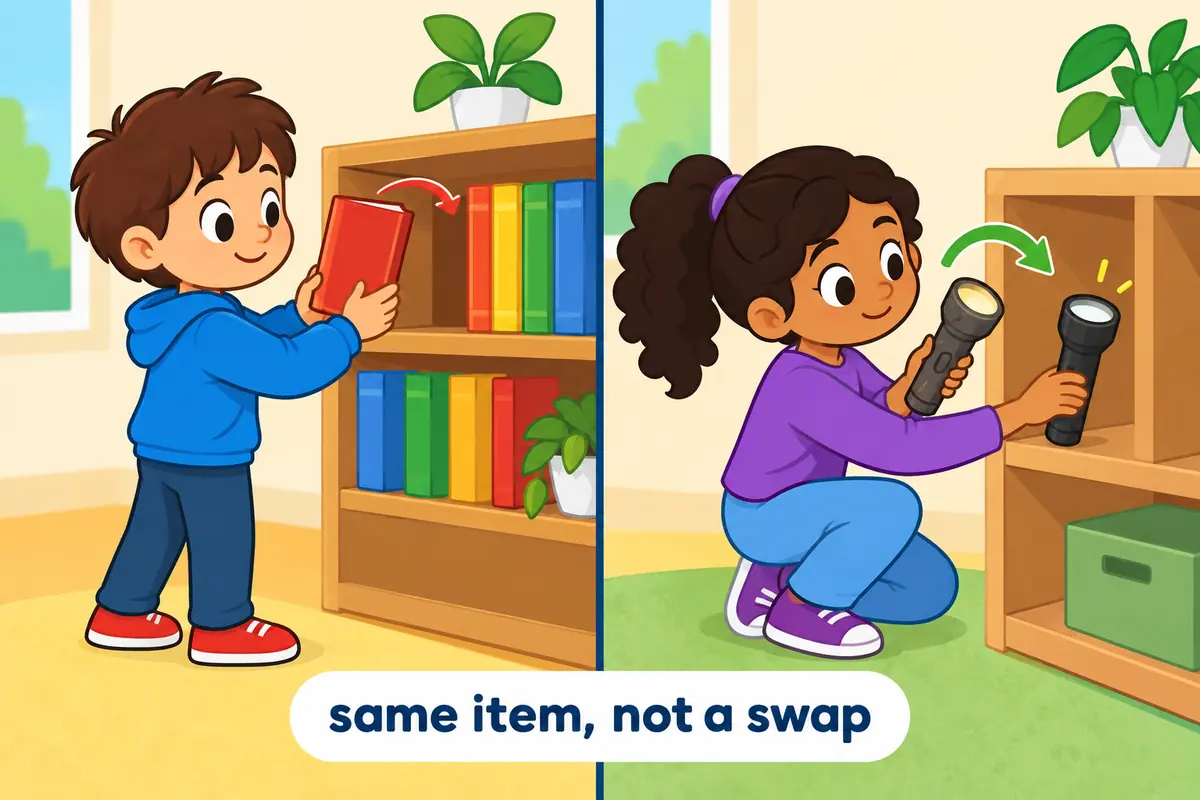
Put back is not the same as replace. A new part replaces an old one, so the original thing leaves for good, while put back returns the same thing to where it was. The distinction matters in instructions: put the drill back means the same drill goes on the shelf, but replace the drill means the old one is discarded and a different one takes its place.
How do you use put back in a sentence?
Put back follows five patterns. It is transitive and separable, and the object position is what learners get wrong most often, especially when the object is a pronoun.
| Pattern | Example | What it signals |
|---|---|---|
| put back + object | Put back the tools when you finish. | Object after the particle |
| put + object + back | Put the tools back when you finish. | Object between the verb and the particle |
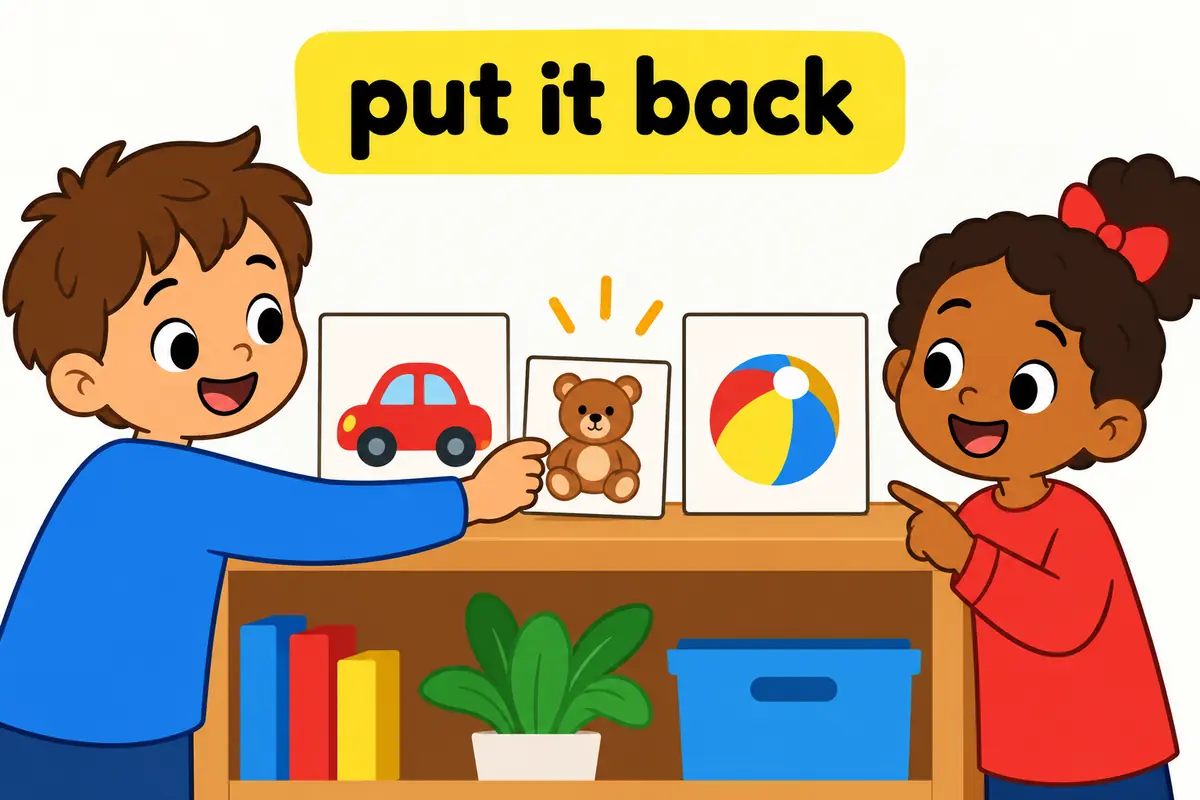
| put + pronoun + back | Put it back on the shelf. | A pronoun must sit in the middle |
| put back + object + time phrase | They put the meeting back to Friday. | The postponement sense with a new date |
| be put back | The bridge was put back in service. | Passive form with the thing in focus |
When the object is a noun, both positions work: put back the box and put the box back are equally correct. When the object is a pronoun, only one order is allowed, and it is the split one. Put it back is standard, while put back it sounds foreign to a native ear and is a reliable marker of a learner. The same pronoun rule applies to other put phrasal verbs, such as put aside and put down, so the pattern is worth learning once.
Put back in a sentence: examples across contexts
| Context | Example sentence | Why this works |
|---|---|---|
| Kitchen conversation | Put the butter back in the fridge after breakfast. | Everyday instruction about a place. |
| Workplace email | We have put the review back to the first week of May. | Postponement in a professional tone. |
| News report | Flood repairs put the opening back by six weeks. | A delay caused by an outside event. |
| Clock change | Every October the country puts the clocks back an hour. | A timekeeping custom in the return family. |
| Library notice | Please put back the chairs you moved. | A public, polite instruction. |
| Management memo | The company put two engineers back on the night shift. | Restoring a former arrangement. |
| British diary | The match was put back to the following Saturday. | Rescheduling a fixture. |
| Online shopping | I put the order back in the basket by mistake. | Returning an item in a digital setting. |
| Sports report | The restart was put back because of lightning. | A safety delay. |
| Household reminder | Put the lid back on the jar tightly. | A small, concrete return action. |
Writers who need a synonym should match the sense, not just the phrase. Use reschedule for a moved fixture, shelve for a plan set aside indefinitely, and return or restore for the physical and personal senses of put back.
Put back vs set back
Put back and set back both move something backward, but set back usually measures a loss, while put back simply returns or delays.
| Attribute | Put back | Set back |
|---|---|---|
| Core meaning | Move to a previous place or a later time | Delay progress or cost someone money |
| Typical object | Items, meetings, clocks, people | A project, a schedule, a person financially |
| Tone | Neutral and often physical | Often negative and measuring |
| Literal use | Put the cup back on the shelf | Rare in the literal sense |
| Figurative use | Restore someone to a role | A storm set the building back months |
| Register | Everyday and general | Business, news and finance |
Choose set back when the sentence talks about cost or lost time, and put back when the same thing simply changes place or date; delay and postpone sit close to the time sense but name the delay itself rather than the backward move.
Word forms and grammar of put back
| Form | Part of speech | Example |
|---|---|---|
| put back | base phrasal verb | Please put back the tray. |
| puts back | third person singular | She puts back each file at once. |
| put back | past tense and past participle | He put back the wrench and left. |
| putting back | present participle | They are putting back the shelves. |
| putted back | non-standard | Put is irregular; the past is put, never putted. |
| put back up | non-standard | Use put back, not put back up, for a return. |
The irregular past is the form to memorise: yesterday I put the book back, never I putted the book back. Because the base, past and past participle are all spelled put, the only cue to tense is the surrounding sentence, which is why the time phrase matters so much in written English.
Common mistakes with put back
- Incorrect: Put back it on the shelf. Correct: Put it back on the shelf. Rule: A pronoun object goes between the verb and the particle.
- Incorrect: I have putted the book back. Correct: I have put the book back. Rule: Put is irregular, so the past participle is put.
- Incorrect: They put back the meeting off. Correct: They put the meeting back. Rule: Back already carries the delay, so off is not added.
- Incorrect: She put back the old battery with a new one. Correct: She replaced the old battery with a new one. Rule: A different item needs replace; put back returns the same item.
- Incorrect: We put the clocks back forward. Correct: We put the clocks back. Rule: Back and forward contradict each other.
- Incorrect: He put the milk back into the fridge out. Correct: He put the milk back in the fridge. Rule: Use one clear particle and one preposition, not a string of them.
Practice using put back
These seven exercises test the pronoun order, the four senses and the choice between put back, replace, set back and postpone.
- Fill in the blank: Please ____ the scissors in the drawer when you finish.
- Choose the better word: We had to (put back / set back) the launch, which cost the team two weeks.
- Correct the error: She puts back it every evening.
- Build a sentence: use put back about a match moved to a later date.
- Spot the register: which sentence suits a formal notice? (a) Please put back the chairs after use. (b) Chuck those chairs back over there.
- Fill in the blank: The company ____ her back on the day shift.
- Choose the better word: The mechanic (put back / replaced) the worn brake pads with new ones.
Answers
- put back: the object scissors returns to its place.
- set back: the sentence measures lost time, so set back fits.
- She puts it back every evening: a pronoun sits between put and back.
- Sample: Officials put the final back to the following Sunday.
- (a): a formal notice needs polite, neutral wording.
- put: the object her points to the restore sense, and the past is put.
- replaced: new pads take the place of old ones, so a swap is happening.
The bottom line
Put back in a sentence covers four linked ideas, all built on moving something backward in space or time. The object decides the sense: an item returns, a meeting is postponed, a clock is set earlier, and a person is restored. The verb is separable, so a noun object may sit on either side of back while a pronoun must go between them. Use replace when a different item takes over, and set back when the sentence measures cost.
Frequently asked questions about put back
Does put back mean the same as postpone?
Put back means postpone only when its object is an event, a date or a meeting, as in they put the launch back a week. When the object is a physical item, put back means return it to its place. The object, rather than the particle, decides which sense is live.
Is it put back or put it back?
Both can be correct, but the order depends on the object. A noun object may sit on either side of back, so put back the book and put the book back are both standard. A pronoun must sit in the middle, so the correct form is always put it back.
Do Americans say put the clocks back?
The clock sense is more common in British usage, where autumn sees people put the clocks back an hour. American speakers more often say set the clocks back. The meaning is identical, but put back is the chiefly British choice for moving the hands to an earlier hour.
What is the difference between put back and replace?
Put back returns the same item to its place or a person to a former role. Replace swaps one item for another, so the old thing leaves for good. If the identical object goes back on the shelf, use put back; if a new part takes its position, use replace.