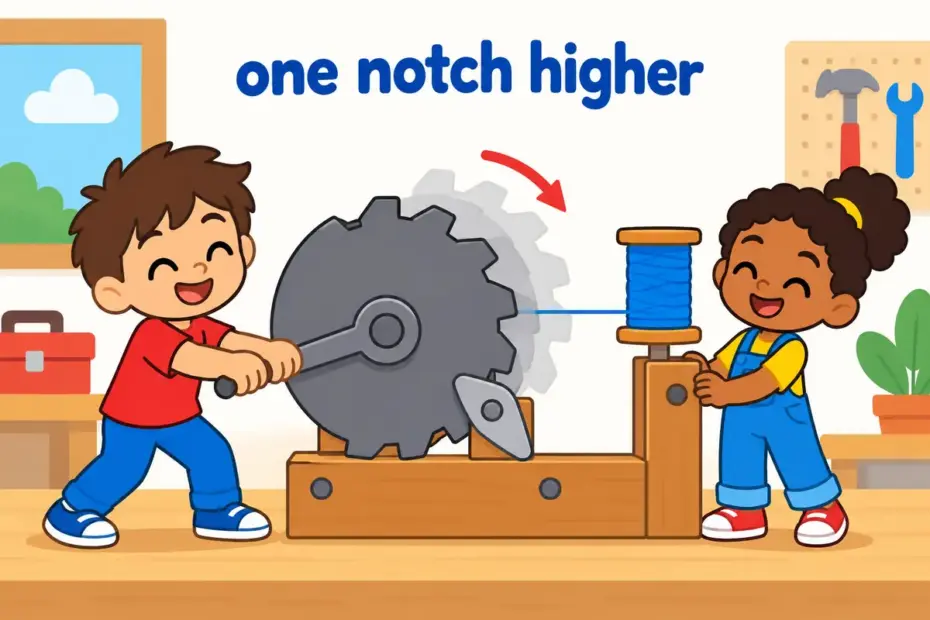
Ratchet up means to raise something by a series of small, deliberate steps rather than in one jump. To use ratchet up in a sentence, give it something that can rise, such as prices, pressure, targets or tension: “The board ratcheted up its targets each quarter.”
Ratchet up at a glance
- Ratchet up is a separable phrasal verb built from the verb ratchet and the particle up.
- Its forms are ratchets up, ratcheted up and ratcheting up.
- The object is usually something measurable that rises: pressure, prices, security, demands or tension.
- A noun object may sit after up or between the two words, but a pronoun must sit between them.
- The phrase suits news, business and policy writing more than casual talk.
- The commonest order error is ratchet up it, which no native speaker says.
What does ratchet up mean?
Ratchet up is a phrasal verb meaning to increase something gradually and often deliberately, as though turning a ratchet one notch at a time. The Cambridge entry for ratchet up records this stepwise sense of increase. The force of the phrase is the combination of movement and permanence: after each turn the new level holds, so it is never simply a number going up.
| Sense | Plain meaning | Example sentence |
|---|---|---|
| Raise step by step | Move a value upward in stages and keep it there | The firm ratcheted up prices by two percent a month. |
| Intensify pressure | Make demands, tension or scrutiny stronger over time | Editors ratcheted up the pressure for a comment. |
| Rise by degrees | Increase without a named agent, used intransitively | Security costs have ratcheted up since spring. |
Ratchet up is the wrong choice for a single sudden jump; for one quick rise, climbed or jumped fits better. The phrase also implies that the new level stays, so it is rarely used for a value that falls straight back. There is no common matching verb ratchet down, and writers say eased, reduced in stages or wound down instead.
Two details separate ratchet up from a plain synonym. First, the steps are countable: each turn of the ratchet raises the level by a fixed amount, which is why the word suits month-on-month targets better than a single spike. Second, the change is directional and lasting, so it describes a floor being lifted rather than a value that drifts back.
Two near neighbours are easy to mix up. To intensify the pressure is close in meaning, but it carries no sense of fixed steps that stay. A coach might raise the stakes in one move rather than ratchet up a training load by degrees, and teams that boost output quickly describe a change without the step-by-step sense.
How do you use ratchet up in a sentence?
| Pattern | Example | What it signals |
|---|---|---|
| ratchet up + noun | Regulators ratcheted up fines for late filing. | Neutral statement of a staged increase. |
| ratchet + noun + up | The coach ratcheted the training load up in January. | Emphasis on the object being changed. |
| ratchet + pronoun + up | They ratcheted it up after the review. | The only correct order with a pronoun. |
| subject + ratchet up | Costs ratcheted up through the summer. | Intransitive rise with no named cause. |
| be + ratcheted up | Standards were ratcheted up last year. | Focus on the thing that rose, not the agent. |
Because ratchet up is separable, a full noun object can follow the particle or slide between the verb and particle. A pronoun object, by contrast, has only one grammatical slot, and it is the middle one, so ratchet it up is correct while ratchet up it is not. A useful test is to substitute a pronoun: if it, them or this can take the middle slot, the phrase is separable, and ratchet up passes that test.
Register matters as much as grammar. In a news report or a business memo, ratchet up reads as neutral and precise; in a legal judgment or a technical standard, progressive tightening or stepped increases sounds more at home. The verb is rarely used in casual chat, where pushed up or bumped up is more natural.
Ratchet up in a sentence: examples across contexts
The nine contexts below show the phrase moving from literal prices to figurative pressure; notice that every sentence names the thing being raised and the direction of travel.
| Context | Example sentence | Why this works |
|---|---|---|
| Workplace email | The supervisor ratcheted up the weekly targets after the audit. | Names a concrete rise and a clear reason. |
| News report | The central bank ratcheted up interest rates for a third time. | Fits formal reporting of staged increases. |
| Business writing | We ratcheted up production once demand recovered. | Shows a controlled, deliberate increase. |
| Political commentary | Both camps ratcheted up the rhetoric before the vote. | Uses the phrase figuratively for rising intensity. |
| Academic writing | The researchers ratcheted up the dosage between trials. | Describes stepwise change in a method. |
| Conversation | He keeps ratcheting up the stakes every time we play. | Casual but still stepwise, so the phrase fits. |
| Sports writing | The visitors ratcheted up the tempo in the final quarter. | Captures an intentional change of gear. |
| Legal writing | The penalty was ratcheted up for repeat offences. | The passive keeps attention on the penalty. |
| Personal finance | Our rent ratcheted up by fifty pounds each year. | Intransitive use with a steady repeating rise. |
Ratchet up vs escalate
| Attribute | Ratchet up | Escalate |
|---|---|---|
| Core idea | Raise in fixed steps and hold at the new level | Grow in scale or seriousness |
| Direction | Usually deliberate and controlled | Often unwanted and hard to stop |
| Typical subject | Prices, targets, pressure, rhetoric | Conflict, costs, tension, a dispute |
| Register | Business, policy and journalism | Broad, including everyday speech |
| Implication | The new level is meant to stay | No sense that the rise will stop |
| Transitivity | Both transitive and intransitive | Mainly transitive, with some intransitive use |
Choose ratchet up when the increase happens in steps you can count and is meant to hold; choose to escalate a dispute when a situation grows more serious and may keep growing. The two verbs overlap when a number rises and the reason is unwelcome, but only ratchet up promises that the increase will stick.
Word forms and grammar of ratchet up
| Form | Part of speech | Example |
|---|---|---|
| ratchet up | phrasal verb, base | They plan to ratchet up security. |
| ratchets up | third-person singular | The scheme ratchets up fees each year. |
| ratcheted up | past tense and past participle | Management ratcheted up output in May. |
| ratcheting up | present participle | Slowly ratcheting up the dose, the team watched for side effects. |
| ratchet | noun, a one-way gear | A ratchet lets the wheel turn one way only. |
| ratcheted up | separable order | Ratchet the figure up, or ratchet it up. |
Non-standard forms to avoid are ratchet up it and any invented noun such as up-ratchet. Compare the particle in back up a claim, where up carries a different meaning altogether.
Common mistakes with ratchet up
- Wrong:
They ratcheted up it after the review.Right: They ratcheted it up after the review. Rule: A pronoun object must sit between a separable phrasal verb and its particle. - Wrong:
The manager ratcheted up.Right: The manager ratcheted up the workload. Rule: With a noun object you must supply it; the intransitive use needs a subject that rises by itself. - Wrong:
Prices ratcheted up by a sudden jump.Right: Prices rose by a sudden jump. Rule: Ratchet up describes stepwise increases, not one abrupt change. - Wrong:
The government ratcheted the taxes up on.Right: The government ratcheted up the taxes. Rule: Do not add a preposition after the particle; up already completes the verb. - Wrong tone:
The filing states the parties really ratcheted it up.Right: The filing states the sanctions were progressively tightened. Rule: Match register, because the phrasal verb reads as journalism or business rather than courtroom prose.
Practice using ratchet up
- Fill in the blank: The committee voted to ______ ______ the fines for repeat offenders.
- Choose the better word: a rise that happens in steps and holds suggests ______; a conflict growing more serious suggests ______.
- Correct the error: They ratcheted up it after the inspection.
- Build a sentence: describe a school raising its entry requirements in stages; use ratchet + up + noun.
- Spot the register: which sentence belongs in a tribunal submission, (a) the regulator really ratcheted it up, or (b) the regulator ratcheted up the inspection fees?
- Fill in the blank with the correct form: The cost of borrowing has ______ ______ three times this year.
- Build a sentence: describe rising rhetoric in an election campaign using ratchet up and an abstract object.
Answers
- ratchet up, because the base form follows voted to.
- ratchet up, then escalate; steps that hold point to ratchet up, rising seriousness to escalate.
- They ratcheted it up after the inspection; a pronoun goes between verb and particle.
- Model: The school ratcheted up its entry requirements over three years.
- Sentence (b), because the phrasal verb still suits a formal document when it carries a concrete object.
- ratcheted up, because the present perfect takes the past participle.
- Model: Both sides ratcheted up the rhetoric as polling day approached.
The bottom line
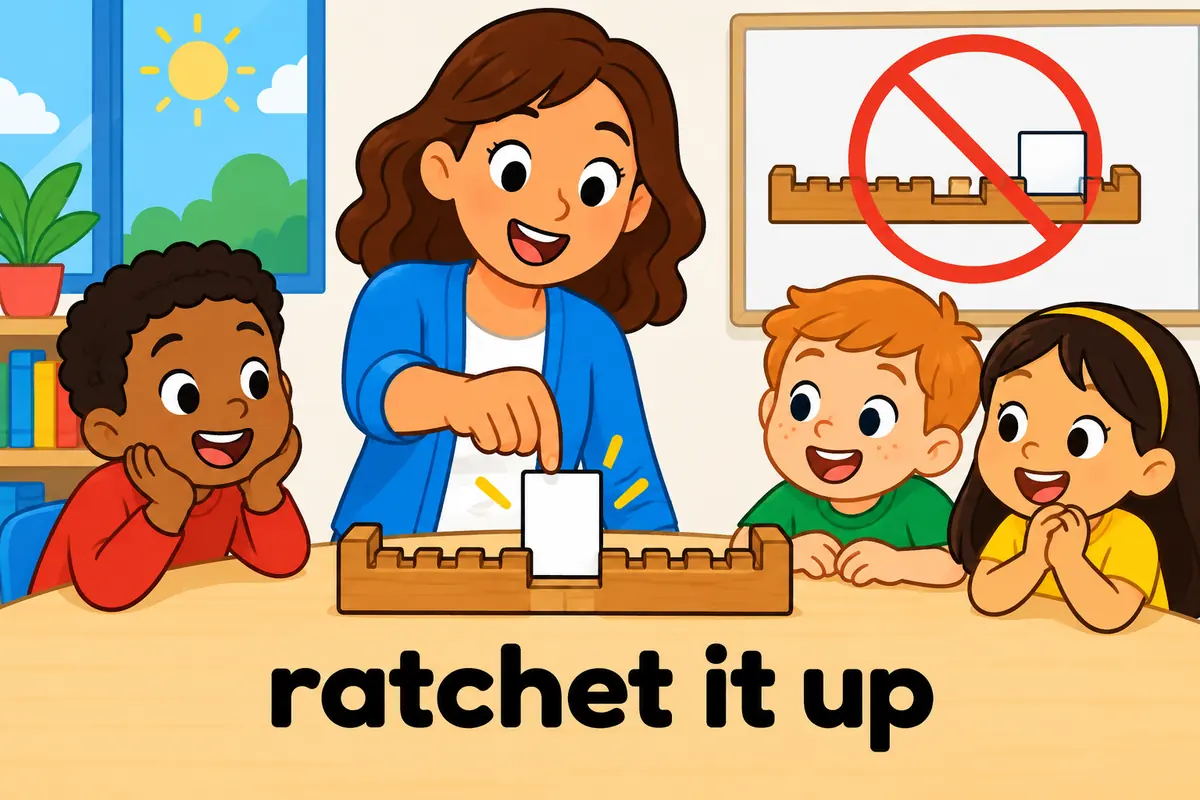
Ratchet up in a sentence names an increase you can count, made in deliberate steps that are meant to last. Give it a concrete object such as prices, pressure or targets, and keep a pronoun object between the verb and its particle. Reach for escalate instead when the growth is unbounded and unwanted, and for rose or jumped when the change happens all at once.
Frequently asked questions about ratchet up
Is ratchet up one word or two?
It is always two words in the verb phrase, ratchet up, with a space. The noun ratchet is a single word, but the phrasal verb keeps the particle separate, and its forms are ratchets up, ratcheted up and ratcheting up, so it never becomes ratchetup.
Can ratchet up be used without an object?
Yes. The phrase works as an intransitive verb when the subject is the thing that rises, as in costs ratcheted up through the summer. It is also transitive, so the same words can take an object such as fees or pressure, which makes it flexible across registers.
What is the opposite of ratchet up?
English has no common phrasal verb ratchet down that mirrors it exactly. For a stepwise fall, writers use wind down, ease or reduce in stages; for a single drop they use cut or slash. The missing opposite is why the phrase feels lopsided.
Why do writers choose ratchet up instead of increase?
Ratchet up adds two ideas that increase alone does not carry: the rise happens in visible steps, and the new level is meant to hold. Increase states only that a number got larger, without the sense of deliberate, lasting adjustment that makes policy writers reach for it.