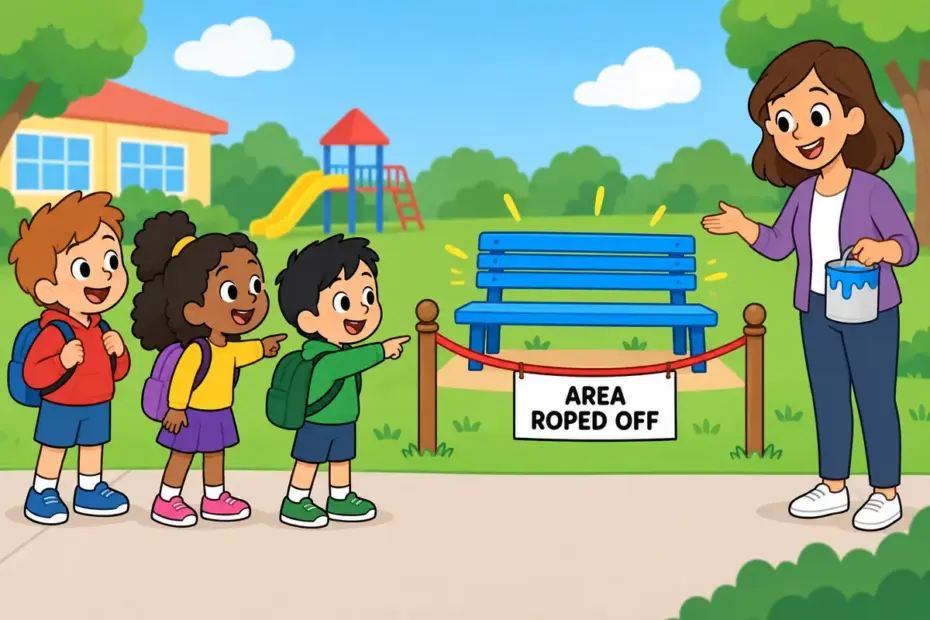
Rope off means to put a rope around an area so that people cannot enter it. To use rope off in a sentence, name the place and the reason: “Stewards roped off the front row before the concert.” The phrasal verb is separable, so the object can sit between rope and off.
Rope off at a glance
- Rope off is a separable phrasal verb meaning to close an area with a rope barrier.
- Its forms are rope off, ropes off, roped off and roping off.
- The object may follow off or sit between rope and off: rope off the pitch, rope the pitch off.
- The passive be roped off is the commonest shape in notices and reports.
- The usual mistake is dropping off and writing that a place was roped.
- Rope off is neutral in register and appears in notices, news reports and everyday speech.
What does rope off mean?
Rope off is a phrasal verb meaning to fasten a rope around a place so that people stay outside it. The Cambridge entry for rope off records the act as closing an area with a rope, and the term almost always describes a temporary barrier rather than a permanent wall. A corridor, a pool, a flight of steps or a row of seats can all be roped off for an hour or for a season.
Two nearby verbs are worth separating early. To enclose an area is to surround it on every side, which a single length of rope usually does not do. To seal a whole street in an emergency, officials use a different verb entirely, and that contrast is taken up below.
One limitation is worth stating plainly. Rope off suits a light barrier that one person can put up and take down. When the barrier is a fixed structure, fence off is the better choice, and when people in authority seal a large area, cordon off is the correct verb. Rope off also says nothing about permanence, so a roped-off corner of a museum may reopen the same afternoon.
How do you use rope off in a sentence?
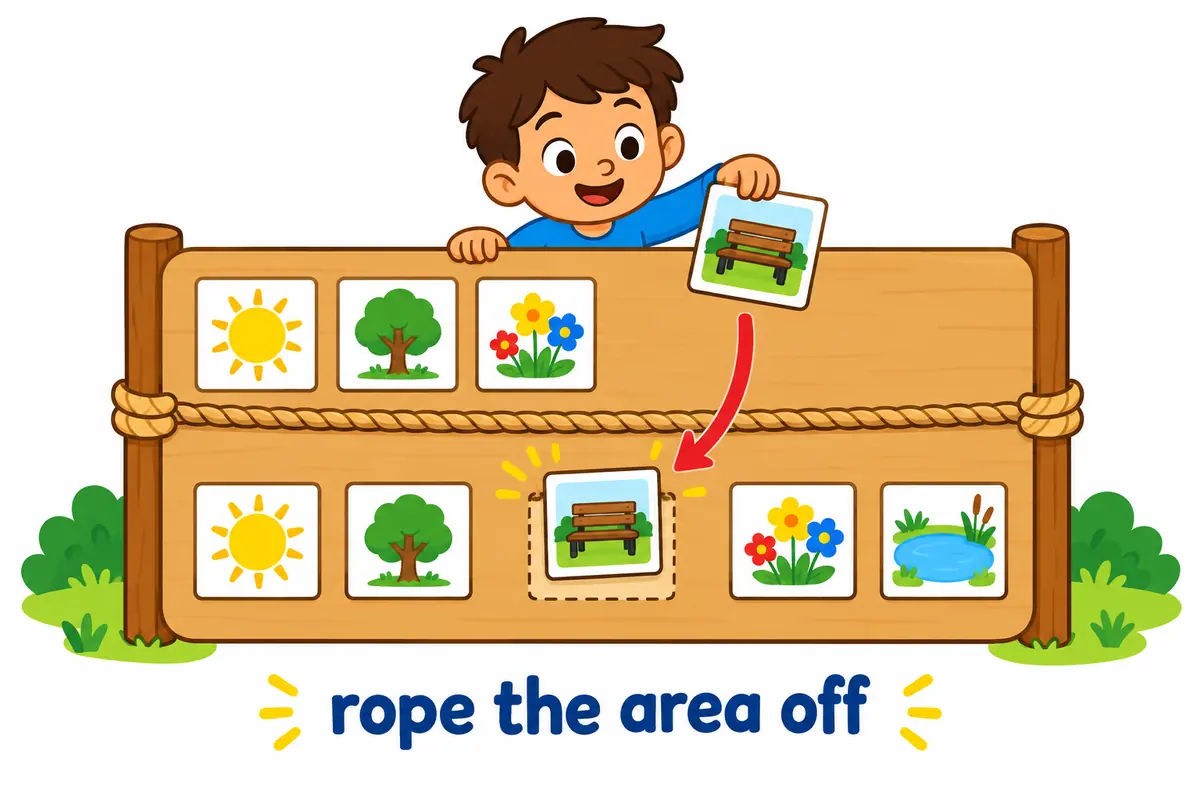
The place being closed goes straight after the verb. Because rope off is separable, the object can also sit between rope and off without changing the meaning. Five patterns cover almost every real sentence.
| Pattern | Example | What it signals |
|---|---|---|
| rope off + place | Stewards roped off the pavement. | The closed area is the direct object of the verb. |
| rope + place + off | Stewards roped the pavement off. | Separable form, with the object splitting the verb and the particle. |
| be roped off | The balcony is roped off tonight. | Passive voice, used when the area matters more than the person who closed it. |
| rope off + area + for + person | They roped off the front seats for the judges. | Reserves a space for a named group. |
| rope off + area + from + area | Crew members roped the stage off from the audience. | Marks a boundary between two adjoining spaces. |
Rope off in a sentence: examples across contexts
Rope off keeps its meaning while the setting changes. The twelve sentences below move from a school playground to a news report, and each one names the place that is closed.
| Context | Example sentence | Why this works |
|---|---|---|
| Classroom | The teacher roped off the wet corner after a leak. | A school setting supplies a concrete, ordinary reason. |
| Sports day | Stewards roped off the finish line before the first race. | The object is a marked line rather than a whole field. |
| Museum | The gallery roped off the sculpture while the glass was cleaned. | Shows a short, genuinely temporary closure. |
| Construction | Workers roped off the trench along the pavement. | A safety barrier around a hazard, with the object kept specific. |
| Festival | Organisers roped off a viewing area near the main stage. | Reserving space for a crowd, not sealing a hazard. |
| Hospital | Staff roped off the corridor during the floor cleaning. | An everyday institutional use with a clear time limit. |
| Swimming pool | The pool was roped off for the swimming gala. | Passive form, because the event matters more than the person. |
| Library | A librarian roped off the reading room for repairs. | Keeps the closed object, the room, in clear focus. |
| News report | Police roped off the lane after the storm brought down a tree. | Reports an official response without claiming a formal seal. |
| Workplace | The lab manager roped off the bench before the inspection. | Formal but ordinary, and the object is a defined surface. |
| Transport | Staff roped off the boarding lane to keep the queues apart. | Separating two streams of people in one space. |
| Conversation | They roped off the goal area so the little kids could play safely. | Informal speech keeps the separable pattern unchanged. |
Rope off vs cordon off
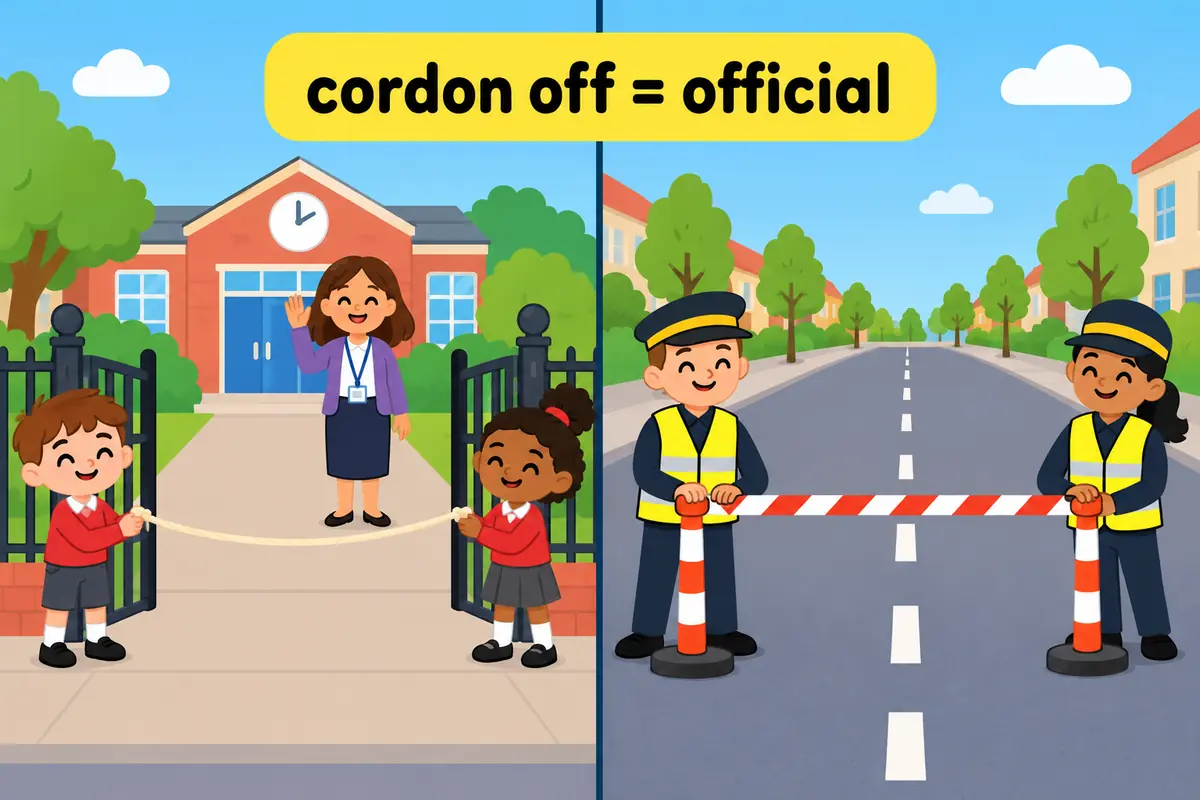
cordon off and rope off both close an area, but they signal different levels of authority. This table separates the two, treating a rope barrier as the light end and a full street seal as the heavy end.
| Attribute | rope off | cordon off |
|---|---|---|
| Barrier used | Rope, tape or a light chain | Police tape, metal barriers or officers |
| Who does it | Anyone holding the rope, such as a teacher or steward | Officials, police or staff acting under authority |
| Typical scale | A bench, a row of seats, one small area | A street, a building or an entire zone |
| Usual setting | School, gallery, pool, sports club | Crime scene, emergency, protest, major event |
| Register | Everyday and neutral | Official and journalistic |
| What it implies | A temporary soft boundary | Controlled access enforced by authority |
A fixed fence marks a permanent boundary, so fence off is the right verb when the barrier cannot be moved. Rope off, by contrast, assumes the barrier will come down. Verdict: choose rope off when you put up a light barrier yourself, and cordon off when people in authority seal a larger area.
Word forms and grammar of rope off
Rope off inflects like a regular verb, and the compound adjective roped-off appears before nouns. The particle back off behaves in the same way in other phrasal verbs, so the shape is worth learning once.
| Form | Part of speech | Example |
|---|---|---|
| rope off | base phrasal verb | Please rope off the wet steps. |
| ropes off | third person singular | The caretaker ropes off the hall each evening. |
| roped off | past and past participle | They roped off the pitch before kick-off. |
| roping off | present participle | She is roping off the queue area. |
| roped-off | compound adjective | A roped-off lane kept the runners apart. |
| rope | base verb, different meaning | To rope a calf means to catch it, not to close a space. |
Common mistakes with rope off
- Incorrect:
The pool was roped.Correct: The pool was roped off. Rule: The particle off carries the meaning closed, so it cannot be dropped. - Incorrect:
The organisers roped off.Correct: The organisers roped off the front rows. Rule: Rope off is transitive, so the sentence needs the area it closes. - Incorrect:
The museum roped the statue.Correct: The museum roped the statue off. Rule: In the separable form the object sits between rope and off, and the bare verb means something else. - Incorrect:
Police roped off the entire city centre.Correct: Police cordoned off the entire city centre. Rule: Rope off suits a small light barrier, while an official large-scale closure takes cordon off. - Incorrect:
The area is roping off.Correct: The area is being roped off. Rule: An area cannot rope itself, so the passive needs be plus the past participle.
Practice using rope off
Try the seven items, then read the answers for the reason as well as the word.
- Fill the gap: The staff ______ the aisle so the cleaners could pass.
- Choose the better word: After the crash, police (roped / cordoned) off the whole motorway.
- Correct the error: The lifeguard roped the deep end.
- Build a sentence: use be roped off about a school corridor during an exam.
- Spot the register: which belongs in a news report — the officers roped off the square, or they put a rope round the square?
- Rewrite in the separable form: Volunteers roped off the picnic area.
- Fill the gap: A rope had been ______ across the doorway all morning.
Answers
- roped off — the aisle is the area being closed, and off completes the phrasal verb.
- cordoned — police sealing a motorway is an official, large-scale closure.
- The lifeguard roped the deep end off — the object stays between rope and off.
- Model answer: The corridor was roped off while the exam was in progress.
- The officers roped off the square — a news report prefers the neutral phrasal verb.
- Volunteers roped the picnic area off — the separable form moves the object forward.
- roped off — the passive perfect needs the past participle roped plus off.
The bottom line
Use rope off in a sentence when a light barrier closes a space, and keep the particle off firmly attached because it carries the meaning. The two points that decide most sentences are separability, which lets the object sit after rope or after off, and register, which makes cordon off the choice for an official seal. Once the work behind the barrier is finished, the area is simply open again.
Frequently asked questions about rope off
Is rope off a separable phrasal verb?
Yes, rope off is separable, which means the object can follow the particle or sit between the verb and off. Both stewards roped off the pavement and stewards roped the pavement off are correct and mean the same thing. The joined form is more common in speech, while the split form often sounds slightly more deliberate.
What is the difference between rope off and cordon off?
Rope off uses a rope or tape as a light barrier that anyone can set up. Cordon off is the official version, used when police or staff seal a larger area with barriers, tape or people. Choose rope off for a bench or a row of seats, and cordon off for a street or a building.
Can you say the area was roped?
No. The area was roped is incomplete because the particle off carries the meaning of closing a space. The correct passive is the area was roped off. Without off, the verb rope means to catch an animal or to tie something with rope, which is a different action.
Does rope off mean permanently closed?
No. Rope off signals a temporary barrier. A roped-off stair or gallery is expected to reopen once the reason for closing it is gone, such as wet paint or a private event. For a permanent closure, use close off or fence off instead.