Satiate means to satisfy an appetite or desire completely, often past the point of wanting more. To use satiate in a sentence, make the appetite its object: “A long walk satiated her hunger.” The verb is transitive and slightly formal, so it suits writing about appetite, curiosity, greed or success.
Satiate at a glance
- Satiate is a transitive verb; its forms are satiates, satiated and satiating.
- It means to satisfy an appetite or desire completely, often to the point of excess.
- The object is the appetite, hunger, curiosity or greed that gets filled.
- Typical subjects are meals, experiences, success, praise and long-awaited answers.
- The commonest error is using satiate where plain satisfy would be plainer and more accurate.
What does satiate mean?
Satiate is a transitive verb meaning to satisfy an appetite or desire completely, often to the point of excess. The Cambridge entry for satiate notes its formal tone, and the word has kept the physical idea of filling that it carried from its earliest use.
| Sense | Plain meaning | Example sentence |
|---|---|---|
| Fill an appetite | Meet hunger or thirst completely | The stew satiated their hunger. |
| Fill a desire | Answer a longing so nothing is left | Travel satiated her curiosity for a while. |
| Fill to excess | Satisfy so fully that interest fades | Years of praise satiated his ambition. |
| Adjective use | Completely filled, literary | A satiate audience drifted out at dusk. |
One limitation is worth stating plainly. Satiate is not a general word for satisfying a need or meeting a standard, so it is the wrong choice for a requirement, a condition or a test. What satiate fills is an appetite or a desire, something that can reach a ceiling. For neutral cases, satisfy is the safer verb, and it never implies that the want has been used up.
A second caution concerns degree. Satiate carries a hint of excess, so it suits sentences where too much of a good thing is part of the point. Writers who simply mean someone was content should choose a milder verb, because satiate quietly says the appetite ran out rather than settled down.
How do you use satiate in a sentence?
Satiate is transitive, so it always needs the appetite or desire it fills. Six patterns cover almost every real sentence, and the passive is the one that carries excess most clearly.
| Pattern | Example | What it signals |
|---|---|---|
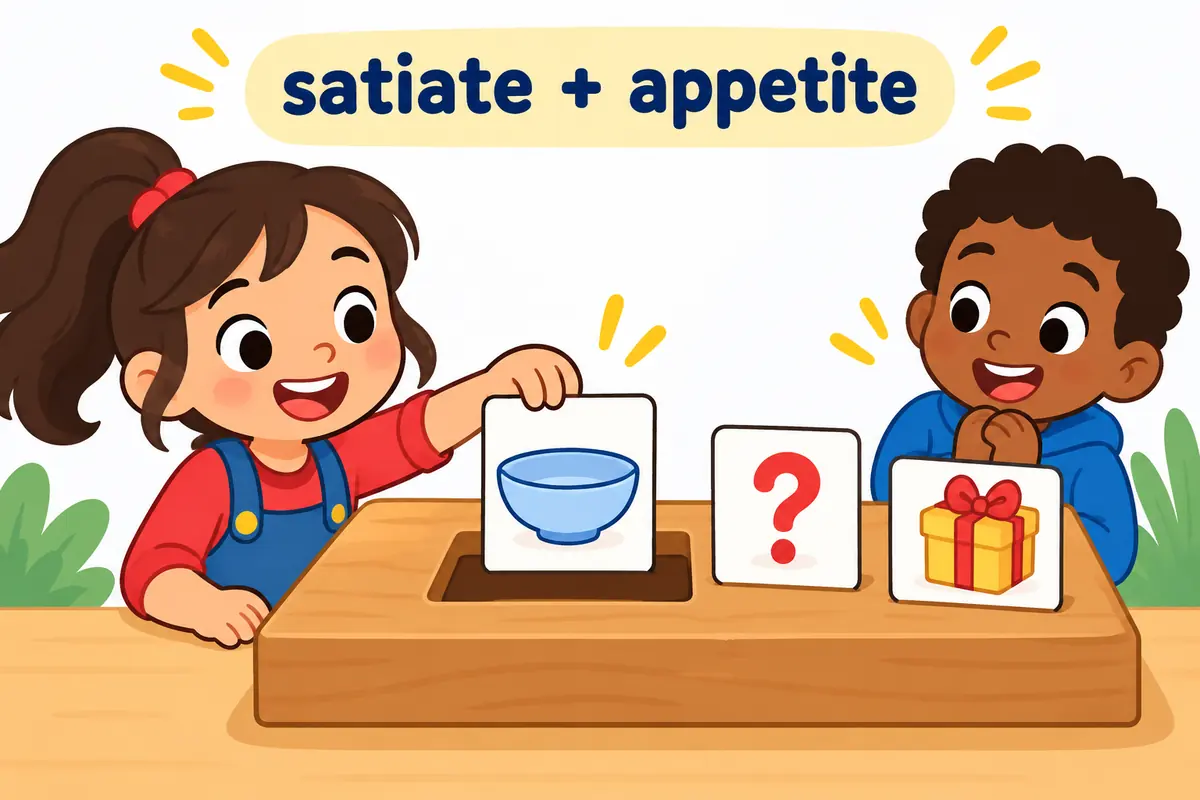
| satiate + appetite | A bowl of soup satiated her hunger. | The object is the thing being filled. |
| satiate + desire / curiosity | The archive satiated his curiosity. | Extends the verb beyond food to longing. |
| be satiated with / by | After the feast we were satiated with rich food. | Passive frame, the clearest signal of excess. |
| be satiated | The guests were satiated and quiet. | States the completed condition rather than the act. |
| satiating + noun | A satiating meal kept them going all day. | The participle works as an adjective. |
| satiate + greed / ambition | Quick profits satiated his greed. | Abstract drives can be objects too. |
The central rule is that the object is what gets full. A learner who writes the chef satiated the guests is understandable, but the idiomatic sentence names the appetite: the chef satiated the guests’ appetite. That shift keeps the verb on the thing that actually reaches its limit.
Satiate in a sentence: examples across contexts
Satiate reaches beyond food into curiosity, ambition and appetite of every kind, and the register stays slightly formal wherever it goes. The ten sentences below show that range, and each one names what was filled.
| Context | Example sentence | Why this works |
|---|---|---|
| Food writing | A few spoonfuls of the dense pudding satiated everyone. | Puts the appetite as the object through everyone’s hunger. |
| Restaurant review | The tasting menu satiated without overwhelming. | Shows the verb can stop short of excess. |
| Education | Two weeks of lessons satiated her appetite for astronomy. | Applies the verb to intellectual hunger. |
| News report | Demand for tickets was satiated only after a third date was added. | The passive suits public appetite. |
| Literary prose | He was satiated with praise and wanted silence. | The with phrase marks the point of excess. |
| Psychology | Rewards that satiate quickly lose their pull. | Uses satiate for a drive that switches off. |
| Travel writing | A single view satiated my longing for the coast. | Names the desire, not the traveller. |
| Business | The market is satiated, so growth must come from elsewhere. | Treats demand as an appetite. |
| Conversation | That huge lunch has completely satiated me. | The formal verb still works once the object is clear. |
| Academic prose | The study measures how quickly a subject becomes satiated. | Keeps the verb impersonal and exact. |
A collocation note: satiate pairs naturally with hunger, appetite, curiosity and desire. Writers rarely say a satiate meeting or a satiate inbox, because the object must name something that can be filled to its limit.
One register tip matters in practice. Satiate is at home in a review or a report, where its formality matches the setting, but a quick message usually prefers to say people are full. Choosing the plainer phrase costs nothing and avoids the faint air of a thesaurus.
Satiate vs satisfy
Satiate and satisfy are close enough that writers swap them, and the shorter sate adds a third option. The three differ mainly in strength and in what they can take as an object.
| Attribute | satiate | satisfy | sate |
|---|---|---|---|
| Degree of filling | Complete, often to excess | Enough to meet the need | Complete, with a literary ring |
| Typical object | Appetite, curiosity, greed | A need, a condition, a person | Appetite or desire |
| Implied excess | Often yes | No | Sometimes |
| Register | Formal and literary | Neutral and broad | Literary and older |
| Works with requirements | No | Yes | No |
Verdict: choose satisfy for needs, conditions and people, satiate when an appetite is filled right up, and sate when the same idea needs an older, more poetic sound. A criterion is satisfied, a hunger is satiated, and only one of the three belongs in a formal checklist.
Word forms and grammar of satiate
Satiate has a small, tidy family, but the two nouns sit on opposite sides of the meaning. The table lists the forms and the adjectives learners build by mistake.
| Form | Part of speech | Example |
|---|---|---|
| satiate | verb, base form | A light supper will satiate most guests. |
| satiates | verb, third person singular | Praise rarely satiates a restless mind. |
| satiated | verb, past and past participle; also adjective | The crowd left satiated. |
| satiating | verb participle and adjective | It was a satiating, slow-cooked meal. |
| satiation | noun, the process | Satiation arrives before the plate is empty. |
| satiety | noun, the settled state | Satiety is the comfortable feeling of having had enough. |
Two forms trip up learners: satiatement, which does not exist, and satiateful, which mistakes the verb for an adjective stem. The related participle satiated already does that work, and the noun satiation covers the process.
The verb also has a near neighbour in cloy, which describes the moment the filling turns unpleasant. Satiate stops at full; cloy carries the sense of sickly sweetness, so the two are not interchangeable even when the scene is the same.
Common mistakes with satiate
- Incorrect:
The new policy satiated the safety rules.Correct: The new policy satisfied the safety rules. Rule: Requirements are satisfied, because they are not appetites that can be filled. - Incorrect:
The chef satiated the guests.Correct: The chef satiated the guests’ appetite. Rule: The object names the appetite, not the people who have it. - Incorrect:
We were satiated of the meal.Correct: We were satiated with the meal. Rule: The passive uses with or by, never of. - Incorrect:
She felt very satiate after lunch.Correct: She felt very satiated after lunch. Rule: Use the participle satiated as the adjective in modern prose.
Practice using satiate
Work through the six items, then read the reasoning beside each answer.
- Fill the gap: A jug of cold water finally ______ their thirst.
- Choose the better word: The applicant (satiated / satisfied) every condition in the brief.
- Correct the error: Endless success satiated the whole team.
- Build a sentence: use be satiated with about a visitor who has seen too many museums.
- Spot the register: which belongs in a research abstract — the study measures satiation, or the study checks when people stop feeling hungry like, completely?
- Rewrite with the noun: Once the appetite is filled, interest falls. Use satiety instead.
Answers
- satiated — the object is thirst, which is filled to its limit.
- satisfied — conditions are met, not filled like an appetite.
- Endless success satiated the team’s ambition — the object is the drive, not the people.
- Model answer: After a week of galleries the traveller was satiated with paintings.
- The study measures satiation — an abstract uses the precise noun and no slang.
- Satiety ends interest in more food — the noun names the settled state.
The bottom line
Use satiate in a sentence when an appetite, hunger or desire is filled completely, and make that appetite the object rather than the person who feels it. Two nuances decide most examples: the verb implies a ceiling, so it hints at excess, and it is transitive and slightly formal, which keeps it out of casual requirement sentences. Where the need is ordinary or the context is a rule, satisfy is the plainer verb, and where thirst is the only thing being answered, quench is more precise.

Frequently asked questions about satiate
Is satiate a formal word?
Satiate sits at the formal end of the range, which is why it appears in literary and academic prose more often than in speech. In conversation most people say satisfy or fill up instead. The verb is not archaic, but it carries a bookish weight, so a casual sentence such as I ate until I was satiated can sound grand.
Can satiate be used for people?
Satiate usually takes an appetite, hunger, curiosity or desire as its object, not a whole person. You satiate a craving, not normally a guest. A sentence such as the meal satiated the family is understandable, but the feast satiated their appetite is the more idiomatic pattern because the object names the thing being filled completely.
What is the noun form of satiate?
Satiate has two related nouns. Satiation names the act or process of being filled completely, and satiety names the settled state of no longer wanting more. Satiation appears in research on appetite, while satiety is the everyday word for the comfortable, full feeling after a meal. Both are more precise than the vague phrase being full.
Is satiated an adjective?
Yes. The past participle satiated works as a full adjective meaning completely filled or satisfied to excess. You can say a satiated appetite or a satiated crowd. The adjective keeps the same implication as the verb: the filling is complete, so the desire has been used up rather than merely quietened for a while.