
Shone vs. Shown: Meaning, Grammar & Examples
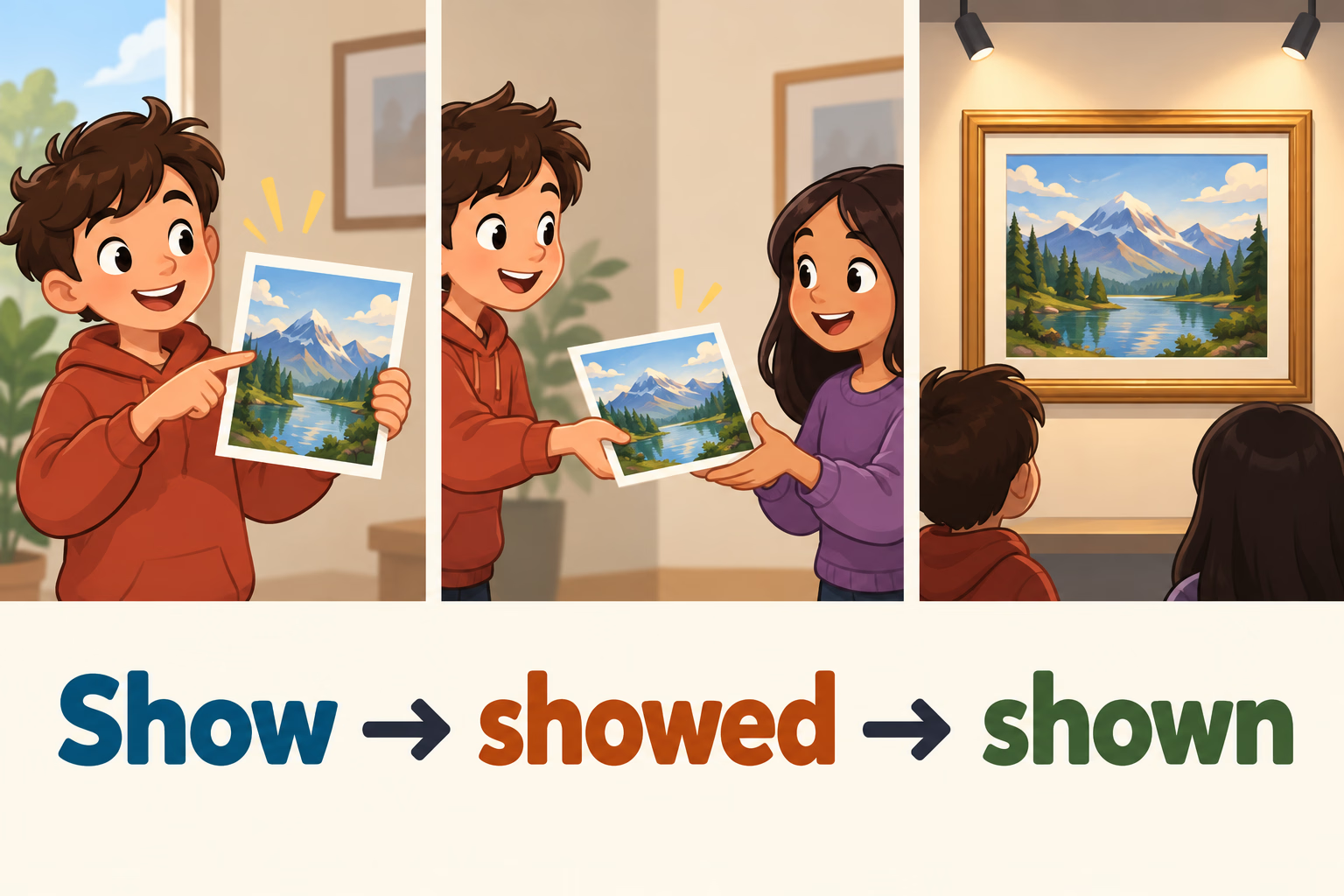
Shone and shown come from different verbs. Shone is a past form of shine, usually for light or radiance; shown is the past participle of show. For a simple past sentence, write “I showed her the painting”; use “I have shown her the painting” for a present-perfect construction.
At a Glance: Shone vs. Shown
- Shone belongs to shine: “The stars shone.”
- Shown belongs to show: “The results were shown on a chart.”
- The simple past of show is showed: “She showed us the map.”
- Shown usually appears as a participle with an auxiliary verb, such as have, has, had, or be.
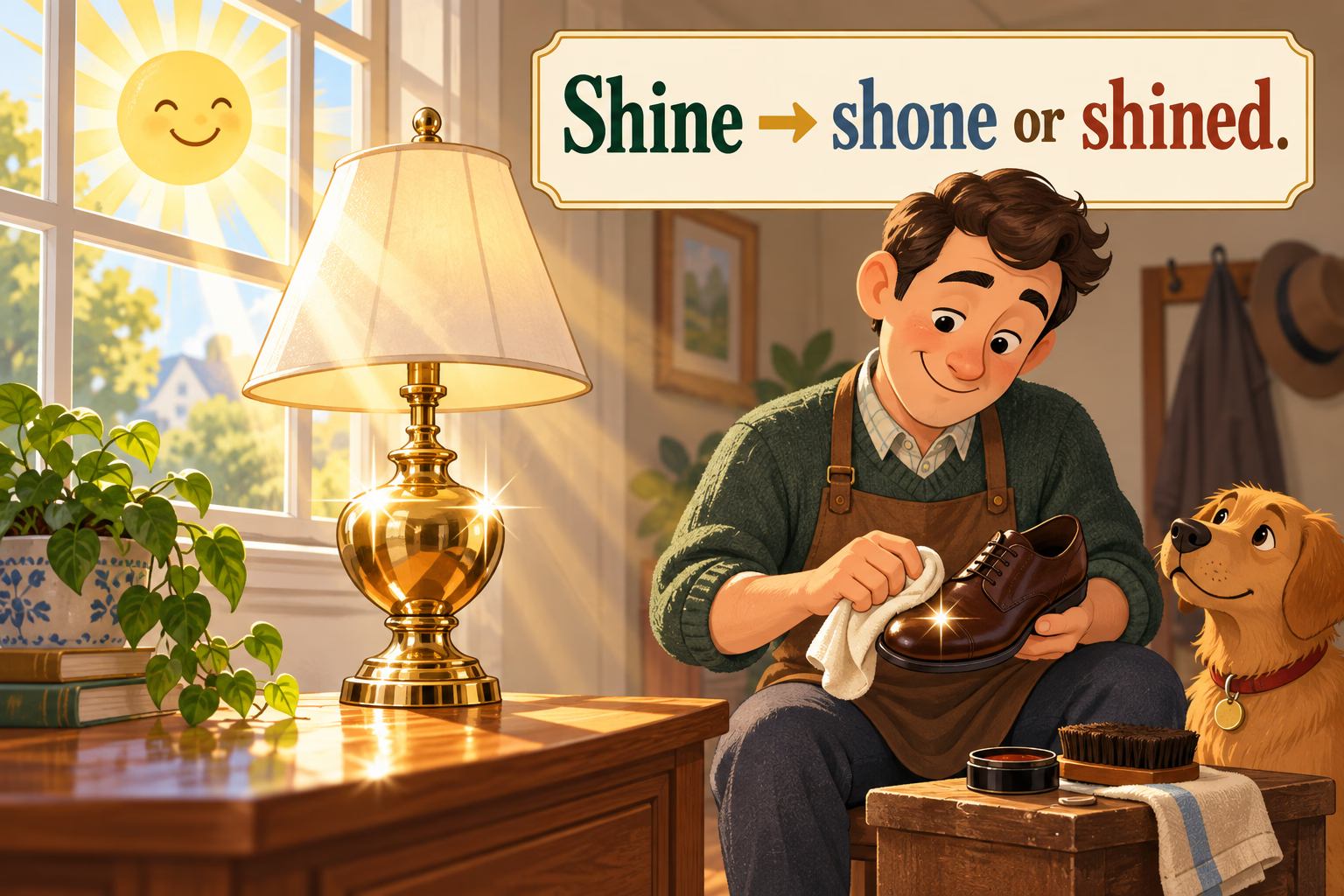
- Cambridge lists both shone and shined as past forms of shine; usage can depend on sense and style.
What Is the Difference Between Shone and Shown?
The fastest way to choose is to identify the base verb: if the sentence means “give or reflect light,” use a form of shine; if it means “present, display, or make something visible,” use a form of show. Cambridge’s irregular-verb table lists shine–shone–shone and show–showed–shown.
| Base verb | Simple past | Past participle | Typical meaning | Example |
|---|---|---|---|---|
| shine | shone (also shined) | shone (also shined) | Send out or reflect light; figuratively, display ability | “The moon shone through the clouds.” |
| show | showed | shown | Present, display, demonstrate, or make evident | “The diagram has shown each step clearly.” |
When Should You Use Shone?
Use shone for the simple past or past participle of shine, often when something emitted or reflected light. It can also describe a quality or ability that was conspicuous: “Her enthusiasm shone through the presentation.”
- Light source: “The lantern shone across the path.”
- Reflected light: “The wet pavement shone under the streetlights.”
- Expression: “His eyes shone with excitement.”
- Ability or quality: “The young musician shone in the final movement.”
Both shone and shined are accepted past and past-participle forms of shine. Cambridge lists both and uses shined in a shoe-polishing example; its examples also use shone for light that appears or reflects. This is a usage tendency, not a rule that makes the forms mutually exclusive. Follow a consistent dictionary or house style when one is required; Cambridge’s shine entry shows both forms and examples.
When Should You Use Shown?
Use shown as the past participle of show, not as its ordinary simple-past form. It commonly follows have, has, or had in perfect tenses, and it appears after a form of be in passive constructions.
| Grammar pattern | Correct example | Why it works |
|---|---|---|
| Simple past | “I showed her the painting.” | Showed is the past-simple form. |
| Present perfect | “I have shown her the painting.” | Have takes the past participle. |
| Past perfect | “By then, I had shown them the route.” | Had takes the past participle. |
| Passive voice | “The painting was shown at the gallery.” | Was combines with the participle. |

Why Is “I Shown Her” Incorrect?
In standard English, the simple-past sentence is “I showed her the painting,” not “I shown her the painting.” The form shown needs an auxiliary in a perfect or passive construction: “I have shown her the painting” or “The painting was shown.”
The unchanged original article below contains two examples written as “I shown…” and “The professor shown…”. Those examples are incorrect in standard English; use “I showed…” and “The professor showed…” for simple past, or add an auxiliary if shown is intended. The original text is retained as required, and this correction is provided here so the examples are not mistaken for recommended usage.
How Can You Choose the Right Word?
- Find the intended base verb. Is the sentence about shining light or showing something?
- Check the time and construction. Use showed for simple past; use shown after an auxiliary in perfect or passive forms.
- Read the sentence aloud and replace the word. “The report ___ the results yesterday” takes showed; “The report has ___ the results” takes shown.
- For shine, check the meaning and style. Both shone and shined are accepted past forms; use the form expected by your editor or dictionary where consistency matters.
Pronunciation is not a reliable universal test: Cambridge gives UK /ʃɒn/ and US /ʃoʊn/ for shone in its pronunciation guide. Because the vowel differs across these two varieties, sentence meaning and verb structure make a clearer guide than trying to match a single pronunciation.
Frequently Asked Questions
Is shone the past tense of show?
No. Shone is a past form of shine. The simple past of show is showed, and its past participle is shown.
Can I say “I have showed”?
Showed is normally the simple past (“I showed her the plan”), while shown is the standard past participle (“I have shown her the plan”). Use the participle after have, has, or had.
Is “shined” a real word?
Yes. Cambridge lists shined as an accepted past and past-participle form of shine, alongside shone. Shined is especially familiar when someone polishes an object or directs a light; follow your chosen style guide for consistency.
Does shown always need have, has, or had?
No. Those auxiliaries form perfect tenses (“has shown”), but shown also appears in passive phrases with be: “The film was shown last night.” In either case, it functions as a past participle.
Sources and Further Reading
- Cambridge Grammar: Table of irregular verbs
- Cambridge Dictionary: shine
- Cambridge Dictionary: shone
- Cambridge Dictionary: show
- Cambridge Dictionary: shown
- Cambridge pronunciation: shone
The complete original article follows unchanged. Its source examples are preserved as published; the corrections above take precedence for standard current usage.
Have you ever found yourself confused about when to use “shone” and when to use “shown”? Don’t worry, you’re not alone. In this text, I’ll shed some light on this common grammar dilemma and help you use these words appropriately.
Many people mistakenly believe that “shone” and “shown” are interchangeable, but that’s not the case. Each word has its own specific usage and meaning. Understanding the difference between the two can greatly enhance your writing and communication skills.
Key Takeaways
- “Shone” and “shown” are not interchangeable and have distinct meanings and uses.
- “Shone” is the past participle of the verb “shine” and is used to describe the emission of light or radiance.
- “Shown” is the past participle of the verb “show” and is used to indicate the act of presenting or displaying something.
- Using the correct word (“shone” or “shown”) according to its meaning can greatly enhance your writing and communication skills.
- “Shone” is used when describing the emission of light, while “shown” is used when presenting or demonstrating something.
- By understanding the difference between “shone” and “shown,” you can avoid confusion and effectively convey your intended message.
What is the difference between “shone” and “shown”?
When it comes to the confusion between “shone” and “shown,” understanding their specific usage and meaning can significantly improve your writing and communication skills. These two words are not interchangeable, and using them correctly can make a big difference in conveying your message effectively.
Definition of “Shone”:
The word “shone” is the past participle of the verb “shine.” It is primarily used when referring to the emission of light or radiance from something. Think of it as describing a bright light or a glowing object. For example:
- The sun shone brightly in the sky.
- The diamond shone in the light.
Definition of “Shown”:
On the other hand, “shown” is the past participle of the verb “show.” It is employed when indicating the act of presenting or displaying something. This word is used to describe showing or demonstrating something to someone. For instance:
- I shown her the painting that I had completed.
- The professor shown us an interesting video during the lecture.
Understanding the difference between “shone” and “shown” can prevent confusion and help you use the appropriate word in the right context. Here’s a quick summary to keep in mind:
| Shone | Shown |
|---|---|
| Describes the emission of light or radiance | Indicates the act of presenting or demonstrating something |
| Past participle of the verb “shine” | Past participle of the verb “show” |
| “The sun shone brightly in the sky.” | “I shown her the painting that I had completed.” |
By being mindful of these differences, you can enhance your writing and effectively communicate your ideas. It’s important to use the correct form according to the intended meaning you wish to convey.
Now that we’ve identified the distinction between “shone” and “shown,” let’s investigate into some examples that further clarify their usage, so you can use them confidently in your writing.
When to use “shone”
Shone is the past tense of the verb “shine.” It is used to describe the act of emitting or reflecting light. Understanding when to use “shone” is important for effective communication. Let’s explore some specific scenarios where this word is applicable:
1. Directly describing light:
- The sun shone brightly through the window.
- The flashlight shone in the dark room.
2. Describing a person or object radiating light:
- Her smile shone with happiness.
- The diamonds on her necklace shone brilliantly.
3. Referring to a specific point or period in time:
- The memory of that day still shone in my mind.
- The victory shone as a milestone in their history.
- The team’s performance shone on the field.
- Her talent shone through her art.
When to Use “Shown”
Examples of using “shone”
As discussed earlier, “shone” is the past tense of the verb “shine.” Here are some examples of when to use “shone” correctly:
- The sun shone brightly, illuminating the entire room with its warm rays.
- The stars shone like diamonds against the dark night sky.
- The lighthouse shone its beacon across the stormy sea, guiding ships safely to shore.
- Her eyes shone with excitement as she received the news of her promotion.
- The polished silverware shone on the table, reflecting the candlelight.
- The fireworks shone brilliantly in the sky, creating a dazzling display of colors.
- The moon shone through the clouds, casting a soft glow over the world.
Remember, “shone” is used when referring to the act of emitting or reflecting light. It conveys a sense of brightness or radiance. Using “shone” correctly in these contexts will enhance your writing and make it more precise.
In the next section, we will explore more examples of using “shone” to solidify your understanding and ensure that you can confidently use it in your own writing.
When to use “shown”
As I mentioned earlier, understanding the difference between “shone” and “shown” is essential for effective communication and writing. So far, we have explored the usage of “shone” as the past tense of the verb “shine.” Now, let’s investigate into when and how to use “shown” correctly.
What is the definition of “shown”?
According to Merriam-Webster, “shown” is the past participle of the verb “show,” which means to present or display something to someone. It is used when referring to an action of exhibiting or revealing something to others.
When do we use “shown”?
Here are a few scenarios where “shown” should be used appropriately:
- Presentations or demonstrations: When giving a talk or showing something to an audience, we use “shown” to describe the act of displaying or presenting information or objects. For example, “I have shown the results of my research during the conference.”
- Visual representation: “Shown” is used when referring to visual representations such as graphs, charts, or images. For instance, “The data is shown in the graph below.”
- Exhibitions or displays: When discussing exhibitions, displays, or art shows, we use “shown” to describe the act of showcasing or presenting artwork or objects. For example, “Her paintings were shown at the art gallery last month.”
Remember, “shown” emphasizes the act of presenting or displaying something, while “shone” is used when referring to the emission or reflection of light.
More Examples to Clarify Usage
In the next section, I will provide additional examples to solidify your understanding of when to use “shone” and “shown.” By exploring various contexts and scenarios, we will ensure confident and accurate usage of these words in your writing. Stay tuned!
But before that, let’s summarize what we’ve learned so far: “shone” is used to describe the act of emitting or reflecting light, often conveying a sense of brightness or radiance. On the other hand, “shown” is the past participle of “show,” used when presenting or displaying something to others.
Let’s continue our journey of exploring more examples to enhance your grasp of these commonly confused words.
Examples of using “shown”
When it comes to using “shown” as the past participle of the verb “show,” there are various scenarios in which it is appropriate and can enhance your communication. Let’s explore some examples to solidify understanding and ensure confident usage in your writing.
- Presentations or Demonstrations: When giving a presentation or demonstration, visual aids play a crucial role in conveying information effectively. In such instances, “shown” is the suitable choice. For example:
- “In my presentation, I have shown the audience how to use the new software.”
- “She has shown great expertise in demonstrating the correct technique.”
- Visual Representation: “Shown” is commonly used when referring to visual representation, whether it’s through images, graphs, or diagrams. Take a look at these examples:
- “The data is shown in the bar chart on page 5 of the report.”
- “The photograph shown on the website depicts the breathtaking beauty of the sunset.”
- Exhibitions or Displays: When discussing exhibitions or displays, the word “shown” is appropriate for highlighting items being showcased. Consider these examples:
- “The artwork was shown in a prestigious gallery.”
- “The latest fashion trends were shown on the runway during the fashion show.”
Remember, using “shown” correctly helps to convey your message clearly and avoids confusion. By understanding its specific usage and applying it appropriately, you can elevate the quality of your writing and enhance your communication skills.
Conclusion
Understanding the difference between “shone” and “shown” is crucial for effective communication. By using these words appropriately, we can convey our messages clearly and avoid confusion. “Shone” is used to describe the action of emitting light, while “shown” is the past participle of the verb “show.”
Using “shown” correctly is essential in scenarios such as presentations, demonstrations, visual representation, and exhibitions. It helps to provide evidence, display information, and present facts. On the other hand, “shone” is used to describe the act of radiating light, like the sun or a flashlight.
By grasping the specific usage of “shown” and applying it correctly, we can elevate the quality of our writing and enhance our communication skills. It allows us to express ourselves precisely and effectively.
So, next time you’re writing, remember to use “shone” when referring to the emission of light and “shown” when indicating the past tense of “show.” By mastering these distinctions, you’ll shine as a skilled communicator.
Frequently Asked Questions
Q: What is the difference between “shone” and “shown”?
A: “Shone” is the past tense and past participle of the verb “shine,” typically used to describe the emission of light. On the other hand, “shown” is the past participle of the verb “show,” used to indicate displaying or demonstrating something.
Q: When should I use “shown”?
A: “Shown” is used when you want to present or illustrate something visually, such as in presentations, demonstrations, exhibitions, or displays. It helps to provide a clear, visual representation of information or concepts.
Q: Why is it important to use the correct word?
A: Using the correct word, such as “shown,” improves clarity and avoids confusion in your writing. It ensures that your message is conveyed accurately and effectively, enhancing the overall quality of your communication.
Q: How can using “shown” improve my writing skills?
A: Understanding the appropriate usage of “shown” allows you to express ideas more precisely and professionally. By implementing it correctly, you elevate the quality of your writing and demonstrate a higher level of communication skills.


