
Shore up is a phrasal verb meaning to support or strengthen something weak so that it does not collapse. To use shore up in a sentence, place the object after the particle or between the verb and up: Workers shored up the wall. The verb is transitive and separable, so a pronoun must sit in the middle.
Shore up at a glance
- Shore up is a transitive phrasal verb; its forms are shores up, shored up and shoring up.
- It is separable: you can write shore up the wall or shore the wall up.
- A pronoun object must sit between the verb and the particle, as in shore it up.
- The dominant collocations are shore up a wall, support, currency or confidence.
- The commonest learner error is dropping up, as in the wall was shored.
What does shore up mean?
Shore up is a phrasal verb meaning to prop, support or strengthen something that is weak or failing. The Cambridge Dictionary entry for shore up records both the physical sense of propping a structure and the figurative sense of strengthening something such as an economy. A related concrete verb is buttress, which also names outside support added to a weak structure.
| Sense | Plain meaning | Example sentence |
|---|---|---|
| Physical | Prop up a wall, bank or structure | Builders shored up the collapsing wall. |
| Financial or political | Strengthen a currency, economy or institution | The central bank moved to shore up the currency. |
| Emotional or social | Strengthen confidence, support or morale | The speech shored up the team’s morale. |
How do you use shore up in a sentence?
The particle up is fixed to the verb, but the object can move. That separability is the part learners get wrong most often, so the pattern table shows it directly.
| Pattern | Example | What it signals |
|---|---|---|
| shore up + noun | Engineers shored up the riverbank. | The core transitive pattern, object after up. |
| shore + noun + up | Engineers shored the riverbank up. | Separable: the object can sit between verb and particle. |
| shore + pronoun + up | Shore it up before winter. | A pronoun must go between verb and particle. |
| be shored up (by) | The roof was shored up with beams. | The passive, common in reports. |
| shore up against + noun | They shored up the house against the storm. | Adds the threat being guarded against. |
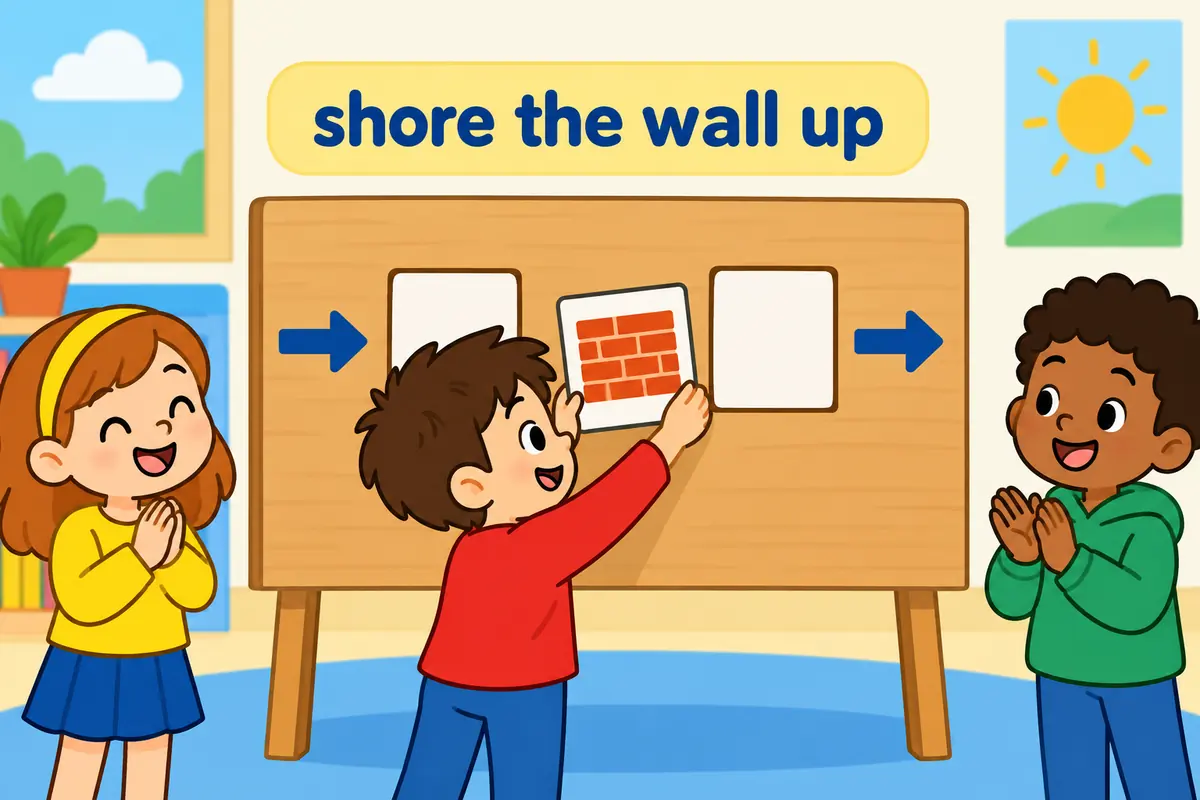
Shore up in a sentence: examples across contexts
| Context | Example sentence | Why this works |
|---|---|---|
| Engineering report | Crews shored up the tunnel roof before the storm season. | Uses the concrete, physical sense with a place object. |
| Economics news | The finance ministry announced new measures to shore up the currency. | The standard figurative use with an abstract financial object. |
| Workplace email | Let us shore up the schedule before the client notices the gaps. | A figurative, forward-looking use in a team note. |
| Sports report | A late signing shored up a defence that had leaked goals all season. | Applies the verb to a weak unit, not a physical object. |
| Conversation | We shored up the old fence so the dog would stop escaping. | A small, household use with a clear object. |
| Charity appeal | Donations shored up the food bank through a hard winter. | Shows people or money as the strengthening force. |
| Political writing | The coalition shored up its majority with two quiet deals. | Makes the abstract object a majority rather than a structure. |
| Academic writing | Practices that shore up trust matter more than formal rules. | Places the phrasal verb in analytical prose. |
Shore up vs prop up
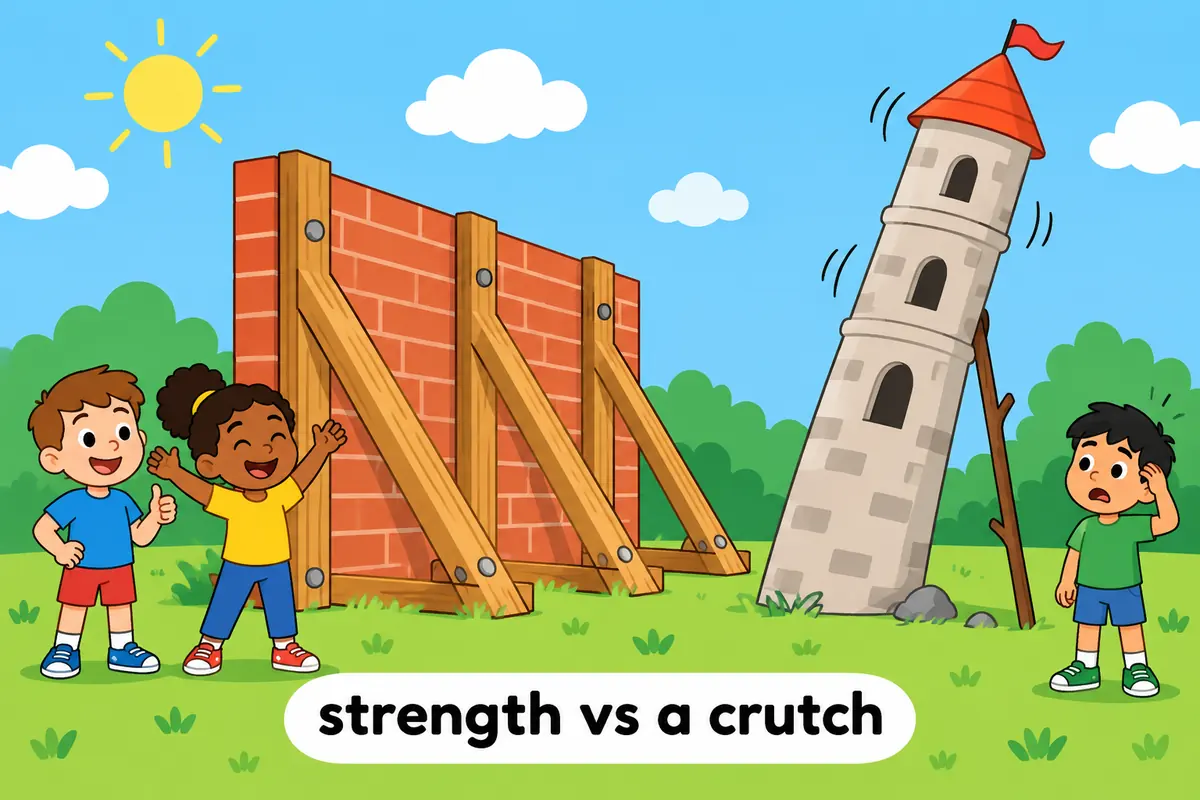
Both verbs keep something standing, but they carry different reviews. Shore up implies useful strengthening; prop up often implies artificial or temporary support.
| Attribute | Shore up | Prop up |
|---|---|---|
| Meaning | Strengthen something weak so it holds | Hold something up, often a failing thing |
| Connotation | Preventive and constructive | Temporary, sometimes criticised |
| Typical object | a wall, a bank, morale, a currency | a regime, a failing company, prices |
| What it implies | Added strength before collapse | Support that may only delay collapse |
| Separability | Separable; pronoun sits inside | Separable; pronoun sits inside |
| Register | Neutral, slightly concrete | Neutral, often critical |
Use shore up to say a weak thing was made stronger, and prop up to suggest it was merely held upright. When the support genuinely restores strength, bolster or reinforce often sound more positive than either.
An honest limit: shore up always implies a weakness that needed fixing, so it can insult something you meant to praise, and it is vague if no threat is named. For a plain sense of making something stronger, strengthen is the safer word, and the base noun shore means a wooden prop, not a coastline.
Word forms and grammar of shore up
| Form | Part of speech | Example |
|---|---|---|
| shore up | base form | We must shore up the dam. |
| shores up | third person singular | The plan shores up falling demand. |
| shored up | past tense and participle | They shored up the old barn. |
| shoring up | gerund and participle | Shoring up the wall took two days. |
| shore | noun (a wooden prop) | A wooden shore held the tunnel roof. |
Common mistakes with shore up
They shored up it.→ They shored it up. — Rule: with a pronoun object, the particle must follow the pronoun.The wall was shored.→ The wall was shored up. — Rule: the particle is obligatory; without up the verb loses this sense.The government shored the economy.→ The government shored up the economy. — Rule: in the figurative sense, up is fixed to the verb.They shored up to the roof.→ They shored up the roof. — Rule: shore up is transitive and takes a direct object, with no to.Workers shored up the shore with sand.→ Workers shored up the seawall with sand. — Rule: the verb is unrelated to the coast sense of shore; name the structure instead.
Practice using shore up
- Fill in the blank: The crew ___ the tunnel roof before the rain returned. (use the past tense)
- Choose the better word: The charity was accused of merely ___ a failing business. (shoring up / propping up)
- Correct the error: They shored up it with steel beams.
- Build a sentence: use shore up about a team’s confidence.
- Spot the register: which sentence belongs in a formal engineering report? (a) Crews shored up the eastern wall with steel. (b) They, like, stuck some stuff on the wall.
- Fill in the blank: The central bank acted to ___ the currency before markets opened.
Answers
- shored up — the past tense takes the regular ending and keeps the particle.
- propping up — the criticism of artificial support points to prop up rather than shore up.
- They shored it up with steel beams. — A pronoun object must sit between the verb and the particle.
- Sample: The captain’s calm talk shored up the team’s confidence before the final. — Shore up takes the abstract object confidence.
- (a) — the report needs precise nouns and the correct particle; the second option is casual and vague.
- shore up — the base form follows to after acted; the object is the currency.
The bottom line
Shore up is a transitive, separable phrasal verb meaning to strengthen something weak so it holds, and using shore up in a sentence means keeping the particle and placing a pronoun object between verb and particle. It covers walls, banks, currencies, morale and majorities, all of them weak or under threat. It suggests genuine reinforcement, so reach for prop up when you mean support that merely delays collapse.
Frequently asked questions about shore up
Is shore up one word or two?
It is two words. Shore is the verb and up is the particle, and they always appear together in that order unless an object moves between them. No dictionary hyphenates it, so write shore up, not shore-up or shoreup, even when the phrase acts as a single idea in a sentence.
Can you separate shore up?
Yes. The verb is separable, so you can write shore up the wall or shore the wall up. A pronoun object, however, must sit between the verb and the particle, giving shore it up rather than shore up it. Keep the particle after the object only when the object is a full noun phrase.
What is the past tense of shore up?
The past tense and past participle are both shored up, with a regular -ed ending on the verb and the particle unchanged. The present participle is shoring up. So a report can say crews shored up the bank yesterday, and the bank has been shored up since spring.
Does shore up mean the same as support?
Only partly. Support is a general verb that can describe any help, while shore up adds the idea of a specific weakness under threat. You can support a friend without any danger present, but you shore up something that might otherwise collapse, such as a wall, a currency or a fragile majority.
Have you ever heard the term “shore up” in conversation or writing and wondered what it meant? Essentially, to “shore up” means to provide support, strengthen, or reinforce something that may be weak or unstable. This phrase is often used in a figurative sense to describe taking actions to address a problem or improve a situation.
When someone talks about shoring up a project, a relationship, or even a financial portfolio, they are discussing ways to make it more secure or stable. By taking steps to shore up weaknesses or vulnerabilities, individuals can prevent further problems or setbacks and ensure a more solid foundation for whatever they are working on.
7 Examples Of Shore Up Used In a Sentence For Kids
- The workers helped shore up the broken bridge.
- We need to shore up the sandcastle before the tide comes in.
- The storm caused the trees to fall, so we had to shore up the fence.
- Let’s work together to shore up the blocks and build a tall tower.
- The strong winds can knock over the tent, so we need to shore up the ropes.
- The boat needed repairs to shore up the leak in its hull.
- It’s important to shore up our umbrella to protect us from the sun.
14 Sentences with Shore Up Examples
- Shore up your knowledge by attending extra tutorial sessions for difficult subjects.
- College students often need to shore up their time management skills to balance studies and extracurricular activities.
- It’s important to shore up your savings to cover unexpected expenses during your college years.
- Joining a study group can help you shore up your understanding of complex topics.
- Make sure to shore up your resume with relevant internships and extracurricular experiences.
- Taking regular breaks can help shore up your focus and concentration during study sessions.
- Shore up your communication skills through participation in debates and public speaking events.
- Building a strong network of friends and mentors can shore up your emotional well-being during stressful times.
- Use online resources to shore up your research for academic projects and assignments.
- Attending career fairs and workshops can help you shore up your job prospects after graduation.
- Seek guidance from professors or academic advisors to shore up your academic performance.
- Engaging in physical activities can help shore up your physical health and well-being.
- Taking up part-time work can help you shore up your financial independence during college.
- Develop a personal study routine to shore up your academic discipline and performance.
How To Use Shore Up in Sentences?
To Shore Up means to provide support or reinforcement for something.
Here is a simple guide on how to use Shore Up in a sentence:
-
Identify the situation: Think about a scenario where something needs to be strengthened or supported.
-
Choose the context: Determine whether you are referring to tangible objects like a wall or a financial plan, or intangible concepts like an argument or a friendship.
-
Form the sentence: Once you have your scenario and context in mind, create a sentence using Shore Up.
-
Example: “The construction crew worked diligently to shore up the crumbling foundation of the old building.”
-
Alternate Examples:
- “After the economic downturn, the government implemented policies to shore up the struggling economy.”
- “The team captain decided to recruit new players to shore up the team’s defense.”
-
Practice: Try forming different sentences using Shore Up in various contexts to become more comfortable with its usage.
Remember, using Shore Up adds strength and stability to the subject matter of your sentence.
Conclusion
In conclusion, using sentences with “shore up” emphasizes the act of strengthening or improving something, whether it be financial institutions, policies, or relationships. These sentences depict efforts to provide support, protection, or reinforcement in order to make something more stable or secure. By incorporating this term into sentences, it helps to underscore the importance of taking proactive measures to address weaknesses and enhance overall effectiveness.
Overall, the use of “shore up” in sentences serves as a reminder of the value in shoring up various aspects of life, be it through implementing reforms, bolstering resources, or fortifying structures. It encourages a proactive approach to addressing vulnerabilities and ensuring long-term stability and success in different areas of interest.


