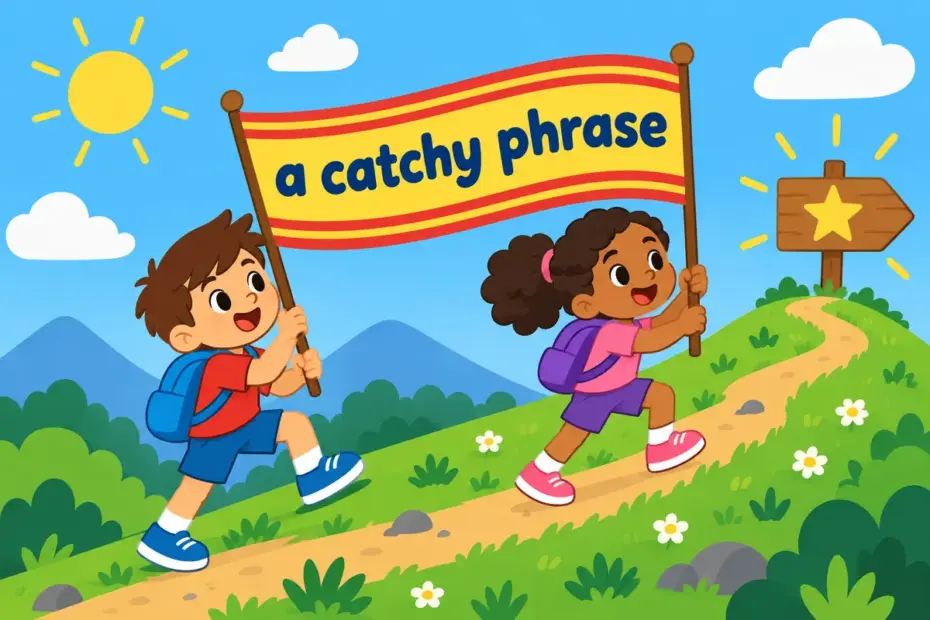
Slogan vs slog on is a spelling trap with no shared meaning: use slogan, a noun, for a short memorable advertising phrase, and slog on, a verb, to mean continuing a hard task. A missing space links them, so the sentence slot decides: “The slogan was catchy” against “We slogged on.”
Slogan and slog on at a glance
- Slogan is a noun; slog on is a phrasal verb made from slog plus the particle on.
- Slogan is one word; slog on is always two.
- Slogan names a short, memorable phrase; slog on means keep working or moving despite difficulty.
- Slogan pluralises to slogans; slog on inflects as slogged on and slogging on.
- The two sound almost identical in speech, which is why they are so often confused in writing.
- The reliable test is the job of the word: a naming slot takes slogan, an action slot takes slog on.
What do slogan and slog on mean?
Slogan is a noun meaning a short memorable phrase used to promote a product, brand or cause; slog on is a phrasal verb meaning to continue working or travelling doggedly despite difficulty. The Cambridge entry for slogan treats it as a catchphrase of advertising, while the entry for slog on records the sense of persisting with effort. One word names a thing; the other describes an action.
| Term | Part of speech | Meaning | Example sentence |
|---|---|---|---|
| slogan | noun | a short memorable phrase used in advertising or a campaign | The slogan fitted neatly on the billboard. |
| slog on | phrasal verb | continue working or moving with steady effort | The crew slogged on through the storm. |
Slogan is the wrong choice for a private rule or guiding principle; that is a motto, and it can be long. It also fails when the phrase is spoken by one person as a habit, which is a catchphrase rather than an advertising line. Slog on, for its part, is informal, so a formal report about persistence should prefer persevere or endure.
Slogan vs slog on
The master comparison below settles the choice in one pass. Read down the criteria rather than across the examples, because the parts of speech are what separate the two words.
| Criterion | Slogan | Slog on |
|---|---|---|
| Part of speech | noun | phrasal verb, slog plus on |
| Word count | one | two |
| Core meaning | a short memorable phrase | keep going through hard work |
| Typical subject | a brand, campaign or cause | a person, a team, a process |
| Register | neutral; business and media | informal; narrative and spoken |
| Common partners | catchy, advertising, campaign, brand | through the rain, regardless, anyway |
| Example | The slogan won the pitch. | They slogged on through the night. |
The verdict is simple. If the word must name a phrase, write slogan; if it must carry an action, write slog on. No sentence needs both meanings at once, so a correct choice makes the other spelling impossible.
How do you use slogan and slog on in a sentence?
Each word has its own small set of patterns. Learn them separately, because they never share a structure.
| Slogan pattern | Example | What it signals |
|---|---|---|
| adjective + slogan | a catchy slogan | the usual slot for judging a phrase |
| slogan + of + group | the slogan of the movement | identifies whose phrase it is |
| verb + slogan | The team coined a new slogan. | names the actions that attach to a phrase |
| slogan as subject | The slogan stuck in every mind. | makes the phrase itself the actor |
| Slog on pattern | Example | What it signals |
|---|---|---|
| slog on + through + obstacle | They slogged on through the mud. | the effort and the setting it resists |
| slog on + adverb | She slogged on regardless. | determination without a stated goal |
| slog on + to + goal | The team slogged on to victory. | the endpoint of the struggle |
| no object after on | never “slog on the report” | the phrase is intransitive, so on cannot be split off |
The particle on stays attached because there is no object to separate it from. That is the opposite of a separable phrasal verb such as keep someone on, where the object slides between the words.
Slogan and slog on in a sentence: examples across contexts
Both words appear below, in the settings where each one feels natural. The reason in each row shows what would go wrong with the other spelling.
| Context | Example sentence | Why this works |
|---|---|---|
| Advertising | The slogan ran for a decade without a change. | The phrase is a thing, so the noun is required. |
| Political speech | A single slogan can carry a whole campaign. | The countable noun takes an article and a modifier. |
| Sports report | The runners slogged on through the freezing rain. | The verb describes effort over time. |
| Workplace message | We will slog on until the audit closes. | Informal resolve, suited to a team note. |
| Fiction | He slogged on across the empty plain. | The verb supplies the slow rhythm of the journey. |
| Conversation | That slogan is everywhere this month. | The noun names a familiar public phrase. |
| Academic prose | The study lists the slogans used by each party. | The plural noun fits a formal inventory. |
| Travel writing | They slogged on to the next village by dusk. | The verb names the physical ordeal and its goal. |
| Business pitch | One strong slogan can outsell a larger budget. | The noun sits in a subject position and acts. |
| Encouragement | Slog on a little longer; the summit is close. | The imperative verb drives the listener forward. |
Where persistence needs a formal synonym, persist suits a report and plod keeps the heavy, unhurried movement of slog on. For travel without the sense of struggle, trudge is close, though it stresses weariness rather than determination.
Which should you use?
Five reader situations cover most real choices. Each one points to a firm answer rather than a compromise.
| Situation | Use | Why |
|---|---|---|
| You need a memorable line for a campaign | slogan | slog on is a verb and cannot name a phrase. |
| You are describing effort against difficulty | slog on | slogan is a noun and cannot carry the action. |
| You are writing a formal report on perseverance | persevere or endure | slog on is too informal for that register. |
| You hear a near-identical sound and must spell it | check the job in the sentence | a naming slot takes slogan; an action slot takes slog on. |
| You mean a private guiding rule | motto | a slogan is public and promotional, not personal. |
Read the sentence aloud if the choice is still unclear. Only one of the two can follow an article like a or the, and only one can take a past tense ending. Those two tests resolve the pair without a dictionary.
Word forms and grammar of slogan and slog on
The forms run in parallel families: a noun that inflects for number, and a verb that inflects for tense and aspect.
| Form | Part of speech | Example |
|---|---|---|
| slogan | noun, singular | The slogan was short and clear. |
| slogans | noun, plural | Advertisers test dozens of slogans. |
| slogan of | noun with of phrase | The slogan of the campaign was bold. |
| slog on | base phrasal verb | We must slog on. |
| slogged on | past and participle | They slogged on until dawn. |
| slogging on | present participle | Slogging on through winter tested them. |
| slog | base verb | He slogged through the report. |
One shared shape causes trouble: slog, without on, is a plain verb meaning work hard or hit hard. Adding on fixes the sense to steady continuation, which is why “slog the report” and “slog on” describe different things. A related public phrase, a saying, is fixed and traditional, whereas a slogan is written for a purpose, and a watchword is a guiding principle a group repeats.
Common mistakes with slogan and slog on
- Incorrect: The company wrote a clever slog on. Correct: The company wrote a clever slogan. Rule: a phrase is a thing, so the noun form is one word.
- Incorrect: We sloganed on through the storm. Correct: We slogged on through the storm. Rule: slogan is only a noun and never takes a tense ending.
- Incorrect: The slogan of the team was to slog. Correct: The team slogged on. Rule: do not use the noun to describe the action of persisting.
- Incorrect: They slogged on it through the night. Correct: They slogged on through the night. Rule: slog on is intransitive, so it takes no direct object.
- Incorrect: a slog on for the advertisement. Correct: a slogan for the advertisement. Rule: after an article, the naming word is needed.
- Incorrect: The slogan’s are catchy. Correct: The slogans are catchy. Rule: the plural is slogans; an apostrophe marks possession, not a plural.
Practice using slogan and slog on
Seven exercises. Choose the term by the job it must do, then check the reason in each answer.
- Fill in the blank: The charity adopted a bright ______ for its winter appeal.
- Choose the better word: The rescuers (slogan / slogged on) through the deep snow.
- Correct the error: The billboard carried a famous slog on.
- Build a sentence: describe a tired team refusing to quit, using slog on.
- Spot the register: which sentence belongs in a formal report, “We slogged on” or “We persevered”?
- Fill in the blank: Their ______ of the season was only five words long.
- Correct the error: One good slog on can lift a whole campaign.
Answers
- slogan. The article a and the adjective bright demand a noun.
- slogged on. The past-tense verb describes the continuing effort.
- The billboard carried a famous slogan. A printed phrase is a noun.
- The team slogged on long past midnight. The phrase supplies the action, not a noun.
- The second. Formal reports prefer persevered to the informal particle verb.
- slogan. A five-word phrase is a countable noun, so the singular fits.
- One good slogan can lift a whole campaign. The modifier one good and the article mark a noun.
The bottom line
Slogan vs slog on comes down to the job of the word, not its sound. Slogan is a single-word noun that names a short promotional phrase, while slog on is a two-word phrasal verb that means keep going through difficulty. Check whether the sentence needs a thing or an action and the correct spelling follows at once.
Frequently asked questions about slogan vs slog on
Is slog on one word or two?
Slog on is always two words. Slog is the verb and on is a particle that stays separate, as in “they slogged on”. A compound noun such as slogan is unrelated and is written as one word. Joining the two into slogon is a common misspelling that no dictionary recognises.
What is a synonym for slogan?
Close synonyms include catchphrase, tagline and motto, though each differs. A tagline is a short advertising line attached to a brand, a catchphrase is repeated by a person, and a motto is a guiding principle. Slogan is the broad commercial term and fits any short phrase used to promote or rally.
Is slog on used in American English?
Yes, though it feels more at home in British narrative and sports writing. American writers understand it perfectly and use it in fiction and commentary. The difference is one of tone rather than geography: slog on is informal everywhere, so a formal American report would still choose persevere or endure.
Can slogan be used as a verb?
No. Slogan is only a noun, so there is no such form as sloganed or sloganing. When a sentence needs an action, the verb is slog or the phrasal verb slog on. Using slogan as a verb is a category mistake, because the word names a thing rather than an activity.