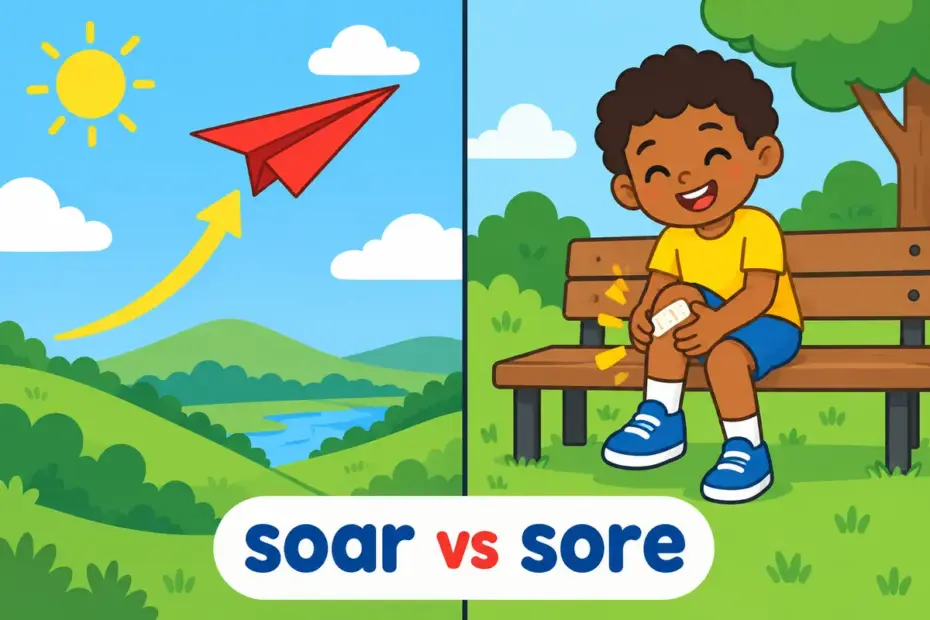
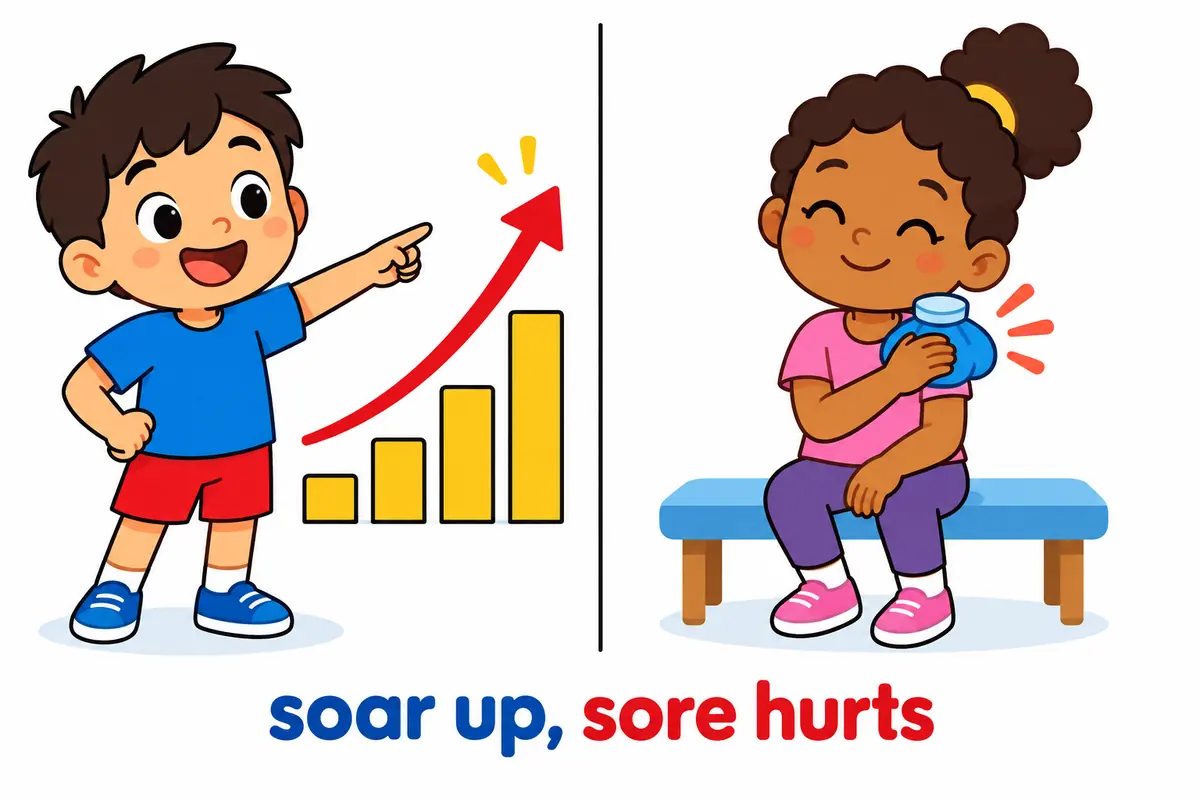
Soar vs sore is a pair of homophones that sound identical but do different work: soar is a verb meaning to rise high, while sore is an adjective meaning painful when touched. Use soar for movement and rising numbers and sore for pain or resentment. A quick check of the word class settles almost every case.
Soar vs sore at a glance
- Soar is a verb of movement or increase; sore is almost always an adjective of pain.
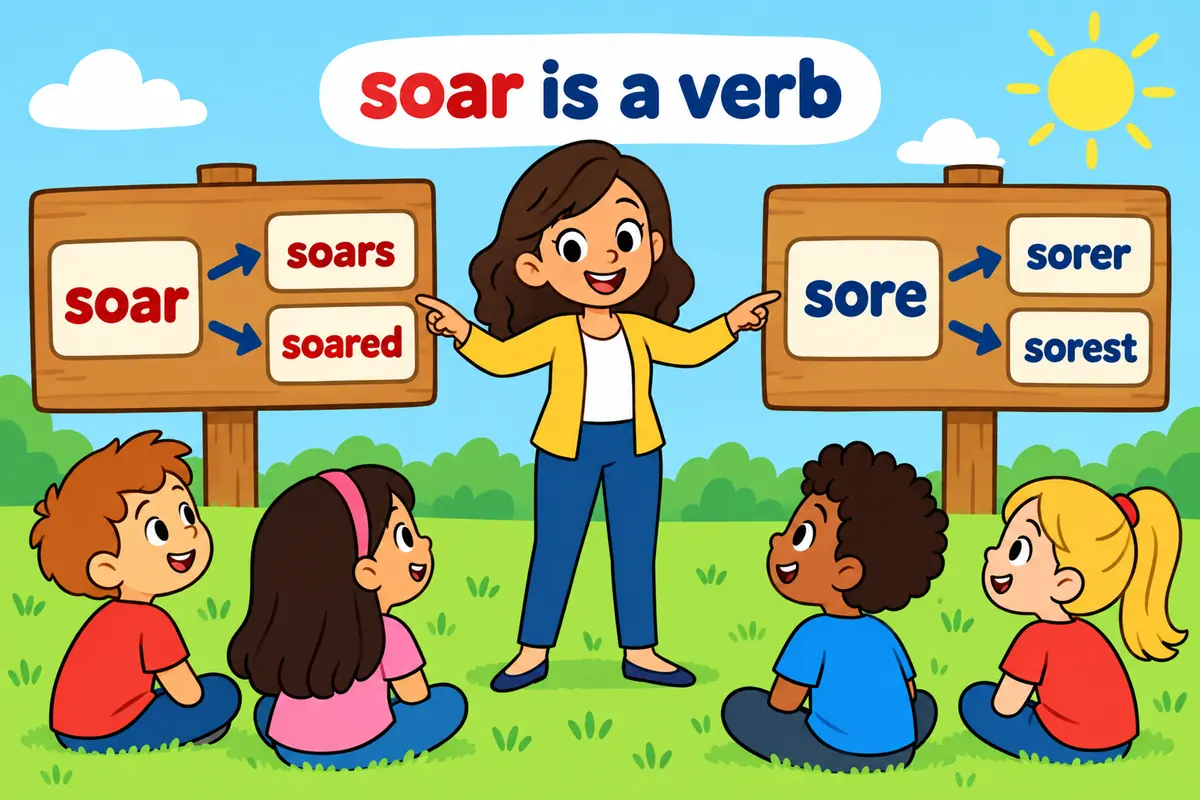
- Soar has the forms soar, soars, soared and soaring; sore has sorer, sorest and the adverb sorely.
- Soar is neutral and slightly literary; sore is common in everyday speech about the body and feelings.
- Common collocations include prices soar, soaring temperatures, a sore throat and a sore loser.
- The commonest error is writing soar for pain or sore for upward movement.
Soar vs sore: the master comparison
| Criterion | Soar | Sore |
|---|---|---|
| Word class | Verb | Adjective, with a rare noun use |
| Core meaning | Rise high in the air or increase quickly | Painful when touched or used |
| Typical subject | A bird, a plane, prices, spirits | A body part, a muscle, a feeling |
| Literal or figurative | Both: birds soar, prices soar | Mostly literal, though feelings can be sore |
| Register | Neutral, sometimes vivid | Everyday and direct |
| Key collocations | soar above, soar to new heights | sore throat, sore point, sore loser |
| Common error | Writing sore after prices | Writing soar about a muscle |
| Example | Demand caused prices to soar. | Her throat was sore all morning. |
The difference comes down to the job each word does: soar tells you something moves or grows, and sore tells you something hurts. Because they are homophones, only spelling and grammar reveal which one a writer intended. In speech the context does the work, but in writing a single letter separates a rising market from an aching back.
Which should you use?
| Situation | Choose | Example |
|---|---|---|
| Describing a fast rise in prices or numbers | Soar | Ticket prices soared before the final. |
| Describing a bird or aircraft climbing | Soar | The eagle soared over the valley. |
| Describing a painful body part | Sore | My legs were sore after the hike. |
| Describing resentment or hurt feelings | Sore | He was still sore about the defeat. |
| Describing a sensitive subject | Sore | The budget is a sore point for the team. |
If the sentence describes movement or a rising figure, reach for soar; if it describes pain, sensitivity or a grudge, the answer is sore. Most real sentences fall neatly on one side of that line, so a writer rarely needs to weigh the two for long.
What does soar mean?
Soar is a verb meaning to fly or rise high, and by extension to increase rapidly or to feel elated. The Cambridge entry for soar gives the upward movement and the sharp increase, and both are frequent: an eagle soars, a kite soars, and so does the price of heating oil in winter. Close verbs include ascend for a formal climb and climb for a steady rise, though neither carries the soaring sense of effortless height.
| Sense of soar | Plain meaning | Example sentence |
|---|---|---|
| Fly high | Rise or glide at a great height | Gulls soared above the harbour. |
| Increase fast | Rise quickly in number or price | Costs rose sharply and then soared. |
| Feel elated | Experience a rush of happiness | Her spirits soared at the news. |
What does sore mean?
Sore is an adjective meaning painful or tender, especially when touched or used. The Cambridge entry for sore records the physical sense and the informal sense of being upset, and another common use is the noun, as in a sore on the skin. Related words include painful, which is stronger and more general, and tender, which describes gentle sensitivity, and ache, which names a dull, continuous pain.
| Sense of sore | Plain meaning | Example sentence |
|---|---|---|
| Physically tender | Painful when touched | His shoulders were sore after rowing. |
| Upset | Informally, angry or hurt | She was sore about the lost match. |
| A painful spot | A noun for an injured area | The sore on his knee was healing. |
How do you use soar and sore in a sentence?
Soar behaves like a normal verb, taking tense endings and subjects that move or grow. Sore behaves like an adjective, sitting before a noun or after a linking verb.
| Pattern | Example | What it signals |
|---|---|---|
| subject + soar | Demand soared overnight. | Soar is the main verb of the clause. |
| subject + soar + preposition | The plane soared above the clouds. | A direction or location follows the verb. |
| sore + noun | He has a sore throat. | The adjective modifies the noun directly. |
| linking verb + sore | My back feels sore. | The adjective describes the subject after feel, seem or be. |
| sore + about + noun | They were sore about the ruling. | The informal sense of resentment. |
A grammatical test works every time: if a tense ending such as ed or ing fits, the word is soar, and if a degree word such as very or too fits, the word is sore.
Soar and sore in a sentence: examples across contexts
| Context | Example sentence | Why this works |
|---|---|---|
| Business news | Energy costs soared after the shortage. | A sharp rise in a figure takes the verb soar. |
| Nature writing | Two hawks soared above the ridge. | Literal flight uses the same verb. |
| Health advice | Rest a sore ankle before you walk again. | A body part in pain takes the adjective sore. |
| Sports report | The team was sore after a narrow loss. | The informal resentment sense of sore. |
| Workplace talk | Pay is a sore point in the negotiations. | A fixed phrase for a sensitive topic. |
| Weather report | Temperatures soared to a record high. | Soar suits a dramatic numerical rise. |
| Child’s diary | My arms were sore after the swim meet. | Everyday muscle tenderness. |
| Motivational note | Her confidence soared after the first win. | Soar for rising feeling or morale. |
| Letter of complaint | The customer was sore about the delay. | A mild, informal grudge. |
| Insurance notice | Premiums soared after the storms. | A sharp, unwelcome rise in a figure. |
| Gym advice | Stretch so your calves are not sore tomorrow. | Prevention of muscle tenderness. |
Notice that every soar sentence has a subject that moves or rises, and every sore sentence has a source of pain or resentment, which is the fastest way to keep the two apart. A sentence rarely needs both words, and when it does, the contrast is usually deliberate, as in prices soared while shoppers went home with sore feet.
Word forms and grammar of soar and sore
| Form | Word | Part of speech and example |
|---|---|---|
| soar | soar | base verb: Prices soar each spring. |
| soars | soar | third person singular: The kite soars in the wind. |
| soared | soar | past tense: The rocket soared away. |
| soaring | soar | present participle: Soaring costs worried families. |
| sore | sore | base adjective: a sore muscle. |
| sorer | sore | comparative: This knee is sorer than the other. |
| sorest | sore | superlative: The sorest spot was his heel. |
| sorely | sore | adverb: The team was sorely tested. |
One trap is the adverb sorely, which never means painfully; it means greatly or severely, as in sorely missed. The verb soar has no such double life, which makes it the more predictable of the two. Note also that the comparison forms sorer and sorest are common in speech but rare in formal writing, where a phrase such as more painful often reads better.
Common mistakes with soar and sore
- Incorrect: Prices sored last month. Correct: Prices soared last month. Rule: Sore is not a verb, so a rising figure needs soar.
- Incorrect: My legs are soar after the run. Correct: My legs are sore after the run. Rule: Physical tenderness takes the adjective sore.
- Incorrect: The eagle sore above the cliffs. Correct: The eagle soared above the cliffs. Rule: Flight and height take the verb soar.
- Incorrect: He is a soar loser. Correct: He is a sore loser. Rule: The fixed expression uses sore.
- Incorrect: She was soar about the result. Correct: She was sore about the result. Rule: The informal sense of resentment uses sore.
Practice using soar and sore
- Fill in the blank: Demand for fans __________ during the heatwave.
- Fill in the blank: My throat is __________, so I will rest my voice.
- Choose the better word: The eagle (soared / sored) over the lake.
- Correct the error: He was sore to the top of the rankings.
- Build a sentence: ticket prices rising quickly before a concert, using soar.
- Spot the register: Which sentence fits a medical note? (a) The patient has a sore back. (b) The patient’s back is soar.
Answers
- soared — a fast rise in a figure takes the verb soar.
- sore — a painful body part takes the adjective sore.
- soared — flight and height use soar.
- He soared to the top of the rankings — upward movement takes soar.
- Ticket prices soared before the concert — a sharp rise suits soar.
- Sentence (a) — a medical note uses the standard adjective sore.
The bottom line
Soar vs sore is settled by one question: is the sentence about rising or about hurting? Soar is a verb for flight, rapid increase and lifted spirits, while sore is an adjective for tenderness and, informally, for resentment. Keep the word classes in mind and the homophone stops being a problem, because only one of the two can take a tense ending.
Frequently asked questions about soar vs sore
Is soar a verb or a noun?
Soar is a verb, so it takes tense endings and follows subjects such as prices, birds or spirits. It is not used as a noun in standard English, which is why a rising figure soars rather than being called a soar. The only noun-like form is the participle soaring, as in soaring costs.
What does sore loser mean?
A sore loser is someone who becomes upset or resentful after losing. The phrase uses the informal sense of sore, meaning angry or hurt, and it is fixed, so the spelling is always sore and never soar. The same sense appears in sore point and sore about something.
Can sore be a noun?
Yes, though less often than the adjective. As a noun, a sore is a painful spot on the skin or a place that hurts, as in the sore on his arm healed slowly. Most everyday uses still treat sore as an adjective before a body part or after a linking verb.
How can I remember which spelling to use?
Tie each word to a sense. Soar contains the letter a, which appears in air and ascend, both linked to rising. Sore sounds like the start of sorrow and sour, which suit pain and resentment. A quick check of the word class then confirms the choice.