
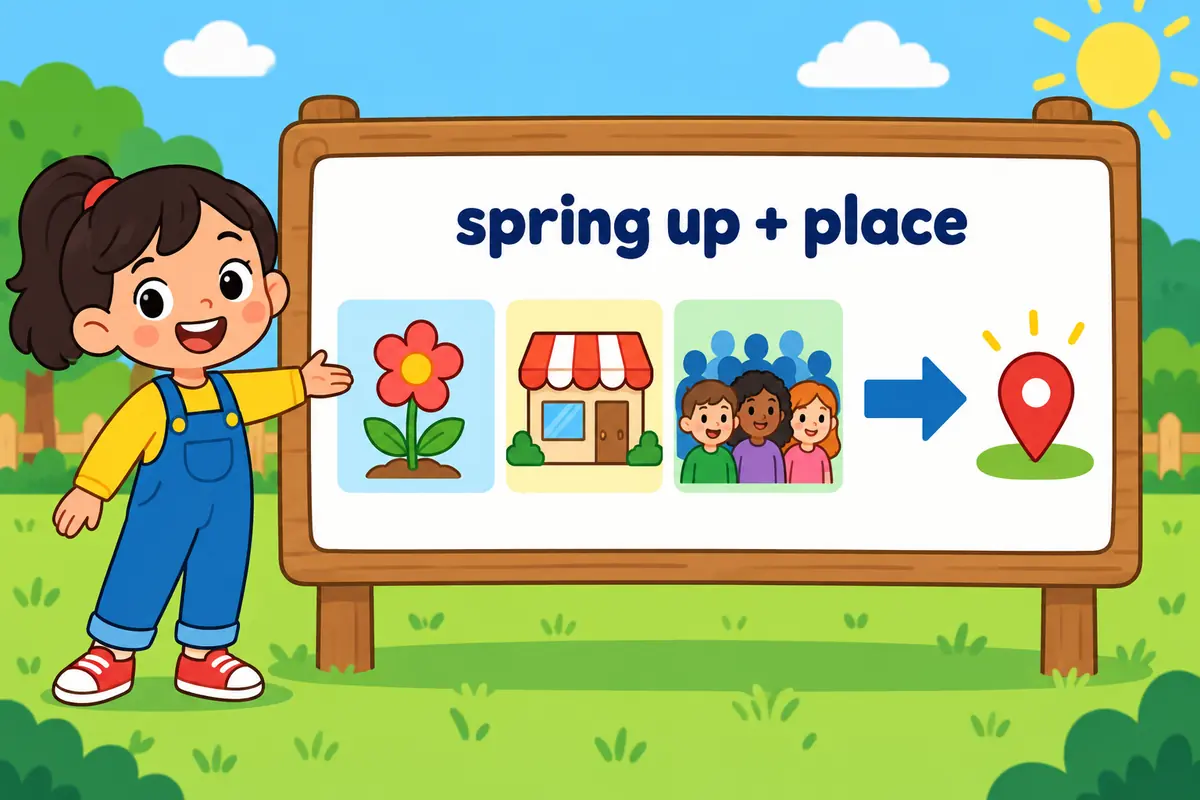
Spring up means to appear, grow or begin quickly and unexpectedly. To use spring up in a sentence, describe the place or time it happens, as in “New cafes spring up along the river every summer.” The verb is intransitive, so it never takes a direct object.
Spring up at a glance
- Spring up is an intransitive phrasal verb; its forms are springs up, sprang up, sprung up and springing up.
- The dominant pattern is subject + spring up + place or time phrase.
- Typical subjects are things that appear in numbers: shops, houses, weeds, camps, ideas or doubts.
- The particle stays with the verb, so up can never be separated from spring.
- Spring up is neutral in register and appears in news, business and everyday writing.
- The commonest error is forcing a direct object after the verb, as in spring up a shop.
What does spring up mean?
Spring up is a phrasal verb meaning to appear, grow or begin suddenly, usually in numbers or with little warning. The Cambridge entry for spring up treats the two words as one unit, and that unit is what a sentence moves around. The verb covers four related situations, kept apart in the table below.
| Sense | Plain meaning | Example sentence |
|---|---|---|
| Plants appear | Vegetation grows quickly from the ground | Tiny shoots sprang up after the rain. |
| Places appear | Buildings or businesses open quickly | New phone shops spring up on every corner. |
| Problems appear | Difficulties or feelings begin suddenly | Doubts sprang up during the meeting. |
| Crowds form | People gather quickly in one place | A crowd sprang up around the busker. |
Spring up is the wrong choice when something appears slowly or one at a time. A single shop that opens after two years of planning does not spring up; it opens. The verb also carries a sense of number, so it rarely describes one object on its own, and it says nothing about how long the thing lasts.
The register shifts with the degree of surprise. Where a thing simply becomes visible without suddenness, emerge quietly is the calmer verb, and a problem that builds over time will arise later rather than spring up.
How do you use spring up in a sentence?
Spring up is intransitive, which decides its whole grammar: no direct object ever follows it, and the particle up cannot be pulled away from the verb. The subject is the thing that appears, and the sentence usually adds a place or a time.
| Pattern | Example | What it signals |
|---|---|---|
| subject + spring up + place | Wild flowers sprang up along the fence. | sudden local appearance |
| subject + spring up + overnight / quickly | Fake reviews spring up overnight. | speed and ease of appearing |
| new + plural noun + spring up | New bakeries spring up across the city. | multiplication in number |
| subject + spring up + around / behind + noun | Protests sprang up around the new law. | forming in response to an event |
| subject + has / have + sprung up | A whole suburb has sprung up since 2005. | a present result of past growth |
Because there is no object, nothing can sit between spring and up: spring a shop up is not English. Compare that with a separable verb such as add the figures up, where the object may go in the middle.
Spring up in a sentence: examples across contexts
| Context | Example sentence | Why this works |
|---|---|---|
| Classroom | Sunflowers sprang up in the school garden after the spring rain. | a plant subject with a clear place phrase |
| Workplace email | Please flag any duplicate orders that spring up during the sale. | neutral wording for problems in a polite register |
| News report | Tented camps have sprung up along the border since the floods. | the present perfect records a visible result |
| Science writing | Seedlings spring up wherever the soil is left undisturbed. | a general truth with a place clause |
| Everyday conversation | We were talking, and then this whole plan just sprang up. | the verb marks an idea appearing quickly |
| Business report | Pop-up stalls spring up around the stadium on match days. | a repeated habit shown by the simple present |
| Travel writing | Small guesthouses have sprung up beside the old harbour. | describes development a reader can picture |
| Gardening | Weeds spring up faster than anything you plant on purpose. | the comparative adds a wry, natural tone |
| Academic writing | Similar objections sprang up in three separate reviews. | reports a repeated pattern without blame |
Spring up vs sprout
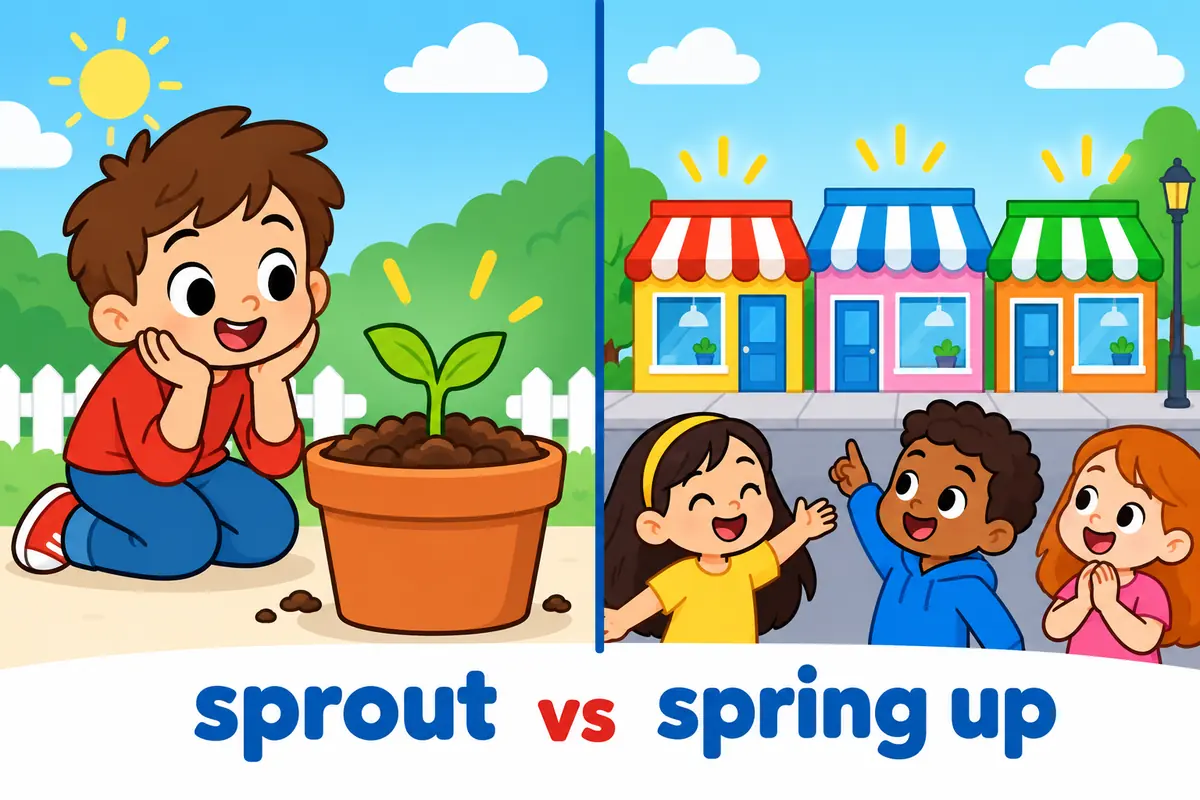
Both words describe something starting to grow, but they answer different questions. Sprout is about a seed or plant breaking the surface; spring up is about many things appearing suddenly, plants included. The two rarely swap without shifting the picture.
| Attribute | spring up | sprout |
|---|---|---|
| Meaning | appear suddenly, often in numbers | put out shoots from a seed |
| Typical subject | shops, weeds, camps, doubts | beans, grass, a single shoot |
| Number | usually many at once | usually one plant or shoot |
| Speed | sudden, often overnight | gradual, tied to real growth |
| Register | general writing and speech | gardening and biology |
| What it implies | quick appearance with no visible cause | natural growth from a source |
Choose sprout for a single plant pushing out of the soil, and spring up for a crowd of things appearing at once.
Word forms and grammar of spring up
| Form | Part of speech | Example |
|---|---|---|
| spring up | base phrasal verb | Cafes spring up near the station. |
| springs up | third person singular | A fresh rumour springs up every week. |
| sprang up | simple past | A fence of tents sprang up overnight. |
| sprung up | past participle | Several clinics have sprung up since the quake. |
| springing up | present participle | Businesses are springing up along the coast. |
| springtime | noun on the same root | The park fills with colour in springtime. |
Common mistakes with spring up
Incorrect: The town sprang up a new library.
Correct: A new library sprang up in the town.
The rule: spring up is intransitive, so the thing that appears is the subject, never the object.
Incorrect: The project sprang up it last year.
Correct: The project sprang up last year.
The rule: no object pronoun can follow, because the verb is already complete.
Incorrect: They sprang up a tent in the garden.
Correct: They put up a tent in the garden.
The rule: for one deliberate act, use put up; spring up is for sudden, unplanned appearance.
Incorrect: New houses have spring up in the field.
Correct: New houses have sprung up in the field.
The rule: after have or has, the past participle is sprung, not spring.
Incorrect: The idea sprang up slowly over many months.
Correct: The idea grew over many months.
The rule: spring up means sudden, so a slow process needs a different verb.
Practice using spring up
- Fill the blank: After the rain, mushrooms ______ across the lawn.
- Fill the blank: A whole market has ______ up beside the station since 2019.
- Choose the better word: A single bean (sprouted / sprang up) in the cup on the windowsill.
- Correct the error: The city sprang up a new district last year.
- Build a sentence: use spring up with a place phrase about shops appearing along a beach.
- Spot the register: which sentence belongs in a news report? (a) Loads of cafes spring up there. (b) Cafes have sprung up throughout the district.
Answers
- sprang up — the past tense matches the past time phrase after the rain.
- sprung up — the present perfect after has uses the participle sprung.
- sprouted — one plant breaking the soil is the work of sprout.
- A new district sprang up in the city. — the appearing thing is the subject, and intransitive verbs take no object.
- Small surf shops have sprung up along the beach. — the subject appears in numbers and a place follows.
- (b) — the full form and present perfect suit a published report, while loads of belongs to speech.
The bottom line
To use spring up in a sentence, make the thing that appears the subject and add a place or a time, as in cafes spring up near the station. The verb is intransitive, so it never takes an object, and the particle always stays attached. Reserve it for sudden, often numerous appearances; for one plant pushing through soil, sprout is the sharper choice.
Frequently asked questions about spring up
Is spring up a separable phrasal verb?
No. Because spring up is intransitive, there is no object to place between the two words, so the verb and the particle always stay together. You write that shops spring up, never that someone springs shops up, and the same rule holds in every tense.
What is the past tense of spring up?
The simple past is sprang up and the past participle is sprung up, as in the shops sprang up last year and the shops have sprung up since. Both keep the particle up attached to the verb, and neither changes the intransitive grammar.
What kinds of subjects does spring up take?
Subjects are usually things that appear in numbers or without warning: plants, weeds, buildings, shops, camps, rumours, doubts and crowds. A single planned object rarely springs up. Something built on purpose after long planning is normally opened, built or installed instead.
Is spring up formal or informal?
Spring up is neutral. It fits news reports, business writing and ordinary conversation, so it is neither slang nor strictly formal. The only real restriction is meaning: the appearance has to be quick and often numerous, which is what keeps the phrasal verb precise.
Have you ever heard someone use the phrase “spring up” in conversation and wondered what it meant? “Spring up” is an idiomatic expression that typically refers to something suddenly appearing or coming into existence.
This phrase is often used to describe something that grows or emerges rapidly and unexpectedly, like a new idea springing up in a brainstorming session, or a fresh batch of flowers springing up in a garden.
7 Examples Of Spring Up Used In a Sentence For Kids
- Flowers spring up in the garden during spring.
- The tree branches spring up towards the sky.
- The puppy likes to spring up and play with the ball.
- Birds spring up into the air to fly.
- Jack likes to spring up from his seat when he’s excited.
- The colorful balloons spring up when they are filled with air.
- The grass spring up after the rain.
14 Sentences with Spring Up Examples
- Spring up early to catch the first bus to college and avoid being late for your lectures.
- Make sure to spring up when your alarm goes off so you have enough time to get ready for your morning classes.
- As exams approach, study groups tend to spring up all over campus to help students prepare together.
- Opportunities for internships and job placements can spring up when you least expect it, so always be on the lookout.
- Don’t be surprised if new clubs and organizations spring up on campus – it’s a great way to get involved and meet new people.
- With the arrival of spring, events and festivals will start to spring up all around the college campus.
- It’s important to spring up and check your emails regularly for any important updates or announcements from your professors.
- Group projects can often spring up towards the middle of the semester, so make sure you are prepared to work collaboratively with your classmates.
- Campus events and workshops may spring up from time to time, offering students valuable learning experiences outside the classroom.
- Keep an eye out for career fairs that may spring up on campus, giving you the chance to network with potential employers.
- Unexpected social gatherings can spring up on weekends, providing a nice break from your academic routine.
- Take advantage of any study groups that spring up in your classes – working with peers can help reinforce your understanding of the material.
- Be ready to spring up and register for courses as soon as the registration portal opens to secure a spot in your preferred classes.
- Sporting events and tournaments can spring up throughout the year, giving you the opportunity to support your college teams and show some school spirit.
How To Use Spring Up in Sentences?
Spring Up is a verb that signifies the action of quickly or suddenly moving upwards or becoming higher from a lower position. When using Spring Up in a sentence, make sure to place the phrase after the subject of the sentence and before the object. For example:
- “The cat sprang up onto the table when it heard a noise.”
- “The flowers spring up in the garden every spring.”
- “I watched the basketball player spring up to make a dunk.”
Remember that Spring Up can also be used figuratively to describe sudden growth, increase, or improvement. Here are some examples:
- “The tech industry sprung up quickly in the last decade.”
- “The new shopping mall sprang up in the center of town within a few months.”
When using Spring Up in a sentence, ensure that the subject is the one performing the action. The tense of the verb should also match the subject and the context of the sentence. By following these guidelines, you can effectively incorporate Spring Up into your writing to convey upward movement or sudden growth in a clear and concise manner.
Conclusion
In conclusion, “spring up” refers to something appearing quickly or unexpectedly, often in large numbers or quantities. Examples of this include new businesses springing up in the city or flowers springing up in the garden. This phrase highlights the sudden and vigorous emergence of something, emphasizing its rapid growth or occurrence.
Whether it’s opportunities, new ideas, or developments, the phrase “spring up” conveys a sense of freshness, vitality, and dynamism. It captures the notion of things appearing swiftly and energetically, adding a sense of spontaneity and excitement to the description. Overall, “spring up” effectively conveys the idea of things coming into being swiftly and abundantly.


