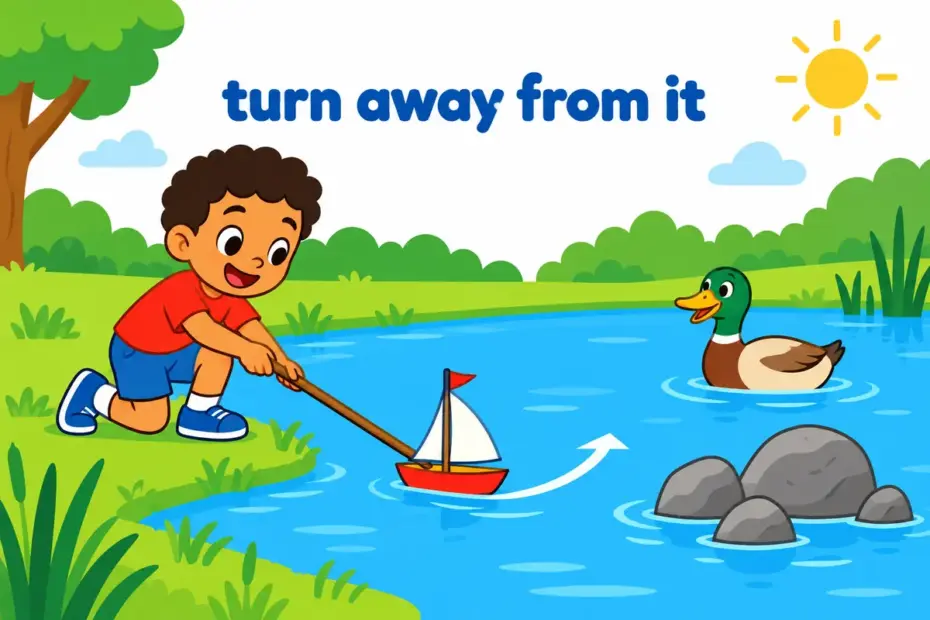
Steer away is a phrasal verb meaning to turn or guide something away from a person, place or risk. To use steer away in a sentence, name what moves, then add away from and the thing avoided: “she steered the car away from the kerb”. The verb has a literal driving sense and a figurative one about choices.
Steer away at a glance
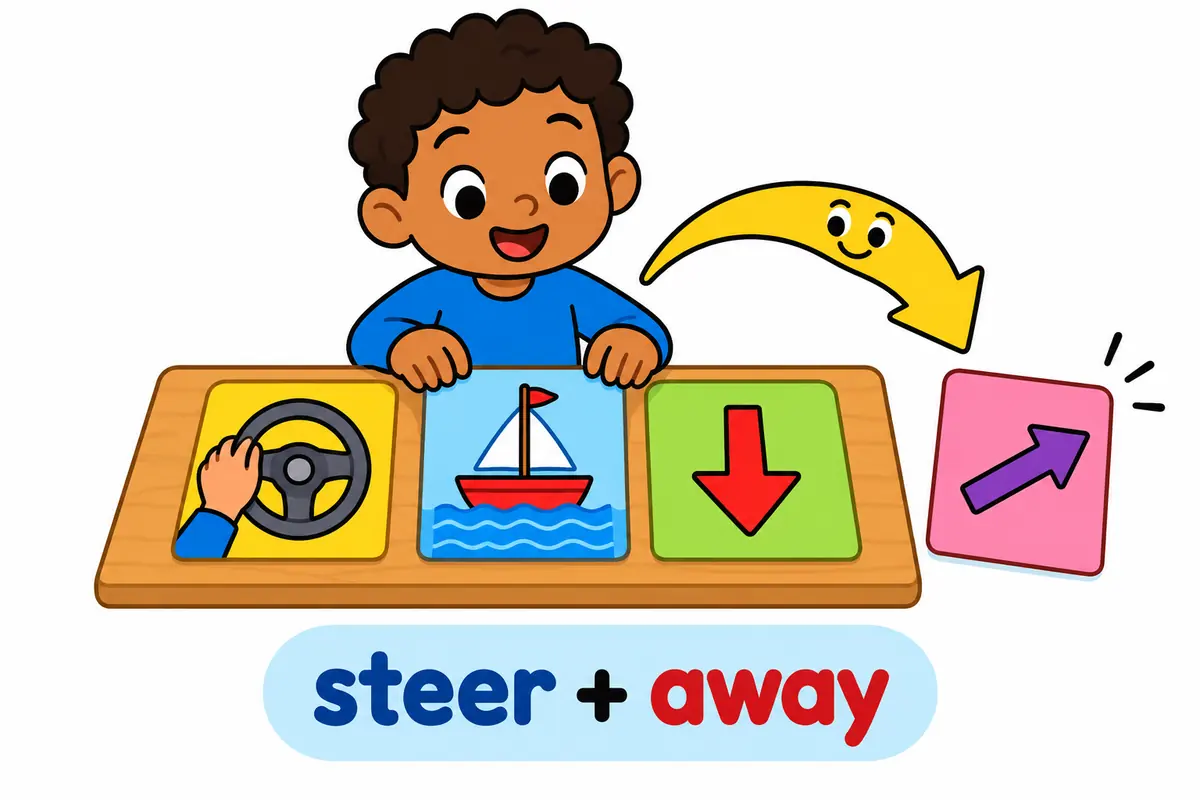
- Steer away is a phrasal verb built from steer plus the particle away, usually followed by from.
- Its forms are steers away, steered away and steering away.
- The verb is separable when an object appears, because the object sits between steer and away.
- From introduces what is avoided and may be left at the end of the clause.
- The register is neutral to slightly formal, common in advice, reporting and safety writing.
- The commonest error is dropping from before the thing avoided.
What does steer away mean?
Steer away is a phrasal verb meaning to turn or guide something away from a route, danger or choice. The Cambridge entry for steer away records the physical sense of turning aside and the figurative sense of avoiding something. The distinction is worth holding on to: a bicycle can be steered away from a pothole by hand, while a teenager is steered away from a bad decision by advice.
| Sense | Plain meaning | Example sentence |
|---|---|---|
| Turn aside physically | Move a vehicle or body away from something | She steered the bike away from the pothole. |
| Avoid or discourage | Guide someone away from a choice | His mentor steered him away from the loan. |
| Redirect attention | Turn a discussion away from a subject | The chair steered the debate away from blame. |
One limitation is worth stating plainly. Steer away is not simply avoid, and it is not the same as forbid. It describes active guidance away from something, so a person who steers you away from a scheme is advising, not commanding. Where no guidance is involved, avoid is the plainer and more direct verb, and a crisis stopped outright is averted rather than steered away from.
How do you use steer away in a sentence?
Steer away is separable because an object can sit between steer and away, as in steer the boat away. When no object appears, from still introduces what is avoided, and that preposition may be stranded at the end of the clause. The verb is intransitive with from and transitive when an object comes first.
| Pattern | Example | What it signals |
|---|---|---|
| steer + object + away (from) | She steered the cart away from the puddle. | The object separates the verb and particle. |
| steer away from + noun | He steered away from the subject. | Intransitive; from names what is avoided. |
| steer + object + away from + noun | Mentors steer students away from poor choices. | Both an object and a from-phrase appear. |
| steer away + adverb | The driver steered away sharply. | The particle can end the clause. |
| be steered away from | New buyers are steered away from hidden fees. | Passive voice, common in consumer writing. |
Two grammar notes decide most sentences. The particle away never floats to the front, and from can be left behind when the avoided thing is obvious, as in the risk she steered away from.
Steer away in a sentence: examples across contexts
Steer away travels easily from traffic to office talk, and the ten sentences below keep the particle and the from-phrase in their natural places. Each row also shows who or what does the steering.
| Context | Example sentence | Why this works |
|---|---|---|
| Classroom | The teacher steered the argument away from blame and back to the science. | Names the subject dropped and the subject restored. |
| Driving | He steered the van away from the fallen branch just in time. | The object separates steer and away, a native pattern. |
| Workplace email | Please steer the team away from shortcuts that skip testing. | A polite request with a from-phrase naming the risk. |
| News report | Officials steered the inquiry away from the minister’s office. | Reports guidance without claiming a command. |
| Conversation | I steered away from the topic everyone feared. | Intransitive use with from left in place. |
| Finance writing | Advisers steer savers away from products they do not understand. | The from-phrase carries the avoided item. |
| Parenting | We steered our son away from the gang at the park corner. | Shows gentle guidance rather than a ban. |
| Sports report | The full-back swerved and steered the ball away from his own net. | Pairs physical movement with the particle away. |
| Medical advice | Doctors steer patients away from unproven remedies. | Uses the verb in a professional register. |
| Marketing | The design steers the eye away from the clutter. | Extends the verb to attention rather than travel. |
Notice that only the driving and sports rows describe something physical. The same grammar carries an abstract warning in every other row, which is what makes the phrasal verb so useful. A speaker who deflects a question names the question itself, while steer away names the thing being avoided.
Steer away vs avoid
Steer away and avoid overlap in meaning, but only one of them implies guidance. Steer away turns something aside; avoid keeps away from it in the first place.
| Attribute | steer away | avoid |
|---|---|---|
| Meaning | Guide or turn something aside | Keep away from something |
| Implies guidance | Yes, usually by a person | No |
| Grammar | Phrasal verb, often with from | Single transitive verb |
| Typical object | A vehicle, person or topic | A risk, expense or person |
| Register | Neutral to slightly formal | Neutral |
| Example | She steered the deal away from collapse. | She avoided a costly mistake. |
Verdict: choose steer away when someone actively guides the outcome, and avoid when the subject simply keeps clear of the danger without steering anything. A driver who swerves clears a single obstacle in a second, while a mentor who steers a student away from a loan changes an entire decision over months.
Word forms and grammar of steer away
Steer away inflects through steer, and the phrase steer clear of is a close relative that learners often mix with it. The table also lists a phrasal verb built on the same particle.
| Form | Part of speech | Example |
|---|---|---|
| steer away | phrasal verb, base | Good coaches steer away from panic. |
| steers away | phrasal verb, third person singular | He steers away from gossip at work. |
| steered away | phrasal verb, past and participle | The captain steered the ship away from the reef. |
| steering away | phrasal verb, present participle | She is steering the project away from delay. |
| steer clear of | idiomatic phrase | Steer clear of that contract. |
| call away | phrasal verb, same particle | Duty called him away. |
Keep steer clear of apart from steer away: the first forbids contact with something, while the second describes active guidance away from it.
Common mistakes with steer away
- Incorrect:
She steered away the pothole.Correct: She steered away from the pothole. Rule: The from-phrase names what is avoided, so from cannot be dropped before a noun. - Incorrect:
He steered the company from trouble away.Correct: He steered the company away from trouble. Rule: The order is steer, object, away, then from, not from before away. - Incorrect:
The teacher steered away the students.Correct: The teacher steered the students away from the fight. Rule: With an object, away follows the object and the from-phrase stays. - Incorrect:
We steered the meeting away of the budget.Correct: We steered the meeting away from the budget. Rule: Steer away selects from, never of. - Incorrect:
Away he steered from the truth.Correct: He steered away from the truth. Rule: The particle away does not move to the front of the clause.
Practice using steer away
Work through the seven items, then read the reasoning rather than only the answer.
- Fill the gap: The guide ______ the hikers from the flooded path.
- Choose the better word: The new signs (steer away / avoid) drivers from the closed lane.
- Correct the error: He steered away the dangerous topic at dinner.
- Build a sentence: use steer away from about a manager who keeps a team off risky promises.
- Rewrite with the object between: She steered away from the cyclist. Move the object into its natural place.
- Spot the register: which belongs in a safety notice, drivers should steer away from the ice, or drivers should, like, steer away from the ice?
- Change the voice: The crowd was steered away from the barrier. Make it active with officials as the subject.
Answers
- steered — the past tense matches the sentence and from follows the particle.
- steer away — the signs actively guide drivers, which avoid alone does not convey.
- He steered away from the dangerous topic at dinner — from must introduce the avoided subject.
- Model answer: The manager steered the team away from promises it could not keep.
- The object is the cyclist: She steered the bike away from the cyclist, with away after the object and from before the noun.
- Drivers should steer away from the ice — a safety notice keeps a plain, formal tone.
- Officials steered the crowd away from the barrier — the active version names who did the guiding.
The bottom line
Use steer away in a sentence when someone or something turns aside from a route, risk or topic, and keep away before from. Two details decide most sentences: an object sits between steer and away, and from introduces what is being avoided. Where no active guidance is meant, avoid is the simpler verb with the same core idea.
Frequently asked questions about steer away
Is steer away one word or two?
Steer away is written as two words and works as a single phrasal verb. It is never hyphenated in verb use, so the correct form is she steered away from the crowd. A noun built from it, such as a steer-away, is rare and not standard in formal writing.
What preposition follows steer away?
Steer away almost always takes from, as in steer away from the edge. The preposition introduces the person, place or risk being avoided. Other prepositions are errors: steer away of and steer away to do not occur in standard English, and the from cannot simply disappear.
Can steer away take an object?
Yes, and the object sits between steer and away. You would write she steered the kayak away from the weir, not she steered away the kayak. When no object appears the verb is intransitive, as in he steered away from the question, which is equally correct.
Is steer away formal enough for reports?
Steer away suits neutral and slightly formal writing, including news, safety notices and advice columns. A tribunal judgment might prefer directed X away from, because it sounds more neutral. In conversation the verb is common and needs no adjustment, so register is rarely a problem.