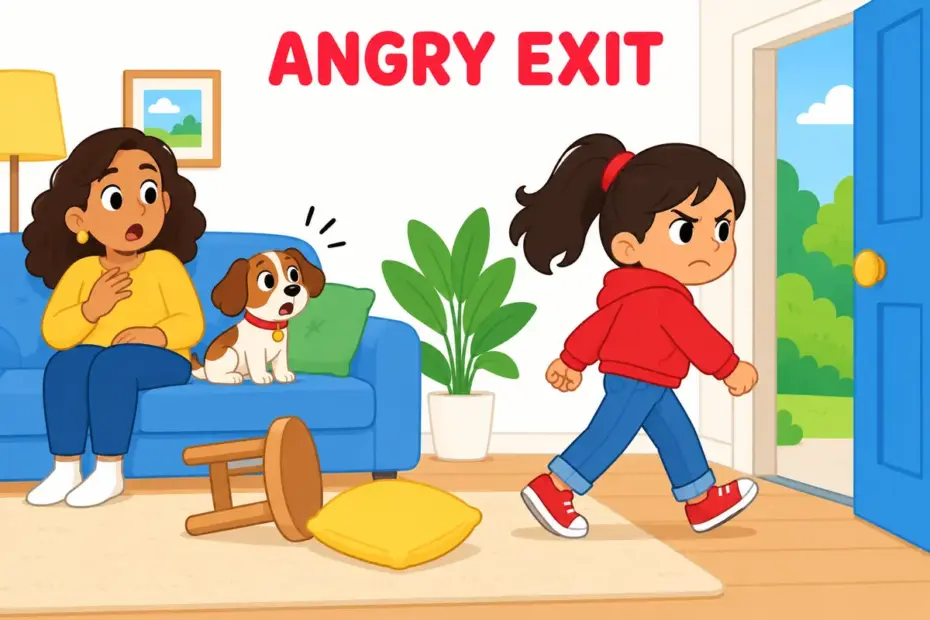
Storm off means to leave a place suddenly and in visible anger, usually so that other people notice. To use storm off in a sentence, put the person as the subject and add a destination: “She stormed off to her room.” The phrasal verb is intransitive, so it never takes a direct object.
Storm off at a glance
- Storm off is an intransitive phrasal verb meaning to leave a place in visible anger.
- Its forms are storm off, storms off, stormed off and storming off.
- The particle off is fixed, so an object can never sit between storm and off.
- A destination usually follows as a prepositional phrase: stormed off to her room.
- The subject is a person or an animal, never a thing.
- The commonest mistake is adding a direct object, as in stormed off the room.
What does storm off mean?
Storm off is an intransitive phrasal verb meaning to leave a place abruptly and in visible anger. The departure is emotional and usually has an audience, which separates it from the neutral verb leave. The Cambridge entry for storm off records the angry-exit sense. A neutral report simply says the witness departed, which is why storm off is the vivid choice.
| Sense | Plain meaning | Example sentence |
|---|---|---|
| Leave in anger | Walk out because something has annoyed you | Maya stormed off when the referee ignored her. |
| Leave a stage or pitch | Exit a performance or match abruptly | The singer stormed off midway through the second song. |
| End a discussion by walking out | Refuse to continue by leaving the room | He stormed off before the vote was taken. |
| Quit a role in a display | Resign visibly after a dispute | The coach stormed off after the final defeat. |
One limitation is worth stating plainly. Storm off does not mean to disappear or to go away quietly: the person wants the exit noticed, so a sentence that hides the anger needs leave instead.
How do you use storm off in a sentence?
Storm off is intransitive, so the sentence ends either at the verb or at a prepositional phrase that names a destination. The particle off stays fixed to storm, and a destination is added with to. Where the exit is from a room or a meeting rather than to a place, English often prefers storm out, which does take of.
| Pattern | Example | What it signals |
|---|---|---|
| subject + storm off | Ravi stormed off. | The bare verb already reports the anger; nothing follows it. |
| storm off + to + place | She stormed off to the staff room. | A destination shows the exit is deliberate. |
| storm off + in + mood noun | He stormed off in silence. | Names the mood the departure displays. |
| storm off + from + place | The players stormed off from training. | Marks what was abandoned. |
| storm off + mid- + event | She stormed off mid-meeting. | Shows the exit interrupts something in progress. |
| storm off + without + noun | He stormed off without a word. | A without-phrase stresses the abrupt silence. |

Storm off in a sentence: examples across contexts
Storm off changes register more than it changes meaning. The twelve sentences below keep the same verb while moving from a classroom to a match report, and each one shows the exit and its cause. Someone who storms off may still be seething with anger afterwards, which the verb alone does not report.
| Context | Example sentence | Why this works |
|---|---|---|
| Classroom | The bell rang early, and the whole class stormed off before the experiment. | A group subject is natural for storm off. |
| Workplace email | Priya stormed off after the review, so we moved her items to Thursday. | Reports the exit plainly without describing the emotion. |
| News report | The minister stormed off when reporters asked about the missing files. | Pairs the exit with the action that caused it. |
| Sports report | The striker stormed off after the manager withdrew him. | Common in football writing for a visible angry exit. |
| Theatre review | The lead actor stormed off during the curtain call. | Uses the stage sense, where the audience sees the exit. |
| Conversation | He stormed off the moment I mentioned the bill. | A time clause mid-sentence is typical of speech. |
| Parent at home | My brother stormed off to his room and slammed the door. | A destination plus a sound shows the mood. |
| Narrative prose | She stormed off into the rain, leaving her coat on the chair. | An into-phrase gives the exit a direction and an image. |
| Customer service | The buyer stormed off before the manager could explain. | The before-clause underlines the interruption. |
| Social media | Fans stormed off from the stadium after the final whistle. | A from-phrase names the place being abandoned. |
| Academic writing | Two delegates stormed off from the session, and the vote was postponed. | Keeps the formal register while reporting the walkout. |
| Diary entry | We stormed off to the park to cool down. | The first-person plural suits informal reflection. |
The person always storms off alone, so no object follows. In sport, walk off the pitch is the calmer alternative and reports no anger at all.
Storm off vs storm out
Storm off and storm out share the base verb and both mean an angry exit, but the particle decides the geometry of the sentence. The one-word synonym flounce out of a room adds a hint of theatrical drama that storm off keeps only in the stage sense.
| Attribute | storm off | storm out |
|---|---|---|
| Core move | Leave for somewhere else | Leave a room or a meeting |
| Direction needed | Usually a to-phrase | Usually an of-phrase |
| What the reader sees | A person heading away | A person crossing a threshold |
| Focus | The angry departure itself | The group or room left behind |
| Common pairing | stormed off to bed | stormed out of the meeting |
| Register | Neutral narrative and speech | Neutral, slightly more dramatic |
Verdict: choose storm off when the person heads away to some place, and storm out when the person leaves a room, a meeting or a group behind.
Word forms and grammar of storm off
Storm off keeps off fixed, and because it is intransitive it has no passive form. The table lists the forms and the one pattern learners invent.
| Form | Part of speech | Example |
|---|---|---|
| storm off | phrasal verb, base | Do not storm off before the vote. |
| storms off | present, third person | He storms off whenever he loses. |
| stormed off | past and past participle | She stormed off before the meeting ended. |
| storming off | present participle | Storming off only made the argument worse. |
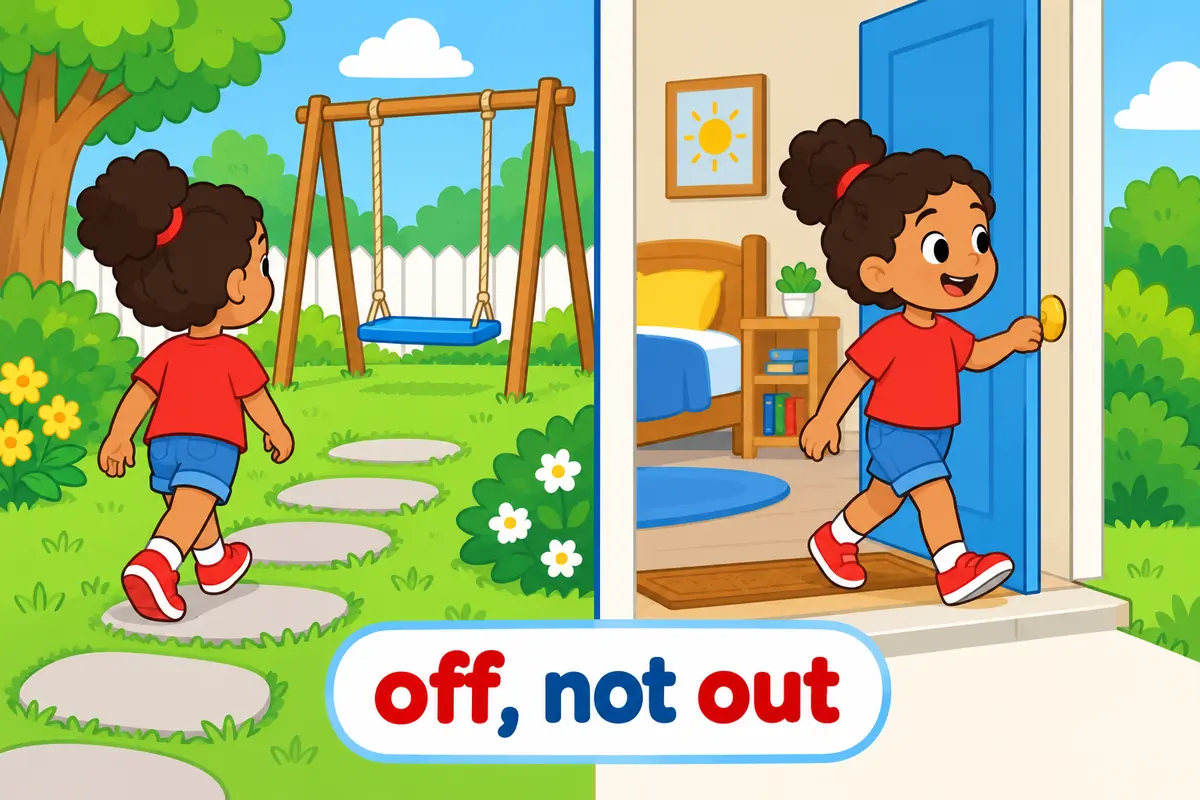
| storm off + a noun | non-standard | Say stormed out of the room. |
| be stormed off | non-standard passive | An intransitive verb has no passive; keep the person as subject. |
The same particle turns up in back off from a confrontation, which means retreat rather than leave in anger, so the two are not interchangeable.
Common mistakes with storm off
- Incorrect:
She stormed off the room.Correct: She stormed out of the room. Rule: Storm off takes no object; when a room is left, use storm out of. - Incorrect:
He stormed the meeting off.Correct: He stormed off from the meeting. Rule: Off is a fixed particle, so it never separates from storm. - Incorrect:
The email stormed off to the folder.Correct: Priya stormed off with the letter. Rule: Only people and animals storm off; a thing cannot show anger. - Incorrect:
They stormed off to home.Correct: They stormed off home. Rule: Home is an adverb here, so it takes no to. - Incorrect:
He was stormed off by the decision.Correct: He stormed off because of the decision. Rule: An intransitive verb has no passive, so the person stays the subject. - Incorrect:
She stormed off angrily.Correct: She stormed off. Rule: The anger is already inside the verb, so angrily sounds redundant.
Practice using storm off
Work through the eight items, then read the answers for the reasoning rather than only the key.
- Fill the gap: The goalkeeper ______ off after the final whistle.
- Choose the better word: Furious at the decision, the captain (stormed off / strolled off) to the changing room.
- Correct the error: The players stormed off the pitch.
- Build a sentence: use storm off with a to-phrase about a child leaving a party early.
- Spot the register: which belongs in a news report — the striker stormed off after the red card, or the striker totally stormed off?
- Rewrite with out: She stormed off from the room.
- Fill the gap: Tempers rose and two delegates ______ off mid-sentence.
- Choose the better word: The runners had to (storm off / set off) at dawn to beat the heat.
Answers
- stormed — the goalkeeper leaves alone, so no object follows the verb.
- stormed off — the captain is angry and heads to a place; strolled off removes the anger.
- The players stormed off — a pitch is not named by an object, so drop the noun or switch to stormed out of the pitch.
- Model answer: Mia stormed off to the garden when the magician started.
- The striker stormed off after the red card — a report avoids totally and keeps the tone formal.
- She stormed out of the room — storm out of names the room being left.
- stormed — the delegates leave angrily, and mid-sentence names the interruption.
- set off — setting off is neutral departure, so storm off would add anger that the sentence lacks.
The bottom line
Use storm off in a sentence when somebody leaves a place abruptly and wants the exit to be noticed. Two details decide most sentences: the verb is intransitive, so no object ever follows it, and a destination is usually added with to, as in stormed off to her room. Where the exit is from a room or a meeting, storm out of is the more precise choice.
Frequently asked questions about storm off
Is storm off written as one word or two?
Storm off is written as two words and works as a phrasal verb. The base is the verb storm and off is a fixed particle. Hyphenated forms appear only as occasional informal nouns, so the verb is always they stormed off, never they storm-offed.
Can storm off take a direct object?
No. Storm off is intransitive, so the person storms off alone. To name the room or meeting being left, switch to storm out of, as in she stormed out of the room. Adding an object to storm off, as in stormed off the room, is the commonest error.
Does storm off always mean the person is angry?
Almost always, because the verb carries visible emotion by itself. The feeling can be frustration, offence or wounded pride, but it is never calm, so a relaxed exit needs leave or go instead. A sentence that adds an adverb such as calmly contradicts the verb.
Is storm off used in formal writing?
Storm off appears in news reports and match summaries, which count as standard writing, but it stays informal in tone. A tribunal report would write the witness left the hearing instead. In academic prose, name the action plainly and save storm off for speech or vivid narrative.