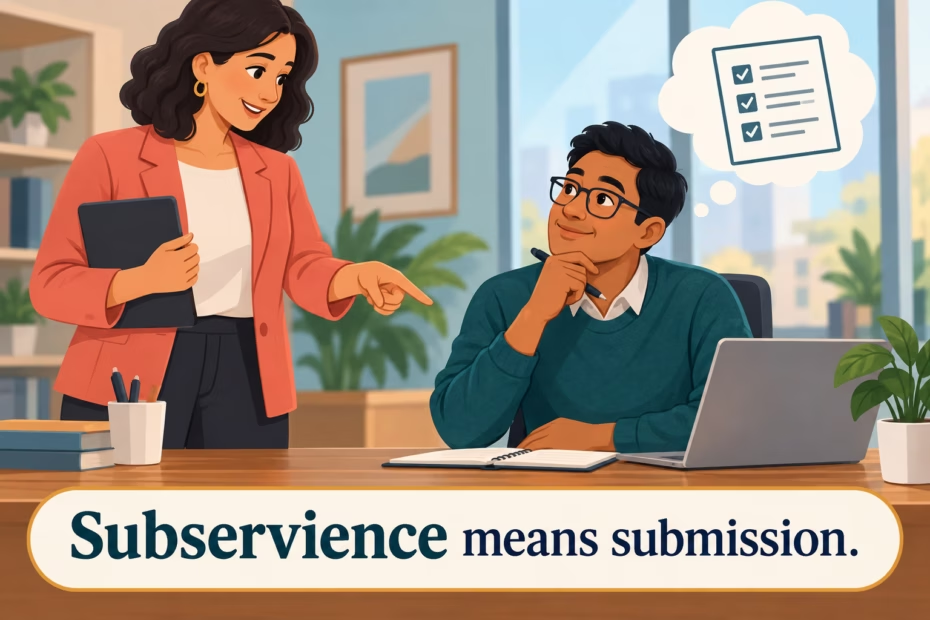
Have you ever wondered what it means to be in a state of subservience to someone or something? Subservience is the act of being submissive, obedient, or excessively compliant to an authority figure or a dominant force. It often involves a hierarchy where one party holds power over another, leading to a dynamic of control and dependency.
In instances of subservience, individuals may feel compelled to follow orders, fulfill demands, or conform to expectations out of fear, duty, or a perceived lack of autonomy. This can result in a loss of personal agency and freedom, as well as potential exploitation or manipulation by those in positions of authority.

What Does “Subservience” Mean?
Subservience is a noun for a willingness to do what another person wants or to treat one’s own wishes as less important. It does not require a formal authority relationship, and the word alone does not establish coercion, fear, exploitation, or a lasting loss of autonomy. Cambridge Dictionary describes the personal sense and the pattern “subservience to” a person, group, or influence. In a formal use, subservience can also mean that one thing is treated as secondary to another, as in “the subservience of design to function”; subservient is the related adjective (“design was subservient to function”). Cambridge Dictionary and Oxford Learner’s Dictionaries show these uses.
The word often has a critical or disapproving tone when it describes a person’s deference or a social relationship. It can suggest that someone’s choices or interests are being given too little weight. It does not simply mean politeness, teamwork, or following a reasonable rule.
How Do You Use “Subservience” in a Sentence?
Common patterns include subservience to someone or something and show or demand subservience. For example: “The council rejected subservience to a single donor’s priorities” names a relationship of undue deference, while “The workers showed subservience to management” identifies the relationship being described. Because subservience is an uncountable noun, it normally does not take a before it.
When writing your own sentence, make the relationship clear: who is yielding, whose wishes or authority take precedence, and whether the word is being used critically. A specific example is clearer than using subservience as a vague label for someone’s personality.
Is Subservience the Same as Respect, Obedience, or Cooperation?
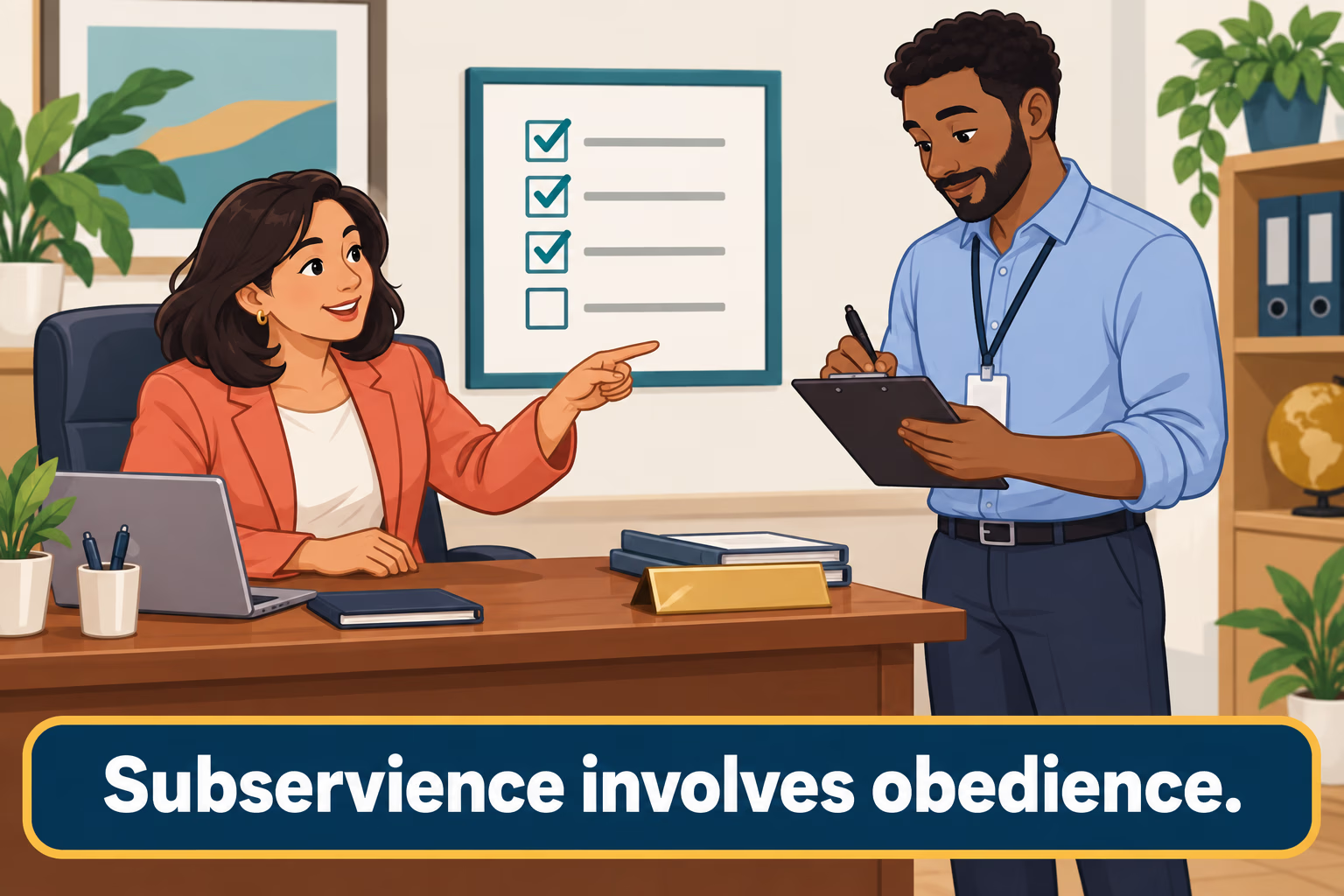
Obedience is doing what one is told, often in response to a direct command (APA Dictionary of Psychology). The terms overlap, but subservience more often suggests deference or putting another’s wishes first; following one reasonable instruction does not by itself show a broader pattern of subservience (Cambridge Dictionary).
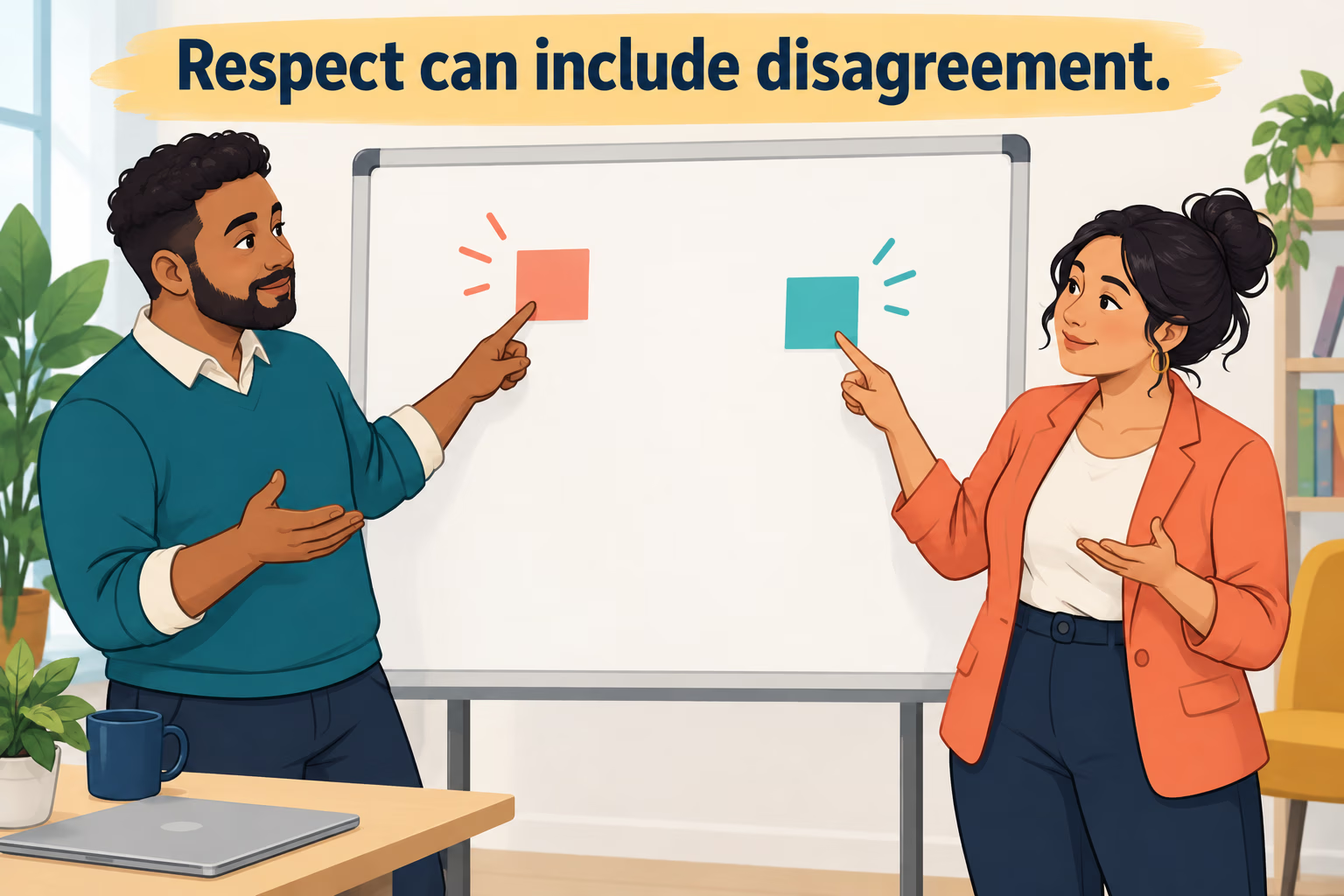
No. Respect means treating people with consideration; cooperation means working together toward a task. Either can include disagreement, questions, and personal choice. Subservience points to a more one-sided pattern in which one person’s wishes or authority are treated as more important than another’s. Context matters: complying with one fair instruction does not by itself prove that a person is generally subservient.
What Is the Difference Between “Subservience” and “Subordination”?
Subordination can name a lower position or lesser importance in a structure. Subservience more specifically emphasizes deference or putting another’s wishes first, and can sound disapproving when applied to a person. In “the details were subservient to the main goal,” the adjective means secondary to that goal; it is not describing a person’s obedience. Cambridge Dictionary: subordination defines the related rank and importance senses.
Quick Tips for Using “Subservience”
- Use subservience to to name the person, group, or influence receiving deference.
- Remember that subservience is a noun and subservient is an adjective.
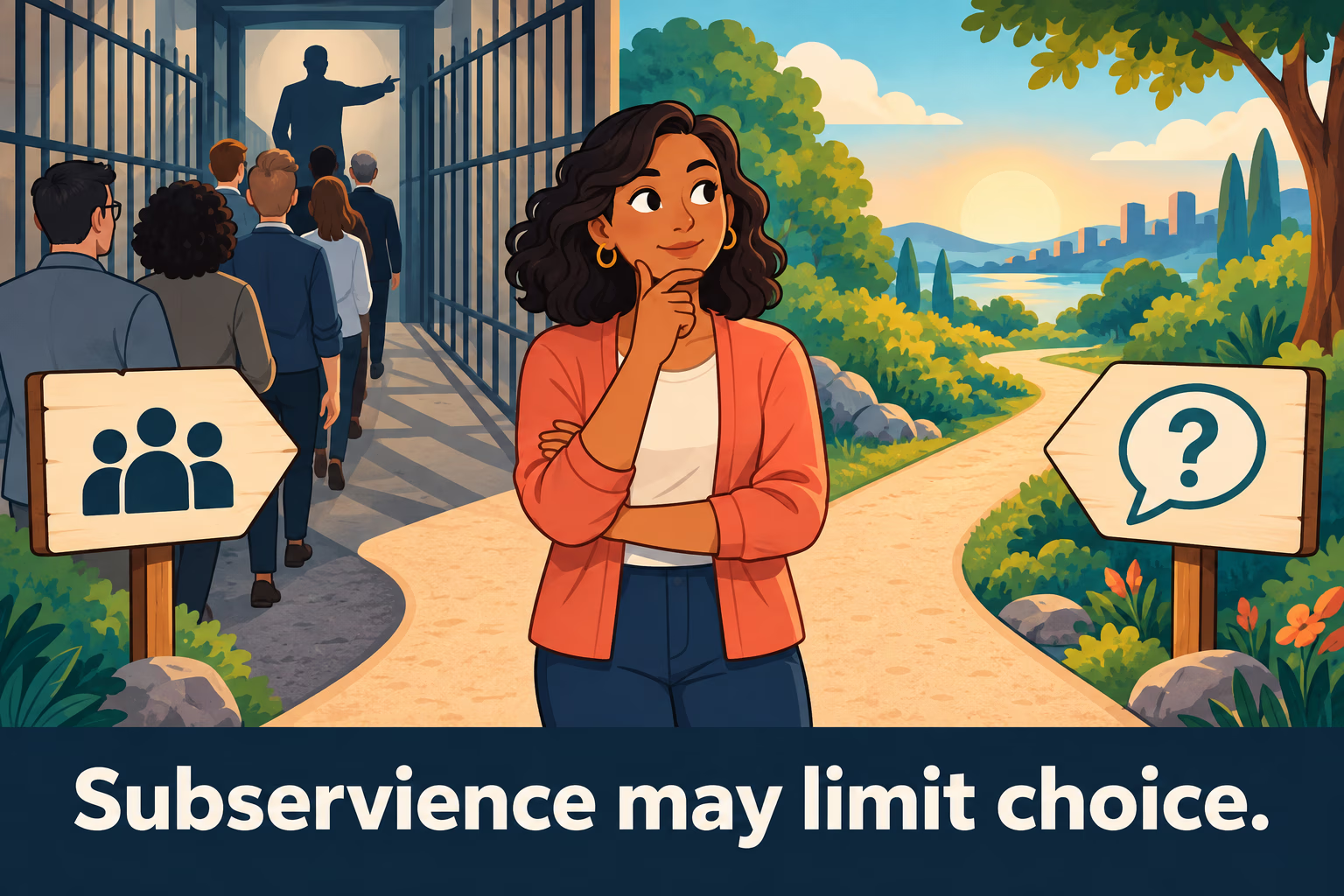
- Use the word carefully because it can imply an unequal relationship or an unfair loss of agency.
- Do not treat ordinary courtesy, collaboration, or reasonable compliance as proof of subservience.
- When subservient means “secondary to,” identify the purpose or priority it serves.
Note on the original examples below: They are preserved from the source article, but some use subservience for ordinary rule-following, kindness, or politeness, which can blur the distinctions above. Other examples make broad claims about Indian colleges or hostels without evidence; they should not be read as factual descriptions of those institutions. The sentences are usage material, not evidence that these behaviors are common or that every act of compliance is subservience.
7 Examples Of Subservience Used In a Sentence For Kids
- Subservience means always following the rules.
- We should treat everyone with kindness, not subservience.
- Parents should guide us, but we should not always act in subservience to them.
- It’s important to show respect, but we should never let anyone take advantage of our subservience.
- We should ask questions if we do not understand something, even if it means questioning subservience.
- We can show subservience by helping others and being polite.
- Remember, being kind is important, but always standing up for ourselves is also crucial when faced with subservience.
14 Sentences with Subservience Examples
- Subservience to senior classmen is a common practice in many college hostels in India.
- It is important for college students to avoid subservience to academic pressure and focus on a healthy work-life balance.
- Some students mistakenly equate respect with subservience to professors, but it is important to maintain a professional relationship.
- Group projects can sometimes lead to feelings of subservience among team members, but effective communication can help prevent this.
- The culture of subservience to authority figures in Indian colleges can sometimes hinder students from questioning outdated practices.
- It is crucial for college students to recognize the fine line between respect and subservience in their interactions with faculty members.
- Students should strive for a balance between cooperation and subservience in group discussions to ensure that all viewpoints are considered.
- The pressure to conform to societal norms can sometimes lead to a sense of subservience among college students, but it is important to stay true to oneself.
- In competitive environments, such as college admissions, it is common to see a certain level of subservience among students vying for top spots.
- Being assertive and standing up for their beliefs can help college students avoid falling into a pattern of subservience in various aspects of campus life.
- The traditions of hierarchy and subservience in college clubs and organizations can often deter new members from actively participating.
- Students should be wary of falling into a pattern of subservience to negative influences, such as peer pressure, during their college years.
- Recognizing when subservience is crossing the line into exploitation is an essential skill for college students navigating complex social dynamics.
- By fostering a culture of mutual respect and collaboration, colleges can help students break free from patterns of subservience that may be holding them back.
How To Use Subservience in Sentences?
Subservience means to act in a way that shows submission or obedience to someone else. When using this word in a sentence, it is important to consider the context in which it is being used.
Here is a helpful guide on how to use Subservience in a sentence for beginners:
-
Identify a situation where one person is following the orders or commands of another person without question. For example, “The servant showed great subservience to her master by always obeying his every command.”
-
When constructing your sentence, make sure that the word “subservience” is used in a way that clearly demonstrates the idea of submission or obedience. For instance, “The employee’s constant subservience to her boss’s demands eventually led to burnout.”
-
Remember that “subservience” is a noun, so it should be used to describe a quality or behavior of a person. An example could be, “The dictator demanded absolute subservience from his followers.”
By following these guidelines, you can effectively incorporate the word “subservience” into your writing or conversations in a way that accurately conveys its meaning.
Conclusion
In exploring sentences with the word “subservience,” it becomes clear that this term denotes a state of being subordinate or obedient to another. Through examples like “She displayed her unwavering subservience to her boss’s every whim” or “The leader demanded complete subservience from his followers,” it is evident that subservience implies a lack of autonomy or independence in a relationship.
These sentences highlight the power dynamics at play when subservience is present, underscoring a dynamic where one party holds authority and the other complies. The varying contexts in which subservience can manifest emphasize its role in shaping relationships and interactions, illustrating the significance of recognizing and addressing issues of dominance and submission in personal and professional settings.