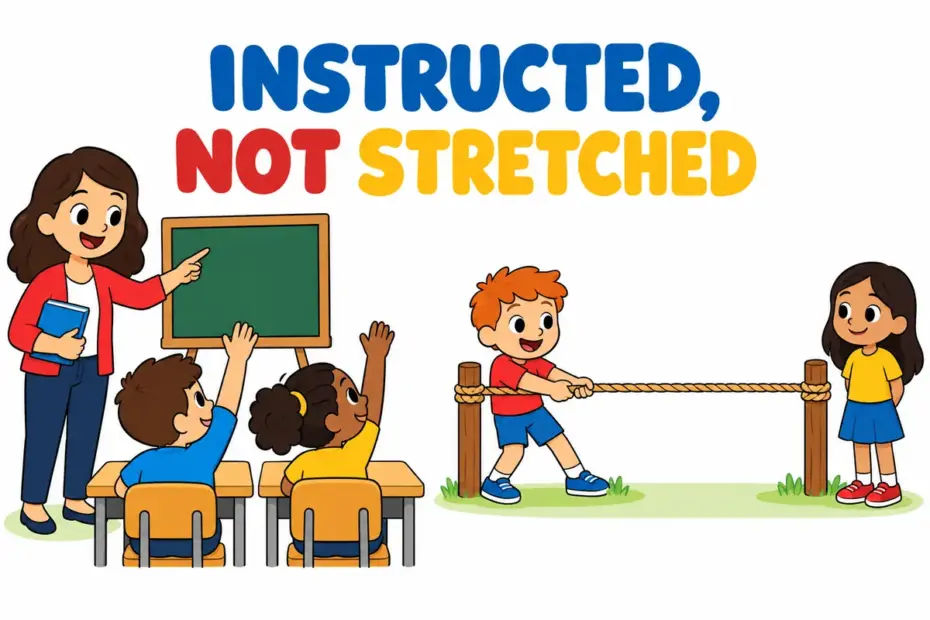
Taught vs taut is decided by meaning, not by sound: taught is the past tense of teach, while taut means stretched tight or tense. Write taught whenever you mean instruction, and taut whenever you mean tension or tightness. Because the two sound alike, proofread by replacing the word with gave instruction or pulled tight.
Taught vs taut at a glance
- Taught is the past tense and past participle of the verb teach.
- Taut is an adjective meaning stretched tight, tense or showing strain.
- Both are pronounced the same way, which is why the spellings are confused.
- Taught pairs with a person or subject; taut usually follows be or before a noun.
- The commonest error is writing taut for the past of teach, or taught for something pulled tight.
What do taught and taut mean?
Taught is the past tense and past participle of teach, so it reports instruction that already happened. Taut is an adjective meaning stretched or pulled tight, and by extension tense or strained. The Cambridge entry for taught lists it only as a form of teach, while the entry for taut gives the tight-and-tense sense, and that split is the whole comparison.
| Word | Part of speech | Plain meaning | Example sentence |
|---|---|---|---|
| taught | verb form | Past tense of teach; gave instruction | She taught the class how to read a map. |
| taught | verb form | Past participle of teach, used after have | He has taught the same course for years. |
| taut | adjective | Stretched or pulled tight | The rope went taut as the sail filled. |
| taut | adjective | Tense, strained or held under pressure | Her voice was taut with worry. |
One limitation is worth stating plainly. Taught has no other meaning, so it can never describe a physical object, and taut is never a verb. If you want the opposite of taut, write slack or loose; if you want the opposite of taught in time, write will teach.
Taught vs taut: the master comparison
Six criteria separate the two words, and each one gives a different test for the writer. The table below answers the main comparison in one place.
| Criterion | taught | taut |
|---|---|---|
| Word class | Verb form | Adjective |
| Core meaning | Gave instruction | Stretched tight, tense |
| Time reference | Past; the teaching already happened | No time reference; describes a state |
| Typical subject | A teacher, school or lesson | A rope, wire, jaw, voice or atmosphere |
| Opposite | Will teach, or is teaching | Slack, loose, relaxed |
| Register | Neutral and everyday | Neutral, with a technical edge |
Notice that only taut can stand after the verb be as a description, as in the line is taut. Taught needs a helper verb in the perfect, as in has taught, which is the grammar point most tests check. The dedicated page for taught gathers the verb form across school and work sentences.
Which should you use?
Four reader situations settle the choice, and each one points to a single answer without hedging.
- You are describing a lesson, a skill or a subject: use taught. The course taught grammar in eight weeks.
- You are describing something pulled or stretched: use taut. The tent ropes must stay taut in wind.
- You are describing nervous tension: use taut. The room felt taut before the result.
- You are unsure: replace the word with gave instruction for taught or pulled tight for taut.
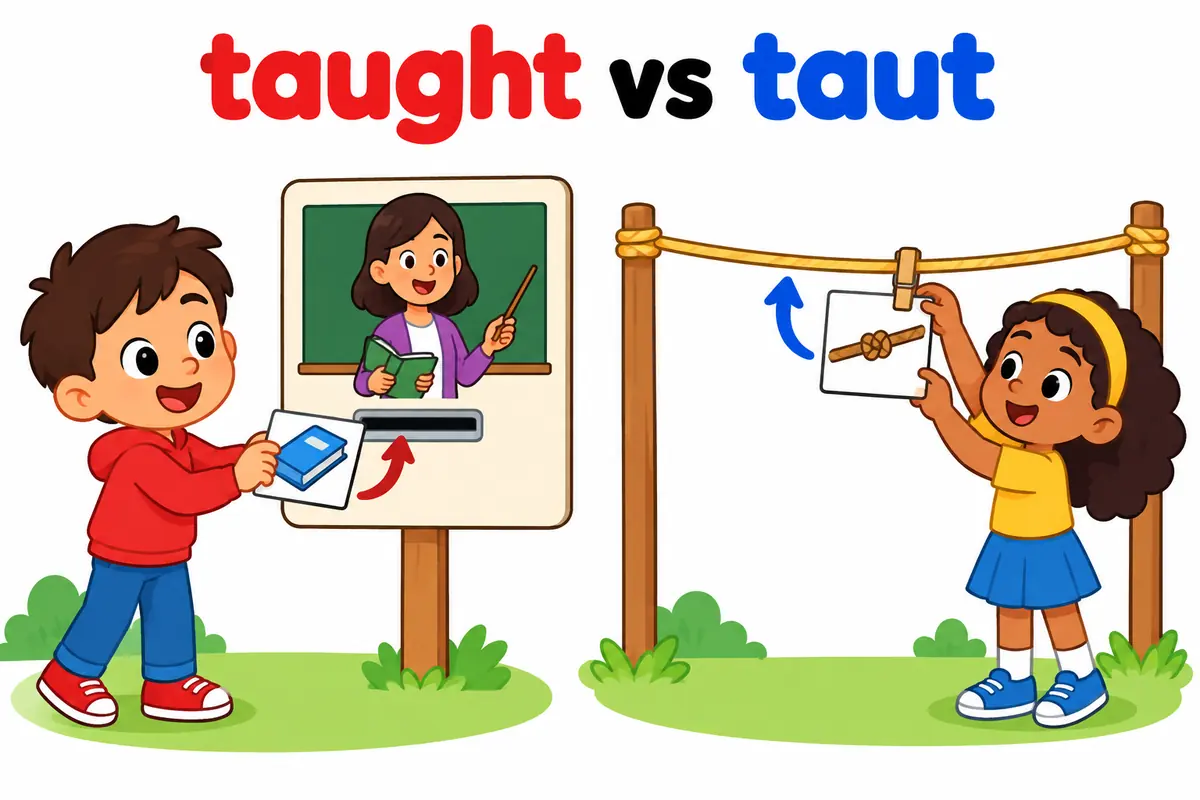
Taught in a sentence: examples across contexts
Taught stays close to the idea of instruction, and the examples below place it in the settings where it appears most. Each sentence names who gave the teaching and what was passed on. A lesson is what gets taught, which is why the noun sits naturally beside the past form.
| Context | Example sentence | Why this works |
|---|---|---|
| Classroom | Mr Okafor taught us how a bill becomes law. | Names the teacher and the exact skill. |
| Workplace email | The last manager taught me to check figures twice. | Links instruction to a lasting habit. |
| News report | She taught science for thirty years in the same town. | A time span shows a career of teaching. |
| Academic writing | The course taught statistical methods before any project work. | Places the teaching before later practice. |
| Family memory | My grandfather taught me to whistle through my fingers. | The small skill makes the past tense natural. |
| Sports coaching | He taught the team to defend as a single line. | One tactic shows taught as a completed lesson. |
Taut in a sentence: examples across contexts
Taut covers both physical tightness and nervous strain, and the examples below keep the two uses apart in setting. Each sentence gives the object or the feeling that is stretched. The page on taut gathers the physical and emotional senses of tightness.
| Context | Example sentence | Why this works |
|---|---|---|
| Physical | Keep the guy ropes taut or the tent will sag. | Names an object that can be pulled tight. |
| Technical writing | A taut cable carries the load with less give. | Uses the precise physical sense of taut. |
| News report | The atmosphere turned taut as the votes were counted. | Extends the word to collective tension. |
| Fiction | His jaw was taut and his answers were short. | Shows strain through a body detail. |
| Sport | The finish was taut, with three runners within a stride. | Describes a contest held under pressure. |
| Music review | The drumming stays taut and never loses the beat. | Uses taut for controlled tension in sound. |
How do you use them in a sentence?
The two words sit in different grammatical slots, and the patterns below make the placement clear. Taught takes an object, while taut normally follows be or precedes a noun.
| Pattern | Example | What it signals |
|---|---|---|
| subject + taught + object | Mrs Bell taught history for a decade. | Past action with a direct object. |
| has or had + taught | The school has taught Latin since 1901. | Perfect tense, still relevant now. |
| be + taut | The wire is taut. | Describes a present state. |
| taut + noun | A taut silence followed the announcement. | Attaches the adjective to what is tense. |
Word forms and grammar of taught and taut
The forms below show how far apart the two words are once they inflect. Taught belongs to a verb paradigm, while taut belongs to an adjective family.
| Form | Part of speech | Example |
|---|---|---|
| teach | verb, base | They teach reading in small groups. |
| taught | verb, past and past participle | He taught the choir on Thursdays. |
| teaching | verb, present participle or noun | She is teaching a new module. |
| taut | adjective | The net was stretched taut. |
| tautly | adverb, rare | He answered tautly and left. |
| tautness | noun | The tautness of the rope held the frame. |
The base verb teach supplies the whole taught family, and taut connects instead to the idea of tight. Rigid describes a stiffness that will not bend, unlike taut, which can still give.
Common mistakes with taught and taut
- Incorrect:
The rope was taught.Correct: The rope was taut. Rule: Only taut means pulled tight; taught always means gave instruction. - Incorrect:
She taut the class to sing.Correct: She taught the class to sing. Rule: Taught is the past of teach; taut is never a verb. - Incorrect:
The line has taut for years.Correct: The line has held taut for years. Rule: Taut cannot take the perfect; add a verb such as held. - Incorrect:
He taught with tension.Correct: He answered in a taut voice. Rule: Teach describes instruction, not tension, so taught cannot carry that sense.
Practice using taught and taut
- Fill the gap: Our guide ______ us to read the tide tables.
- Choose the better word: Pull the sail until it is (taught / taut).
- Correct the error: The atmosphere was taught before the final whistle.
- Build a sentence: use taught a lesson about a coach and a hard defeat.
- Spot the register: which belongs in a safety manual – keep the cables taut, or keep the cables taught?
- Rewrite in the perfect: The school gave Latin lessons for a century. Use has taught.
Answers
- taught – the guide gave instruction, so the past of teach is required.
- taut – a sail pulled tight needs the adjective; taught means gave instruction.
- The atmosphere was taut before the final whistle – tension needs the adjective taut.
- Model answer: The heavy defeat taught the young coach a lesson about patience.
- Keep the cables taut – a safety manual needs the adjective for tightness.
- The school has taught Latin for a century – the perfect links past teaching to the present.
The bottom line
Choose taught for the past of teach and taut for something stretched tight or tense, and the meaning of the sentence, not the sound, should settle it. The two nuances that decide most sentences are these: taught always needs an object or a helper verb, while taut describes a state after be or before a noun. Keep the proofreading test ready, because tense and tight sit closer to taut than taught ever will.
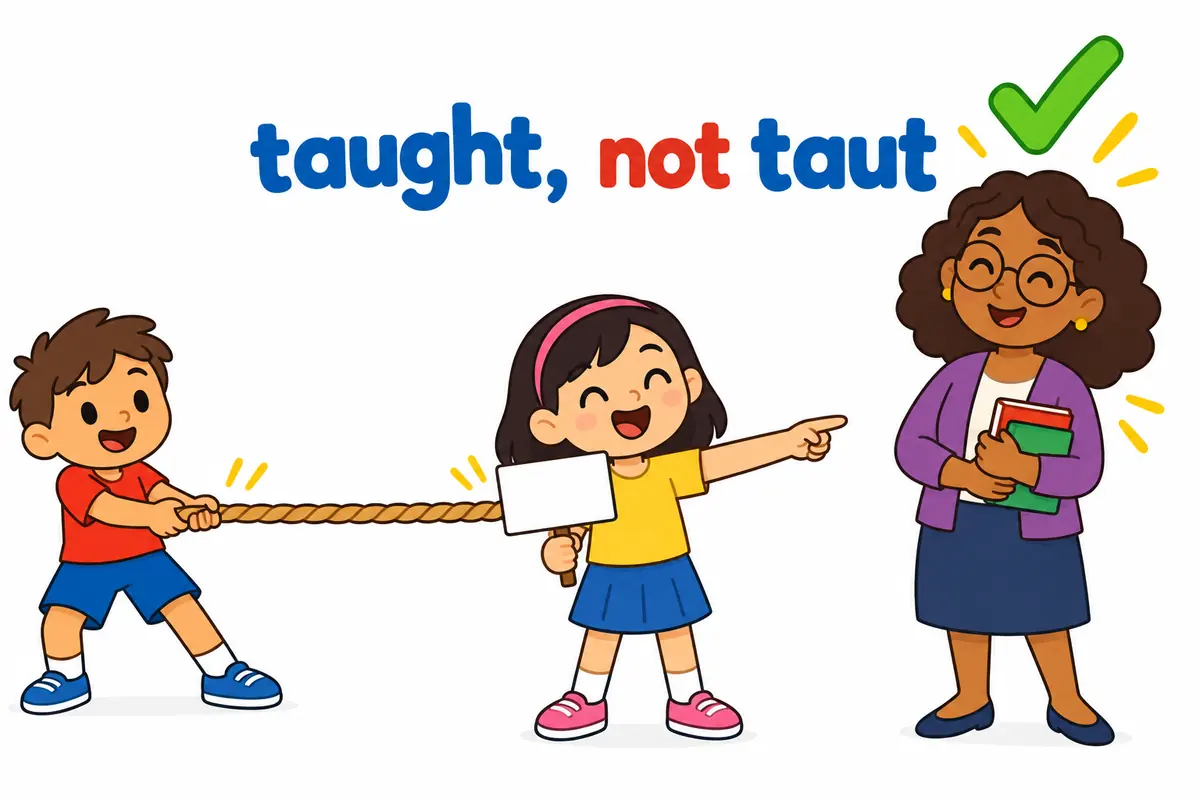
Frequently asked questions about taught vs taut
Is taught ever spelled taut?
No. The two are different words that happen to sound the same. Taught is the past tense of teach, and taut is an adjective meaning tight or tense. A spell-check will flag neither, so proofreaders read the sentence aloud and ask whether it describes instruction or tightness.
What part of speech is taut?
Taut is an adjective, so it describes a noun or follows the verb be, as in a taut rope or the rope is taut. It can turn into the noun tautness and the rare adverb tautly. It is never a verb, which is the mistake that produces the non-word taut wrongly where taught belongs.
Can taut describe a person?
It can describe a person’s body or manner when they show strain, as in his shoulders were taut or her face was taut with effort. It does not mean a strict or organised person; for that, use organised or disciplined. The image behind the word is always something pulled tight.
Which is correct, taught me or learnt me?
Standard English uses taught me, because teach takes the person as its object, as in she taught me to swim. Learnt me is not standard. The past form taught never changes with the subject, so I taught, you taught and they taught all use the same spelling.
Taught is the past tense and past participle of teach, while taut describes something tightly stretched or tense. In taught vs taut, choose taught for instruction and taut for tension. “The coach taught us to keep the rope taut” shows both meanings: an earlier lesson and the stretched condition of the rope.
Key facts at a glance
- taught means past tense or participle of teach.
- taut means tightly stretched or tense.
- Teach forms teaches, taught, and teaching. Taut is an adjective, with tauter and tautest available for comparison. Tautness is a related noun.
Which spelling fits the meaning?
| Word | Meaning | Example |
|---|---|---|
| taught | past tense or participle of teach | She taught the class yesterday. |
| taut | tightly stretched or tense | The rope remained taut. |

How does the context decide your choice?
Taught reports teaching in the past or in a perfect or passive construction: “has taught” and “was taught.” It is irregular, so the standard form is not teached.
Taut commonly describes a rope, fabric, or tense situation. Taught does not describe a physical tension level merely because both words have the same sound in many accents.
What are useful example sentences?
- She taught the class yesterday.
- The rope remained taut.
Read the example with the table definition in mind. The surrounding noun, action, or setting provides the clue; similar pronunciation does not make the meanings interchangeable.
Which forms and grammar patterns matter?
Teach forms teaches, taught, and teaching. Taut is an adjective, with tauter and tautest available for comparison. Tautness is a related noun.
Test instructed for taught and tightly stretched for taut. A sentence about a lesson can contain a taut object without merging the grammatical roles.
How can you check taught vs taut?
- Identify the intended person, thing, quality, or action.
- Substitute the relevant definition for the doubtful word.
- Check whether the grammatical role fits the sentence.
- Use the dictionary for a specialized sense or unfamiliar proper name.
Merriam-Webster Dictionary: teach and Merriam-Webster Dictionary: taut document the vocabulary distinctions. The sample sentences here are original usage examples.

Frequently asked questions
Can these words be substituted for each other?
No. Taught describes an instruction-related verb form, while taut describes tension or a tightly stretched condition. They serve different meanings despite similar pronunciation. Read the whole sentence before changing the spelling. The intended meaning and grammatical role provide stronger evidence than sound alone, especially when a word also has a specialized or less common sense.
What is the quickest proofreading test?
Ask whether someone instructed another person or whether an object is tightly stretched. Then check whether taught appears as a past verb or participle. Read the whole sentence before changing the spelling. The intended meaning and grammatical role provide stronger evidence than sound alone, especially when a word also has a specialized or less common sense.
Does similar pronunciation prove the spelling?
No. They can sound alike, but the act of teaching and a tense condition remain distinct. Meaning and grammatical role determine the written form. Read the whole sentence before changing the spelling. The intended meaning and grammatical role provide stronger evidence than sound alone, especially when a word also has a specialized or less common sense.
How can a learner practice the distinction?
Write a sentence about a teacher who taught a lesson and another about a taut rope. Combine them after explaining each word’s job. Read the whole sentence before changing the spelling. The intended meaning and grammatical role provide stronger evidence than sound alone, especially when a word also has a specialized or less common sense.
Have you ever found yourself confused between the words “taught” and “taut”? You’re not alone. These two words may sound similar, but they have distinct meanings and uses. In this text, I’ll clarify the difference between “taught” and “taut” and provide you with some helpful tips on how to use them appropriately in your writing. Understanding the nuances of these words is essential for effective communication. So, let’s immerse and unravel the mystery behind “taught” and “taut” once and for all.
Key Takeaways
- “Taught” is the past tense of the verb “teach” and refers to imparting knowledge or skill through instruction or example.
- “Taut” is an adjective that describes something stretched or pulled tight, indicating a state of tension or rigidity.
- The key difference between “taught” and “taut” lies in their parts of speech and contexts of use.
- “Taught” is a verb used to describe teaching or instructing, while “taut” is an adjective used to describe a state of tension or tightness.
- Properly understanding and using “taught” and “taut” is important for effective communication and clarity in writing.
- Pay attention to context, tense, and verb forms when deciding whether to use “taught” or “taut”.
The Difference Between “Taught” and “Taut”
When it comes to the English language, it’s easy to get tripped up by words that sound similar but have different meanings. Two such words are “taught” and “taut”. In this section, I’ll explain the differences between these two words to help you use them appropriately.
Definition of “Taught”
First, let’s talk about the word “taught.” The past tense and past participle form of the verb “teach,” it means to impart knowledge or skill to someone by instruction or example. When you say, “I taught him how to ride a bike,” you’re indicating that you provided instruction and knowledge to help someone learn a new skill.
Definition of “Taut”
On to the word “taut.” Unlike “taught,” “taut” is an adjective that describes something that is stretched or pulled tight. It’s often used to describe a physical state of tension or rigidity. For example, you might say, “The rope is taut,” indicating that it is tightly stretched.
The Difference Between the Two
While “taught” and “taut” may sound similar, their meanings are quite distinct. The key difference lies in their parts of speech and the contexts in which they are used. “Taught” is the past tense of the verb “teach” and refers to the act of instructing or imparting knowledge, while “taut” is an adjective that describes a state of tension or tightness.
Here’s a quick overview of the differences:
| Term | Part of Speech | Meaning |
|---|---|---|
| Taught | Verb | Past tense of “teach”; imparting knowledge |
| Taut | Adjective | Describing something stretched or pulled tight |
Understanding the nuances between “taught” and “taut” is essential for effective communication. Using these words correctly will help ensure clarity in your writing and avoid confusion.
Remember, “taught” is about teaching and imparting knowledge, while “taut” refers to something being stretched or pulled tight. Now that we’ve cleared up the differences, let’s move on to examples of how to use these words in sentences.
When to Use “Taught”
As a skilled writer and language enthusiast, I believe it is crucial to have a solid understanding of the correct usage of words. In this section, I will investigate into the definition and appropriate use of the word “taught.” So, let’s get started!
Definition of “Taught”:
“Taught” is the past tense of the verb “teach.” It refers to the act of instructing or imparting knowledge to someone. When you use “taught,” you are indicating that someone has been educated or trained by a teacher or instructor.
The Difference Between “Taught” and “Taut”:
Before we proceed, it’s important to make a clear distinction between “taught” and “taut.” Though they may sound similar, they have completely different meanings. “Taught” is a past tense verb, while “taut” is an adjective that describes something that is stretched or pulled tight.
Let’s explore a few scenarios where “taught” is the appropriate choice:
- Educational Experiences: I can use “taught” to describe instances where knowledge or skills are imparted by an instructor or teacher. For example, I could say, “My English teacher taught me how to write a compelling essay.”
- Training and Learning: “Taught” is also used when referring to lessons, courses, or workshops. For instance, I could say, “The workshop I attended last week taught me valuable negotiation skills.”
- Past Tense: When discussing or narrating past events involving teaching and learning, “taught” is the correct form. For example, I might say, “He taught music lessons throughout his career” or “She taught math to elementary school students for many years.”
Remember, it is essential to pay attention to the context and tense of a sentence when deciding whether to use “taught” or another word. Understanding the distinctions between similar words like “taught” and “taut” is key to effective communication.
Now that we have a solid grasp on “taught,” let’s move on to exploring the proper use of “taut” in the next section of this article.
Examples of “Taught”
As I mentioned earlier, “taught” is the past tense of the verb “teach” and is used to describe the act of instructing or imparting knowledge. Let’s explore some examples where “taught” is the appropriate choice:
- Educational Experiences:
- In high school, my math teacher taught us advanced calculus.
- My parents taught me how to ride a bike when I was a child.
- The professor taught the students about the effects of climate change.
- Training and Learning:
- The coach taught the athletes proper running techniques.
- The cooking class taught us how to make delicious pasta from scratch.
- The online course taught me valuable business skills.
- Discussing Past Events:
- Last summer, I taught a photography workshop for beginners.
- The history instructor taught us about ancient civilizations.
- My grandparents taught me traditional dance steps from their culture.
In all of these examples, “taught” is used to describe a person giving knowledge or instructions, whether in an educational setting, training session, or during a past event. It indicates that someone has been the teacher or instructor, sharing their expertise with others.
Remember, when deciding between “taught” and other similar words like “taut,” it’s important to pay attention to the context and tense of the sentence. “Taught” specifically refers to the past tense of teaching or instructing, while “taut” relates to something being pulled tight or compact.
Understanding the difference between these words enhances our ability to communicate effectively and ensures accurate usage in our writing and conversations.
Now that we have explored the examples of “taught,” let’s move on to examining the proper usage of “taut” in the next section.
When to Use “Taut”
“Taut” is a word that often gets confused with “taught.” But, they have different meanings and are used in different contexts. Let me explain when to use “taut” in your writing.
Definition of “Taut”
To start, it’s important to understand the definition of “taut.” When something is “taut,” it means that it is stretched or pulled tightly, without any slack. It is used to describe something that is tense, firm, or rigid.
Examples of “Taut”
Here are a few common situations where you would use “taut” correctly:
- Physical Objects: Use “taut” when referring to objects that are tightly stretched or pulled. For example, a tightrope or a sail that is pulled tight by the wind.
- Muscles or Skin: When describing the condition of muscles or skin, use “taut” to convey the sense of firmness or tightness. For instance, you may talk about a person’s taut muscles after an intense workout.
- Emotions or Atmosphere: “Taut” can also be used metaphorically to describe emotions or an atmosphere that is filled with tension or suspense. This can be seen in phrases like “a taut silence” or “a taut atmosphere before a big game.”
Remember, “taut” is used to describe something that is tightly stretched, firm, or tense.
Understanding the difference between “taught” and “taut” is important for clear and effective communication. Now that we have covered when to use “taut,” let’s move on to exploring more about the usage of “taught” in the next section of this article.
Examples of “Taut”
To further illustrate the correct usage of the word “taut,” I’ll provide you with some examples in different contexts:
- Physical objects: In the context of physical objects, “taut” means stretched or tightly drawn. For example:
- The sail on the boat was taut as the wind propelled it forward.
- She carefully pulled the sheet taut to create a smooth, wrinkle-free surface.
- Muscles or skin: When referring to muscles or skin, “taut” implies a tight or firm condition. Consider these examples:
- After months of training, his abs were perfectly taut and defined.
- The dancer’s legs were taut as she gracefully leaped across the stage.
- Emotions or atmosphere: “Taut” can also describe a tense or strained situation, emotions, or atmosphere. Here are a couple of examples:
- The taut silence filled the room as everyone awaited the judge’s decision.
- The movie created a taut atmosphere, keeping the audience on the edge of their seats.
- Materials: In terms of materials, “taut” can refer to something being tightly stretched or held in a state of tension. Consider these examples:
- The trampoline’s surface was taut and provided a perfect bounce.
- He strummed the guitar, making the strings taut to achieve a crisp sound.
Understanding the proper usage of “taut” is essential for clear and effective communication. Focusing to context and selecting the appropriate word, you can convey your thoughts accurately. Remember, “taut” describes something stretched or firm, whether it’s physical objects, muscles, emotions, or materials.
Tips for Using “Taught” and “Taut” Appropriately
When it comes to distinguishing between “taught” and “taut,” understanding their definitions and contexts is crucial. Let’s explore some tips to help you use these words appropriately:
- Understand the Difference: The first step in using “taught” and “taut” correctly is to grasp their meanings.
- “Taught” is the past tense of the verb “teach.” It refers to the act of instructing or imparting knowledge to someone or something. For example, “He taught me how to play the guitar.”
- “Taut” refers to something that is stretched or pulled tightly. It can describe physical objects, muscles or skin, emotions or atmosphere, and even materials. For instance, “The rope was taut across the gap.”
- Consider Context and Tense: Context and tense play a crucial role in determining whether to use “taught” or “taut.”
- Use “taught” when discussing past educational experiences, such as when you learned a new subject or skill. For example, “My math teacher taught us algebra last semester.”
- On the other hand, use “taut” when describing something that is tightly stretched or pulled. For instance, “Her face looked taut with worry.”
- Be Mindful of Verb Forms: Another helpful tip is to pay attention to the verb forms associated with each word.
- Remember, “taught” is the past tense of “teach.” Use it when talking about instruction that occurred in the past. For example, “He taught the class yesterday.”
- Review Examples: Sometimes, seeing examples can make it easier to understand and remember the proper usage of “taught” and “taut.” Here are a few more examples to reinforce your understanding:
- I taught my younger brother how to ride a bicycle last summer.
- The tightrope walker’s wire was taut as he performed daring tricks.
- The yoga instructor taught the class
Conclusion
Understanding the difference between “taught” and “taut” is essential for clear and effective communication. By knowing when to use each word appropriately, you can avoid confusing your readers and convey your message accurately.
Remember, “taught” is the past tense of the verb “teach” and is used to describe the act of instructing or imparting knowledge. On the other hand, “taut” refers to something that is stretched or pulled tightly.
To ensure the correct usage of these words, consider the context and tense of your sentence. Pay attention to the verb forms associated with each word, as they can guide you in choosing the right one.
By following these guidelines, you can confidently use “taught” and “taut” in your writing. Remember, practice makes perfect, so keep using these words correctly to reinforce your understanding.
Now that you have a solid grasp of the appropriate usage of “taught” and “taut,” you can confidently express yourself and communicate with precision.
Frequently Asked Questions
Q: What is the difference between “taught” and “taut”?
A: “Taught” is the past tense of the verb “teach” and means to instruct or impart knowledge. “Taut” refers to something that is stretched or pulled tightly.
Q: When should I use “taught”?
A: Use “taught” when referring to past actions of teaching or instructing someone. For example, “She taught me how to swim.”
Q: When should I use “taut”?
A: Use “taut” to describe something that is stretched or pulled tight. For example, “The rope was taut.”
Q: How can I remember the difference between the two words?
A: Pay attention to the context and tense. “Taught” is related to teaching, while “taut” refers to something being stretched or tight. Remembering the verb forms can also help. “Teach, taught, taught” and “tight, taut” have a similar pattern.
Q: Can you provide more examples for using “taught” and “taut” correctly?
A: Sure! “He taught math at the university.” (past tense of teach)
“The drumhead was taut.” (describing a stretched surface)


