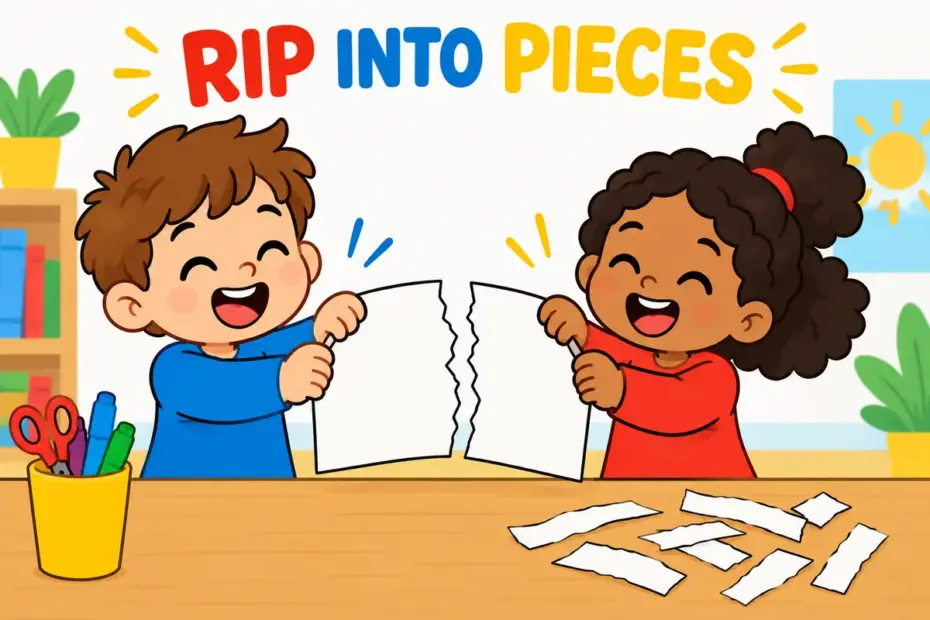
Tear up is a phrasal verb with two senses: to rip something into pieces, and for eyes to fill with tears. To use tear up in a sentence, decide which sense you mean, because the first takes an object and the second does not: “She tore up the letter” and “She teared up at the letter.”
Tear up at a glance
- Tear up is a phrasal verb whose forms are tear up, tore up, torn up and tearing up.
- The ripping sense is transitive; the crying sense is intransitive and takes no object.
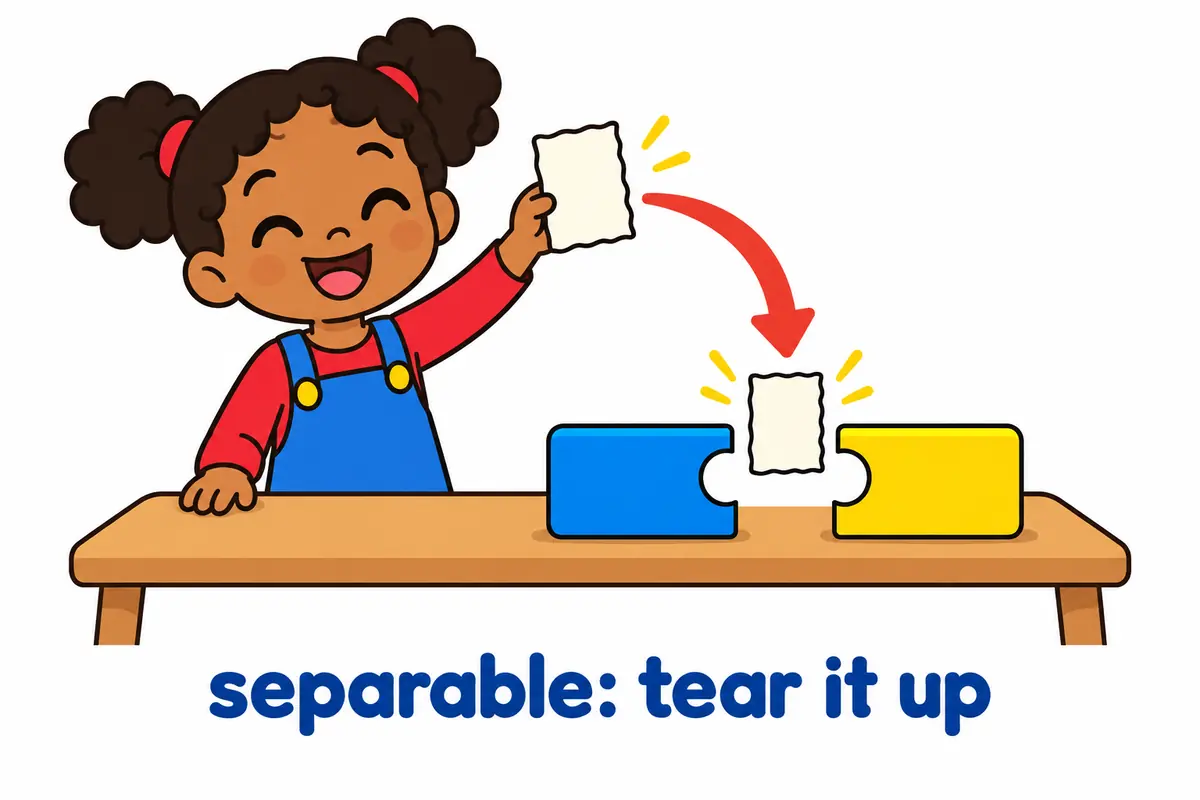
- The ripping sense is separable, so tear the note up and tear up the note are both correct.
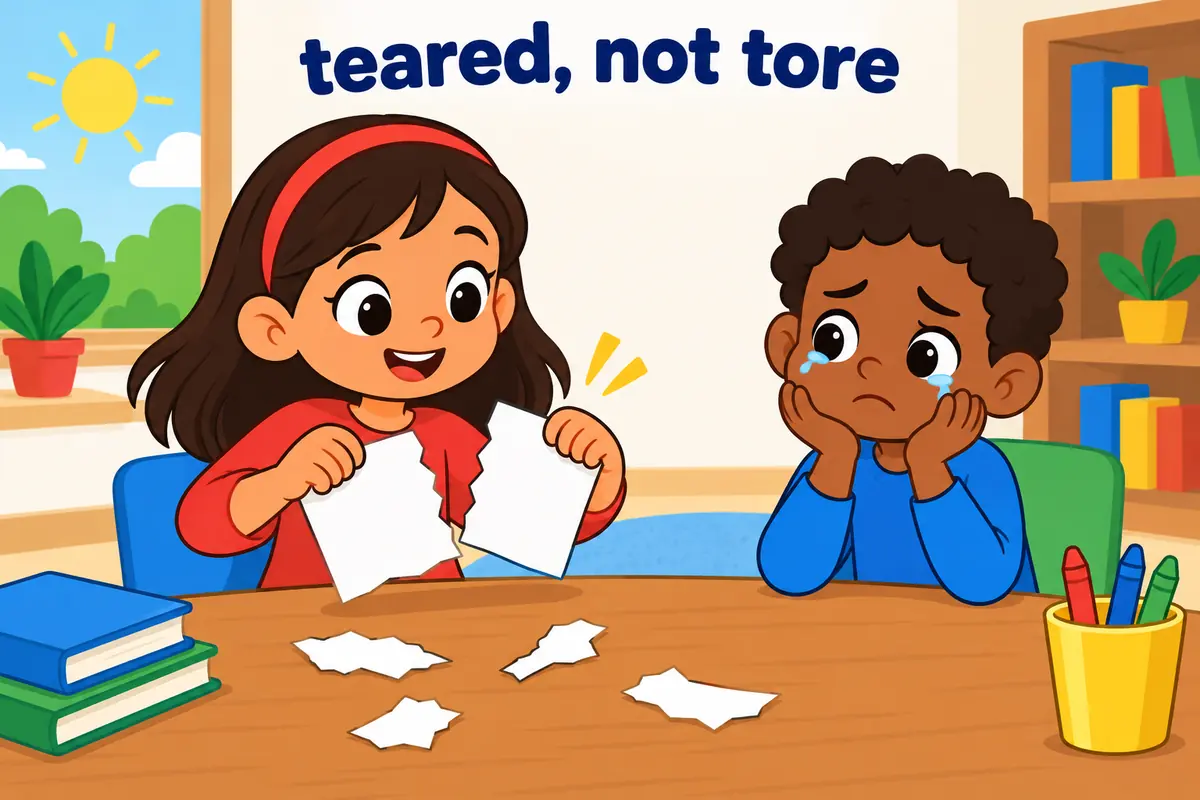
- The crying sense keeps a regular past: teared up, never tore up.
- The commonest error is using tore up for the crying sense or teared up for ripping.
What does tear up mean?
Tear up has two meanings that differ in grammar as well as sense. The Cambridge entry for tear up records both the physical action of pulling something into pieces and the moment eyes begin to water. The first is close to shred, and the most forceful version is to mangle something beyond recognition.
| Sense | Plain meaning | Example sentence |
|---|---|---|
| Rip into pieces | Pull paper or cloth apart | She tore up the draft and started again. |
| Eyes fill with tears | Begin to cry, usually quietly | He teared up during the farewell speech. |
| Damage a surface | Pull up a road, floor or turf | Workers tore up the pavement outside. |
One limitation matters. Tear up describes eyes beginning to water, not a full cry; when someone sobs, burst into tears or weep is the accurate verb. In the ripping sense, shred is the precise word for a document that must not be read again, because tear up says nothing about the size of the pieces.
How do you use tear up in a sentence?
The phrasal verb is separable in its physical senses and inseparable in its crying sense. A separable phrasal verb allows the object to sit either after the particle or between the verb and the particle, and the particle stays put when the object becomes a pronoun.
| Pattern | Example | What it signals |
|---|---|---|
| tear up + object | The child tore up the paper. | Object after the particle, the neutral order. |
| tear + object + up | The child tore the paper up. | Object between verb and particle, equally correct. |
| tear + pronoun + up | She tore it up at once. | A pronoun must sit between the verb and the particle. |
| be torn up | The old map was torn up by mistake. | Passive, with the past participle torn. |
| tear up (no object) | He teared up and looked away. | The crying sense, intransitive and inseparable. |
The test for learners is simple. If something is being ripped, tear up behaves like the separable phrases and you may split it; if eyes are filling, tear up takes no object at all and must never be split.
Tear up in a sentence: examples across contexts
Tear up changes setting more than it changes meaning. The nine sentences below move from a workshop to a wedding, and each one makes clear which of the two senses is at work.
| Context | Example sentence | Why this works |
|---|---|---|
| Classroom | The teacher tore up the wrong worksheet before the lesson. | The object paper makes the ripping sense unmistakable. |
| Workplace email | Please tear up the printed draft and recycle it. | The separable order is natural in an instruction. |
| News report | Crews tore up the road surface to reach the burst main. | Uses the damage sense with a public-works subject. |
| Conversation | I teared up at the last scene of the film. | No object, which signals the crying sense. |
| Wedding speech | The groom teared up when his brother began to speak. | Names the moment the eyes filled, keeping the meaning mild. |
| Sports writing | The captain teared up as the final whistle blew. | As-clause supplies the cause without turning tear up into a full cry. |
| Craft instructions | Tear the strip up slowly so the edge stays straight. | Splits the phrase to keep the adverb close to the action. |
| Legal writing | The unsigned contract was torn up in front of both parties. | Passive torn up shows the act was witnessed. |
| Garden diary | We tore up the turf and planted the bed in autumn. | Uses the damage-a-surface sense with an everyday subject. |
The test in every row is whether the object slot is filled. Only the conversation, wedding and sports sentences leave it empty, and those are precisely the eyes-filling uses.
Tear up vs rip up
For paper and cloth, tear up and rip up overlap, but they are not twins. Tear up suggests a controlled pull along a line, while rip up implies a fast, rough action that leaves jagged edges. Neither word applies to crying, so a sentence about tears needs tear up alone.
| Attribute | tear up | rip up |
|---|---|---|
| Force implied | A controlled pull along a seam | A fast, rough pull |
| Edge left behind | Fairly straight | Jagged and uneven |
| Senses available | Ripping, damaging and crying | Ripping and damaging only |
| Separability | Splits in the ripping sense | Splits in the ripping sense |
| Typical object | Paper, letters, old fabric | Cardboard, packaging, turf |
Verdict: use tear up for a neat pull or any reference to tears, and rip up when the action is quick, rough and careless.
Word forms and grammar of tear up
The base verb is tear, and its two pronunciations are the fastest guide to meaning: the ripping sense rhymes with air, while the crying sense rhymes with ear. That sound difference survives in every form and tells a listener which tear up you mean before the grammar does.
| Form | Sense | Example |
|---|---|---|
| tear up | Ripping, present | Do not tear up the tickets. |
| tore up | Ripping, past | She tore up the note. |
| torn up | Ripping, past participle | The note was torn up. |
| tearing up | Ripping, continuous | He is tearing up the cardboard. |
| teared up | Crying, past | She teared up at the speech. |
| tearing up | Crying, continuous | He is tearing up again. |
The irregular forms belong to the ripping sense only. The crying sense is regular, so its past is teared up and its participle is also teared up, never tore or torn.
Common mistakes with tear up
- Incorrect:
He tore up when he heard the news.Correct: He teared up when he heard the news. Rule: The crying sense has a regular past, teared up. - Incorrect:
She teared the letter up and posted it.Correct: She tore the letter up. Rule: The ripping sense uses tore for the past. - Incorrect:
The letter was tore up.Correct: The letter was torn up. Rule: The past participle of tear is torn. - Incorrect:
She tore up the form into the bin.Correct: She tore up the form and put it in the bin. Rule: Tear up means rip, not throw away. - Incorrect:
His eyes tore up during the anthem.Correct: His eyes teared up during the anthem. Rule: Eyes fill with tears, so the crying form is needed.
Practice using tear up
Work through the six items, then check the reasoning rather than only the answer.
- Fill the gap: The puppy ______ up the newspaper before anyone could stop it.
- Choose the better word: When the choir began, her eyes (teared / tore) up.
- Correct the error: He torn up the receipt and threw it away.
- Build a sentence: use tear up about someone becoming emotional at a graduation.
- Spot the register: which belongs in a news report — several guests teared up as the names were read, or the whole room got all weepy?
- Split the verb: rewrite He tore up the contract with the object between the verb and the particle.
Answers
- tore — this is the ripping sense in the past, so tore up is correct.
- teared — eyes filling with tears use the regular past, teared up.
- He tore up the receipt — the past of the ripping sense is tore, not torn.
- Model answer: Her grandmother teared up when the graduates walked in.
- Several guests teared up as the names were read — a report keeps the plain verb and avoids the slang.
- He tore the contract up — a separable phrasal verb allows the object in the middle.
The bottom line
Use tear up in a sentence for either ripping something into pieces or for eyes beginning to fill, and settle the grammar before you write. The two decisive points are that the ripping sense is separable and transitive while the crying sense is neither, and that the past forms differ: tore up and torn up for ripping, teared up for tears. To smash something beyond repair, destroy carries the force that tear up does not.
Frequently asked questions about tear up
How is tear up pronounced?
The spelling tear carries two sounds, and they separate the senses. In the ripping sense the vowel rhymes with air, as in tear the paper. In the crying sense it rhymes with ear, as in tear up at the speech. The sound difference is a reliable guide to meaning even in speech.
Can tear up take an object?
It can in the physical senses: you tear up paper, a road or a floor, and the noun or pronoun is the thing being damaged. It cannot in the crying sense, which is intransitive. The sentence he teared up has no object and admits none, so adding one is always an error.
Is tear up formal or informal?
Tear up belongs to neutral, everyday English and appears in news reports, fiction and conversation alike. The crying sense is gentler and less dramatic than burst into tears, which suits a quiet moment. Only the slang phrase get weepy should be avoided in a formal report.
What is the past tense of tear up?
The past tense depends on the sense. For ripping, it is tore up, as in she tore up the letter, and the past participle is torn up. For crying, the past is regular: she teared up. Mixing them, as in he tore up at the speech, is the commonest mistake.
Have you ever experienced a moment that was so emotional or overwhelming that it caused you to tear up? “Tear up” is a phrasal verb that describes the action of crying or becoming emotional to the point where tears start to form in your eyes.
This common expression can be used to convey various levels of emotion, from feeling touched by a heartwarming story to being deeply moved by a sad event. “Tearing up” is a natural human response to strong feelings, whether they are positive or negative, and can serve as a cathartic release of pent-up emotions.
7 Examples Of Tear Up Used In a Sentence For Kids
- I tear up the paper into small pieces.
- Please be careful not to tear up the book.
- It’s fun to tear up old newspapers for crafting.
- The wind can tear up our kite if it’s too strong.
- Don’t tear up your drawing if you make a mistake.
- Let’s tear up some colored paper to make a collage.
- Be gentle and don’t tear up the delicate tissue paper.
14 Sentences with Tear Up Examples
- Tear up those old notes from last semester; it’s time to start fresh.
- I accidentally tore up my assignment while trying to fix it.
- The stress of exams made her tear up during the presentation.
- Don’t forget to tear up the rough draft before submitting your final essay.
- He had to tear up his plan for the group project when his teammates didn’t agree with it.
- Tear up the syllabus and rearrange the topics to study more efficiently.
- The professor’s feedback made her tear up her original research proposal and start over.
- My friend accidentally tore up his exam paper in frustration, and had to ask for a new one.
- She had to tear up her original study schedule and create a new one due to unexpected events.
- I had to tear up my budget plan after realizing I had forgotten to factor in some essential expenses.
- The student was so overwhelmed with emotions that he tore up his rejection letter from the university.
- Tear up that old timetable and create a new one for the upcoming semester.
- The intense debate in class made him tear up his notes and rewrite his argument.
- I accidentally tore up my lecture notes, but managed to piece them back together before the exam.
How To Use Tear Up in Sentences?
To ** use Tear Up in a sentence, you can start by understanding its meaning and context. Tear Up means to rip something into pieces or destroy it completely.
Here is an example sentence using Tear Up:
“After receiving the bad news, she was so upset that she began to tear up the letter in frustration.”
In this sentence, Tear Up is used to describe the action of ripping the letter into pieces due to frustration. It signifies a strong emotion or an intense reaction to a situation.
When using Tear Up in a sentence, consider the context in which you are describing the action. It is important to ensure that the sentence effectively conveys the idea of tearing something into pieces or destroying it completely.
Remember, Tear Up is a phrasal verb and should be used in its correct form within a sentence. It is essential to place the object of the action after the phrasal verb for clarity.
Practice using Tear Up in various sentences to become more comfortable with incorporating it into your writing. Understanding the meaning and proper usage of this phrasal verb will help you communicate your ideas effectively.
Conclusion
In conclusion, the phrase “tear up” is often used to describe actions like ripping paper into pieces or shedding tears due to strong emotions. When someone tears up a paper, they are physically tearing it apart, usually into small fragments. On the other hand, tearing up due to emotions signifies a display of strong feelings like sadness, joy, or gratitude.
Whether it is tearing up a document for disposal or tearing up with emotion during a heartfelt moment, the expression “tear up” can convey both physical and emotional acts of tearing. It is a versatile term that captures breaking something into smaller parts or releasing built-up emotions through tears, showcasing the diverse ways in which this phrase can be used in everyday language.


