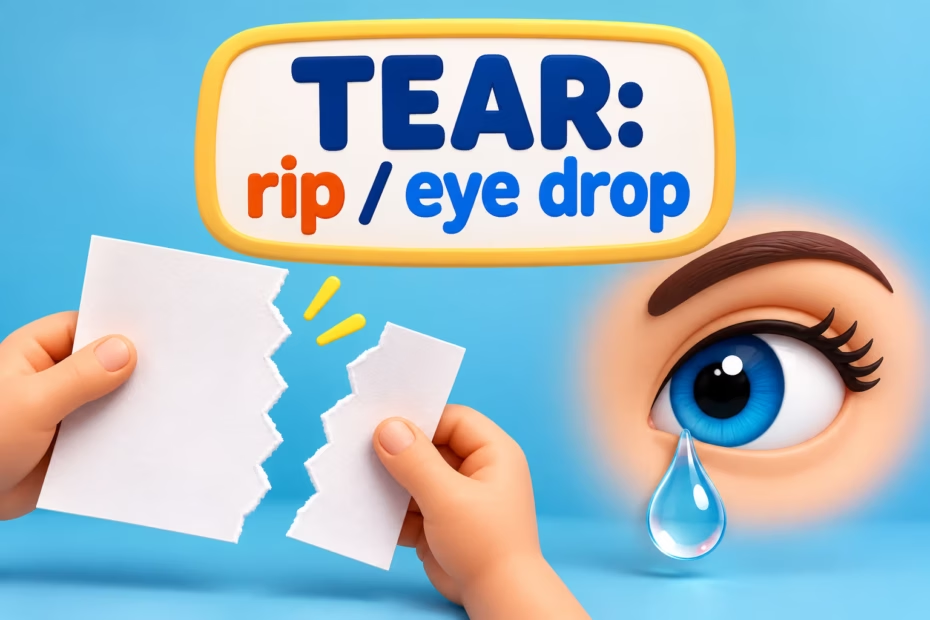
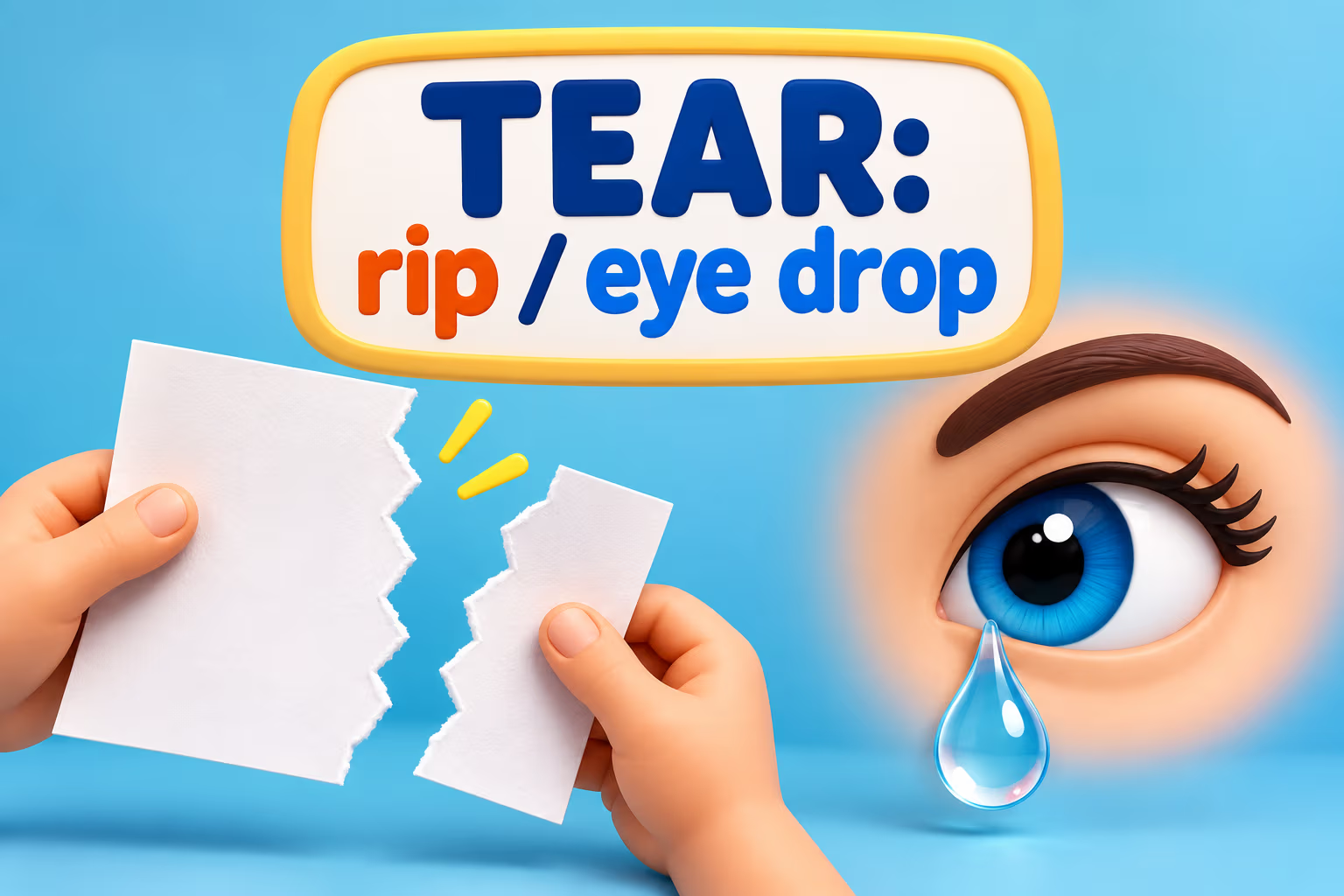
Quick guide: tear has two common pronunciations and several related meanings. When it rhymes with care (often respelled “TAIR”), it can mean to pull something apart or the rip left behind. When it rhymes with dear (“TEER”), it can mean a drop from the eye or the act of producing tears. Context, pronunciation, and the word’s role in the sentence tell you which one is meant.

Two Meanings, Two Pronunciations
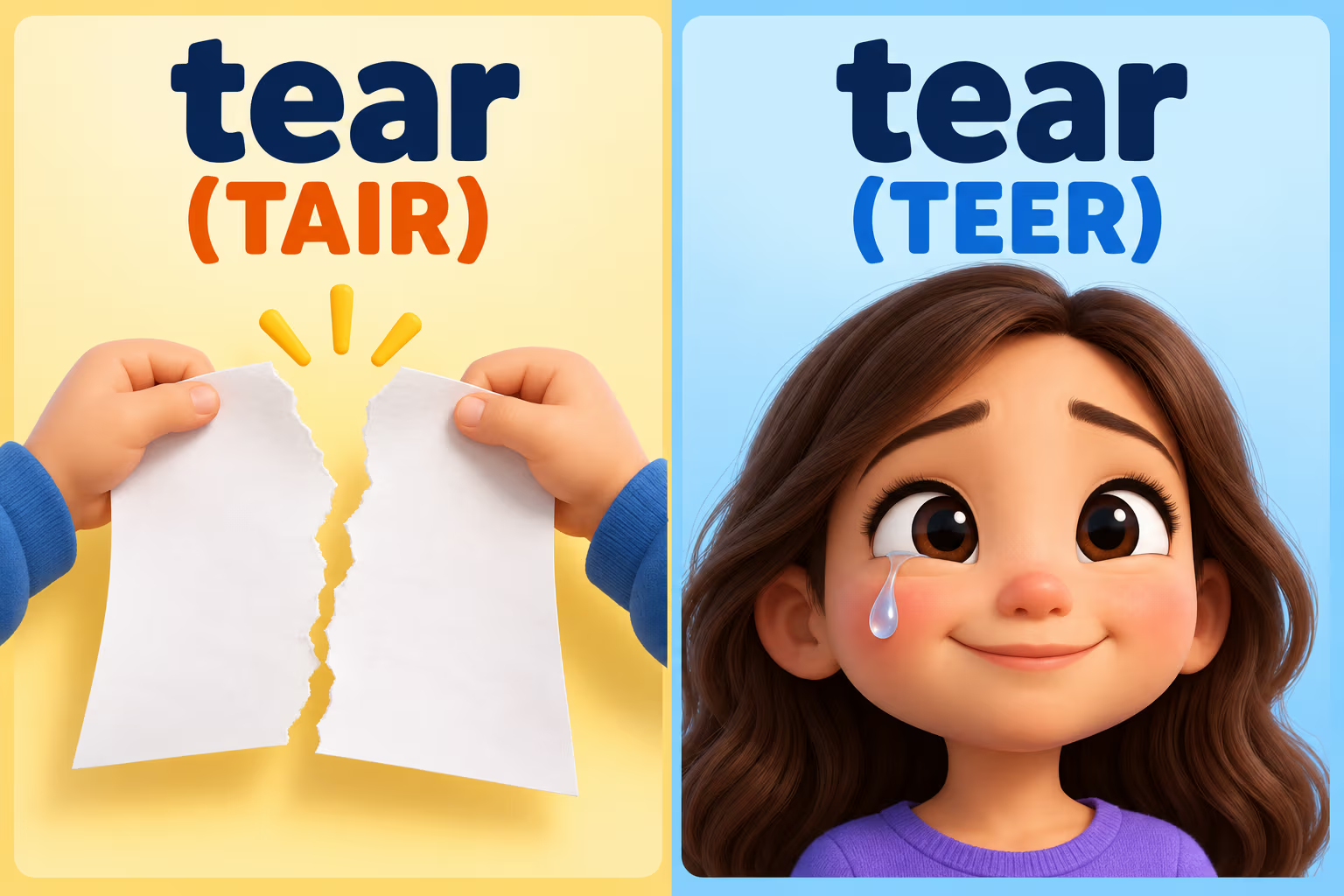
In the physical sense, tear is usually a verb meaning to damage or separate something by pulling, or a noun for the resulting opening. In the eye-related sense, a tear is a drop of liquid from the eye, while to tear means to produce tears. The spellings look identical, but the vowel sound differs: say the first like “TAIR” and the second like “TEER.” Those respellings are memory aids; pronunciations can vary by accent. Cambridge’s pronunciation guide lists separate UK and US pronunciations for the two senses, and its entry for tear distinguishes the eye-related noun and verb from the pull-apart meaning.
| Form | Meaning | Example pattern |
|---|---|---|
| tear (TAIR), verb | Pull apart or damage | tear a sheet; tear the sheet |
| tear (TAIR), noun | A rip or hole in material | a tear in the sleeve |
| tear (TEER), noun | A drop from the eye | a tear rolled down her cheek |
| tear (TEER), verb | Produce tears | his eyes began to tear |
Verb Forms: Tear, Tore, Torn
For the pull-apart verb, use tear in the present, tore for the simple past, and torn after a form of have or as a participle: “They tear scrap paper,” “They tore the paper yesterday,” and “They have torn the paper.” The -ing form is tearing. Do not use teared for this sense in standard usage. Oxford Learner’s Dictionaries lists the irregular forms and examples such as tore a hole and torn to pieces in its entry for the rip verb.
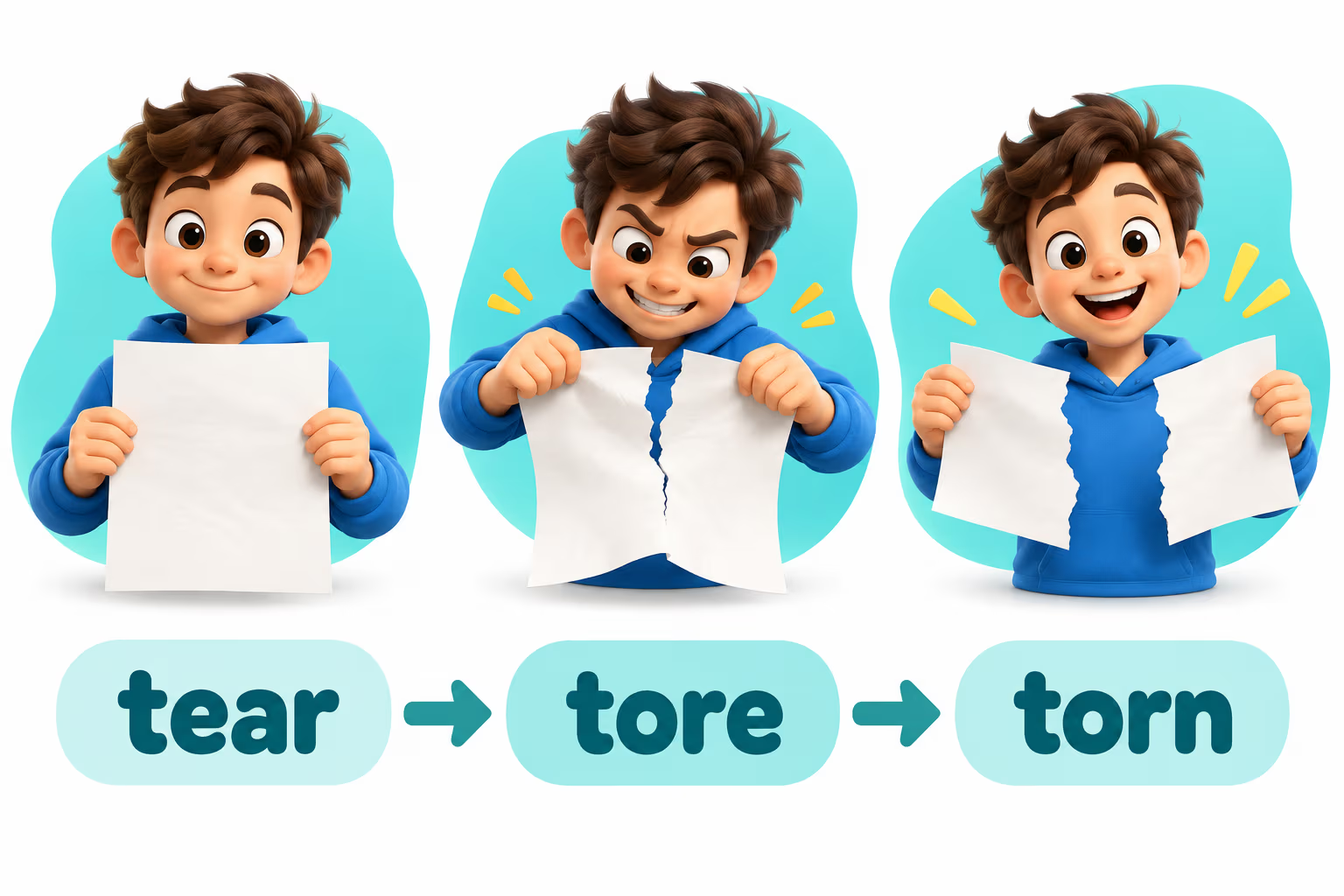
The crying verb has a different pattern: its past forms are teared, as in “Her eyes teared up during the film.” The phrasal verb tear up can also mean to begin to cry. Oxford records teared for this eye-related verb in its separate entry for tear (produce tears). The noun for a rip is also a distinct countable use: “There is a small tear in the page”; see Oxford’s noun entry.
Sentence Patterns That Make the Meaning Clear
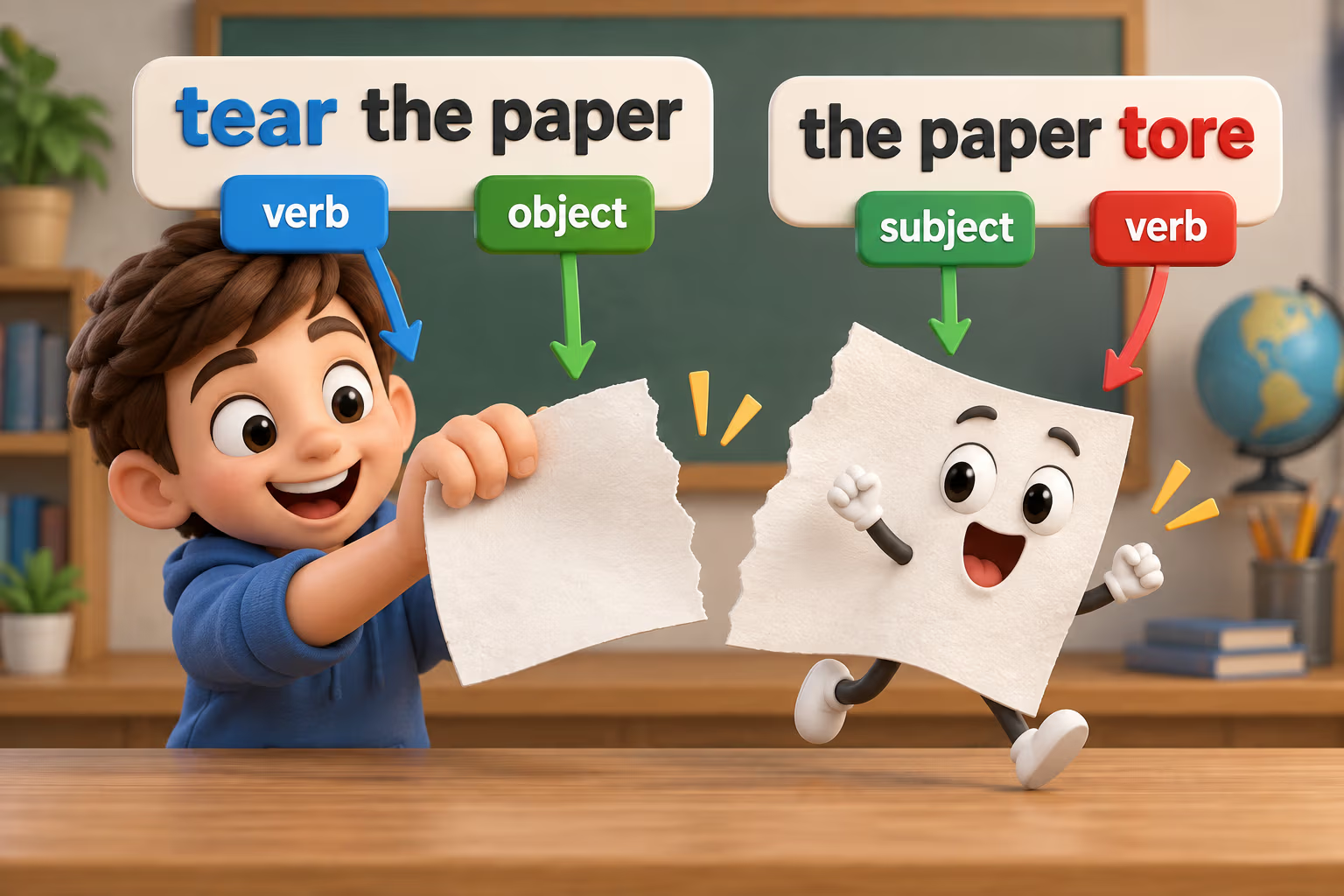
Use the physical verb with a thing that is pulled, or describe the material that splits. In “Please tear the paper along the line,” the paper is the object. In “The paper tore along the fold,” the subject is what split, so no object is needed. For the eye-related sense, the subject is usually a person’s eyes: “My eyes teared in the cold wind.” A person can also “tear up” in response to a strong feeling. These patterns help readers hear the intended sense even when the word is only seen in print.
More examples by meaning
- Pull apart: Please tear the coupon from the page.
- Come apart: The thin fabric tore when it caught on a nail.
- Remove: Mara tore the label off the jar.
- Make a hole: A branch tore a hole in the screen door.
- Rip as a noun: A small tear appeared near the seam.
- Eye-related noun: One tear slipped down his cheek.
- Produce tears: Her eyes teared as the smoke drifted indoors.
- Be undecided: I was torn between walking home and taking the bus.
Some expressions are figurative. To “tear someone away from a task” means to make them leave or stop doing it; “the argument tore the group apart” describes serious division. Oxford’s verb entry includes senses for removing something, moving quickly, and being “torn between” choices, so read the surrounding words rather than assuming every use describes damaged paper.
A Note on the Examples Below
The examples in the original list are retained below. Some are literal, while others use figurative phrasing. For clear standard prose, say “interrupt students’ concentration” or “undermine motivation” when you mean that studying or stress affects focus; tear their focus is not the usual expression. By contrast, tear students away from their books and tear friendships apart are recognizable figurative patterns. For a physical rip, name the material or object that is damaged.
Sources: Cambridge Dictionary pronunciation: tear; Cambridge Dictionary: tear; Oxford Learner’s Dictionaries: tear (rip verb); Oxford Learner’s Dictionaries: tear (produce tears); Oxford Learner’s Dictionaries: tear (rip noun).
When we talk about tears, we are not only referring to the salty droplets that flow from our eyes when we cry. There is another meaning of tear, one that involves ripping or damaging something by pulling it apart.
In the context of tear as a verb, it signifies the action of forcefully separating or causing damage to an object or material by pulling or ripping it. This type of tear can be intentional or accidental, resulting in a visible break or damage to the surface of the item.
7 Examples Of Tear Used In a Sentence For Kids
- Tear the paper carefully along the line.
- A drop fell from his eye as he began to tear.
- She used a tissue to wipe away her tear.
- Be gentle when you tear the page out of the notebook.
- The strong wind can tear the leaves off the trees.
- He felt a tear run down his cheek as he watched the sad movie.
- Please do not tear the book pages, handle them gently.
14 Sentences with Tear Examples
- Students often struggle with managing their time effectively, which can tear them apart during exam season.
- It’s common for college students to experience the occasional tear in their notes or textbooks, but it’s important to keep them organized.
- Late-night study sessions can sometimes lead to a tear in motivation, but remember to take breaks and stay focused.
- Group projects can be stressful, but don’t let it tear apart your team dynamic – communication is key.
- Financial pressures can tear students away from their studies, so it’s important to seek support if needed.
- It’s not uncommon for students to tear their assignments at the last minute, so try to plan ahead and avoid that situation.
- Campus events and social activities can be a great way to tear students away from their books and unwind.
- Roommate conflicts can tear students down emotionally, so be open to communication and find a solution together.
- Lack of sleep can tear students’ focus in class, so make sure to prioritize a healthy sleep schedule.
- Procrastination can tear students away from achieving their full potential, so cultivate good study habits.
- Technology can be a double-edged sword, as it can tear students away from their studies but also be a useful tool for research.
- Competition among peers can sometimes tear friendships apart, so remember to always support each other.
- Worrying about the future can tear students down mentally, so try to focus on the present moment and take one step at a time.
- Homesickness can tear students away from their studies, so it’s important to stay connected with loved ones and seek support when needed.
How To Use Tear in Sentences?
Tear can be used in different ways in a sentence. It is important to understand the context in which you are using this word to ensure clear communication. Here are some examples to help you get started:
- Tear (verb – present tense): “I am going to tear the paper into small pieces.”
- Tear (verb – past tense): “Yesterday, she tore her dress accidentally.”
-
Tear (noun – meaning a drop of clear salty liquid that comes out of your eyes when you cry): “She wiped away a tear from her cheek.”
Remember, tear can have different meanings based on the context in the sentence, so pay attention to how it is used in the sentence to understand its intended meaning. Practice using tear in various sentences to become familiar with its usage.
Conclusion
In conclusion, the word “tear” can be used in various contexts, such as expressing sadness or physical action like ripping or tearing something apart. Sentences with the word “tear” can evoke powerful emotions and imagery, making them impactful and versatile in written and spoken communication. Whether describing a tear rolling down a cheek or tearing open a package, the word “tear” can convey a range of meanings and create vivid mental pictures for the reader or listener.
By incorporating sentences with “tear” into your writing or speech, you can add depth and emotion to your expressions. The word’s multiple uses highlight its flexibility in capturing both the physical and emotional aspects of tearing or being torn, enriching the language with nuanced layers of meaning.