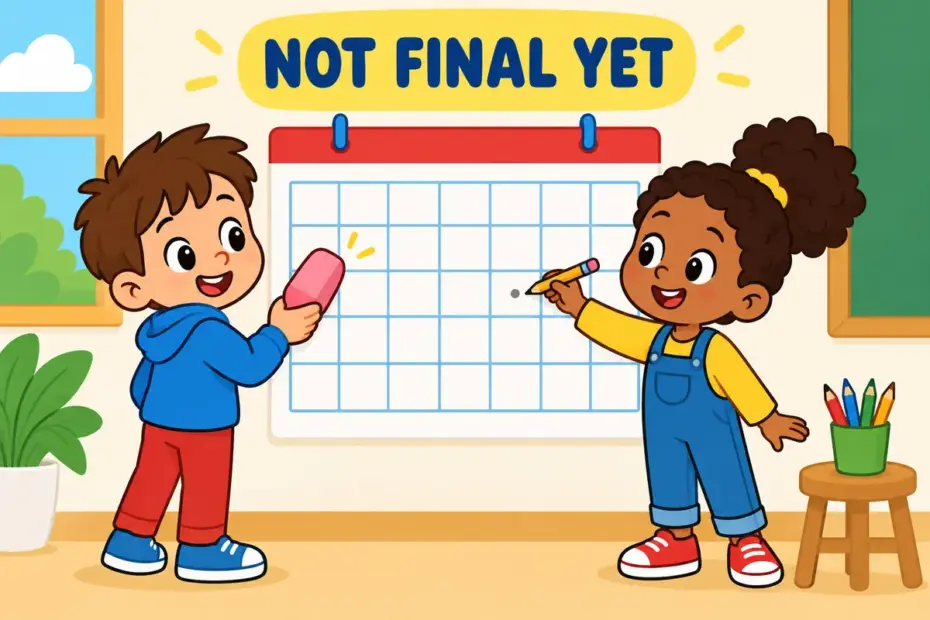
Tentative means not final or not certain, and it describes both plans and people: a tentative date may still change, and a tentative knock sounds unsure. To use tentative in a sentence, place it before a noun or after a linking verb: “We made a tentative plan for Saturday.” The adjective signals caution rather than failure.
Tentative at a glance
- Tentative is an adjective; its adverb is tentatively and its noun is tentativeness.
- The dominant patterns are tentative plus a noun and be or seem plus tentative.
- The two senses are provisional, meaning not final, and hesitant, meaning unsure in manner.
- Usual collocations include tentative plan, tentative date, tentative agreement and tentative step.
- The commonest error is treating tentative as if it meant temporary or cancelled.
What does tentative mean?
Tentative is an adjective meaning not final or not fully certain. The Cambridge entry for tentative separates a provisional arrangement from a hesitant manner. A tentative arrangement exists and is being acted on; it is simply open to change, which is why the word pairs so often with plan, date and agreement. Tentative is not temporary: a temporary measure has a planned end, while a tentative plan is waiting for a decision. When only initial or rough will do, the plainer word serves better than tentative.
| Sense | Plain meaning | Example sentence |
|---|---|---|
| Provisional | Arranged but open to change | We agreed on a tentative date in May. |
| Hesitant | Done slowly or with visible doubt | She gave a tentative wave from the doorway. |
| Exploratory | A first cautious attempt | The two sides held tentative talks last week. |
How do you use tentative in a sentence?
The adjective sits before a noun or after a linking verb, and the adverb tentatively replaces it when a verb needs describing. The table shows the patterns that sound natural.
| Pattern | Example | What it signals |
|---|---|---|
| tentative + noun | They set a tentative date for the launch. | The noun is an arrangement that may still change. |
| be, seem or sound + tentative | His reply sounded tentative. | Describes the manner of the reply rather than the plan. |
| tentative + about + noun | She was tentative about signing the lease. | Names what the person feels unsure about. |
| tentative + step, move or attempt | The company made a tentative move into Asia. | A first cautious action taken without a guarantee. |
| tentatively + verb | They tentatively agreed to meet again. | Describes how an action is carried out. |
A person who is cautious about a whole plan may still describe one date as tentative, because the adjective can point at a single detail rather than a general attitude.
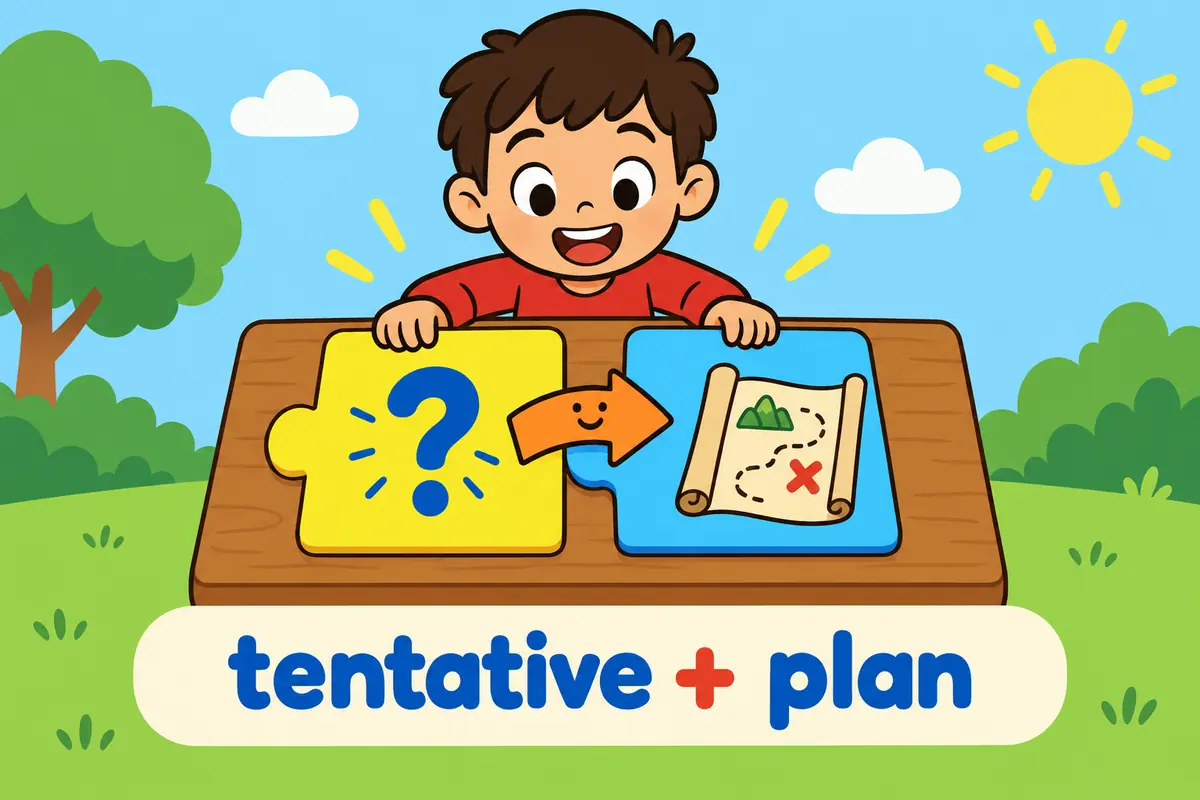
Tentative in a sentence: examples across contexts
Each row shows the adjective or its adverb in a different writing situation, because register decides how firm the word sounds.
| Context | Example sentence | Why this works |
|---|---|---|
| Workplace email | We have a tentative launch date of 14 June, pending the final review. | Marks a date that exists but can still move. |
| News report | The two sides reached a tentative agreement after overnight talks. | A newsroom standard for a deal not yet signed. |
| Academic writing | The study draws a tentative conclusion that needs more data. | Signals a cautious claim held open to revision. |
| Conversation | I gave a tentative yes, but I need to check my calendar. | Everyday speech uses it for a soft commitment. |
| Classroom | The class made a tentative guess before the experiment. | Describes a first answer held loosely. |
| Meeting notes | The team set a tentative schedule for the next quarter. | Flags a plan that can still change. |
| Home and parenting | The toddler took a few tentative steps across the rug. | Describes hesitant movement rather than a plan. |
| Customer service | We can offer a tentative delivery window of two weeks. | Sets expectations without making a promise. |
| Legal or formal | The parties signed a tentative settlement subject to approval. | A formal placeholder pending a final decision. |
When the doubt belongs to the person rather than the arrangement, uncertain about the outcome is the plainer choice, because tentative attaches more naturally to the plan itself.
Tentative vs provisional
Both words describe something not final, so readers often reach for the wrong one. The difference lies in what is expected to follow.
| Attribute | Tentative | Provisional |
|---|---|---|
| Meaning | Arranged but likely to change | Put in place to serve until something permanent arrives |
| What it applies to | Plans, dates, agreements, steps and replies | Licences, arrangements, governments and results |
| Register | General, business and conversational | Formal, official and technical |
| Typical partners | date, plan, agreement, step, smile | licence, government, measure, ruling |
| What it implies | Another decision is expected | A fixed replacement is already planned |
| Tone | Cautious, sometimes hesitant | Neutral and administrative |
Verdict: choose tentative for a plan you expect to confirm, and a provisional timetable for an official stopgap; the deciding question is whether a final version is coming.
Word forms and grammar of tentative
| Form | Part of speech | Example |
|---|---|---|
| tentative | Adjective | We set a tentative date for the fair. |
| tentatively | Adverb | They tentatively agreed to meet again. |
| tentativeness | Noun | His tentativeness faded once the tests began. |
| tentative as an adverb | Non-standard | Say she spoke tentatively, not she spoke tentative. |
The adverb is the form most learners need in speech: a group that tentatively agreed has made a decision it can revisit, and the adverb modifies agreed rather than the people.
Common mistakes with tentative
- Incorrect:
The meeting is tentative cancelled.Correct: The meeting is tentatively cancelled. Rule: use the adverb tentatively to modify a verb. - Incorrect:
Our plan is tentative, so we cancelled it.Correct: Our plan is tentative, so we may change it. Rule: tentative means open to change, not abandoned. - Incorrect:
She felt tentative about the whole career.Correct: She felt hesitant about the whole career. Rule: hesitant describes a person, while tentative usually marks one plan or action. - Incorrect:
We made a tentative appointment and never changed it.Correct: We made a firm appointment and never changed it. Rule: if nothing is likely to change, drop tentative. - Incorrect:
He gave a temporary answer.Correct: He gave a tentative answer. Rule: temporary means short-lived, while tentative means not yet final.
Practice using tentative
- Fill in the blank: The committee set a ______ date for the vote, to be confirmed later.
- Fill in the blank: She smiled ______ at the new group.
- Choose the better word: The two countries signed a (tentative / temporary) agreement that still needs approval.
- Correct the error: They tentative agreed to the schedule.
- Build a sentence: Use tentative + noun about a holiday plan.
- Spot the register: Which sentence belongs in a formal email? (a) We have a rough idea of the date. (b) We have a tentative date of 3 May.
Answers
- tentative. The date is set but not final, which is the exact sense of the adjective.
- tentatively. The adverb modifies smiled.
- tentative. The deal exists but still needs approval, so it is not final.
- They tentatively agreed to the schedule. Adverbs modify verbs, so the -ly form is required.
- Sample: We made a tentative booking for the last week of August. The noun booking names the arrangement.
- (b) We have a tentative date of 3 May. The precise adjective suits a formal message.
The bottom line
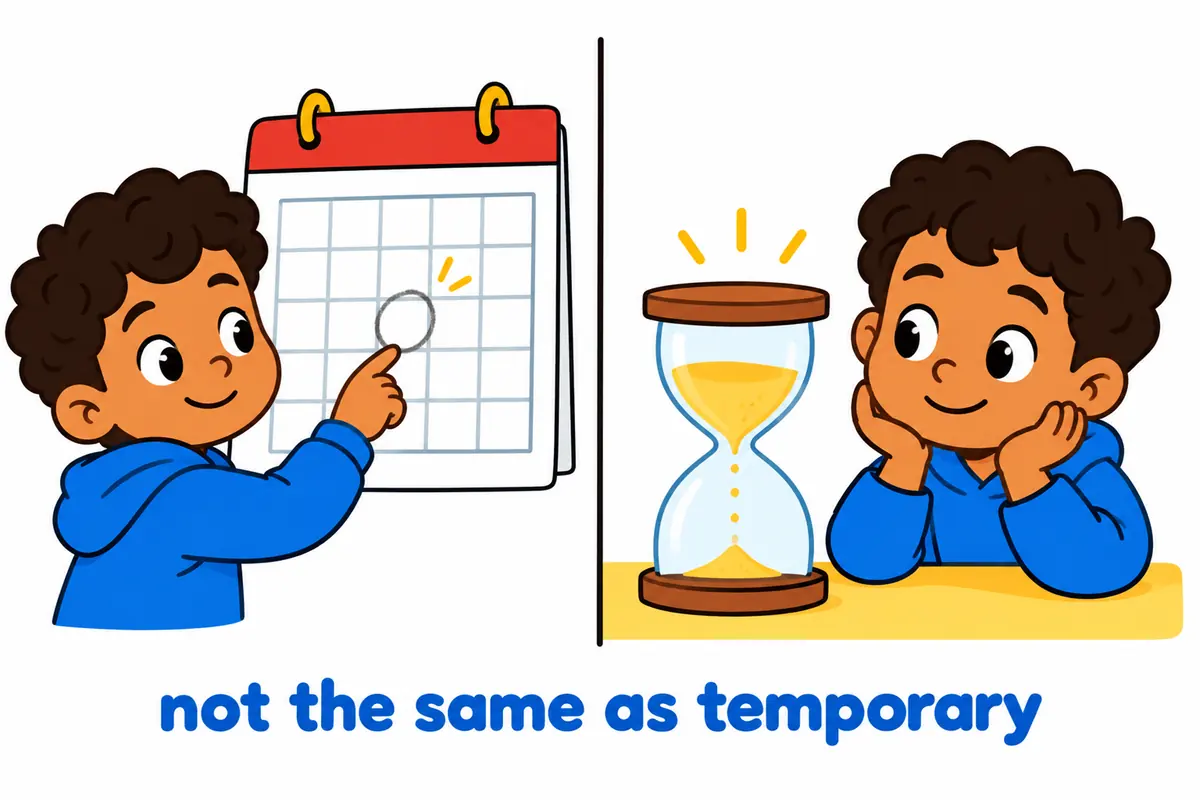
Tentative in a sentence describes something arranged but not final, whether it is a plan, a date or a step, and it keeps the possibility of change alive. It is the natural choice for provisional arrangements and for hesitant actions, and it appears before the noun far more often than after it. A tentative plan is not a temporary arrangement, because the plan still exists and is merely waiting for confirmation. Confirmation, not cancellation, is what the word expects.
Frequently asked questions about tentative
Is tentative a positive or negative word?
Tentative is mostly neutral and can be positive in business, where a tentative agreement means real progress. It turns slightly negative only when it describes a person, because a tentative manner can suggest low confidence. The intended tone depends on whether the word describes a plan or a person.
What is a tentative agreement?
A tentative agreement is a deal that both sides have accepted in outline but not yet signed or approved. News reports use the phrase because it records progress while leaving room for a final vote. Once the paperwork is complete, the deal is described as final or confirmed instead.
Can tentative describe a person?
Tentative can describe a person’s manner or movement, as in a tentative smile or tentative steps, but it usually attaches to the action rather than the whole personality. To describe a lasting trait, hesitant or cautious is the better word, because tentative points to one uncertain moment.
Does tentative mean the same as temporary?
No. Temporary means lasting only a short time, with an end already expected. Tentative means not yet final, so the thing may continue unchanged or may change after a decision. A temporary job has a finish date, while a tentative start date only needs confirmation.
Tentative in a sentence describes a plan that is not final or an action taken with uncertainty: “We made a tentative plan for Saturday.” A tentative answer or step can show hesitation. Use context to distinguish provisional status from lack of confidence, and do not present a tentative arrangement as a confirmed commitment.
Tentative at a glance
- Tentative is an adjective for something provisional or uncertain, or an action made cautiously without full confidence.
- Tentative is an adjective, tentatively is the adverb, and tentativeness is a noun naming the quality of uncertainty.
- Do not confuse tentative with temporary; an unconfirmed status differs from an arrangement intended to last a limited time.
- Context should make the intended sense clear before adding decorative description.
What does tentative mean?
Tentative is an adjective for something provisional or uncertain, or an action made cautiously without full confidence. The dictionary entry for tentative documents the basic vocabulary sense; the examples here show how that sense works in complete sentences.

Tentative in a sentence: clear examples
- We made a tentative plan for Saturday.
- The invitation gives a tentative date.
- She took a tentative step forward.
- They tentatively agreed to meet.
- He offered a tentative answer to the difficult question.
- The team reached a tentative agreement.
- The schedule remains tentative until the venue is confirmed.
- Her tentative smile suggested uncertainty within the story.
- The report offers a tentative explanation of the result.
- We treated the first idea as tentative rather than final.
How does the context change the meaning?
| Use | Meaning or pattern | Example |
|---|---|---|
| Provisional plan | tentative plan | We made a tentative plan for Saturday. |
| Unconfirmed date | tentative date | The invitation gives a tentative date. |
| Hesitant action | tentative step | She took a tentative step forward. |
| Adverb | tentatively agreed | They tentatively agreed to meet. |
Which grammar patterns are useful?
Tentative modifies a noun or follows a linking verb: tentative plans; the plans are tentative. Tentatively is the adverb: “We tentatively scheduled the meeting.” Do not write “We tentative scheduled” when the word modifies the action.
An agreement described as tentative is not presented as final in ordinary language. The exact remaining approvals or conditions depend on the situation. A clear sentence names what is still pending rather than relying on the adjective alone to communicate every qualification.
How can you avoid unclear word choices?
Tentative and temporary are different. Tentative concerns uncertainty or provisional status; temporary concerns limited duration. A confirmed two-day arrangement can be temporary without being tentative. A tentative plan may eventually become a permanent arrangement after confirmation.
Tentative also differs from careless. A cautious first step or uncertain answer can reflect care. State the unresolved point or limited confidence when it matters, and avoid changing “tentative explanation” into “proven explanation” without additional evidence.

Frequently asked questions about tentative
What is a short sentence with tentative?
“We made a tentative plan for Saturday.” is a short example using tentative. The sentence supplies a concrete setting so the meaning can be understood without a separate definition. For a classroom exercise, ask learners to identify the key relationship, then change one detail while keeping the same grammatical pattern.
Which related forms should I learn with tentative?
Tentative is an adjective, tentatively is the adverb, and tentativeness is a noun naming the quality of uncertainty. Learn related forms in a complete sentence. A change in grammatical role can require a different form even when the underlying idea remains similar. Read the surrounding subject, verb, and modifiers before deciding which form belongs.
What mistake should I check before using tentative?
Do not confuse tentative with temporary; an unconfirmed status differs from an arrangement intended to last a limited time. Check the intended meaning as well as the spelling. A sentence can be grammatically complete yet suggest the wrong relationship. When revising, name the subject and explain what the surrounding phrase contributes, then remove any word that creates an unintended implication.
Can I replace tentative with a simpler word?
Provisional fits an unconfirmed plan, while hesitant or cautious may fit a person’s tentative action or response. Choose a replacement that preserves the intended meaning and level of formality. Test it in the whole sentence: a near synonym may fit one sense while failing in another. Keep the original word when its distinction matters to the reader.
Have you ever heard of the word “tentative” and wondered what it means? To put it simply, a tentative action or decision is one that is uncertain or not firmly established. It carries a sense of hesitancy or caution.
In practical terms, a tentative plan or statement is subject to change, often depending on further information or confirmation. This flexibility allows for adjustments and refinements as needed. Let’s delve deeper into the concept of being tentative and how it plays a role in various aspects of our lives.
7 Examples Of Tentative Used In a Sentence For Kids
- We will be having a tentative picnic next week.
- The time for our tentative school assembly is 10 am.
- Our field trip to the zoo is still tentative.
- The date for the class party is tentative.
- The book fair schedule is tentative.
- Our sports day is currently tentative.
- The guest speaker’s visit is tentative.
14 Sentences with Tentative Examples
- I am tentative about choosing my major because I am interested in multiple subjects.
- I made a tentative schedule for next semester, but I might need to adjust it based on class availability.
- My friends and I are tentative about starting a study group for the upcoming exams.
- I have a tentative plan to join a club on campus, but I need more information before committing.
- I am tentative about attending the career fair because I am not sure if I am prepared.
- The professor gave us a tentative deadline for the research paper, but it might change depending on our progress.
- I am tentative about applying for an internship abroad because I am not sure if I meet all the requirements.
- My group members and I are tentative about our presentation topic and are considering other options.
- I made a tentative budget for this semester, but I need to track my expenses to see if it is realistic.
- I am tentative about signing up for summer classes because I am also considering an internship opportunity.
- The study abroad program has a tentative itinerary, but it might change based on travel restrictions.
- I am tentative about joining the debate team because I am not confident in my public speaking skills.
- I have a tentative list of grad schools I want to apply to, but I need to research more before finalizing.
- The workshop schedule is tentative, so I need to confirm the dates before registering.
How To Use Tentative in Sentences?
To use “Tentative” in a sentence, first understand that this word conveys the idea of something that is not final or definite, something that is uncertain or hesitant.
Here are some examples of how you can use “Tentative” in a sentence:
- “She gave a tentative answer to his proposal, saying she needed more time to think about it.”
- “The team made a tentative plan to meet next week, but they were not sure about their availability.”
- “His acceptance of the new job offer was tentative, as he was waiting to hear back from another company.”
When constructing a sentence with tentative, make sure that the context suggests uncertainty or hesitancy. This word is often used to describe actions, decisions, plans, or statements that are not yet firm or confident.
Remember to use the word “tentative” appropriately in your sentence while maintaining clarity and coherence. As you become more familiar with its usage, you can start incorporating it into both spoken and written communication effectively. Practice constructing sentences with “tentative” in different contexts to enhance your understanding and usage of the word.
Conclusion
In summary, the use of tentative sentences allows for flexibility in communication by indicating a level of uncertainty or openness to alternate viewpoints. These sentences often include qualifiers like “possibly,” “sometimes,” or “maybe,” providing an opportunity for further discussion or clarification.
By using tentative language, individuals can convey a sense of humility and demonstrate an understanding that knowledge is not always absolute. This can contribute to more effective and respectful communication, encouraging collaboration and mutual learning. Embracing the use of tentative sentences can lead to more nuanced conversations and a greater willingness to explore diverse perspectives, ultimately enriching interactions and fostering mutual understanding.


