
Cautious means careful about possible risks. Use it as an adjective: “The cautious cyclist slowed before the bend,” or “I am cautious about sharing personal details.” Use cautiously to describe an action and caution for the noun: “She stepped cautiously” and “She acted with caution.”
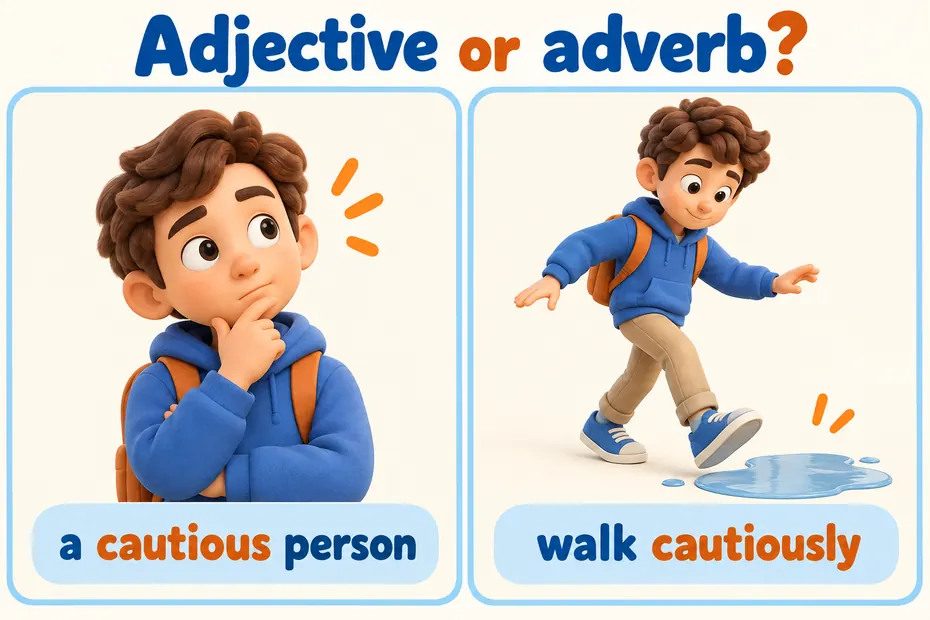
What does cautious mean in a sentence?
A cautious person considers what might go wrong before acting. The word can describe a person, a decision, an approach, or a response. Merriam-Webster’s cautious entry identifies it as an adjective connected with avoiding risk. The examples in this guide are original sentences designed to show different grammatical patterns.
Cautious does not automatically mean unwilling to act. “The cautious climber checked the rope and continued” shows preparation followed by action. “The climber refused to continue” says something different. Name the behavior that makes someone cautious so readers can understand the choice rather than guessing at a personality label.
Where does cautious go in a sentence?
Cautious has no rule requiring it to appear at the beginning. It commonly comes before a noun or after a linking verb such as be, seem, or remain. A longer introductory phrase is also possible, but that phrase must describe the subject that follows it.
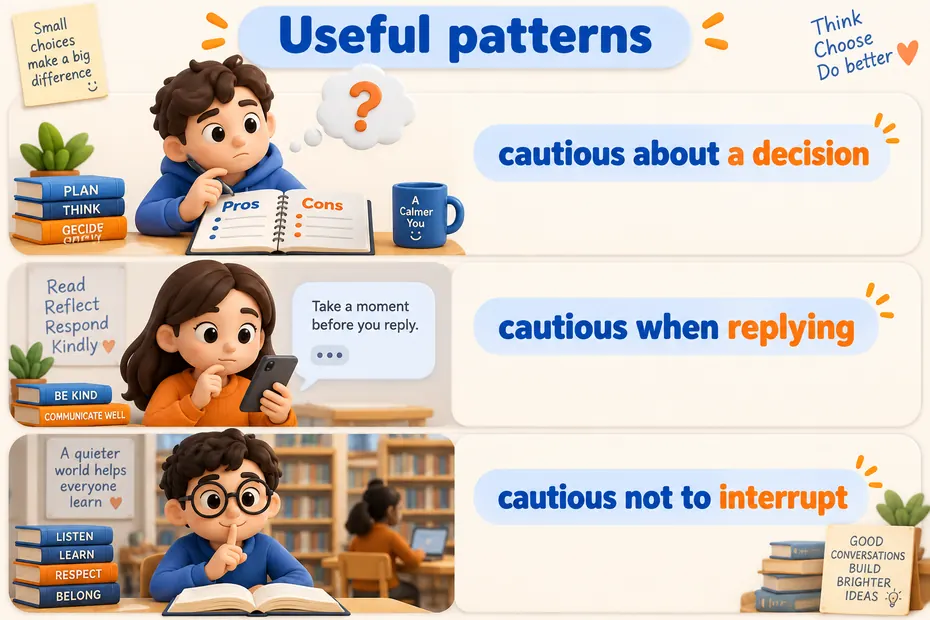
| Pattern | Original example | What it describes |
|---|---|---|
| cautious + noun | A cautious editor checked every quotation. | The editor |
| be + cautious | We were cautious during the trial run. | The subject we |
| cautious about + noun | Amira is cautious about online offers. | The area of concern |
| cautious about + -ing | He is cautious about lending his camera. | An action under consideration |
| cautious when + -ing | Be cautious when opening unfamiliar attachments. | The situation |
| cautious not to + verb | They were cautious not to reveal the ending. | An outcome to avoid |
“Cautious about the forecast, Maya packed a raincoat” works because Maya is the cautious person. “Cautious about the forecast, a raincoat went into the bag” gives that quality to the raincoat. Rewrite the second sentence with a human subject or use “Because the forecast was uncertain, Maya packed a raincoat.”
Cautious, cautiously, and caution: which form fits?
Choose the form according to its job. “He was cautious” describes him; “He answered cautiously” describes how he answered. “He answered with caution” expresses the same general idea through a noun phrase. The dictionary entry for caution also records a verb meaning to warn: “The guide cautioned us against leaving the path.”
That distinction matters in the original examples below. “He proceeded with caution” is grammatical, but it illustrates caution, not the adjective cautious. Likewise, “cautious to make a good impression” is awkward for the intended meaning. Prefer “careful to make a good impression” or “cautious about making promises at the meeting.” The second version identifies an actual concern.
More cautious sentence examples with different purposes
- The cautious driver left extra space behind the bus.
- Our teacher gave a cautious reply because the results were incomplete.
- I am cautious about accepting claims without evidence.
- The kitten was cautious at first, then approached the toy.
- A cautious estimate puts the repair at two days.
- We took a cautious approach to changing the schedule.
- Ravi remained cautious even after the first successful test.
- She was cautious not to interrupt the speaker.
These sentences cover behavior, speech, evaluation, and change over time. In “a cautious estimate,” the adjective suggests the speaker avoids overstating confidence. If a precise number matters, explain the assumptions too; the adjective alone does not reveal how an estimate was calculated.

What is cautious optimism?
Cautious optimism is hope accompanied by reservations. “The team expressed cautious optimism after the first rehearsal” means the team sees promising signs while recognizing that problems may remain. It is suitable when evidence is encouraging but incomplete. To make the sentence informative, add the reason for hope and the unresolved issue.
For example: “We are cautiously optimistic because the new timetable reduced delays, although only one week of results is available.” The adverb modifies optimistic here. Avoid using the expression as a substitute for evidence: a report becomes clearer when it identifies what has improved and what still needs checking.
Frequently asked questions about cautious
Is cautious an adjective or a verb?
Cautious is an adjective. Use “a cautious response” or “the response was cautious.” To express the action of warning someone, use the verb caution: “The supervisor cautioned us against rushing.” Do not write “the supervisor cautious us.”
Should I say cautious about or cautious of?
“Cautious about” is a useful default for a topic, decision, or activity: “cautious about signing.” “Cautious of” is also used for a possible threat. If your sentence names something suspicious, “wary of” may express that idea more directly. Select the phrase that makes the concern clear.
Does cautious mean scared?
Not necessarily. A person can take precautions calmly. “The cautious researcher checked the measurements twice” describes a careful method without claiming fear. Use words such as frightened or anxious when that emotion is what you intend to communicate.
How can I improve a sentence using cautious?
Add a concrete concern and action. “They were cautious” becomes “They were cautious about the unfamiliar route, so they checked the map before leaving.” The revision explains what prompted the caution and what the people did, making the sentence easier to picture.

Are you someone who likes to approach situations with careful thought and consideration? If so, you probably exhibit cautious behavior. Being cautious means being mindful of potential risks and taking steps to prevent harm or mistakes. It involves proceeding with care and deliberation in order to minimize negative outcomes.
People who are cautious tend to weigh their options before making decisions, seeking to avoid impulsive actions. This trait is often characterized by a sense of prudence and a willingness to take necessary precautions in various aspects of life.
7 Examples Of Cautious Used In a Sentence For Kids
- Be cautious while crossing the road.
- It’s important to be cautious around strangers.
- Always be cautious when handling sharp objects.
- Remember to be cautious around fire.
- We should be cautious when walking on slippery floors.
- Be cautious while climbing the stairs.
- Don’t forget to be cautious near electrical outlets.
14 Sentences with Cautious Examples
- Cautious about spending money, the college students decided to stick to a strict budget during their trip.
- Before signing up for any workshops, the college students made sure to do thorough research and be cautious about where they invested their time and money.
- Cautious of plagiarism, the college students always made sure to properly cite their sources in their research papers.
- Wanting to avoid any potential scams, the college students were cautious when responding to emails offering them internships abroad.
- Cautious about their personal safety, the college students made sure to always walk in well-lit areas when returning to campus late at night.
- When it came to joining new clubs on campus, the college students were always cautious about not overcommitting themselves and spreading themselves too thin.
- Cautious about their health, the college students made sure to get enough sleep and eat well-balanced meals to avoid getting sick during exams.
- Realizing the importance of networking, the college students were cautious to make a good impression when attending career fairs and industry events.
- Cautious about the credibility of online resources, the college students double-checked information from websites before including them in their assignments.
- Believing in the importance of consent, the college students were always cautious to ask for permission before borrowing someone else’s notes or materials.
- Cautious not to disrupt their sleep schedule, the college students made sure to avoid caffeine and screen time before bedtime.
- Cautious about their digital footprint, the college students regularly checked their privacy settings on social media platforms to protect their personal information.
- Knowing the risks of identity theft, the college students were cautious about sharing their personal information online.
- Wanting to excel in their academics, the college students were cautious about procrastination and always made sure to start assignments well before the due date.
How To Use Cautious in Sentences?
Using the word Cautious in a sentence is important to communicate effectively. Here is a simple guide to help beginners understand how to incorporate this word into their writing:
-
Definition: The word Cautious means to be careful and avoid risks or potential dangers.
-
Placement: Typically, the word Cautious is used at the beginning of a sentence to highlight the cautious nature of a person or action.
-
Examples:
- She was cautious when crossing the busy street.
- He proceeded with caution as he approached the wild animal.
- The company took a cautious approach to investing in the volatile market.
-
Context: When using Cautious in a sentence, consider the context of the situation to ensure the meaning is clear. It is often used to describe a state of mind or behavior.
-
Variations: To add variety to your writing, you can use synonyms of Cautious such as careful, wary, or prudent.
Remember, incorporating the word Cautious in your writing can add depth and nuance to your descriptions. Practice using it in different contexts to become more comfortable with its usage.
Conclusion
In conclusion, it is evident that using cautious sentences can help convey a sense of care, consideration, and thoughtfulness in communication. Whether in professional or personal contexts, being cautious in our choice of words can contribute to building trust, reducing misunderstandings, and promoting positive relationships. By selecting words carefully, framing thoughts thoughtfully, and being mindful of their impact, we can navigate conversations prudently and respectfully.
Cautious sentences serve as a valuable tool in expressing empathy, respect, and mindfulness towards others. They enable us to communicate effectively while also indicating our willingness to listen, understand, and address concerns considerately. Embracing cautious sentences can foster harmonious interactions and promote a culture of sensitivity and understanding in our exchanges with others.


