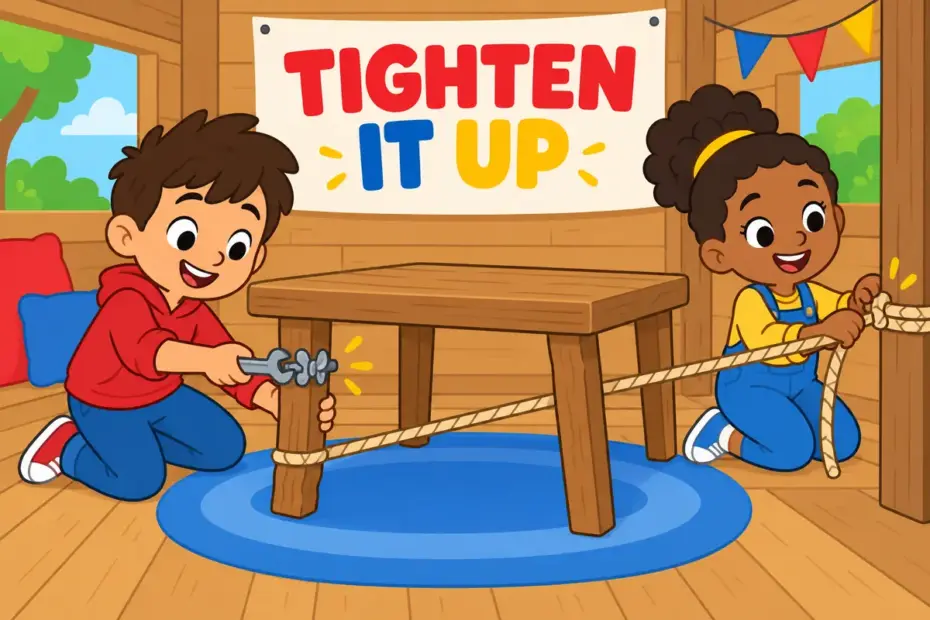
Tighten up is a phrasal verb meaning to make something firmer, stricter or neater. In a sentence it usually follows a concrete object, as in “Tighten up the bolts,” or an abstract one, as in “The board tightened up the rules.” The particle may move after the object.
Tighten up at a glance
- Tighten up is a separable phrasal verb with forms tightens up, tightened up and tightening up.
- The literal sense makes something physically firmer: “Tighten up the lid.”
- The abstract sense makes rules, security or budgets stricter: “The city tightened up parking fines.”
- An editing sense means cutting slack from writing: “Tighten up the second paragraph.”
- A pronoun object always goes between the verb and the particle: “tighten it up.”
- The commonest error is confusing tighten up with firm up, which settles a plan.
What does tighten up mean?
Tighten up is a transitive phrasal verb meaning to make something firmer, or to make controls stricter. The Cambridge entry for tighten up records both the physical and the regulatory senses, and the object tells you which is meant: bolts, lids and ropes are physical, while rules, security and budgets are not. For a single buckle or button, fasten is the precise verb, and when the goal is safety rather than tightness, secure is the better choice.
| Sense | Plain meaning | Example sentence |
|---|---|---|
| Physical | Make a fitting or fixing firmer | Tighten up the loose handle before it falls off. |
| Regulatory | Make a rule or control stricter | The league tightened up its safety checks. |
| Editorial | Remove slack from writing or a routine | Tighten up the opening paragraph to save space. |
Tighten up is the wrong choice for something that has slipped out altogether, where fix or refasten is more accurate. It also never means to make something stronger in a lasting way; that job belongs to strengthen or reinforce.
How do you use tighten up in a sentence?
Five patterns cover most uses. The object may follow the whole phrase or sit between tighten and up, but a pronoun must take the middle position.
| Pattern | Example | What it signals |
|---|---|---|
| tighten up + object | Tighten up that shelf bracket. | the thing being made firmer |
| tighten + object + up | Tighten the shelf bracket up. | the same action with the object first |
| tighten + pronoun + up | Tighten it up. | the only order a pronoun allows |
| tighten up + on + noun | The school tightened up on late arrivals. | stricter control of a behaviour |
| tighten up + a text or routine | Tighten up the final draft. | removing slack, not turning a bolt |
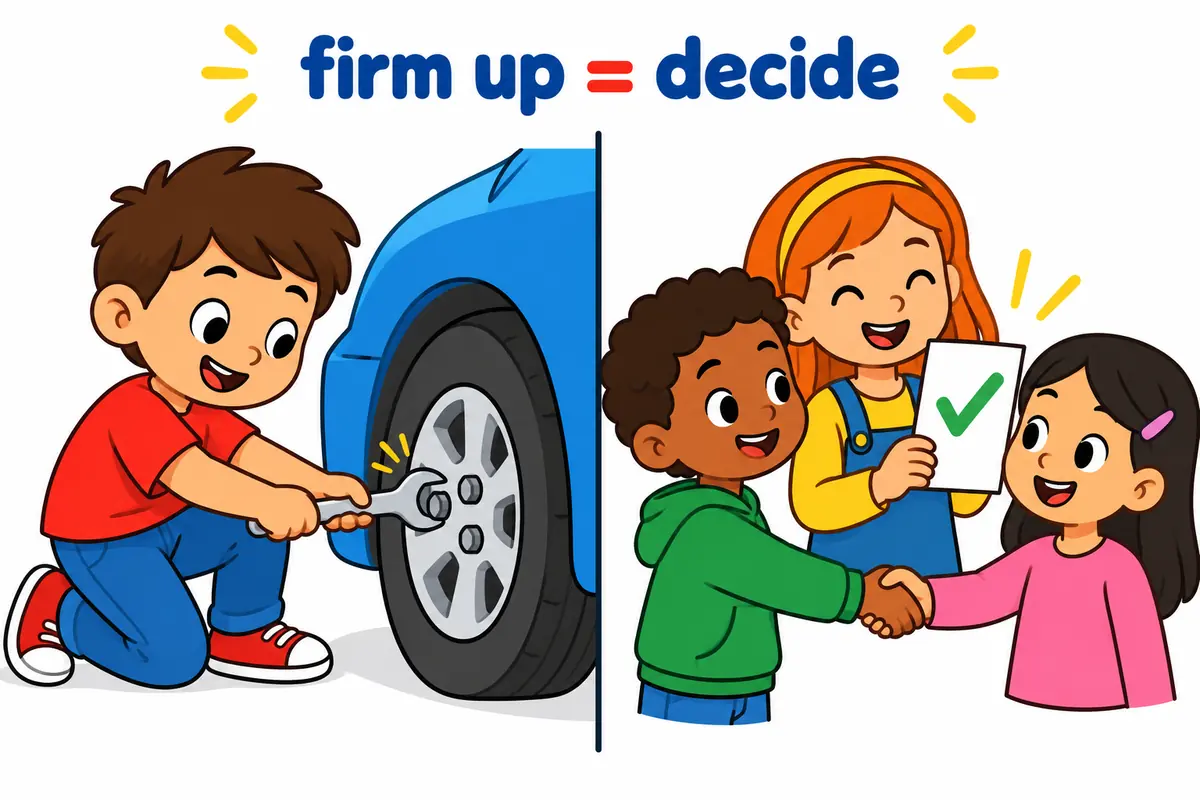
Where a plan still needs to be settled rather than firmed, firm up is the verb readers expect, because it carries the idea of deciding rather than tightening. The particle up adds a sense of completion to many verbs, exactly as it does in add up.
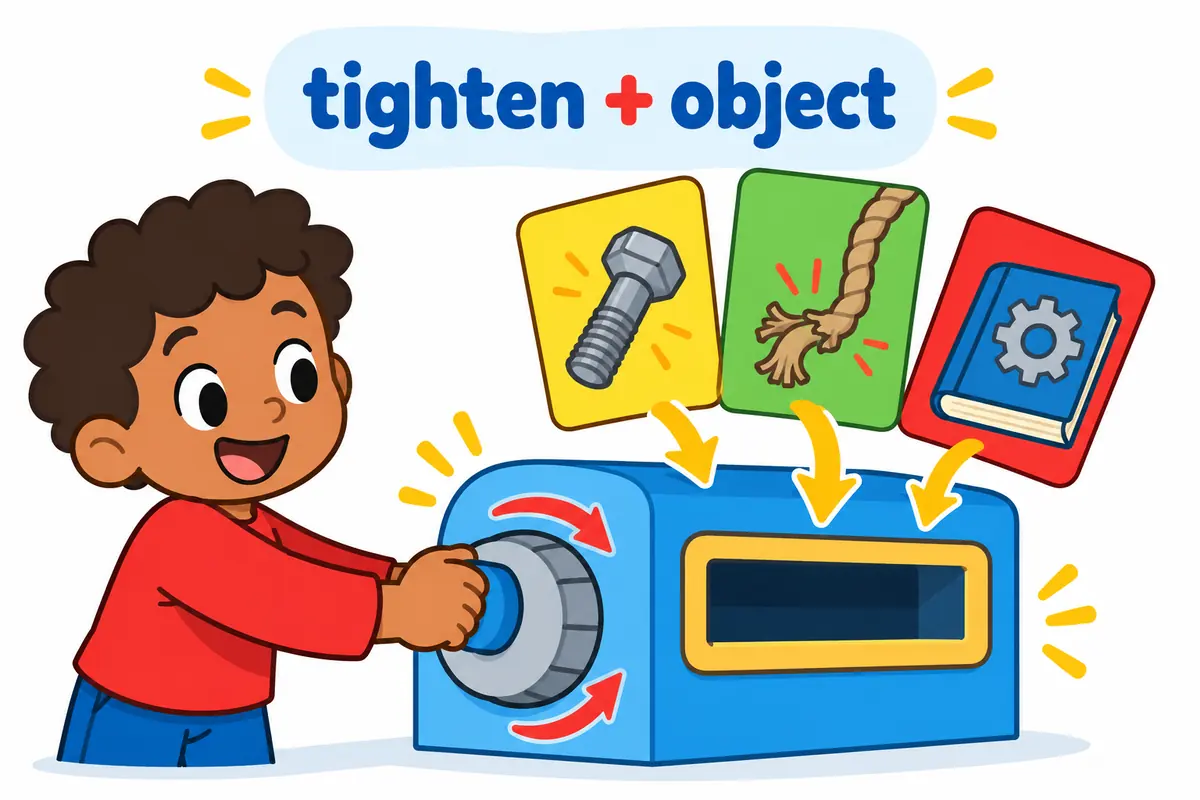
Tighten up in a sentence: examples across contexts
| Context | Example sentence | Why this works |
|---|---|---|
| Classroom | The teacher tightened up the noise rule before the test. | A rule becomes stricter, which is the abstract sense. |
| Workplace email | We tightened up the schedule to fit the new deadline. | Removing slack from a plan, not a physical object. |
| News report | Airports tightened up screening after the alert. | The regulatory sense in a formal report. |
| Technical writing | Tighten up the cable clamp to the stated torque. | The literal mechanical sense with a measured action. |
| Editing | Tighten up the middle section and the argument reads faster. | The editorial sense, cutting words rather than bolts. |
| Conversation | Tighten it up or the drawer will keep catching. | A pronoun takes the middle position. |
| Sports report | The defence tightened up after the first goal. | A collective improving its grip, an abstract sense. |
| Home advice | Tighten up the screws on the door hinge. | Everyday instruction with a concrete object. |
| Business writing | The board tightened up spending on travel. | A budget becomes stricter. |
Tighten up vs tighten and firm up
All three suggest a firmer state, but only one of them is about certainty.
| Attribute | Tighten up | Tighten | Firm up |
|---|---|---|---|
| Core meaning | Make firmer or stricter | Make firmer | Make definite or settled |
| Typical object | rules, security, a draft, a bolt | a bolt, a grip, a lid | a plan, a date, a price |
| Particle | adds a sense of finishing the job | none | adds the idea of settling |
| Register | neutral, strong in news and editing | neutral, physical | business and planning |
| What it implies | a loose thing brought back into line | turning something tighter | a decision reached |
Use tighten up for a thing that has come loose or slack, and firm up for a plan that is not yet settled. The shorter tighten keeps the physical sense without the added idea of finishing the job, and for defences, muscles or arguments, strengthen is the more common verb.
Word forms and grammar of tighten up
| Form | Part of speech | Example |
|---|---|---|
| tighten up (base) | phrasal verb | Tighten up the rope. |
| tightens up (third person) | phrasal verb | The coach tightens up the drills. |
| tightened up (past) | phrasal verb | They tightened up the rules. |
| tightening up (present participle) | phrasal verb | Tightening up the budget took a month. |
| tighten up on (phrasal verb + on) | phrasal verb | The city tightened up on littering. |
The form learners build wrongly is “tightened up on it” for a physical object; the on pattern belongs only to behaviour and rules, never to a bolt or a lid.
Common mistakes with tighten up
- Incorrect:
Tighten up it before it leaks.Correct: Tighten it up before it leaks. Rule: a pronoun object goes between the verb and the particle. - Incorrect:
The city tightened up parking rules on.Correct: The city tightened up on parking rules. Rule: on precedes the behaviour, not the rule itself. - Incorrect:
We will firm up the loose bolt.Correct: We will tighten up the loose bolt. Rule: firm up settles a plan, not a physical fitting. - Incorrect:
He tightens up the meeting date.Correct: He firms up the meeting date. Rule: dates and plans become definite, not tighter. - Incorrect:
The essay needs to tighten up.Correct: The essay needs tightening up. Rule: this transitive verb does not take the essay as its own subject here.
Practice using tighten up
Six tasks cover the physical sense, the rule sense and the editing sense.
- The plumber ______ the valve before running the test. (fill in the blank)
- The library ______ on overdue books this term. (fill in the blank)
- Choose the better verb: We need to ______ the launch date. (tighten up / firm up)
- Correct this sentence: “Tighten up it or the wheel will wobble.”
- Build a sentence with tighten up about a school making a rule stricter.
- Which sentence belongs in an editing note? (A) Tighten up the final paragraph. (B) Tighten up the door hinge.
Answers
- tightened up — a valve is a physical object being made firmer.
- has tightened up — the rule sense takes on after the phrase.
- firm up — a date needs to be settled, not tightened.
- Tighten it up or the wheel will wobble — the pronoun goes in the middle.
- The school tightened up the late-arrival rule — tighten up plus object marks the stricter rule.
- Sentence A — tighten up about a draft is the editorial sense.
The bottom line
Tighten up does one job in three settings: it makes a fitting firmer, a rule stricter or a draft neater. The object tells you which sense is active, and the particle may move after that object unless it is a pronoun. Choose firm up when the goal is a settled decision rather than a firmer state. Used that way, tighten up in a sentence always points at something loose being brought back into line.
Frequently asked questions about tighten up
Is tighten up one word or two?
It is always two words in a sentence. Writers sometimes use the hyphenated form as an adjective before a noun, as in a tighten-up plan, but that is rare. As a verb, keep tighten and up separate, and note that a pronoun object must sit between them.
Can you tighten up writing?
Yes. In editing, tighten up means removing slack, repetition and vague clauses so the argument moves faster. An editor might say the report reads well but needs tightening up in the middle. The object is text or a routine, not a physical fitting.
Does tighten up always mean physically tight?
No. Only the literal sense is physical. The word also covers stricter rules, tighter security and neater prose. A sentence about airports tightening up screening is about checks, not bolts, so the surrounding noun decides which meaning a reader takes.
Can tighten up be used without an object?
Usually it needs one, because it is transitive. The exception is the intransitive sense of a group getting a firmer grip, as in the defence tightened up after the break. Even there, the subject stands for the thing that becomes tighter.
When we talk about tightening up, we refer to the process of making something more secure, compact, or efficient. It involves making adjustments or improvements to bring something into a better, more functional state.
Whether it’s tightening up a loose screw, a loose schedule, a loose budget, or even a loose writing style, the concept of tightening up applies across various aspects of our lives. By addressing inconsistencies, inefficiencies, or vulnerabilities, tightening up ensures a smoother operation and a more polished final product.
7 Examples Of Tighten Up Used In a Sentence For Kids
- Tighten up your shoelaces before going to play outside.
- Don’t forget to tighten up your backpack so nothing falls out.
- Let’s all work together to tighten up the ropes on the swing set.
- Remember to always tighten up the lid on your water bottle.
- Before painting, make sure to tighten up the cap on the marker.
- It’s important to tighten up the screws on your toys so they stay in one piece.
- Before riding your bicycle, double check to tighten up your helmet strap.
14 Sentences with Tighten Up Examples
- Tighten up your study schedule if you want to improve your grades this semester.
- Make sure to tighten up your resume before submitting it for internship applications.
- It’s time to tighten up your budget and cut down on unnecessary expenses.
- Tighten up your presentation skills before the next class project.
- Remember to tighten up your time management skills to balance academics and extracurricular activities.
- Don’t forget to tighten up your referencing and citation skills for your research papers.
- It’s important to tighten up your communication skills for group projects and presentations.
- Tighten up your understanding of key concepts before the upcoming exams.
- Make sure to tighten up your networking skills to build connections in your field.
- Tighten up your writing skills to enhance the quality of your assignments.
- Don’t procrastinate, it’s time to tighten up your study habits.
- Focus on tightening up your critical thinking skills for analytical assignments.
- Prioritize and tighten up your daily tasks to stay organized and productive.
- Begin to tighten up your studying technique to maximize retention and understanding of the material.
How To Use Tighten Up in Sentences?
To use “Tighten Up” in a sentence, you can follow these steps:
First, identify the areas in your writing that may need to be more concise or could benefit from stronger language. This could include cutting out unnecessary words, clarifying your message, or making your point more impactful.
Next, think about how you can incorporate the phrase “Tighten Up” into your sentence. For example, you could use it to describe the process of revising and improving your writing.
Then, place the phrase in a way that makes sense within the context of your sentence. This could be at the beginning, middle, or end of the sentence, depending on where it fits best.
Finally, read your sentence out loud to make sure it flows smoothly and effectively communicates your intended meaning. If you feel that “Tighten Up” adds value to your sentence and enhances your writing, then you have successfully used it in a sentence.
Overall, incorporating the phrase “Tighten Up” into your writing can help you to be more concise, impactful, and intentional with your words. Practice using it in different contexts to become more comfortable and fluent in expressing your ideas with precision and clarity.
Conclusion
In summary, by incorporating sentences with “tighten up” into your writing or speech, you can emphasize the need for improvement, refinement, or precision. Whether referring to making adjustments to plans, strategies, or physical objects, using this phrase can convey the importance of efficiency and attention to detail. For instance, “We need to tighten up our budget to avoid overspending” highlights the necessity of managing finances carefully, while “I’ll tighten up my presentation to communicate key points more effectively” underscores the significance of clarity and conciseness in communication.
By using sentences with “tighten up,” you can effectively communicate the need to streamline, refine, or enhance various aspects of your work, project, or performance. This can help convey a sense of purpose and commitment to excellence, encouraging others to prioritize efficiency and precision in their endeavors.


