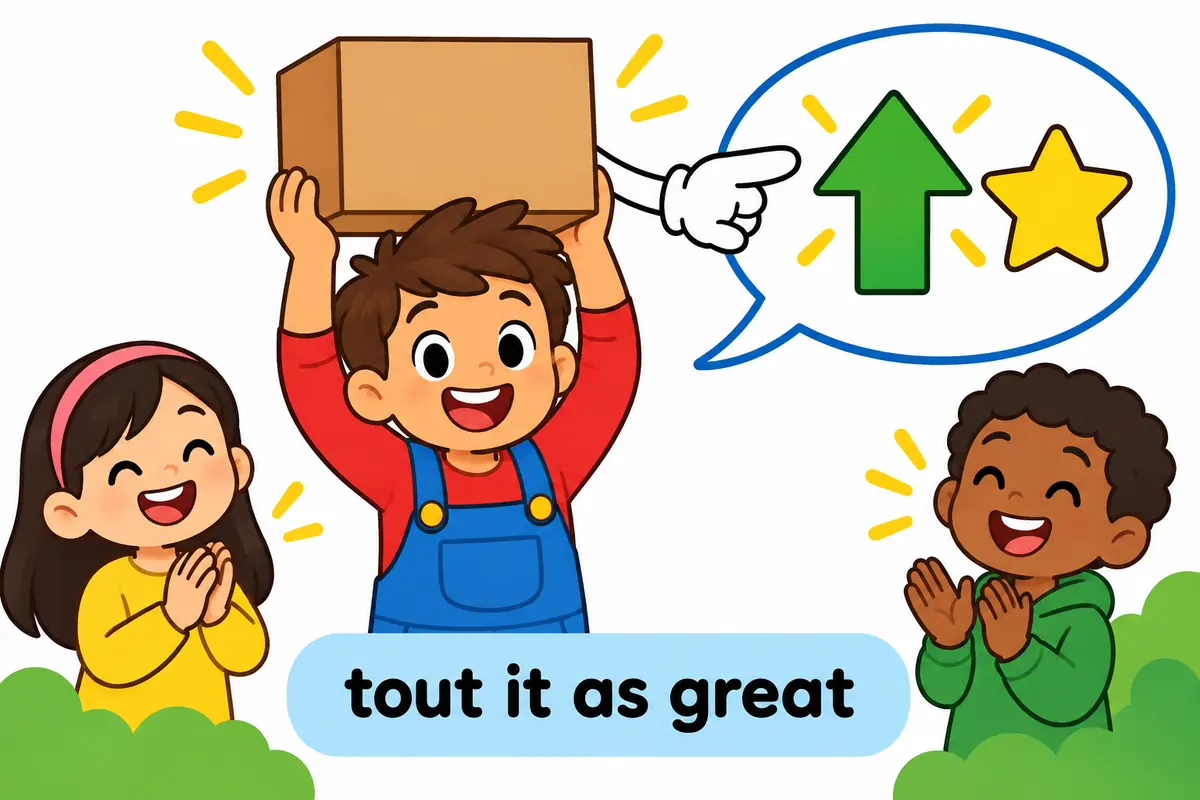
Tout means to praise or advertise something enthusiastically, and in British English it also means to resell tickets at a profit. To use tout in a sentence, name the promoter and the thing promoted, as in companies tout a phone as a breakthrough. The verb is transitive, so it always needs an object.
Tout at a glance
- Tout is a verb, with the forms touts, touted and touting; in British English it is also a noun.
- The verb is transitive, so it always needs a direct object such as a product, a plan or a person.
- The most common pattern puts as after the object to name the claim being made.
- The usual subjects are companies, agents, fans, adverts and ticket sellers.
- The commonest error is adding about after tout, which the verb never takes.
What does tout mean?
Tout is a verb meaning to praise or advertise something enthusiastically, sometimes in a way that sounds exaggerated. The Cambridge entry for tout records both the selling sense and the praise sense, and the difference shows in the object: you tout a product to buyers, but you tout a policy as a success. Where you only mean to promote a product without a hint of sales talk, the plainer verb fits better.
| Sense | Plain meaning | Example sentence |
|---|---|---|
| Praise or promote | Advertise something eagerly, often with doubt implied | The startup touted its app as a cure for procrastination. |
| Try to sell | Offer goods or tickets for sale, often persistently | A man was touting umbrellas outside the station. |
| Ticket reseller (noun) | A person who buys tickets and resells them at a high price | Touts were asking three times the face value. |
One limitation is worth stating plainly. Tout is not a neutral word: it often hints that the praise is louder than the evidence. If nothing doubtful is implied, advertise, recommend or praise is the safer choice, and tout should be kept for the moments when the promotion itself is the point.
How do you use tout in a sentence?
Put the thing being promoted straight after the verb, and add as when a claim follows: firms tout a phone as a breakthrough. Five patterns cover almost every real sentence, and the passive is the one news writing reaches for most.
| Pattern | Example | What it signals |
|---|---|---|
| tout + object | The agent touted her new novel. | The promoted thing is the direct object. |
| tout + object + as + noun | They touted the deal as a bargain. | The as-phrase names the claim. |
| be touted as | The drug is touted as a safe alternative. | Passive keeps attention on the claim. |
| tout for + business | The shop touts for business at the market. | A British pattern meaning to seek customers. |
| tout as a noun | A ticket tout waited outside the stadium. | The same spelling names the seller in British English. |
News desks prefer the passive because the claim, not the promoter, is the story, and when the aim is neutral coverage they publicize an event rather than tout it. In British English, tout for business means to seek customers actively, often by approaching them directly.
Tout in a sentence: examples across contexts
Tout keeps its meaning as it moves between registers, but the hint of sales pressure grows stronger outside the classroom. Teachers who simply want to praise a pupil would not use it, because tout implies an audience to persuade. Each example below names the promoter and the claim.
| Context | Example sentence | Why this works |
|---|---|---|
| Classroom | The class captain touted the recycling plan as the cheapest option. | A concrete plan and a cost claim make the praise testable. |
| Workplace email | Sales touted the new schedule as a fix for late deliveries. | Pairs the promoted thing with the problem it claims to solve. |
| News report | The firm was touted as a leader in battery design. | The passive keeps the claim, not the firm, in focus. |
| Advertising | The advert touts the phone as unbreakable. | A commercial subject matches the hint of exaggeration. |
| Sports writing | Fans touted the rookie as the next champion. | Names who is promoting and the bold comparison they make. |
| Conversation | My uncle keeps touting a diet he read about online. | The present continuous suggests repeated, unwelcome promotion. |
| Travel writing | Touts were selling train tickets at the gate. | The noun form fits the British scene at a station. |
| Academic writing | The paper touts the method as more reliable than the old one. | A formal source can still tout when it pushes a claim. |
Notice that tout almost always comes with a claim in the as-phrase. Remove that claim and the sentence stops sounding like promotion and starts sounding like recommendation.
Tout vs boast
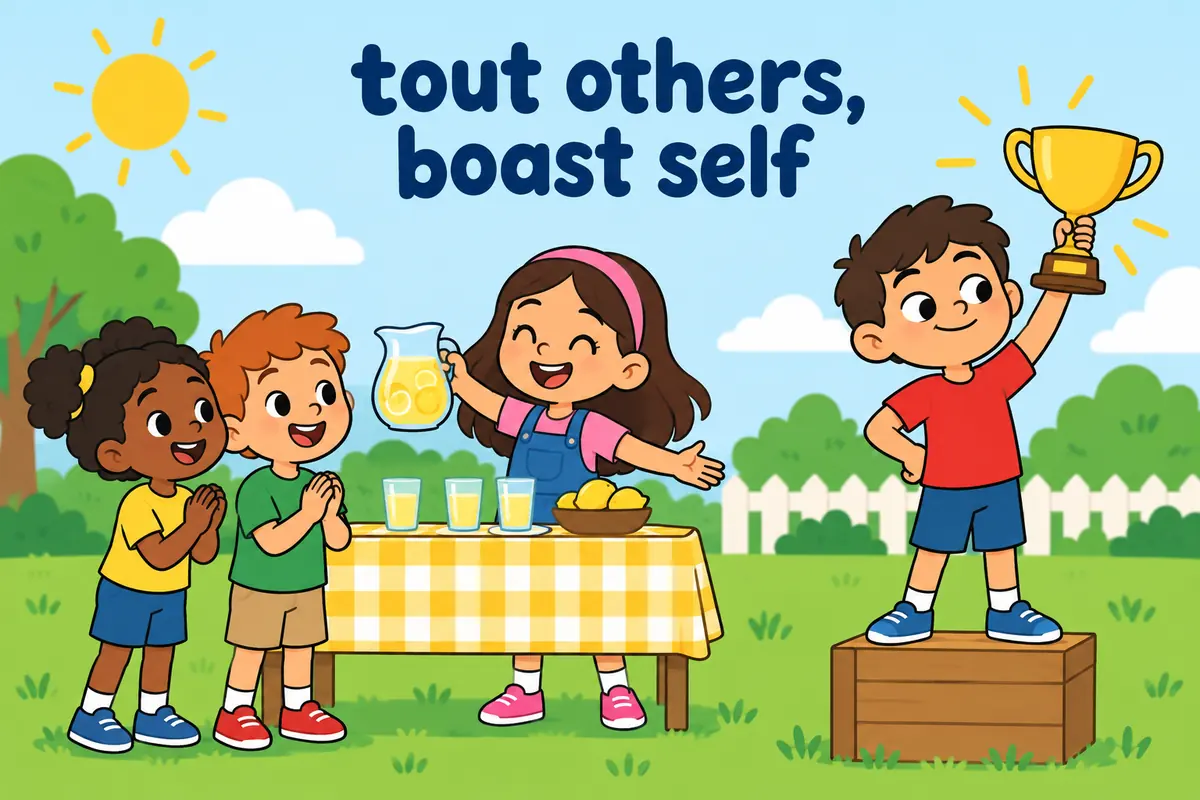
Tout is closest to boast in meaning, but the two point in different directions: tout pushes something outward, boast turns the praise back on the speaker. When somebody is praising their own record, boast about a win is the natural choice.
| Attribute | tout | boast |
|---|---|---|
| Core meaning | Advertise or promote something to others | Talk proudly about oneself or one’s deeds |
| Grammar | Takes a direct object; often tout x as y | Takes about, of or a that-clause |
| Whose credit | Usually promotes another person’s thing | Centres the speaker’s own achievement |
| Tone | Eager, sometimes suspicious of exaggeration | Proud, neutral to boastful |
| Example | The coach touted the young keeper as a future star. | The coach boasted that he had found the keeper. |
Verdict: choose boast when a speaker is praising themselves, tout when they are promoting something to an audience, and advertise when no hint of exaggeration is intended.
Word forms and grammar of tout
Tout inflects regularly, and the same spelling doubles as a noun in British English for somebody who resells tickets. A friend who recommend a book simply likes it, while a tout wants a sale.
| Form | Part of speech | Example |
|---|---|---|
| tout | verb, base form | Companies tout the tablet as a study tool. |
| touts | verb, third person singular | The poster touts a sale that ends on Friday. |
| touted | verb, past and past participle | The film was touted as a hit before release. |
| touting | verb, present participle | He was touting umbrellas in the rain. |
| tout | noun, British | A tout sold us two tickets at the gate. |
| touted | adjective, non-standard as a noun | Use tout, not touted, for the person selling. |
Common mistakes with tout
- Incorrect:
The firm touted about its new drug.Correct: The firm touted its new drug. Rule: Tout is transitive and takes no about. - Incorrect:
The film is touted the best of the year.Correct: The film is touted as the best of the year. Rule: The passive needs as before the claim. - Incorrect:
She touted that she would win.Correct: She boasted that she would win. Rule: Tout does not take a that-clause; boast does. - Incorrect:
He touted me to buy shares.Correct: He urged me to buy shares. Rule: Tout means promote or sell, not urge a person to act. - Incorrect:
The ticket touted was arrested.Correct: The ticket tout was arrested. Rule: The seller is a tout, never a touted.
Practice using tout
Work through the six items, then check the reasoning rather than only the answer.
- Fill the gap: The company ______ the tablet as a tool for students.
- Choose the better word: The champion (touted / boasted) his own record after the race.
- Correct the error: They touted about the new library.
- Build a sentence: use be touted as about a young footballer.
- Spot the register: which belongs in a news report — Officials touted the scheme as a success, or We totally touted it?
- Rewrite with the noun: Shoppers were pestered by people selling tickets. Use tout as a noun.
Answers
- touted — the tablet is the object and as introduces the claim.
- boasted — the champion praises his own record, which is the boast pattern, not tout.
- They touted the new library — tout takes a direct object and never about.
- Model answer: The winger was touted as a future international by his own manager.
- Officials touted the scheme as a success — a report prefers the passive and avoids totally.
- Touts pestered shoppers outside the ground — the noun names the sellers.
The bottom line
Use tout in a sentence when something is being promoted, and let the as-phrase carry the claim: a company touts a phone as a breakthrough. Two nuances decide most sentences: the verb is transitive, so it always needs an object, and it carries a faint warning that the praise may be louder than the proof. Readers who want to champion a cause should remember that tout implies an audience to persuade, so advertise, praise or recommend may be the fairer word when the support is genuine.
Frequently asked questions about tout
Is tout a negative word?
Tout is not always negative, but it carries a hint of suspicion that a plainer verb does not. A firm can tout a genuine product, yet readers hear the sales pressure. When you want neutral praise, choose advertise, recommend or praise; keep tout for moments when loud promotion is exactly what you mean.
What does tout for business mean?
Tout for business is a British pattern meaning to seek customers actively, often by approaching people directly. A shop, taxi driver or agent can tout for business outside a station or at a market. The phrase rarely appears in American English, where seek customers or drum up trade is the usual wording.
What is the difference between tout and taunt?
Tout and taunt differ by one letter but share no meaning. Tout means to promote or sell something, while taunt means to mock or provoke somebody with unkind remarks. Because the spellings are so close, learners sometimes write taunt for praise; check whether the sentence is about promotion or about teasing.
Can tout be used as a noun?
Yes, in British English a tout is a person who buys tickets and resells them at a higher price. The noun takes the same spelling as the verb, so a ticket tout is the seller and to tout tickets is the activity. In American English the noun is rare and scalper is used instead.
Have you ever heard the term “tout” and wondered what it means in English? Simply put, “tout” is a verb that means to promote or brag about someone or something in a boastful manner.
When you “tout” something, you are enthusiastically praising or recommending it to others, often in an attempt to persuade them to believe in its value or effectiveness. It is a common verb used in marketing, advertisement, and everyday conversations to highlight the positive aspects of a product, service, or idea.
7 Examples Of Tout Used In a Sentence For Kids
- Tout the animals went to the farm.
- We need to tout the colors of the rainbow.
- Let’s tout the numbers from one to ten.
- Can you tout all the shapes you see?
- I want to tout the fruits in the basket.
- Tout the letters of the alphabet are important.
- We should tout the days of the week.
14 Sentences with Tout Examples
- Tout le monde a participé à la fête de fin d’année.
- Je dois terminer tout le travail avant la date limite.
- As-tu lu tout le chapitre pour le cours de littérature?
- Il est important de rester organisé pour gérer tout ce qui se passe à l’université.
- La bibliothèque universitaire a tout ce dont j’ai besoin pour mes recherches.
- J’ai visité tout le campus pour trouver les meilleurs endroits où étudier.
- Il faut être prêt à faire face à tout type de question lors des examens.
- Karthik a cherché tout autour de lui avant de retrouver son carnet de notes.
- Les étudiants étaient excités à l’idée de partir en voyage et de découvrir tout ce que le monde a à offrir.
- Pour mieux gérer son temps, Simran a décidé de planifier tout son semestre à l’avance.
- L’association des étudiants a réussi à organiser une collecte de fonds pour aider tout le monde dans le besoin.
- Tout s’est bien passé lors de la présentation du projet devant les professeurs.
- Nous devons nous assurer de sauvegarder tout notre travail sur notre ordinateur pour éviter de le perdre.
- Son discours a captivé tout l’auditoire et a suscité de nombreuses discussions.
How To Use Tout in Sentences?
Tout is a versatile word that can be used in various contexts to convey different meanings. Here is a helpful guide on how to use tout in a sentence for beginners:
-
Tout meaning “to promote or boast about something”: “She likes to tout her baking skills to everyone she meets.”
-
Tout can also mean “to sell or advertise something widely”: “The company decided to tout their new product through social media ads.”
-
Alternatively, tout can be used to indicate “to advocate or support something strongly”: “The doctor continued to tout the benefits of a healthy lifestyle to her patients.”
-
Tout can also be used as a noun, referring to “a person soliciting business or promoting a product”: “The street tout handed out flyers for the upcoming event.”
-
Finally, tout can mean “to completely tout something or someone”: “He was tout as the best candidate for the job.”
By understanding these different meanings and contexts of tout, you can effectively incorporate this word into your conversations and writing. Remember to consider the tone and context of your sentence to ensure you are using tout correctly and effectively.
Conclusion
In conclusion, the use of sentences with the word “tout” can effectively convey a sense of promoting or emphasizing something. Whether it is touting the benefits of a product, highlighting achievements, or showcasing talents, “tout” can capture attention and persuade audiences. By employing sentences with “tout,” individuals can sway opinions, build credibility, and generate interest in their offerings.
The versatility of “tout” in sentences allows for clear and assertive communication. They can help drive home points, boost confidence, and make a strong impression on readers or listeners. Whether used in marketing, personal statements, or presentations, sentences with “tout” can be a powerful tool in effectively showcasing the value and importance of a particular subject.