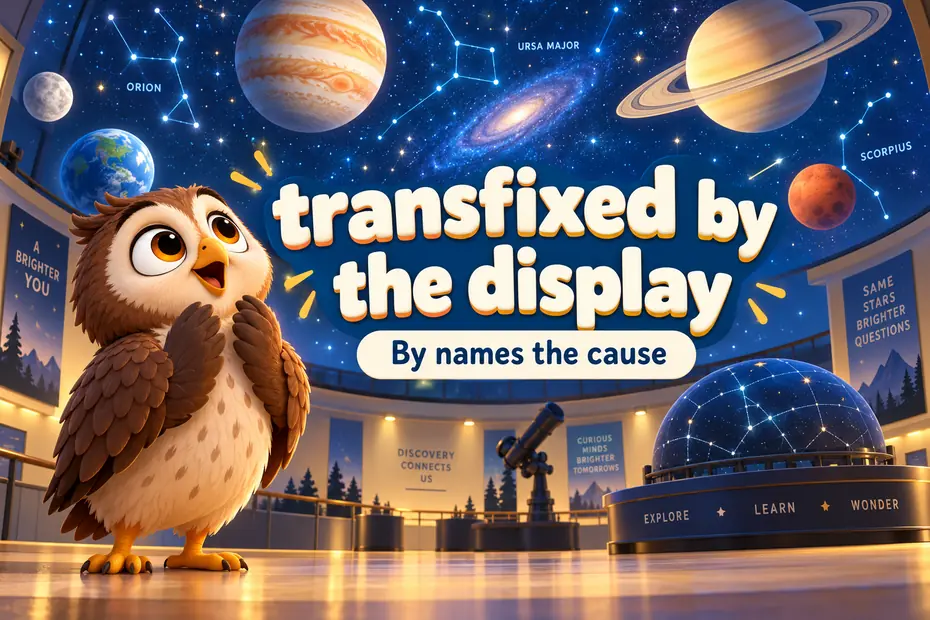
Transfixed describes someone held motionless or unable to turn away because of a strong reaction, such as fascination, surprise, or fear. A clear sentence names both the observer and the cause: “The children stood transfixed by the display.” Use transfixed for an intense reaction, rather than ordinary attention.
What are the main facts about transfixed?
- Base verb: transfix.
- Past tense and participle: transfixed.
- Common construction: was or were transfixed.
- Cause: transfixed by a sight, performance, or event.
- Reaction: transfixed with surprise, fear, or amazement.
- Tone: vivid and stronger than simply interested.
How do you use transfixed by and transfixed with?
Use by to identify the cause and with to identify the emotion. “The audience was transfixed by the final scene” names the scene that caused the reaction. “The audience stood transfixed with amazement” names the reaction itself. A writer can combine the information if the sentence remains clear.
Oxford Learner’s Dictionaries labels transfix usually passive and describes an inability to move through fear, surprise, or a similar reaction. This supports a wider meaning than fascination alone. A frightening discovery can leave a person transfixed even when the person finds nothing enjoyable about it.
| Pattern | Original example | What follows |
|---|---|---|
| Was transfixed by | Nora was transfixed by the unfolding scene. | The cause. |
| Stood transfixed with | Nora stood transfixed with surprise. | The emotion. |
| Held someone transfixed | The performance held Nora transfixed. | The person affected. |
| Left someone transfixed | The unexpected announcement left Nora transfixed. | The resulting state. |

Which examples show different reactions?
Transfixed can suggest wonder, suspense, shock, or fear. These original sentences use context to make the particular reaction visible instead of describing every scene as beautiful.
- The visitor stood transfixed by the moving sculpture.
- The children watched, transfixed, as the lanterns rose.
- She remained transfixed with surprise at the unexpected news.
- The final scene held the audience transfixed.
- For a moment, he was transfixed by the sound behind him.
- The student stood transfixed before the enormous telescope.
- The storyteller left the listeners transfixed until the last line.
- Transfixed by the view, Lina forgot to lift her camera.
The last example adds a concrete consequence: Lina does not take the photograph she intended to take. That consequence makes the intensity plausible. In a quieter context, “Lina admired the view” may be more accurate. Avoid adding transfixed automatically to any sentence in which somebody looks at something.
How do you attach a transfixed opening to the right subject?
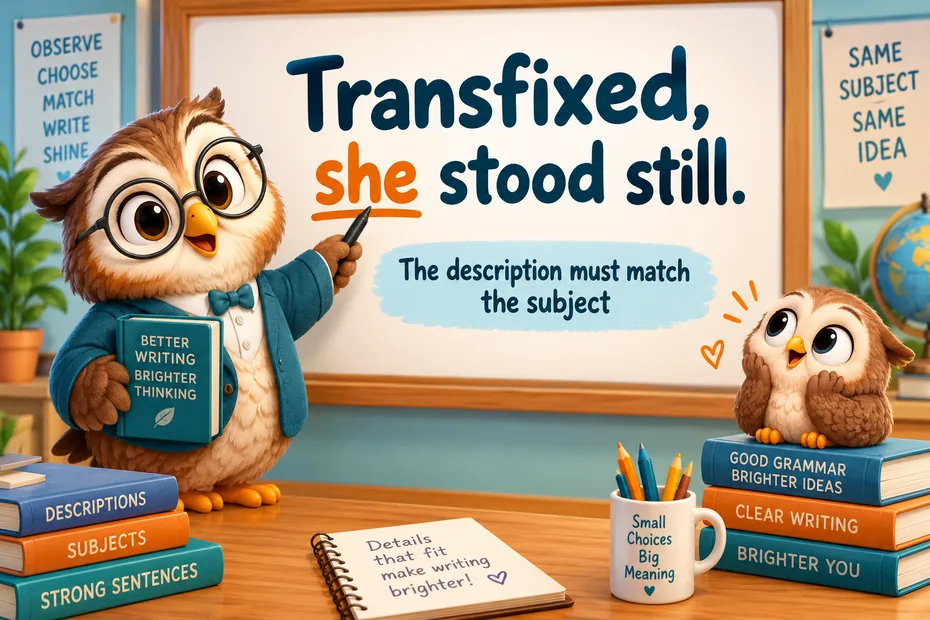
The subject after an introductory participial phrase should be the person who is transfixed. “Transfixed by the display, the children stood silently” clearly identifies the children as observers. “Transfixed by the display, the room grew quiet” accidentally makes the room the grammatical target of the description.
A small revision fixes that mismatch: “The children were transfixed by the display, and the room grew quiet.” Another option is to remove the opening phrase: “The room grew quiet as the children watched the display.” In either version, the reader can distinguish the observer, the cause, and the resulting action without decoding a misplaced modifier.
How does transfixed differ from interested or mesmerized?
Transfixed emphasizes a powerful hold and stillness; interested merely describes attention or curiosity. “The class was interested in the experiment” says the class wanted to follow it. “The class stood transfixed as the model unfolded” presents a more intense and visibly still reaction.
| Word | Useful emphasis in a description | Original model |
|---|---|---|
| Interested | Curiosity or attention. | The group was interested in the design. |
| Fascinated | Strong curiosity or attraction. | The group was fascinated by the mechanism. |
| Transfixed | Held still or unable to turn away. | The group stood transfixed as it opened. |
Near-synonyms may fit the same event but change the writer’s emphasis. Choose the term supported by what the scene shows. A claim about a whole audience should not silently assume that every person had the same emotional response; in a factual account, attribute a subjective description when needed.
Does the verb have a literal meaning as well?
Yes. Transfix also has a literal piercing sense. Merriam-Webster records both the held-motionless meaning and the piercing meaning. Most everyday examples about an audience or a view use the figurative attention sense. The earlier introduction below focuses on that figurative sense but should not be treated as an exhaustive definition.
For beginner sentence practice, the reaction pattern is usually easier to understand: “She was transfixed by the display.” A specialist or historical context may use the literal verb differently, so read the object and surrounding action before deciding which definition applies.
Frequently asked questions
Can someone be transfixed by fear?
Yes. The word can describe being held still by fear or shock, rather than enjoyment. “He stood transfixed with fear” names the emotion; “He was transfixed by the sudden noise” names the cause. Add context if the reader might otherwise assume fascination.
Is transfixed a past tense or an adjective?
Transfixed is the past form and past participle of transfix, and it can also describe a state in participial constructions. “The scene transfixed her” is an active past-tense sentence. “She remained transfixed” describes her continuing state. The complete construction determines the grammatical function.
Can I write transfixxed?
No. The standard spelling is transfixed, with one x. The base verb is transfix, the -ing form is transfixing, and the third-person present form is transfixes. Keep the base spelling intact rather than adding an extra x when changing the verb form.
Original sentence collection and explanations
Have you ever been so captivated by something that you were completely unable to look away? This experience of being entranced, spellbound, and utterly absorbed is what it means to be transfixed.
When someone is transfixed, their full attention is fixated on a particular object, person, or scene, leaving them motionless and in a state of fascination. This word describes a powerful hold that something has over an individual, rendering them momentarily unable to break free from the intense focus it demands.
7 Examples Of Transfixed Used In a Sentence For Kids
- The butterfly landed on the flower, and I was transfixed by its beauty.
- The magician’s tricks had us all transfixed in amazement.
- The colorful fish in the aquarium had the children transfixed.
- As the fireworks lit up the sky, the crowd was transfixed by the display.
- The dancer twirled and pirouetted, leaving everyone transfixed.
- The lion roared loudly, leaving the zoo visitors transfixed.
- The storybook had the children transfixed until the very end.
14 Sentences with Transfixed Examples
- Transfixed by the captivating lecture, the students sat in complete silence.
- The students were transfixed by the professor’s explanation of the complex mathematical theorem.
- As the guest speaker shared her experiences, the audience was transfixed by her words.
- Transfixed by the intricate dance routine, the students couldn’t take their eyes off the performers.
- The students were transfixed by the breathtaking view from the top of the mountain.
- Transfixed by the intense debate, the students eagerly listened to both sides of the argument.
- The students were transfixed by the documentary showcasing wildlife conservation efforts.
- Transfixed by the climax of the movie, the students held their breath in anticipation.
- The students were transfixed by the powerful poetry recitation during the open mic night.
- Transfixed by the latest technology demonstration, the students marveled at the advancements being made.
- The students were transfixed by the magician’s sleight of hand tricks during the college carnival.
- Transfixed by the energetic dance performance, the students couldn’t resist tapping their feet along with the music.
- The students were transfixed by the astronomy professor’s explanation of the constellations visible in the night sky.
- Transfixed by the intriguing story being told, the students eagerly awaited the next plot twist.
How To Use Transfixed in Sentences?
To use the word Transfixed in a sentence, follow these steps:
-
Understand the meaning of the word: Transfixed means to be captivated or entranced by something, unable to move or look away.
-
Choose the right moment to use it: Use Transfixed when you want to describe a situation where someone is completely absorbed or fascinated by something.
-
Structure your sentence: Place Transfixed in the appropriate location within your sentence. For example, “She was transfixed by the stunning sunset.”
-
Context is key: Make sure the sentence conveys a clear image of the person being completely engrossed in whatever has caught their attention.
-
Practice makes perfect: Take every opportunity to incorporate Transfixed into your conversations or writing to become more comfortable using the word.
Remember, using Transfixed in a sentence can add depth and vividness to your descriptions. Whether you’re writing a story or simply trying to express someone’s intense focus, using this word effectively will help you convey the right emotions and imagery.
Conclusion
In conclusion, the examples of sentences with “transfixed” demonstrate how this word is used to describe a state of being completely captivated or focused on something. When someone is transfixed, they are entranced and unable to look away, as shown in sentences like “She was transfixed by the beautiful sunset” or “The audience was transfixed by the magician’s performance.” This state of intense concentration or fascination can be temporary but powerful, holding someone’s attention completely.
By exploring these sentences, we can better understand the impact and meaning of “transfixed” in various contexts. Whether it’s used to describe a person’s reaction to a sight, sound, or performance, this word effectively conveys a sense of being deeply absorbed or spellbound, making it a valuable addition to one’s vocabulary.