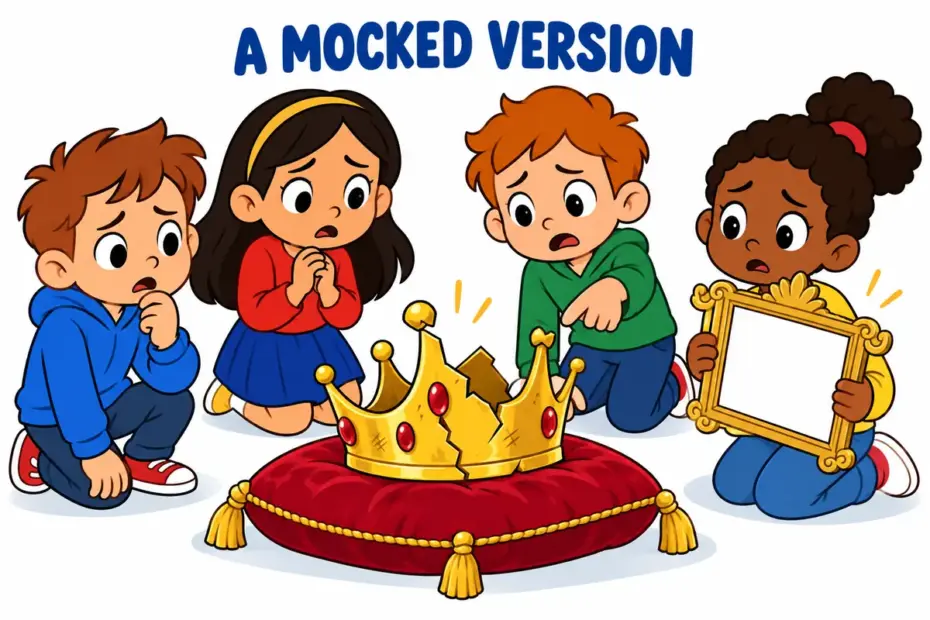
Travesty means a distorted or mocking version of something that should be treated with respect, and it appears most often in the phrase a travesty of justice. To use travesty in a sentence, name the serious thing that was mishandled, as in the trial became a travesty of the law, because the word always points to a grotesque falling short.
Travesty at a glance
- Travesty is a countable noun; its plural is travesties, and a rare verb form also exists.
- It usually appears in the frame a travesty of + noun of value, such as justice, democracy or fair play.
- The word is strongly negative: it calls something a sham or a mockery, never a harmless copy.
- Common collocations are travesty of justice, a complete travesty and an utter travesty.
- The commonest error is confusing travesty with tragedy, which means a disaster rather than a mockery.
- The register is formal and journalistic, which is why it clusters in reports about courts and politics.
What does travesty mean?
Travesty is a countable noun meaning a false, absurd or distorted version of something that deserves respect. The Cambridge entry for travesty records that core sense, and the judgement is severe: a travesty is not a clumsy copy but a mockery of the real thing. A rigged hearing, a rule applied only to one side, and a ceremony stripped of its meaning are all called travesties. Where the point is a comic imitation rather than a serious failure, parody is the closer word, because travesty carries moral outrage that parody does not.
| Sense | Plain meaning | Example sentence |
|---|---|---|
| Distorted version | A false or absurd imitation of something serious | The rushed hearing was a travesty of a fair trial. |
| Mockery or sham | An action that makes a value look worthless | The vote was a travesty that no one could defend. |
One limitation is worth stating plainly. Travesty is not a mild word for a mistake: it accuses someone of turning something important into a sham. Applied to a burnt dinner or a lost football match it sounds wildly out of proportion, and for ordinary mishaps distortion or plain disaster is more honest.
How do you use travesty in a sentence?
The noun fits a small number of frames, and the frame decides how serious the sentence sounds. Four patterns cover almost every real use.
| Pattern | Example | What it signals |
|---|---|---|
| a travesty of + noun | The case became a travesty of justice. | Names the serious value that was betrayed. |
| a travesty that + clause | It was a travesty that no one was charged. | Points at a specific failure of the process. |
| call + something + a travesty | Critics called the result a travesty. | Attributes the judgement to a named group. |
| an utter / complete travesty | The whole review was a complete travesty. | Intensifies the verdict with an adjective. |
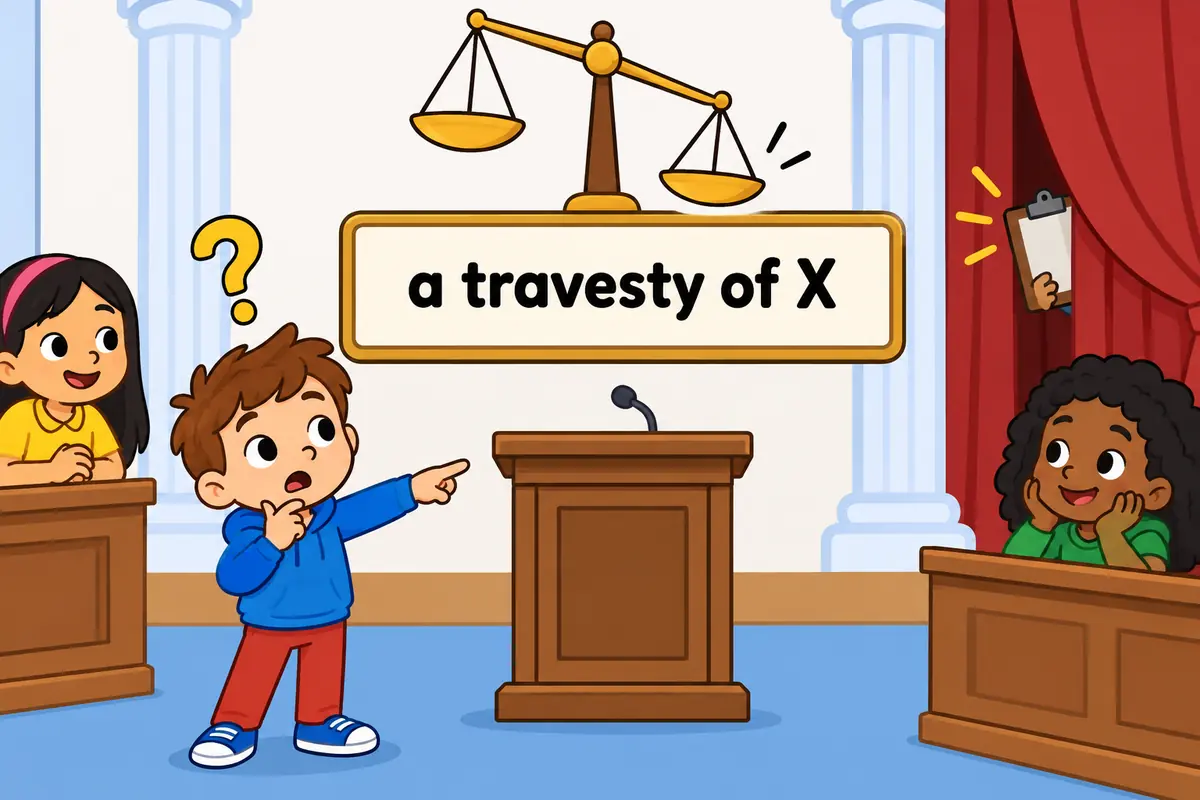
The phrase a travesty of justice is so dominant that readers supply the missing words automatically. Other values slot into the same frame, so a travesty of democracy or a travesty of fair play needs no explanation.
Travesty in a sentence: examples across contexts
The word keeps its moral force while the setting changes. The nine sentences below move from a classroom to a news report, and each names the serious thing that was reduced to a sham.
| Context | Example sentence | Why this works |
|---|---|---|
| Classroom | Pupils agreed the rigged class vote was a travesty of fair play. | Names the value betrayed by the rigged result. |
| Workplace email | Calling that review a travesty of the process would be fair. | Uses the frame to criticise a rushed decision. |
| News report | The court ruling was widely described as a travesty of justice. | Uses the standard collocation in formal reporting. |
| Opinion writing | A travesty that silenced the witnesses left the verdict hollow. | Links the sham to a specific procedural failure. |
| Conversation | That rule change is a complete travesty, and everyone knows it. | Uses an intensifier to convey everyday outrage. |
| Academic writing | The paper argues the inquiry was a travesty of democratic accountability. | Applies the frame to a political value. |
| Sports commentary | Fans saw the replay decision as a travesty of fair play. | Frames a disputed call as a betrayal of the sport. |
| Legal memo | The appeal claims the first hearing was a travesty of due process. | Names the legal standard that was ignored. |
| Government report | Ministers admitted the consultation had been a travesty of proper scrutiny. | Concedes that oversight was only for show. |
Every row names a value that has been mocked rather than merely damaged. A sham is close in meaning, but a travesty usually describes the distorted version of something, while a sham is the pretence itself.
Travesty vs parody
Travesty and parody both involve imitation, yet they point in opposite directions. A parody imitates in order to amuse, while a travesty distorts something serious until it looks worthless, and the speaker is usually angry rather than entertained.
| Attribute | travesty | parody |
|---|---|---|
| Core meaning | A mocking distortion of something serious | A comic imitation for entertainment |
| Speakers attitude | Angry and condemnatory | Playful or admiring |
| Typical object | justice, a trial, democracy | a film, a song, a public figure |
| Register | Journalistic and formal | Everyday and cultural |
| Effect on reader | Shock at a failure | Amusement at an imitation |
Verdict: choose travesty when something valuable has been turned into a sham and you want to accuse, and choose parody when the imitation is meant to make people laugh.
Word forms and grammar of travesty
Travesty is mainly a noun, and its shape is worth learning because the plural is easy to misspell. A related idea appears in words such as caricature, which exaggerates a subject while leaving its value intact.
| Form | Part of speech | Example |
|---|---|---|
| travesty | noun, singular | The decision was a travesty of the process. |
| travesties | noun, plural | The report listed several travesties of justice. |
| travesty | verb, rare | Incorrect in most writing: to travesty the law. Prefer the noun. |
| travestied | verb, past, rare | The role was travestied beyond recognition. |
| travesty of justice | fixed phrase | Critics called the sentence a travesty of justice. |
The plural travesties adds -ies because the noun ends in a consonant plus y, so travestys is always wrong. The verb exists but is rare enough that most writers should keep the noun form.
Common mistakes with travesty
- Incorrect:
The accident was a travesty for the family.Correct: The accident was a tragedy for the family. Rule: a travesty is a mockery of something, not a disaster that causes suffering. - Incorrect:
The burnt dinner was a travesty.Correct: The burnt dinner was a disaster. Rule: travesty belongs to serious matters such as justice or democracy, not to minor mishaps. - Incorrect:
The film was a hilarious travesty of the book.Correct: The film was a hilarious parody of the book. Rule: travesty condemns, so it cannot sit with words that invite laughter. - Incorrect:
Several travestys followed.Correct: Several travesties followed. Rule: the plural replaces the final y with -ies. - Incorrect:
Travesty of the justice system is unfair.Correct: The system’s travesty of justice is unfair. Rule: the noun needs a determiner and points at one particular value.
Practice using travesty
Work through the six items below, then read the reason with each answer, because the reason is the part that carries over to your own writing. A mockery is a near synonym that the exercises also test.
- Fill the gap: The one-sided hearing was a ______ of justice.
- Choose the better word: The flood that ruined the town was a (travesty / tragedy).
- Correct the error: Fans called the match a travesty of fun.
- Build a sentence: use a travesty of before a word such as democracy.
- Spot the register: which fits a formal report — the process was a travesty, or the process was a total mess?
- Change the form: The study listed three ______ of the original rules. Use the plural.
Answers
- travesty — the hearing is being condemned as a distorted version of justice, which is the exact sense.
- tragedy — a flood causes suffering rather than mocking a value, so the disaster word is correct.
- Fans called the match a travesty of fair play — travesty needs a serious value to distort, not fun.
- Model answer: The rushed vote was a travesty of democracy.
- the process was a travesty — a formal report keeps the precise noun rather than the vague mess.
- travesties — the plural of travesty ends in -ies.
The bottom line
Use travesty in a sentence to condemn something serious that has been turned into a distorted sham, and give it a value to mock, as in a travesty of justice. The two details that settle most sentences are that the word carries anger, so it will not work for harmless copies or ordinary mishaps, and that it must never be confused with tragedy. Where the imitation is meant to amuse, choose parody and keep travesty for the times you mean to accuse.
Frequently asked questions about travesty
What does travesty of justice mean?
A travesty of justice is a legal process so distorted that it mocks the idea of fairness. It describes a hearing or ruling that reaches a result no honest procedure would allow. The phrase is the commonest use of the noun, which is why readers supply the words justice almost automatically.
Is travesty a noun or a verb?
It is mainly a noun, as in the ruling was a travesty. A verb also exists, meaning to imitate grotesquely, but it is rare and sounds dated, so most writers should keep the noun. For the action, the noun phrase a travesty of plus a value is the safe choice.
What is the plural of travesty?
The plural is travesties. Because the noun ends in a consonant plus y, the y changes to -ies rather than taking a simple s. So the report described three travesties, never three travestys, and the same rule applies to similar nouns such as parody and mockery.
How is travesty different from tragedy?
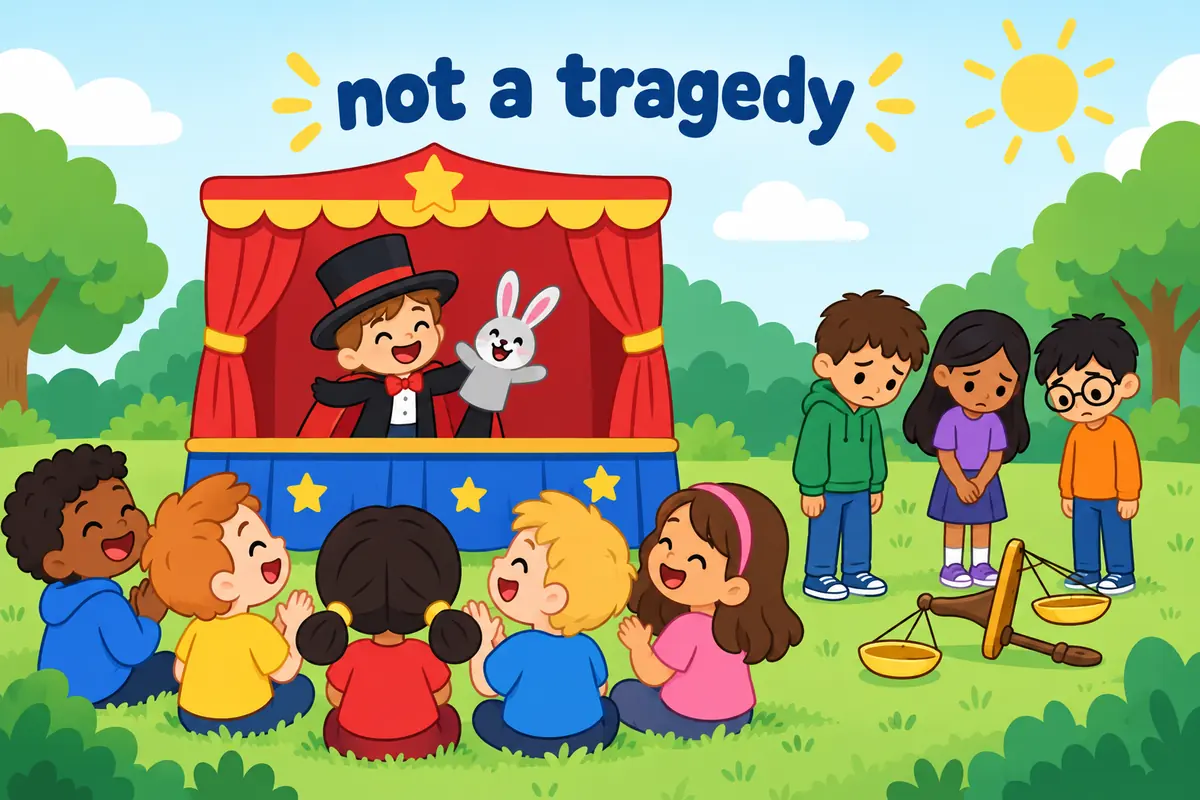
A travesty is a mockery or distorted version of something valuable, while a tragedy is a deeply sad event that causes suffering. A rigged trial is a travesty; a fatal accident is a tragedy. The words sound alike but judge completely different situations, so the choice changes the meaning.
Have you ever encountered a situation where something so unjust or absurd happened that it felt like a complete travesty? The term “travesty” is used to describe an event, action, or situation that is considered a mockery or distortion of something serious or important.
In simpler terms, a travesty is when something wrong or unfair occurs, often resulting in a feeling of injustice or outrage. This word is commonly used to highlight instances of gross misconduct, dishonesty, or mockery that go against the fundamental principles of ethics or justice.
7 Examples Of Travesty Used In a Sentence For Kids
- It is a travesty when you have to share your favorite toy.
- Eating broccoli for dessert is a travesty for many kids.
- It’s a travesty when you have to leave the playground early.
- Not being able to play with friends is a travesty.
- When your ice cream falls on the ground, it’s a travesty.
- Running out of cookies is a travesty for some.
- Losing a game can feel like a travesty for little ones.
14 Sentences with Travesty Examples
- Travesty struck when the students realized their exam had been postponed without any prior notice.
- Missing out on attending the annual college fest would be a travesty for any student.
- It was a travesty that the canteen ran out of food during the lunch break.
- Facing technical issues during an online class was a travesty for many students.
- The cancellation of the much-awaited college trip was a major travesty for the students.
- Students considered it a travesty when the library closed early during exam week.
- Not having access to reliable internet during online exams is a huge travesty for college students.
- Paying excessive fees for additional study materials would be a travesty for students already struggling financially.
- Forgetting to save an important assignment before the deadline could be considered a travesty by many college students.
- Being denied entry to the campus due to a strict dress code is a travesty that students often complain about.
- It was a significant travesty for the students when the college declared a sudden closure due to unforeseen circumstances.
- The lack of job opportunities post-graduation is seen as a travesty by many college students.
- Forgetting to submit a group project on time would be a travesty for the responsible student needing good grades.
- The malfunctioning of the printing machines right before submission deadlines was a travesty for college students.
How To Use Travesty in Sentences?
To use the word Travesty in a sentence, it is important to understand its meaning first. Travesty is a noun that refers to a false, absurd, or distorted representation of something.
Here is a simple guide on how to use Travesty in a sentence:
-
Remember that Travesty is a strong word that conveys a sense of injustice, mockery, or absurdity.
-
Identify a situation where there is a misrepresentation or distortion of something serious or important.
-
Place Travesty in your sentence where it best fits the context. For example: “The decision to cut down the ancient trees for a parking lot is a travesty of environmental conservation.”
-
Ensure that the context of your sentence clearly shows the outrageous or ridiculous nature of the situation being described.
-
Practice using Travesty in different sentences to become more comfortable incorporating it into your vocabulary.
Overall, using Travesty effectively in a sentence can help convey a strong sense of disappointment, injustice, or absurdity. By following this guide and practicing, you can master using this impactful word in your everyday communication.
Conclusion
In conclusion, travesty is a term used to describe something that is a distortion or mockery of what it should be. Whether it be a travesty of justice in a flawed court ruling or a travesty of democracy in a corrupt election process, these examples highlight instances where something has gone wrong or been misrepresented. By understanding the concept of travesty, we can better recognize and address situations where fairness, integrity, or truth have been compromised.
By staying vigilant against travesties, whether in politics, law, or society at large, we can work towards creating a more just and equitable world. It is important to challenge and rectify instances of travesty to ensure that fairness prevails and that institutions uphold their intended purpose of serving the greater good.