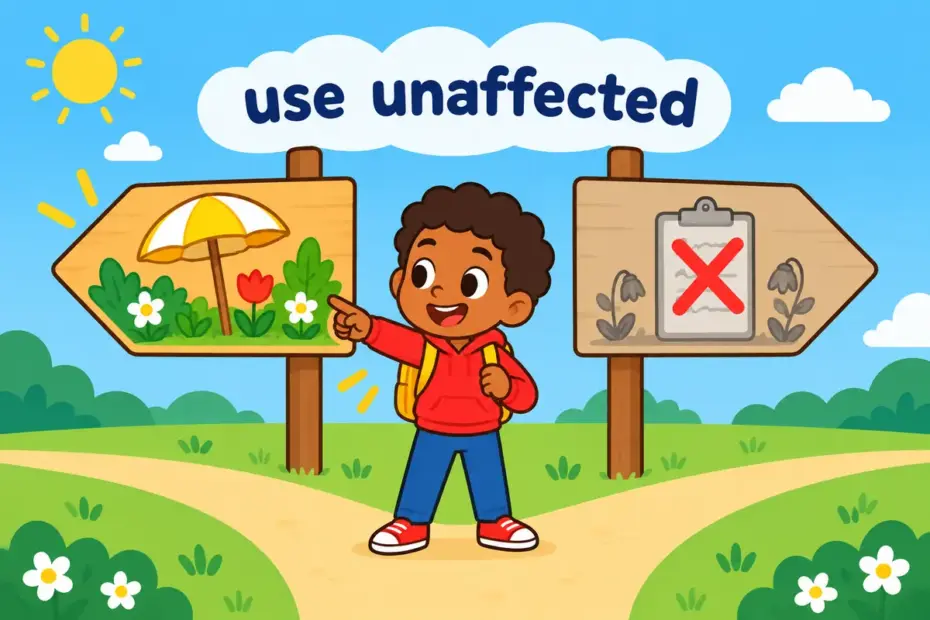
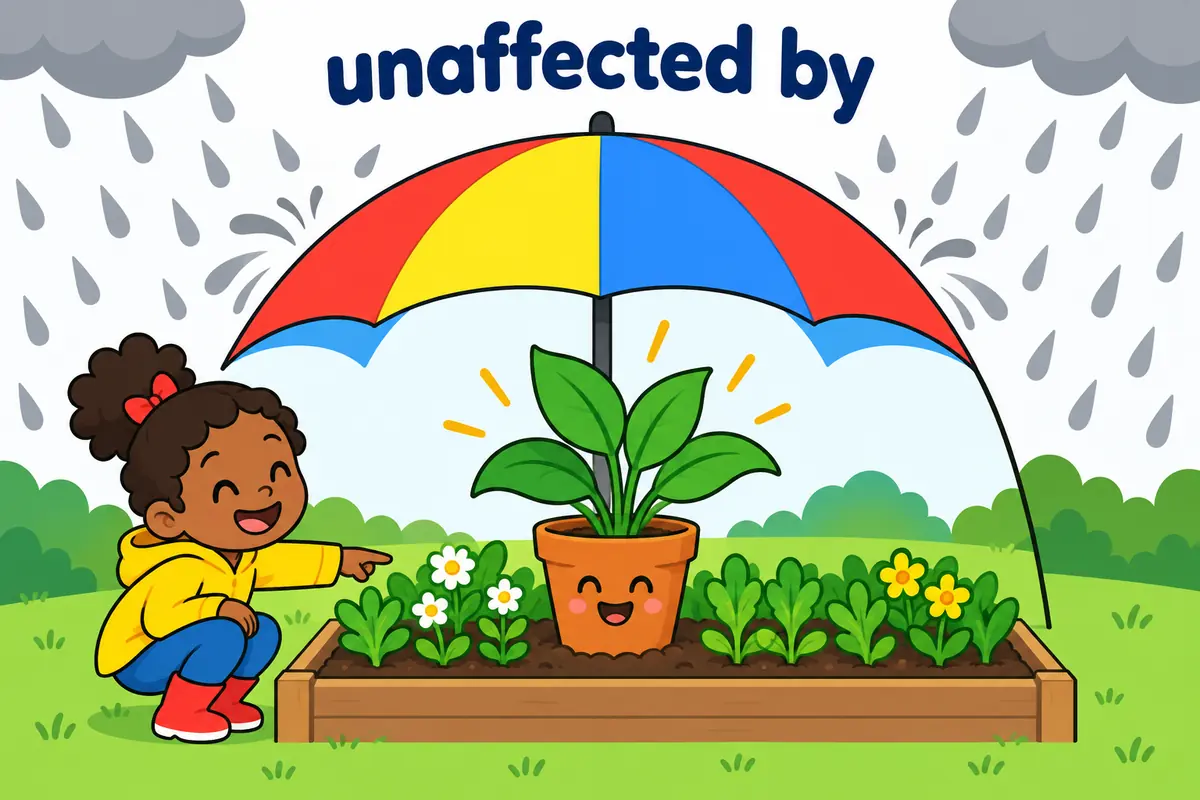
Unaffected vs uneffected is easy to settle: use unaffected for anything not changed or influenced, and treat uneffected as a rare word that means not carried out. If you mean that a person or thing was not altered, unaffected is the word readers expect. “The coast was unaffected by the storm.”
Unaffected vs uneffected at a glance
- Unaffected is the standard adjective meaning not changed or not influenced.
- Uneffected is a rare adjective meaning not carried out or not brought about.
- Uneffected is not a synonym for unaffected in ordinary use.
- Unaffected also means natural and sincere when it describes a person’s manner.
- The usual error is writing uneffected when the meaning is not changed.
Unaffected vs uneffected: the master comparison
The two words look like a pair, but they answer different questions: one asks whether something changed, the other whether an action happened. The table weighs the criteria that decide real sentences.
| Attribute | unaffected | uneffected |
|---|---|---|
| Commonness | Very common | Rare and specialist |
| Core meaning | Not changed or influenced | Not carried out or accomplished |
| Second meaning | Natural and sincere in manner | None in general use |
| Typical subjects | people, places, results, skin | plans, provisions, clauses |
| What it describes | A state that survives an event | An action that never happened |
| Opposite | Affected or changed | Effected or accomplished |
| Register | Neutral to formal | Legal and technical |
| Risk in use | Very low | Mistaken for unaffected |
What do unaffected and uneffected mean?
Unaffected is an adjective with two common senses: not influenced or changed by something, and natural and sincere in manner. The Cambridge entry for unaffected records both. Uneffected is a rare adjective meaning not effected, that is, not carried out or not brought about, and the Merriam-Webster entry for uneffected treats it only in that narrow sense. The words share a prefix but not a meaning.
| Word | Sense | Example sentence |
|---|---|---|
| unaffected | Not changed by an event | The village was unaffected by the floods. |
| unaffected | Natural and sincere | Her unaffected smile won over the room. |
| uneffected | Not carried out | The clause remained uneffected by the amendment. |
One limitation deserves stating plainly. Uneffected is so rare that many careful readers treat it as a misspelling, so reserve it for legal or technical drafting where not carried out is the intended sense. In every other case, use unaffected for a state and a plain phrase such as not implemented for an action. The direct opposite of the first sense is affected, which says something was changed.
Which should you use?
Match the word to the question the sentence is really asking, not to the sound of the prefix.
- You mean a thing or person was not changed or influenced, so use unaffected: the plants were unaffected by the cold.
- You mean a plan, rule or provision was never put into effect, so write not carried out, or uneffected only in legal drafting.
- You mean a person is natural and free of pretence, so use unaffected, which is close to genuine in that sense.
- You are unsure which you need, so use unaffected unless the sentence is a legal document about an action.
How do you use unaffected in a sentence?
Unaffected usually names an event that failed to change something, and the event follows the preposition by. The second, personal sense works like any other describing adjective.
| Pattern | Example | What it signals |
|---|---|---|
| unaffected + by + event | The garden was unaffected by the frost. | Names what failed to change it. |
| remain or stay unaffected | Prices remained unaffected. | Stresses that a state continued. |
| leave + noun + unaffected | The strike left the port unaffected. | Names the cause of the non-change. |
| largely or seemingly unaffected | The results were largely unaffected. | Hedges the claim in careful writing. |
| unaffected + noun (manner) | an unaffected manner | Carries the natural, sincere sense. |
Where the event does not touch a thing at all, untouched is even stronger than unaffected, and someone who simply does not care is indifferent, which names a feeling rather than a state.
Unaffected vs uneffected in a sentence: examples across contexts
The sentences below keep the same contrast while the setting changes, and each one shows why one word, not the other, fits.
| Context | Example sentence | Why this works |
|---|---|---|
| Weather report | Inland towns were unaffected by the coastal winds. | Names the event that failed to reach them. |
| Workplace email | The Tuesday schedule remains unaffected by the delay. | Uses remain to stress continuity. |
| Science writing | The control group was unaffected by the treatment. | Shows the term in a precise experimental claim. |
| Health advice | Most skin is unaffected by the new soap. | Uses the word for a physical state. |
| Legal drafting | The old provision stayed uneffected, since the later clause was never applied. | Uses the rare word for not carried out. |
| Book review | Her unaffected style makes the difficult ideas readable. | Uses the natural, sincere sense. |
| Conversation | He seemed totally unaffected by the criticism. | Shows the everyday predicative use. |
| News report | The port was largely unaffected, officials said. | Hedges the claim with largely. |
| History essay | Rural prices were unaffected by the city riots. | Names the event and the untouched subject. |
| Product notice | The older models are unaffected by the recall. | States clearly who is out of scope. |
| Music writing | An unaffected delivery suits the plain folk melody. | Applies the personal sense to a performance. |
Word forms and grammar of unaffected and uneffected
The confusion behind the pair comes from affect and effect, so the forms are worth keeping in one view. An natural manner and an unaffected manner mean much the same thing.
| Form | Part of speech | Example |
|---|---|---|
| unaffected | adjective | The roof was unaffected by the hail. |
| uneffected | adjective, rare | The rule stayed uneffected by the vote. |
| affect | verb | Rain affected the harvest. |
| effect | verb and noun | The team effected a change; the effect was small. |
| unaffectedly | adverb, rare | She smiled unaffectedly at the praise. |
| unaffectedness | noun, rare | His unaffectedness put the guests at ease. |
Why the two words get mixed up
The confusion is inherited from affect and effect, the verb-and-noun pair that English speakers have tripped over for centuries. Affect is almost always the verb meaning to influence, while effect is usually the noun meaning a result. Adding the negative prefix to each produces unaffected, the common adjective meaning not influenced, and uneffected, the rare adjective meaning not produced or not carried out.
Because the two spellings differ by a single letter in the middle, a spellchecker rarely flags the wrong one, and the error survives proofreading. The practical test is to ask what the sentence is about. If it describes a state that did not change, the word is unaffected. If it describes an action that never happened, the word is uneffected, and even then plain phrasing is usually safer.
Common mistakes with unaffected and uneffected
- Incorrect:
The town was uneffected by the flood.Correct: The town was unaffected by the flood. Rule: A state of not being changed takes unaffected. - Incorrect:
The new rule was unaffected.(meaning not carried out) Correct: The new rule was not carried out. Rule: Choose by meaning, not by the sound of the prefix. - Incorrect:
She has an uneffected manner.Correct: She has an unaffected manner. Rule: The natural, sincere sense belongs to unaffected. - Incorrect:
The delay uneffected the schedule.Correct: The delay affected the schedule. Rule: Affect is the everyday verb; effect as a verb means to bring about. - Incorrect:
The medicine had no affect.Correct: The medicine had no effect. Rule: Effect is the noun, so the phrase is no effect.
Practice using unaffected and uneffected
Work through the seven items, then check the reasoning rather than only the answer.
- Fill the gap: The hilltop village was ______ by the flooding below.
- Choose the better word: The clause stayed (unaffected / uneffected) because it was never enforced.
- Correct the error: The old laptop was uneffected by the price rise.
- Build a sentence: use remain unaffected about a spare room during a heatwave.
- Spot the register: which belongs in a legal memo, the provision remained uneffected, or the rule never really happened?
- Rewrite with a stronger word: The shed was unaffected by the wind. Use untouched.
- Correct the error: The new paint affect the colour of the room.
Answers
- unaffected — the sentence describes a state that the flood did not change.
- uneffected — the clause was never enforced, which is the narrow not-carried-out sense.
- The old laptop was unaffected by the price rise — the price did not change it.
- Model answer: The spare room remained unaffected by the heatwave because its shutters stayed closed.
- The provision remained uneffected — legal drafting is the one place the rare word belongs.
- The shed was untouched by the wind — untouched is the stronger form of the same idea.
- The new paint affected the colour of the room — affect is the everyday verb, not affect as a noun.
The bottom line
Use unaffected in a sentence for anything not changed or influenced, and reserve the rare uneffected for legal or technical writing about an action that was not carried out. Two nuances decide almost every case: the everyday meaning belongs to unaffected in both its senses, including the natural, sincere one, and uneffected is so uncommon that most readers will take it for a mistake. When a person’s manner is simply easy and open, unassuming is often the kinder word.
Frequently asked questions about unaffected vs uneffected
How do you spell unaffected?
Unaffected is spelled u-n-a-f-f-e-c-t-e-d, with the prefix un added to affected. It has two f letters in the middle and ends in ted. The common misspelling replays the affect and effect confusion by swapping in an e after the double f, which produces uneffected.
Is uneffected a real word?
Uneffected appears in dictionaries only in the narrow sense not effected, meaning not carried out or not brought about. It is rare and technical. It is not an accepted spelling of unaffected, so a sentence that means unchanged should never use uneffected, however similar the two look.
What does it mean to be unaffected by something?
To be unaffected by something is to remain unchanged or uninfluenced by it. The phrase names the event after by, as in the crops were unaffected by the drought. It describes a state that survives, not a person’s choice, so it works for places, objects, results and health as well as people.
Can unaffected describe a person?
Yes, in two ways. It can say a person was not changed or hurt by an event, as in he was unaffected by the insult. Separately, it describes a natural, sincere manner with no pretence, as in her unaffected welcome. Context, not the word itself, tells the two senses apart.