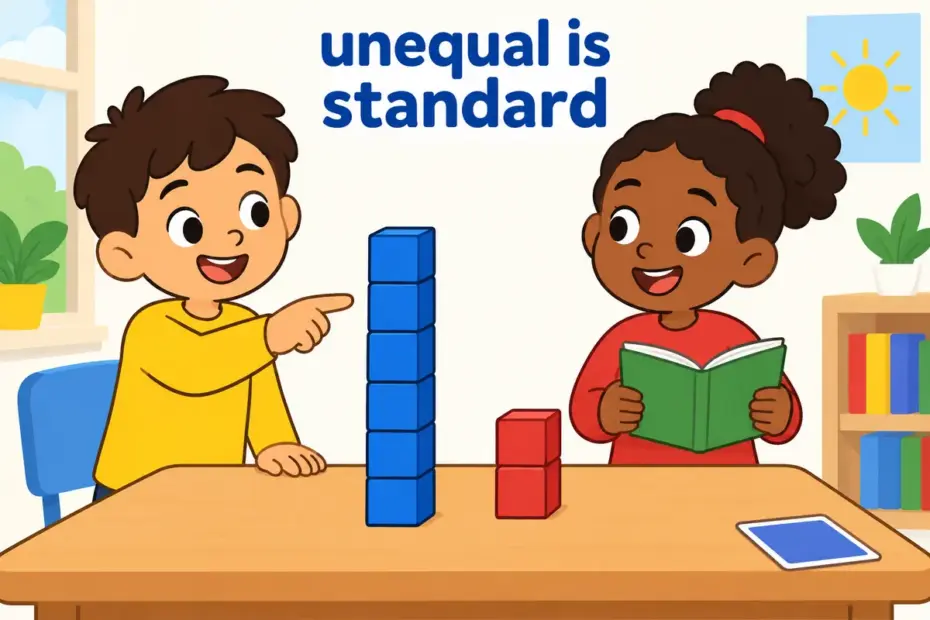
unequal vs inequal is an easy choice once the facts are clear: unequal is the standard English word for two things that are not the same, while inequal is a rare older form that modern readers treat as a mistake. Use unequal in every register, from a maths lesson to a formal report, and leave inequal in the dictionary.
Unequal vs inequal at a glance
- Unequal is the standard adjective; inequal is a rare, older variant of the same word.
- Both describe two things that are not the same, but only unequal is safe in modern writing.
- Unequal takes the adverb unequally and the rare noun unequalness.
- Inequal has no common derived forms and appears in older texts rather than modern prose.
- The commonest error is swapping in inequal for unequal in an attempt to sound formal.
What do unequal and inequal mean?
Unequal is an adjective meaning not equal in size, amount, status or worth, and inequal is a rare form that carries the same meaning but has fallen out of standard use. The Cambridge entry for unequal treats it as an ordinary headword with several senses, while the Cambridge entry for inequal lists only the bare sense of not equal.
The standard word covers two jobs. It can describe a plain difference in measure, as in two unequal halves, or an unfair difference in treatment, as in unequal pay. Unequal pairs naturally with amounts, teams, chances and treatment, and it is neutral in mathematics, where a scalene triangle simply has three unequal sides. A stronger word, disparate, stresses that the two things are not merely unequal but not comparable at all.
| Word | Part of speech | Core sense | Example sentence |
|---|---|---|---|
| unequal | adjective | not equal in size or amount | The two teams played on unequal pitches. |
| unequal | adjective | unfair in its effect | The rules put younger workers at an unequal disadvantage. |
| unequal to | adjective + preposition | not good enough for a task | The supply was unequal to the summer demand. |
| inequal | adjective, rare | an older spelling of unequal | The 1697 edition prints the word as inequal. |
One limitation is worth stating plainly. Unequal does not mean different in every context, and it does not mean bad. Two unequal totals are simply not the same size, and a scalene triangle is unequal without being worse than any other. Where you only mean that two things are not alike, the plainer word different is the better choice. An unequal decision that harms one side is also often called unjust.
Unequal vs inequal: the master comparison
Eight criteria separate the living word from the fossil. Read across each row to see why only one of them earns a place in your writing.
| Criterion | unequal | inequal |
|---|---|---|
| Core meaning | Not equal in size, status or worth | Not equal, the same old sense |
| Standard today | Fully standard in every register | Rare and dated; not standard |
| Dictionary treatment | An ordinary headword with several senses | Listed only as an old variant |
| Derived forms | unequally, unequalness | None in common use |
| Register | Neutral to formal | Archaic or affected |
| Typical subject | amounts, teams, chances, treatment | older texts and quotations |
| Used in maths | Yes, as in unequal sides | No |
| Risk to the writer | None | Reads as a spelling error |
If one form had to replace the other everywhere, unequal could do it without loss, and inequal could not do it at all. The verdict is standard first, and standard means unequal. An unequal split can also be called disproportionate when one side plainly gets far too much.
How do you use unequal and inequal in a sentence?
Both forms take the same grammatical slots, so the choice is never grammatical; it is a choice about which word is current. Unequal sits before a noun or after the verb be, and its adverb unequally describes how something is divided.
| Pattern | Example | What it signals |
|---|---|---|
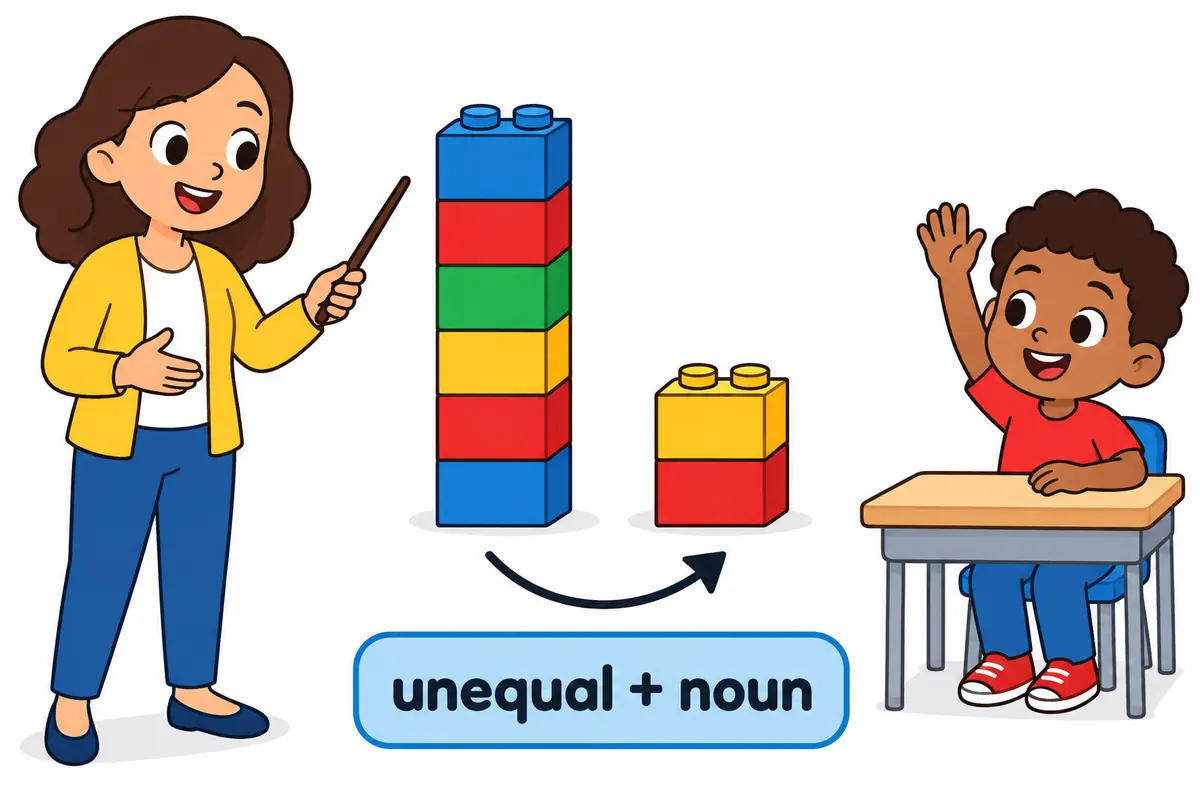
| unequal + noun | They raised children on unequal incomes. | The adjective limits the noun that follows it. |
| be + unequal | The two halves are unequal. | Predicate use, common in maths and science. |
| unequal to + noun | The old pump was unequal to the task. | Means not strong or good enough. |
| verb + unequally | The money was shared unequally. | The adverb states how an action is carried out. |
| inequal + noun | The reprint keeps the old spelling inequal. | Acceptable only inside a quotation from an older text. |
Unequal and inequal in a sentence: examples across contexts
Unequal keeps the same meaning while the setting changes, and each sentence below names the part of the sense doing the work. A record of unequal scores across a season can also be called inconsistent, which names the pattern rather than a single gap.
| Context | Example sentence | Why this works |
|---|---|---|
| Classroom | The teacher cut two unequal strips so the class could compare them. | A concrete object supplies the difference a child can see. |
| Maths | A triangle with three unequal sides is called scalene. | The neutral technical sense, with a precise term attached. |
| Workplace email | The new rota gives the two shifts unequal cover. | States a measurable imbalance without blaming anyone. |
| News report | The report found unequal access to the town sports facilities. | Names the unfair pattern that the adjective can carry. |
| Legal writing | The tribunal held that the contract imposed unequal obligations. | Formal, precise, and typical of a reasoned ruling. |
| Science writing | The experiment used unequal volumes of the two solutions. | Keeps the difference purely quantitative. |
| Conversation | We got unequal slices of the cake, which started an argument. | The everyday sense with a small, human consequence. |
| History essay | The unequal treaties forced the empire to open its ports. | A fixed historical collocation for an unfair agreement. |
| Academic prose | The study links unequal pay to lower staff retention. | The adjective qualifies a measurable workplace outcome. |
| Older text | In the 1697 edition the word appears as inequal. | Shows the rare form only where an original is quoted. |
Which should you use?
Match the word to the reader, and the answer is almost always the same. The table turns the comparison into five decisions.
| Situation | Choose | Why |
|---|---|---|
| Any modern sentence | unequal | It is the standard word in every register. |
| A maths or science text | unequal | The neutral technical sense is well established. |
| A report or contract | unequal | Editors expect the standard spelling. |
| Reproducing an old quotation | inequal | Keep the original spelling only inside the quotation. |
| Trying to sound formal | unequal | Inequal sounds like an error, not an upgrade. |
When in doubt, ask whether the sentence will be read as current English. If it will, unequal is the only safe answer, and inequal belongs between quotation marks or nowhere. Unequal treatment in a workplace is often described as unfair because it puts one group at a disadvantage.
Word forms and grammar of unequal and inequal
Unequal inflects through its adverb and a rare noun, while inequal has no living family. The table also lists the form learners invent by mistake.
| Form | Part of speech | Example |
|---|---|---|
| unequal | adjective | an unequal struggle |
| unequally | adverb | the money was shared unequally |
| unequalness | noun, rare | the unequalness of the two halves |
| unequal to | adjective + preposition | unequal to the demands of the job |
| inequal | adjective, rare | preserved only in older texts |
| inequally | adverb, non-standard | listed here only to be avoided |
Keep unequal apart from unequalled, which shares the root but means better than all others rather than simply not equal.
Common mistakes with unequal and inequal
- Incorrect:
The workload is inequal.Correct: The workload is unequal. Rule: inequal is not standard, so a modern sentence never needs it. - Incorrect:
The two totals are unequal to each other.Correct: The two totals are unequal. Rule: unequal does not take the phrase to each other; use different from when you mean they differ. - Incorrect:
They were treated unequally than the others.Correct: They were treated unequally. Rule: unequally is an adverb of manner, not a comparative, so it cannot pair with than. - Incorrect:
an inequal distribution of fundsCorrect: an unequal distribution of funds. Rule: adjectives that describe a measured difference take the standard spelling. - Incorrect:
This problem is more unequal than the last.Correct: This problem shows a wider inequality than the last. Rule: unequal is not gradable in this sense; use inequality for the noun.
Practice using unequal vs inequal
Work through the six items, then check the reasoning rather than only the answer.
- Fill the gap: The two runners finished in ______ times.
- Choose the better word: The wages are (unequal / inequal) across the two sites.
- Correct the error: The chairs are inequal in height.
- Build a sentence: use unequal to about a task that defeats someone.
- Spot the register: which belongs in a formal report — the pay is unequal, or the pay is inequal?
- Rewrite with the adverb: The committee split the budget unfairly. Use unequally instead.
Answers
- unequal — the standard adjective describes the measured difference.
- unequal — a modern comparison takes the standard spelling, not the rare one.
- The chairs are unequal in height — inequal is never standard.
- Model answer: The young teacher felt unequal to the task of running three clubs.
- The pay is unequal — a report uses the standard word.
- The committee split the budget unequally — the adverb describes the division.
The bottom line
unequal vs inequal comes down to one living word and one fossil. Unequal is standard in every register, covering plain differences and unfair ones, while inequal survives only in older texts and quotations. Choose unequal for amounts, treatment, chances and mathematical sides, and use its adverb unequally for how something is shared. Reproduce inequal only between the quotation marks of an original passage.
Frequently asked questions about unequal vs inequal
Is inequal a real word?
Inequal appears in some dictionaries, but only as an old or rare variant of unequal. It has no place in current English, and a modern reader is likely to take it for a spelling mistake. Treat it as real only in the sense that historical texts used it; for your own writing, choose unequal every time.
What is the noun form of unequal?
The direct noun is unequalness, though it is rare and slightly awkward. Most writers reach for inequality instead, which names the state of being unequal and is the standard term in economics, law and social writing. Use unequalness only when no better noun fits, and never build a noun from inequal.
Can unequal mean unfair?
Yes. Unequal carries a second sense of unfair or unjust because it describes a difference that puts one side at a disadvantage. Unequal pay and unequal treatment are the commonest phrases. A neutral difference in size is unequal too, so the unfair sense depends on what is being compared.
What does unequal to the task mean?
Unequal to the task means not strong enough, skilful enough or capable enough for the job in front of you. The phrase takes the preposition to, never for or with. It is common in formal writing about leaders, systems and machines that fail to meet a demand placed on them.