
Vindicate means to clear someone of blame or to prove that a decision, claim or belief was right. To use vindicate in a sentence, name the evidence first and name what it settles: the audit vindicated the treasurer. The verb is transitive, so it always takes a person, decision or belief as its object.
Vindicate at a glance
- Vindicate is a transitive verb; its forms are vindicates, vindicated, vindicating and vindication.
- The two main senses are clearing someone of blame and proving a decision or belief correct.
- The usual subjects are evidence, results, an audit, a court or time itself.
- Vindicate belongs to formal and journalistic writing rather than casual conversation.
- The commonest error is confusing vindicate with vindictive, which describes a wish for revenge.
What does vindicate mean?
Vindicate is a transitive verb meaning to clear a person of blame, or to prove that a decision, claim or belief was right. The Cambridge entry for vindicate records both senses, and the difference decides the sentence: the first answers an accusation, the second answers a doubt. Where a sentence offers reasons instead of proof, justify a decision is the plainer verb, because vindicate carries the extra idea that somebody has already been judged.
| Sense | Plain meaning | Example sentence |
|---|---|---|
| Clear of blame | Show that an accusation was wrong | The security footage vindicated the night porter. |
| Prove right | Show that a decision or belief was correct | Falling costs vindicated the switch to rail freight. |
| Defend a claim | Uphold a right or claim against challenge | The ruling vindicated the tenants’ right to repairs. |
How do you use vindicate in a sentence?
Vindicate changes shape around its object, and the passive is the commonest pattern in news reports because it keeps the proof, not the actor, in focus.
| Pattern | Example | What it signals |
|---|---|---|
| evidence + vindicate + person | The DNA results vindicated him. | Blame is lifted by proof rather than opinion. |
| outcome + vindicate + decision | The harvest vindicated her gamble on late planting. | A past choice is judged correct by its result. |
| be vindicated | The whistleblower was vindicated eight years later. | Passive voice, used when the evidence matters more than its source. |
| vindicate + a right or claim | The appeal vindicated their claim to the land. | A formal entitlement is upheld. |
| feel vindicated | She felt vindicated when the recall was announced. | Reports the emotion, not the proof; common in reporting. |
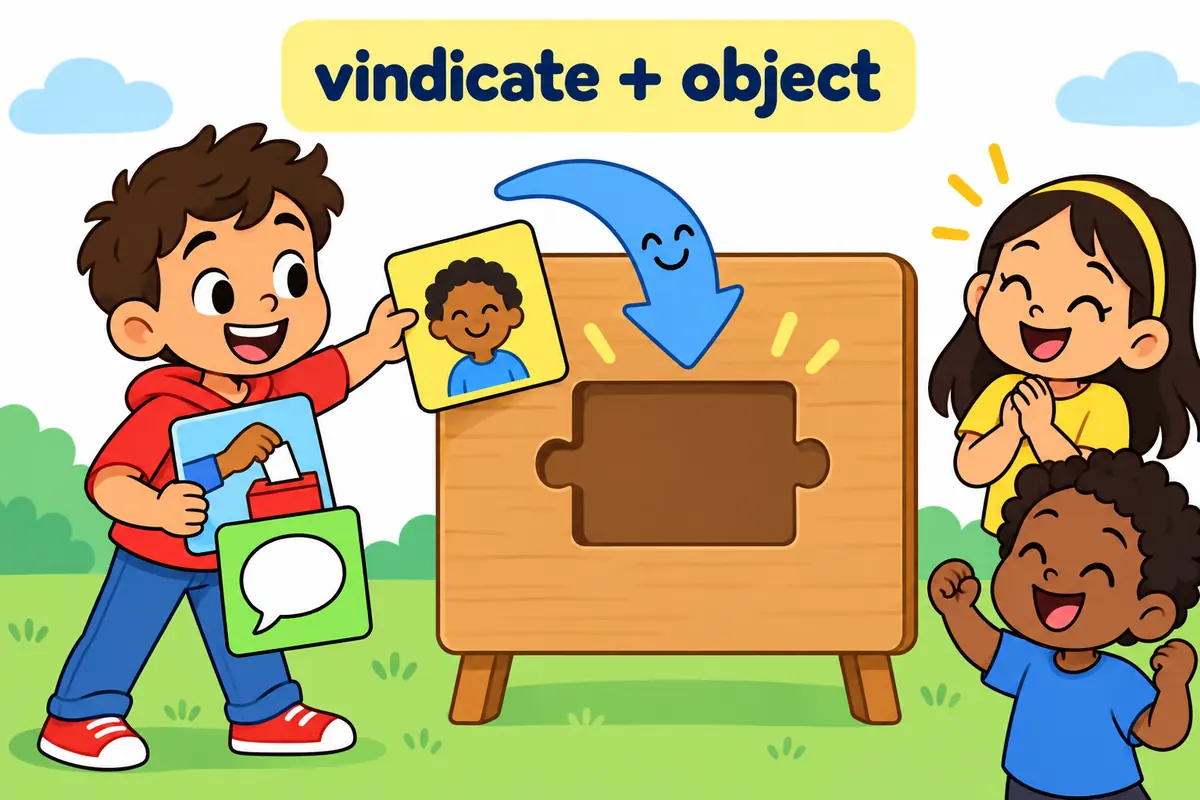
Vindicate in a sentence: examples across contexts
Vindicate changes register more than it changes meaning. The nine sentences below keep the same verb while moving from a classroom to a law report, and each one names the evidence doing the work.
| Context | Example sentence | Why this works |
|---|---|---|
| Classroom | The missing book turned up in the box, which vindicated Priya. | A concrete object supplies proof a reader can picture. |
| Workplace email | The February figures vindicate the decision to delay the launch. | Numbers act as the subject, the natural formal pattern. |
| News report | The inquiry vindicated the two officers suspended in March. | Names the authority and the people who were cleared. |
| Legal writing | The judgment vindicated the council’s reading of the statute. | Uses the defend-a-claim sense rather than the blame sense. |
| Science writing | Replication vindicated the original measurement of the decay rate. | A procedure as subject keeps the claim impersonal. |
| Sports report | The late substitution vindicated a manager everyone had doubted. | Pairs the decision with the doubt it answered. |
| Academic prose | Later excavations vindicated the first survey of the site. | A dated finding becomes the evidence. |
| History essay | Time vindicated the engineers who warned about the bridge deck. | Time as subject signals long-delayed proof. |
| Conversation | I felt vindicated when the mechanic found the same fault. | The feel vindicated pattern is the one that survives in speech. |
Only the last sentence uses the first person, and that asymmetry marks where the verb lives.
Vindicate vs exonerate, absolve and justify
Vindicate overlaps with three near-synonyms and is interchangeable with none of them.
| Attribute | vindicate | exonerate | absolve | justify |
|---|---|---|---|---|
| Core job | Prove right or clear of blame | Formally free from an accusation | Release from blame or duty | Give reasons that support a choice |
| What must exist | An accusation or a doubt | A formal charge | A fault, sin or obligation | A decision needing support |
| Who acts | Evidence, results or time | A court or official body | A person with authority | The person arguing |
| Usual object | A person, decision, belief or claim | A defendant only | A person or a conscience | An action, cost or decision |
| What it implies | A judgement has been made | A verdict has been reached | Blame is lifted and released | Explanation, not proof |
Choose vindicate when proof settles a question about a person or decision; choose exonerate a defendant or absolve someone of blame when the question is legal or moral, and justify when reasons rather than proof do the work.
Vindicate is also the wrong word for mild support: a colleague can back a proposal without the weight of a formal judgement, and vindicate never means forgive or win.
Word forms and grammar of vindicate
Vindicate inflects regularly, and its noun is far more common in headlines than the verb is in speech.
| Form | Part of speech | Example |
|---|---|---|
| vindicate | verb, base form | The data should vindicate the forecast. |
| vindicates | verb, third person singular | Fresh evidence vindicates the earlier finding. |
| vindicated | verb, past and past participle | The inquiry vindicated the manager. |
| vindicating | verb, present participle | The result is slowly vindicating his caution. |
| vindication | noun | The ruling was a vindication of the tenants. |
| vindictive | adjective, different meaning | A vindictive rival spread the rumour. |
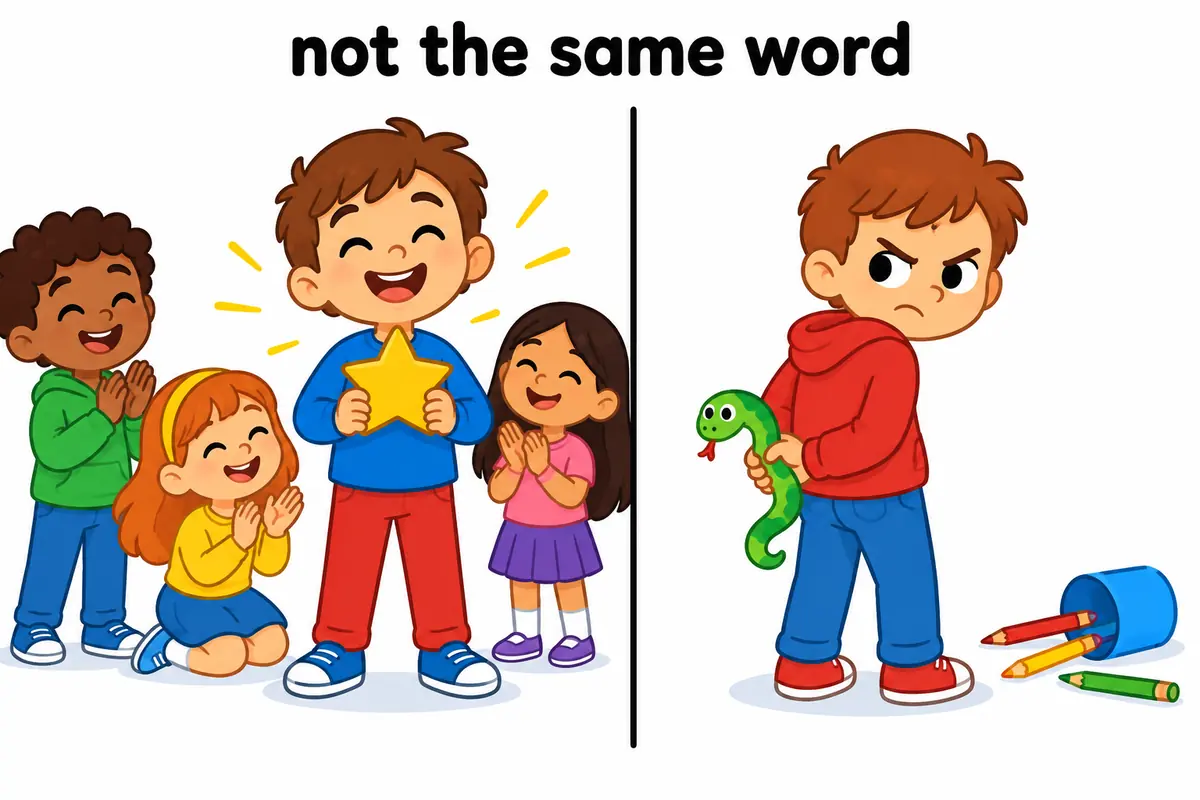
The noun vindication compresses a whole story into one word, which is why editors reach for it. Keep vindictive out of this family in meaning even though it shares the root: the adjective describes a wish for revenge, not a person who has been cleared.
Common mistakes with vindicate
- Incorrect:
He was very vindictive after the inquiry cleared him.Correct: He was vindicated after the inquiry cleared him. Rule: vindictive means wanting revenge; the person cleared has been vindicated. - Incorrect:
The results vindicated.Correct: The results vindicated her approach. Rule: vindicate is transitive, so the object cannot be dropped. - Incorrect:
The new data vindicated that the forecast was right.Correct: The new data vindicated the forecast. Rule: the verb takes a noun phrase, never a that-clause. - Incorrect:
She vindicated herself from the accusation.Correct: She was vindicated by the new evidence. Rule: the passive with by plus evidence is the natural pattern. - Incorrect:
The win vindicated the coach’s job.Correct: The win vindicated the coach’s decision. Rule: you vindicate a decision or a person, not a post.
Practice using vindicate
Work through the six items, then check the reasoning rather than only the answer.
- Fill the gap: The receipt ______ the shopkeeper, who had been accused of overcharging.
- Choose the better word: After the appeal, the pilot was finally (vindicated / vindictive).
- Correct the error: The late delivery vindicated that the supplier was unreliable.
- Build a sentence: use be vindicated about a classmate wrongly blamed for a broken window.
- Spot the register: which belongs in a formal report — the survey vindicates the new timetable, or I totally felt vindicated?
- Rewrite with the noun: The findings vindicated the nurse. Use vindication instead.
Answers
- vindicated — the receipt is the evidence, and the shopkeeper is the object that receives it.
- vindicated — the pilot was cleared; vindictive would mean the pilot wanted revenge.
- The late delivery confirmed that the supplier was unreliable — vindicate cannot take a that-clause.
- Model answer: Dan was vindicated when the caretaker found the cricket ball outside the window.
- The survey vindicates the new timetable — a formal report avoids totally and the first person.
- The findings brought the nurse a long-delayed vindication — the noun needs an article.
The bottom line
Use vindicate in a sentence when evidence settles a question of blame or judgement, and name that evidence as the subject. The two nuances that decide most sentences are these: the verb is transitive, so something must always be vindicated, and the clearing sense needs a prior accusation while the proving-right sense needs only a doubt. Where no accusation exists, confirm and prove are often the more precise choices.
Frequently asked questions about vindicate
Is vindicate a formal word?
Vindicate sits in formal and journalistic writing, where evidence is the subject of the sentence. In speech most people reach for the fixed phrase feel vindicated instead. Writing the receipt vindicated her in a text message would sound stiff, while an inquiry report would use exactly that.
What is the difference between vindicate and vindictive?
Vindicate is a verb meaning to clear of blame or prove right. Vindictive is an adjective describing somebody who wants revenge. The two words share a root but describe opposite behaviour: a vindicated colleague has been cleared, while a vindictive one is settling a score.
Can a person vindicate themselves?
A person can, but the sentence reads better with the evidence as the subject. Writers prefer the file vindicated him to he vindicated himself, because the first names the proof. Reflexive use suggests self-justification, which is closer to defending a choice than to clearing blame.
Does vindicate always need an accusation?
No. The clearing sense needs an accusation, but the proving-right sense does not. Nobody accused the engineer in the sentence the stress tests vindicated her design; doubt alone is enough. Check which sense you mean, because only one of the two implies that somebody was blamed.
Have you ever wanted to prove someone wrong and show that you were right all along? The word “vindicate” perfectly captures that feeling of being justified or cleared from blame or suspicion. Essentially, it means to prove one’s innocence or correctness while defending against doubts or accusations.
7 Examples Of Vindicate Used In a Sentence For Kids
- I will vindicate that the toy is mine!
- She will vindicate that she finished her food.
- He will vindicate that he did his homework.
- The teacher will vindicate that we all did a good job.
- We will vindicate that the painting is beautiful.
- They will vindicate that the story is true.
- You will vindicate that you are a good friend.
14 Sentences with Vindicate Examples
- Vindicate your argument with strong evidence to convince your professor.
- Make sure to vindicate your choice of majors to your parents to gain their support.
- It is important to vindicate your grades by working hard and studying efficiently.
- Vindicate your decision to join a specific club by actively participating and contributing.
- Use this opportunity to vindicate your leadership skills by heading a college project.
- It’s time to vindicate your knowledge by acing your exams and showcasing your expertise.
- Vindicate your passion for a particular subject by pursuing internships and extracurricular activities related to it.
- Don’t forget to vindicate your choice of elective courses for the upcoming semester.
- As a student, it is crucial to vindicate your opinions during group discussions and presentations.
- Take the chance to vindicate your creativity by showcasing your art and projects during college exhibitions.
- Remember to vindicate your decision to pursue higher education by setting clear goals and working towards them.
- Use your research skills to vindicate your arguments in academic papers and presentations.
- As a college student, always strive to vindicate your integrity and ethics in every aspect of your academic life.
- Don’t hesitate to vindicate your innovative ideas by presenting them in college competitions and hackathons.
How To Use Vindicate in Sentences?
Vindicate means to clear someone of blame or suspicion, to prove something to be right or justified, or to uphold or justify a decision or action. When using the word vindicate in a sentence, it is important to ensure that it is used correctly to convey your intended meaning.
For example, you can say, “The evidence presented in court helped to vindicate the wrongly accused man.” In this sentence, vindicate is used to show that the evidence cleared the man of any wrongdoing.
Another way to use vindicate in a sentence is, “Her hard work and dedication vindicated her belief that success comes with perseverance.” Here, vindicate is used to indicate that her success proved her belief to be right.
Remember to use vindicate in a context where it is appropriate to show that someone or something is being justified, supported, or proven right. By understanding the meaning of the word vindicate and practicing its use in sentences, you will be able to communicate more effectively and accurately convey your thoughts and ideas.
Conclusion
In summary, the sentences containing the word “vindicate” illustrate situations where individuals are cleared of blame or proven right in the face of doubts or accusations. These sentences convey a sense of relief, redemption, and justification when one is shown to be innocent or correct. The word “vindicate” encapsulates the idea of being justified or proven right, providing a sense of closure and satisfaction for those who have been doubted or falsely accused. Through these sentences, we can understand the power and importance of vindication in asserting one’s innocence or correctness in various situations.


