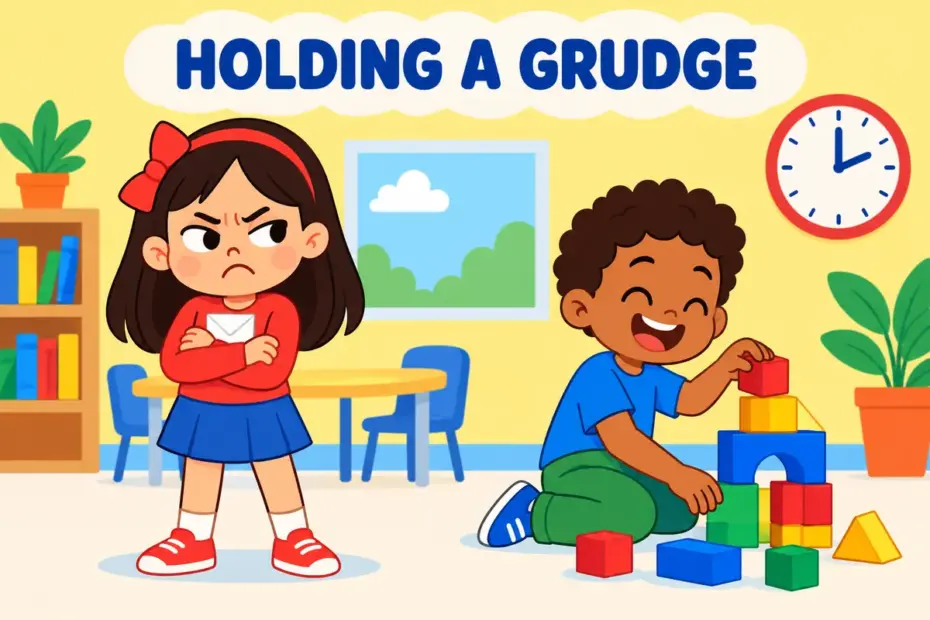
Vindictive describes a person with a strong, lasting wish to hurt someone who has wronged them. To use vindictive in a sentence, place it before what it describes, as in a vindictive message or he grew vindictive after the vote. The adjective names a motive, not a single act.
Vindictive at a glance
- Vindictive is an adjective; its related forms are vindictively and vindictiveness.
- It describes a lasting wish to harm someone, so the grudge outlives the moment that caused it.
- The usual targets are a person, a mood or an act: a vindictive rival, a vindictive silence, a vindictive remark.
- The word is strongly negative, because calling someone vindictive judges their character, not their mood.
- The commonest error is confusing it with vindicate, the verb that means to clear someone of blame.
What does vindictive mean?
Vindictive is an adjective meaning having or showing a strong, lasting wish to hurt someone because you feel wronged. The Cambridge entry for vindictive defines it through that desire for revenge rather than through any single act. A spiteful comment stings in the moment, while a vindictive person keeps the plan alive for months. When the feeling is only mild irritation, petty annoyance is the fairer word, and when it has cooled into quiet bitterness, feeling resentful is more accurate than vindictive.
| Shade of meaning | What it stresses | Example sentence |
|---|---|---|
| Wants revenge | Keeps trying to pay someone back | A vindictive rival reported her twice. |
| Unforgiving temper | Will not let an old slight go | He stayed vindictive for years after the split. |
| Spite in manner | Shows the grudge in small acts | Her vindictive tone silenced the meeting. |
The limitation is worth stating plainly. Vindictive is a strong judgement about character, so it is too heavy for one angry reaction. Somebody who snaps once is irritated, not vindictive, and a strict rule is firm rather than vindictive. The word also says nothing about whether the person ever succeeds.
How do you use vindictive in a sentence?
Because vindictive is an adjective, it either sits before a noun or follows a linking verb such as be, become, sound or seem. It has no object, so you cannot vindictive somebody. The five patterns below cover the ways the word behaves in real writing.
| Pattern | Example | What it signals |
|---|---|---|
| vindictive + person | A vindictive neighbour watched every arrival. | A settled trait of character. |
| vindictive + act | A vindictive remark ended the meeting. | The grudge shows through one act. |
| become or turn vindictive | He became vindictive after the review. | A change of temper over time. |
| sound or seem vindictive | The message sounded vindictive to the team. | A judgement drawn from evidence. |
| vindictively + verb | She vindictively deleted the shared files. | The adverb carries the motive into an action. |
Notice that the adverb vindictively does more work than the adjective in narrative, because it attaches the grudge to a specific deed without labelling the whole person.
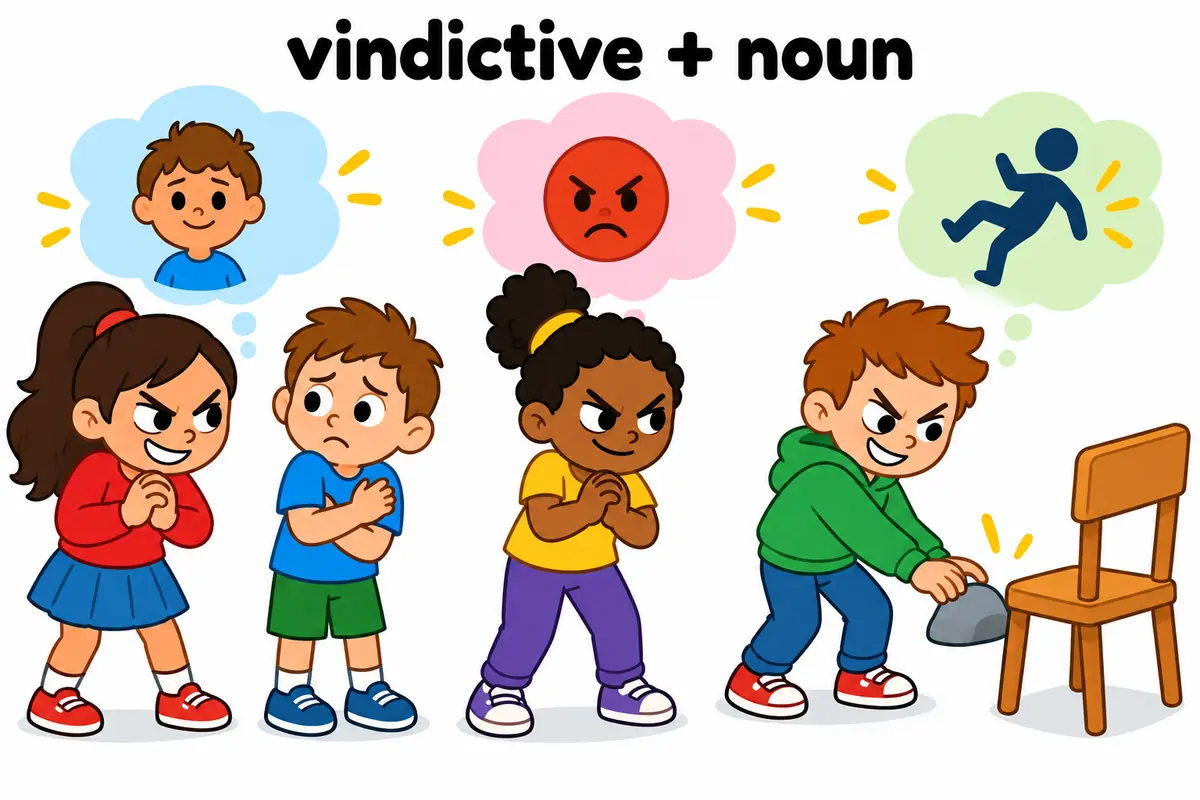
Vindictive in a sentence: examples across contexts
The adjective travels from playground to tribunal without changing meaning, but the setting decides how serious it sounds. Each sentence below keeps vindictive as a description of motive.
| Context | Example sentence | Why this works |
|---|---|---|
| Classroom | The note was vindictive, so the teacher asked both pupils to talk. | Judges the act, then points to a fair response. |
| Workplace | A vindictive manager gave her the worst shifts for a month. | Shows the grudge through repeated decisions. |
| News report | The court heard that a vindictive campaign had targeted the witness. | Describes a pattern rather than one remark. |
| Literature | The novel’s villain is patient and quietly vindictive. | Pairs the adjective with a manner, not an act. |
| Conversation | Do not be vindictive; tell him plainly that you are upset. | Contrasts the grudge with direct honesty. |
| Sports report | A vindictive tackle late in the game earned a red card. | Attaches the motive to a single foul. |
| Academic essay | The essay calls the policy vindictive rather than merely strict. | Draws a fine line between two judgements. |
| Parenting advice | A vindictive punishment teaches children that grudges are normal. | Names the consequence of the motive. |
| Legal writing | The tribunal found the dismissal vindictive rather than fair. | A formal finding about the reason behind an act. |
Every sentence keeps the same structure: the adjective qualifies a person, a campaign, a punishment or an act, and the reader is left to judge the motive.
Vindictive vs vengeful
Vindictive and vengeful both point to payback, but they weigh it differently. Vindictive stresses the lasting, mean-spirited temper; vengeful stresses the active pursuit of revenge.
| Attribute | vindictive | vengeful |
|---|---|---|
| Core meaning | Bearing a lasting grudge | Actively seeking revenge |
| Focus | The temper and intent | The pursuit of payback |
| Duration | Long and smouldering | Until revenge is taken |
| Typical subject | A person, mood or remark | A person, army or campaign |
| Feeling it suggests | Small and mean | Large and dramatic |
| Register | Everyday and journalistic | More literary and dramatic |
Verdict: call a person vindictive when the grudge is the point, and vengeful when the hunt for payback is under way. A vengeful campaign names its target openly, while a vindictive one works in the dark.
Word forms and grammar of vindictive
Vindictive builds a small family of its own, and it shares a root with two words that mean something entirely different. The table keeps the two families apart.
| Form | Part of speech | Example |
|---|---|---|
| vindictive | adjective | A vindictive email helped nobody. |
| vindictively | adverb | He spoke vindictively about the team. |
| vindictiveness | noun | Her vindictiveness surprised the committee. |
| vindicate | verb, different meaning | The report vindicated the nurse. |
| vindication | noun, different meaning | The verdict was a quiet vindication. |
Keep the two families apart in meaning even though they share the root. To vindicate a person is to clear them, and a quiet vindication is the proof that arrives afterwards.
Common mistakes with vindictive
- Incorrect:
He was very vindictive after the inquiry cleared him.Correct: He was vindicated after the inquiry cleared him. Rule: vindicated reports that blame was lifted; vindictive means wanting revenge. - Incorrect:
She vindictived her rival.Correct: She acted vindictively toward her rival. Rule: vindictive is an adjective and has no verb form. - Incorrect:
The team was vindictive to win.Correct: The team was determined to win. Rule: vindictive describes a grudge, not effort or ambition. - Incorrect:
It was a vindication remark.Correct: It was a vindictive remark. Rule: the adjective is vindictive; vindication is a noun. - Incorrect:
He felt vindictive and soon forgave her.Correct: He felt resentful but soon forgave her. Rule: a vindictive person is unwilling to forgive, so the sentence contradicts itself.
The mistake that sounds most foreign is the invented verb. English builds the action from act or behave plus the adverb, so a speaker acts vindictively rather than vindictives.
Practice using vindictive
Read each item, then compare your answer with the reason given below it.
- Fill the gap: After losing the election, he grew bitter and ______.
- Choose the better word: The report (vindicated / vindictive) the driver who had been blamed.
- Correct the error: She vindictived the whole team for one mistake.
- Build a sentence: use vindictive remark about a comment that ends a friendly chat.
- Spot the register: which fits a news report — a vindictive campaign, or he acted totally vindictively?
- Change the form: rewrite Her vindictiveness surprised them using the adverb.
Answers
- vindictive — the adjective follows the linking verb grew and describes character.
- vindicated — the driver was cleared, so the verb is needed, not the adjective.
- She acted vindictively toward the whole team — vindictive has no verb form.
- Model answer: One vindictive remark ended a friendly chat.
- A vindictive campaign — a report favours the adjective and avoids the word totally.
- She behaved vindictively — the adverb describes how she behaved.
The bottom line
Use vindictive in a sentence when you are describing a lasting wish to hurt someone who caused offence, and attach it to a person, a mood or an act. The two details that decide most sentences are these: the word is an adjective with no object, and it is a serious judgement, so it does not fit a single flash of anger. For proof that clears someone, choose the verb instead.
Frequently asked questions about vindictive
Is vindictive used for a person or an action?
Both, because it is an adjective. It most often describes a person, as in a vindictive neighbour, but it also qualifies a mood, an act or a campaign, as in a vindictive remark. The common thread is motive: some strong wish to hurt someone is always behind it.
What is the noun form of vindictive?
The noun is vindictiveness, which names the quality itself, as in her vindictiveness surprised the committee. The adverb is vindictively, used of an action, as in he spoke vindictively about the team. Do not confuse either with vindication, which belongs to the verb vindicate.
Is vindictive the same as vengeful?
They overlap but differ in weight. Vindictive stresses a lasting, mean-spirited grudge, while vengeful stresses the active pursuit of revenge. A vindictive colleague works quietly against you, whereas a vengeful rival openly seeks payback. Only vengeful suggests a campaign rather than a temper.
What does vindictive not mean?
It does not mean angry, strict or determined. A single sharp reaction is irritation, and a firm rule is strictness, neither is vindictive. It also does not mean that revenge succeeds, because the word describes the wish rather than the result, and it never means being cleared of blame.
Have you ever encountered someone who seemed to hold grudges for the slightest offenses, seeking revenge with a malicious intent? This type of behavior can be classified as “vindictive.”
Vindictive actions stem from a deep-seated desire to retaliate against perceived wrongdoings, often with a vindictive person taking pleasure in causing harm or suffering to others.
7 Examples Of Vindictive Used In a Sentence For Kids
- The vindictive witch cast a spell on the princess.
- The vindictive dragon breathed fire on the village.
- The vindictive cat hissed at the dog.
- The vindictive crow stole all the shiny objects.
- The vindictive pirate buried a treasure chest.
- The vindictive lion roared loudly at the other animals.
- The vindictive queen banished her enemies from the kingdom.
14 Sentences with Vindictive Examples
- Vindictive behavior among classmates can create a toxic environment in college.
- Dealing with a vindictive professor can be challenging for students seeking assistance.
- Avoid engaging in vindictive acts towards roommates when facing conflicts in shared living spaces.
- Group projects can be stressful, especially when a team member displays vindictive behavior.
- It’s important to address vindictive comments in a constructive manner to avoid escalating conflicts.
- Participating in gossip can lead to vindictive actions among students in college.
- Seeking help from the college counselor is essential if you are dealing with a vindictive peer.
- Plagiarism is a serious offense that can result in vindictive actions from professors.
- Settling disagreements through dialogue is more effective than resorting to vindictive behavior.
- Joining student organizations can help build a support system against vindictive individuals.
- Balancing academics and personal relationships can prevent vindictive behavior from affecting your college experience.
- Avoid posting vindictive messages on social media platforms, as it can have consequences in college.
- Seek guidance from mentors or seniors if you are unsure how to handle a vindictive situation.
- Practice empathy and understanding to prevent yourself from becoming vindictive towards others in college.
How To Use Vindictive in Sentences?
To use the word Vindictive in a sentence, it is important to understand its meaning and proper context. The word Vindictive is an adjective used to describe someone who has a strong or unreasoning desire for revenge.
Here’s how you can use Vindictive in a sentence:
- “She was feeling vindictive after being treated unfairly at work, so she plotted a way to get back at her colleagues.”
- “His vindictive behavior towards his ex-girlfriend only caused more harm and pain for both of them.”
- “The politician’s vindictive actions towards his opponents ultimately led to his downfall in the election.”
When using Vindictive in a sentence, make sure the context fits the definition of seeking revenge or wanting to cause harm to others. It is important to use this word carefully as it denotes negative behavior or intentions.
By understanding the meaning of Vindictive and incorporating it into appropriate contexts, you can effectively enhance your vocabulary and communication skills. Practice using the word Vindictive in different sentences to become more comfortable with its usage and grasp its nuances.
Conclusion
In conclusion, sentences laden with vindictive language are characterized by a desire for revenge or harm towards others. An individual’s vindictive tone in their sentences can often reveal their resentment, hostility, or desire to cause harm to someone they perceive as having wronged them.
It is important to recognize and address the underlying emotions prompting such vindictive sentences, as they can contribute to unhealthy conflicts and damage relationships. By seeking to understand the root causes of vindictiveness and promoting empathy and communication, individuals can work towards resolving conflicts constructively and fostering healthier interactions with others.


