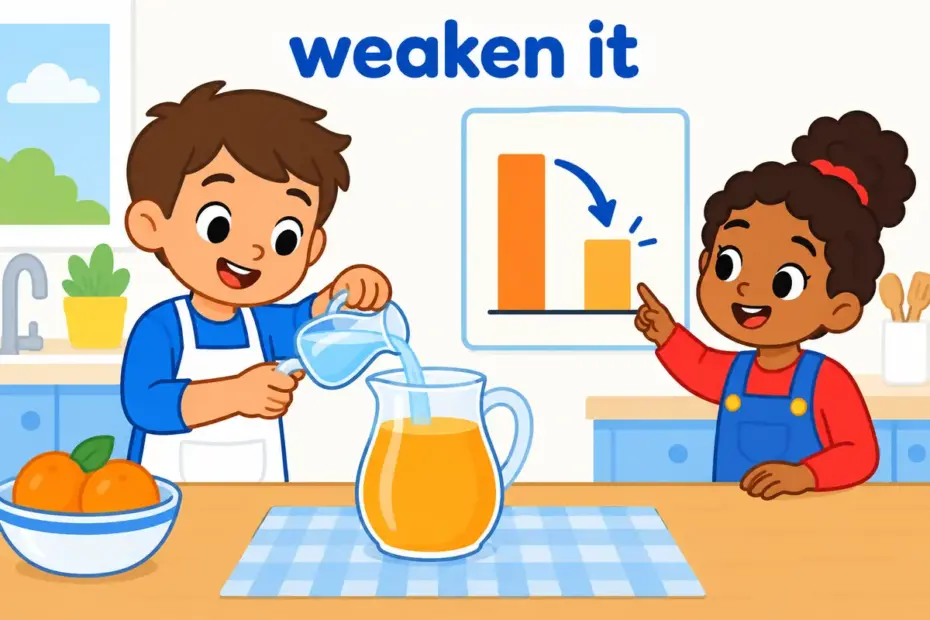
Water down means to make a drink weaker by adding water, or to make a plan, rule or criticism less forceful. To use water down in a sentence, put a pronoun between the two words: “They watered the plan down.” With a full noun, either order works, so the phrase is genuinely separable.
Water down at a glance
- Water down is a separable phrasal verb, and watered-down is its adjective form.
- Its forms are water down, waters down, watered down and watering down.
- The literal sense adds water to a drink; the figurative sense weakens a plan or a statement.
- The verb is transitive and always needs an object to say what is weakened.
- The commonest error is the pronoun order in water down it, which must be water it down.
What does water down mean?
Water down is a phrasal verb with one literal sense and one figurative sense. The Cambridge entry for water down records both: in the kitchen it means adding water to a drink, and in an argument it means removing strength from a proposal until it offends nobody. The adulterate the milk is the technical cousin of the literal sense, but it is used far more narrowly.
| Sense | Plain meaning | Example sentence |
|---|---|---|
| Dilute a drink | Add water to make a liquid weaker | The nurse watered down the juice for the toddler. |
| Weaken a proposal | Remove force from a plan, rule or demand | The committee watered down the new rules. |
| Soften a statement | Make a criticism or claim milder | He watered down his report to avoid a quarrel. |
One limitation is worth stating plainly. Water down is a critical word: it almost always implies that the result is weaker than it should be. When a change is neutral or welcome, choose reduce, simplify or the gentler mitigate the effect, which do not carry the same hint of disappointment.
The figurative sense now dominates, and in journalism it is almost always the one meant. A politician who waters down a promise has not withdrawn it; the promise still stands, but its force has been spent. That distinction between keeping an idea and weakening it is exactly what the verb is for.
How do you use water down in a sentence?
Water down behaves like other separable phrasal verbs. A full noun can follow the particle or sit between the verb and down, but a pronoun must go in the middle, so water it down is correct and water down it is not. The verb stays transitive throughout.
| Pattern | Example | What it signals |
|---|---|---|
| water down + object | They watered down the proposal. | The standard order, with the victim of the change last. |
| water + object + down | They watered the proposal down. | The split order, identical in meaning. |
| water + it / them + down | The board watered it down before the vote. | Pronoun in the middle, the only allowed slot. |
| be watered down | The bill was watered down in committee. | Passive form, common in political reporting. |
| watered-down + noun | Members rejected the watered-down version. | Adjectival use, always hyphenated before a noun. |
The pronoun rule is the clearest test of fluency. A native writer says the board watered it down, never the board watered down it, and that small word order separates idiomatic English from a translation. Political writing leans on the passive because it lets a report name the weakened document without naming who weakened it, which is often the delicate part of the story.
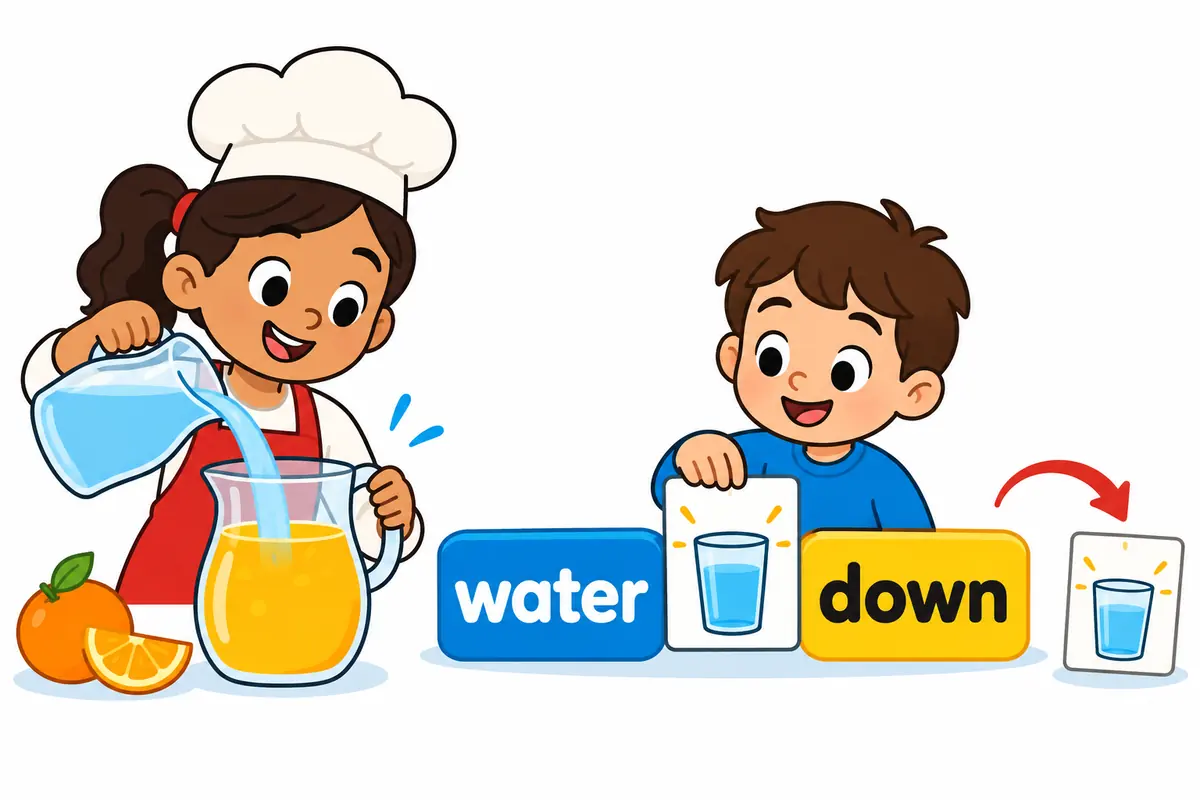
Water down in a sentence: examples across contexts
Water down keeps its critical edge in every register, whether the object is a drink or a policy. The nine sentences below move from a kitchen to a council chamber.
| Context | Example sentence | Why this works |
|---|---|---|
| Kitchen | The host watered down the lemonade for the younger guests. | Uses the literal sense with a clear reason. |
| News report | Ministers watered down the climate bill before the final vote. | Names the document and the weakening in one line. |
| Workplace | We watered the wording down so that no team felt blamed. | Split order after a full noun keeps the tone measured. |
| Politics | The watered-down amendment pleased nobody. | Adjectival use, hyphenated before the noun. |
| School | The head watered down the uniform rule after the parents met. | Shows the verb applied to a rule rather than a liquid. |
| Conversation | Don’t water it down; tell me exactly what happened. | Puts the pronoun in the middle, the idiomatic slot. |
| Business | The board watered down its growth target for the year. | Uses its to tie the weakened object to the subject. |
| Criticism | The reviewer watered down the attack to keep the peace. | Applies the verb to a statement rather than a plan. |
| Academic | Editors feared the peer review would water down the findings. | Frames the weakening as a risk in formal prose. |
| Local news | The parish council watered down the parking ban after protests. | Shows a rule losing force under public pressure. |
| Product review | Critics said the sequel watered down everything that worked. | Applies the verb to a creative work losing its edge. |
When the change goes the other way, writers often reach for the opposite verb: to intensify the pressure is to add force where water down removes it.
Water down vs dilute
The nearest word is dilute the juice, and the two overlap only in the kitchen.
| Attribute | water down | dilute |
|---|---|---|
| Literal use | Add water to a drink or a mixture | Add a liquid to reduce concentration |
| Figurative use | Weaken a plan, rule or statement | Rare, mostly in science and policy |
| Typical object | Lemonade, a bill, a criticism | A solution, a chemical, a policy |
| Tone | Critical, often disappointed | Neutral and technical |
| Register | Everyday to journalistic | Scientific and formal |
| Separability | Separable; water it down | Not separable |
Verdict: use water down when someone has taken the strength out of a plan or a drink and the result is a loss, and dilute when the point is simply that a liquid is now weaker in a measured, neutral way. If the reader cannot tell what was lost, water down is probably the wrong verb.
Word forms and grammar of water down
Water down inflects regularly and gains a hyphen only in its adjectival form. The table also marks two other down phrasal verbs that share the particle but not the meaning.
| Form | Part of speech | Example |
|---|---|---|
| water down | phrasal verb, base | Do not water down the findings. |
| waters down | verb, third person | The editor waters down every strong claim. |
| watered down | verb, past and past participle | They watered down the pledge. |
| watering down | verb, present participle | Watering down the rules took months. |
| watered-down | adjective | It was a watered-down version. |
| break down | related phrasal verb | Can you break down the figures? |
Do not confuse the weakening with the retreat. To back down is to give up a demand entirely, while to water something down is to keep it but remove its force. The particle down is the same, but one shrinks an idea and the other abandons a fight. Keeping the object and changing only the adverb is what makes water down so useful in reporting.
Common mistakes with water down
- Incorrect:
Don’t water down it.Correct: Don’t water it down. Rule: A pronoun must sit between the verb and the particle. - Incorrect:
The bill was water downed.Correct: The bill was watered down. Rule: The past participle is watered, not water downed. - Incorrect:
The rules watered down last year.Correct: The rules were watered down last year. Rule: The verb is transitive, so a weakened thing needs the passive, not an active verb. - Incorrect:
We agreed on a watered down plan.Correct: We agreed on a watered-down plan. Rule: The adjective takes a hyphen before a noun. - Incorrect:
She watered down at the last meeting.Correct: She watered down her proposal at the last meeting. Rule: The verb needs an object to name what is being weakened.
Practice using water down
Work through the six items, then check the reasoning rather than only the answer.
- Fill the gap: The union accused the council of ______ the safety rules.
- Choose the better word: The lab needed a weaker solution, so it chose to (water down / dilute) the acid.
- Correct the error: They watered down it before the vote.
- Build a sentence: use water down about a coach making a tough training plan easier.
- Spot the register: which belongs in a news report — ministers watered down the pledge, or the ministers totally went soft on the pledge, yeah?
- Rewrite with a pronoun: The editor watered the headline down. Replace the headline with it.
Answers
- watering down — the gerund follows the preposition of, and the rules are the object.
- dilute — a measured, technical weakening of a liquid suits dilute better than water down.
- They watered it down before the vote — the pronoun must sit between water and down.
- Model answer: The coach watered down the training plan so the younger players could keep up.
- Ministers watered down the pledge — a report keeps the plain verb and avoids the tag yeah.
- The editor watered it down — the pronoun replaces the noun in the middle of the phrase.
The bottom line
Use water down in a sentence when a drink is made weaker, or when a plan, rule or criticism loses its force and the loss matters. The two points that decide most sentences are that the verb is separable, so a pronoun goes between water and down, and that the hyphen appears only in the adjective watered-down. When the weakening is neutral, dilute or reduce is the fairer word.
Frequently asked questions about water down
Is water down one word or two?
As a verb it is always two words: water down the plan. As an adjective before a noun it takes a hyphen, as in a watered-down version. The spacing and the hyphen are therefore reliable clues to how the word is doing its job in the sentence, whether as a verb or as a describing word.
What is the difference between water down and dilute?
Dilute is the neutral, technical verb for reducing the strength of a liquid, and it rarely describes ideas. Water down works in the kitchen too, but its figurative use is the common one, and it carries a critical edge because something valuable has been removed from a plan or a claim.
Can you water down a statement or a rule?
Yes. A statement, a rule, a promise, a proposal and a criticism can all be watered down. The verb needs a concrete object to say what lost its force, and the figurative sense is now far more frequent than the literal one about drinks.
Is watered-down always hyphenated?
Only before a noun. In a watered-down report the hyphen joins the two words into one adjective, which is standard practice. After the verb, as in the report was watered down, the words separate and no hyphen appears. The position of the phrase decides the spelling.