
Waver means to move unsteadily or to be unable to settle on a decision. To use waver in a sentence, name what is unsteady or what stays unresolved: “Her voice wavered as she answered.” The verb covers both a shaking body and a mind that keeps changing.
Waver at a glance
- Waver is a regular verb; its forms are wavers, wavered and wavering, with the adjective wavering and the rare noun waverer.
- Two senses dominate: moving unsteadily, and being unable to decide between options.
- The decision sense almost always appears as waver between, waver on or waver over.
- The stability sense normally follows a thing that shakes: a voice, a flame, a hand or a light.
- The commonest error is writing waver for waive, the verb that means to give up a right.
What does waver mean?
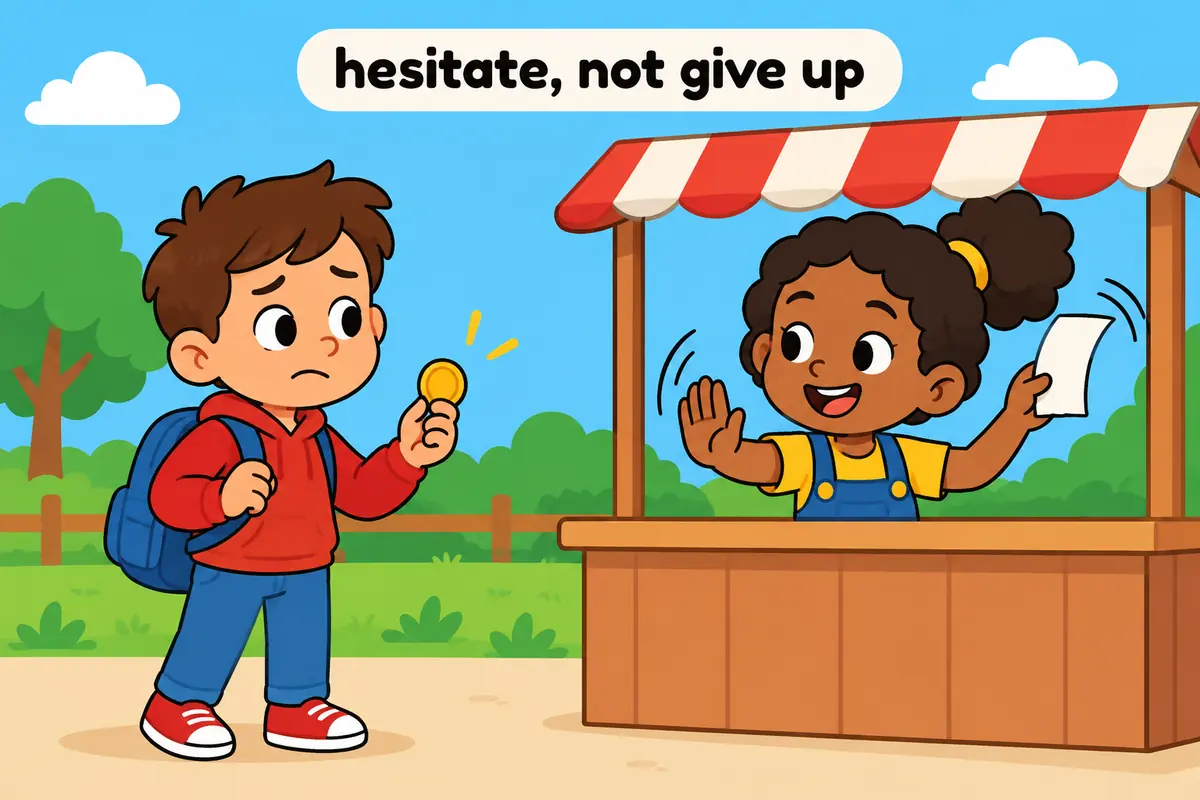
Waver is a verb meaning to move with an unsteady motion or to be unable to settle on one of two choices. The Cambridge entry for waver records both senses, and the difference decides the sentence: the first describes a body or a flame that shakes, the second describes a person who has not yet decided. Where the meaning is only holding back for a moment, hesitate before you answer is the safer verb, because waver suggests a movement back and forth rather than a single pause.
| Sense | Plain meaning | Example sentence |
|---|---|---|
| Move unsteadily | Shake or tremble slightly | The candle flame wavered in the open window. |
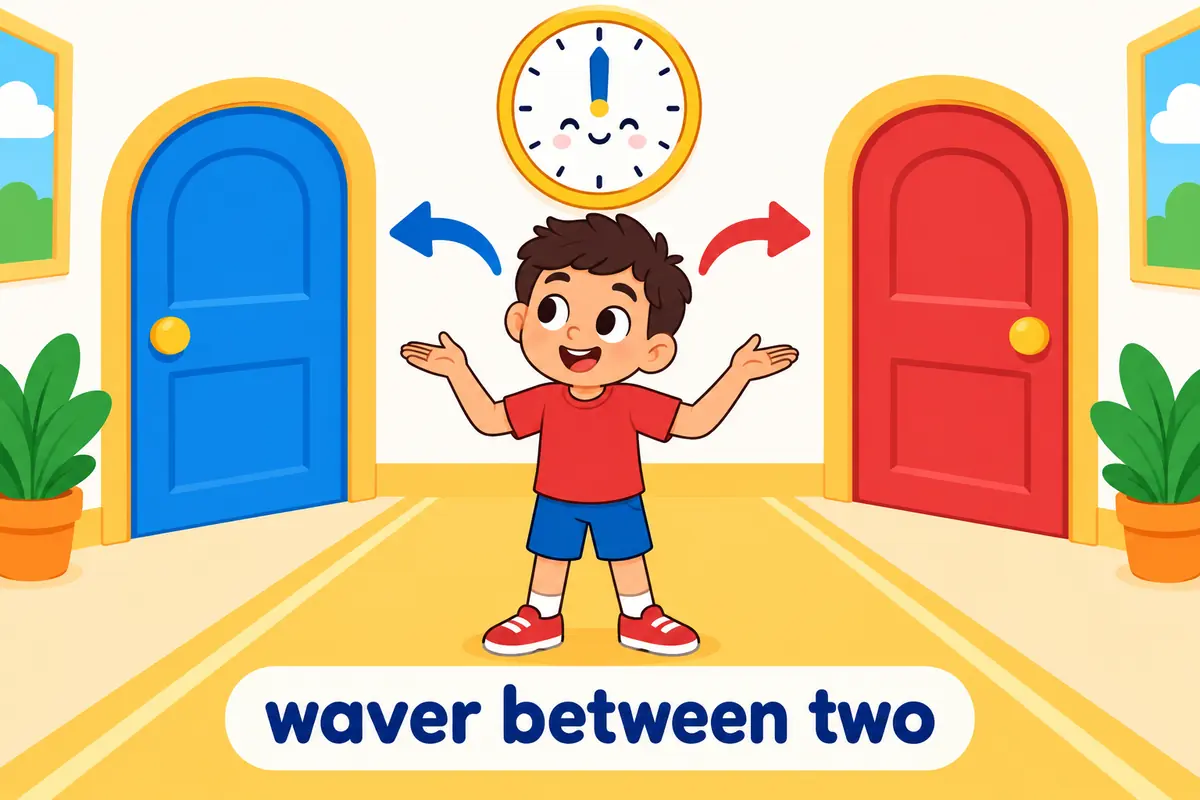
| Cannot decide | Keep shifting between two options | The board wavered between the two bids. |
| Lose resolve | Become less certain or less loyal | His support never wavered during the inquiry. |
One limitation is worth stating plainly. Waver does not mean to fail or to refuse. A person can waver for a second and still decide well, and support that wavers once can recover completely. The word describes movement in the balance, not the final position.
How do you use waver in a sentence?
Waver needs no object, and the pattern you choose tells the reader whether the subject is a thing or a mind. The five frames below cover nearly every real sentence, from a shaking hand to an undecided committee.
| Pattern | Example | What it signals |
|---|---|---|
| waver between A and B | The mayor wavered between the two sites. | Two named options, with no decision yet. |
| waver on or over + issue | She never wavered on the safety rule. | A single topic and a commitment that holds or slips. |
| waver in + quality | He wavered in his resolve after the meeting. | An inner quality losing strength. |
| thing + waver | The flame wavered in the draught. | Physical unsteadiness, with no choice involved. |
| negative + waver | Her belief did not waver. | Emphasis on steadiness, usually after not, never or hardly. |
When the movement is tiny and continuous, tremble with cold is the narrower verb, while waver allows a slower back-and-forth that could still stop. A voice trembles from a physical cause; it wavers when the speaker’s nerve is in question.
Waver in a sentence: examples across contexts
Waver keeps its meaning as the setting changes, but the subject shifts from voices to prices to promises. The sentences below move from a classroom to a market report, and each one names what is doing the wavering.
| Context | Example sentence | Why this works |
|---|---|---|
| Classroom | Her hand wavered before she wrote the final answer. | A physical sign shows the hesitation without stating it. |
| Workplace email | I wavered between the two suppliers all week. | The first person is natural for a decision still open. |
| News report | The minister wavered over the timetable for the vote. | A named figure and one issue match the reporting pattern. |
| Finance writing | The currency wavered near the same level for hours. | A thing that moves fits the stability sense. |
| Sports commentary | The goalkeeper never wavered after the early goal. | The negative stresses steady nerve under pressure. |
| Legal writing | The witness wavered in her account under cross-examination. | The in-quality pattern marks a weakening account. |
| Academic prose | Support for the theory wavered as new data arrived. | An abstract quality as subject suits formal writing. |
| Conversation | My voice wavered when I said her name. | The body sense is the one people use in speech. |
Unlike falter mid-sentence, which implies an actual stumble or failure, waver leaves the outcome open and the subject still capable.
Waver vs waive
Waver and waive sound identical in speech, which is why they are mixed in writing. Waver means to hesitate or shake; waive means to give up a right, fee or rule on purpose. The waive a fee page shows the legal pattern, and the difference is settled by asking whether anything is being surrendered.
| Attribute | waver | waive |
|---|---|---|
| Core meaning | Hesitate or shake | Give up a right or claim |
| Part of speech | Verb only | Verb only |
| Typical subject | A person, voice or price | A person or body with authority |
| Object | None | A fee, rule, right or deadline |
| What it implies | The decision is still open | The decision is final |
| Sound | Identical | Identical |
Verdict: if something is being given up on purpose, choose waive; if someone cannot make up their mind or a thing shakes, choose waver. Between two people, vacillate between options is the formal cousin of waver, while prices and readings more often fluctuate around a value.
Word forms and grammar of waver
Waver inflects like any regular verb, and the spelling keeps a single r in every form. The table also lists the noun that learners wrongly attach to this family.
| Form | Part of speech | Example |
|---|---|---|
| waver | verb, base form | Prices will waver before the announcement. |
| wavers | verb, third person singular | His voice wavers when he is tired. |
| wavered | verb, past and past participle | The committee wavered for a week. |
| wavering | verb participle and adjective | A wavering line is hard to read. |
| waveringly | adverb, literary | She spoke waveringly about the plan. |
| waverer | noun, rare | The waverer finally chose the second offer. |
Keep waiver, the noun for giving up a right, with waive and not with waver, even though the two words look almost identical.
Common mistakes with waver
- Incorrect:
She asked the school to waver the late fee.Correct: She asked the school to waive the late fee. Rule: Waive means to give up a fee or right, and only waive can take that object. - Incorrect:
He wavered to accept the offer.Correct: He wavered about accepting the offer. Rule: Waver takes between, on, over or about before a choice, never a to-infinitive. - Incorrect:
Her voice was wavered with nerves.Correct: Her voice wavered with nerves. Rule: Waver is intransitive, so it has no passive form. - Incorrect:
The flag wavered between the two poles.Correct: The flag waved between the two poles. Rule: Waved describes a steady motion; wavered adds a loss of steadiness. - Incorrect:
I am waivering about the trip.Correct: I am wavering about the trip. Rule: The spelling keeps the single r: wav-er-ing, not waivering.
Practice using waver
Work through the six items, then read the reasons so the pattern stays with you.
- Fill the gap: The jury ______ between a quick verdict and a longer review.
- Choose the better word: The council agreed to (waive / waver) the application fee.
- Correct the error: The team wavered to sign the contract.
- Build a sentence: use waver on about a promise to keep training.
- Spot the register: which belongs in a news report: the pound wavered near 1.2 dollars, or I kinda wavered, you know?
- Rewrite with a negative: The rescue plan held firm. Use not waver.
Answers
- wavered, because a choice between two named options takes between.
- waive, because the fee is being given up and the object verb is waive.
- The team wavered about signing the contract, because waver cannot take a to-infinitive.
- Model answer: He wavered on his promise to train every morning.
- The pound wavered near 1.2 dollars, because a report avoids the first person and slang.
- The rescue plan did not waver, because the negative stresses steady resolve.
The bottom line
Use waver in a sentence when something shakes or a decision is still moving, and choose the preposition to match: waver between two options, waver on one issue, waver in a quality. The two nuances that settle most sentences are these: the verb is intransitive, so it never carries an object, and it differs from waive, which means giving something up on purpose. When the hesitation is fussy and prolonged, dither over small choices is the more pointed verb.
Frequently asked questions about waver
Is waver a regular verb?
Yes. Waver follows the regular pattern, so the past is wavered and the present participle is wavering. It keeps a single r throughout, which is why waivering is a misspelling. The rare noun waverer and the literary adverb waveringly build on the same stem.
What is the difference between waver and waive?
Waver means to hesitate or move unsteadily, and it never takes an object. Waive means to give up a right, fee or rule on purpose, and it always needs one. The homophone trap catches both directions, so check whether something is being surrendered before you choose.
Does waver suggest a decision is final?
No. Waver describes being in the balance, so the outcome stays open. A person who wavers may still decide firmly, and support that wavers can return. That openness is what separates waver from final words such as give up or refuse.
Can a price or a reading waver?
Yes. The stability sense applies to anything that moves unsteadily, including prices, signals and readings. Finance and science writing use waver for a gentle drift rather than a sharp fall, while fluctuate covers wider swings. The subject is the thing itself, never a person deciding.
Have you ever struggled with deciding between two choices, feeling uncertain about which one to choose? This inner conflict, known as wavering, often leaves us feeling indecisive and torn between options.
Wavering describes the hesitation or fluctuation in decision-making and can manifest in various aspects of life, from choosing between different job opportunities to trying to make up one’s mind about dinner plans.
7 Examples Of Waver Used In a Sentence For Kids
- The flag started to waver in the wind.
- The flame of the candle began to waver.
- The flower stems may waver in the breeze.
- The leaves on the tree can waver gently.
- The kite’s tail began to waver as it flew in the sky.
- The ribbon on the gift box can waver in the air.
- The bird’s feathers may waver when it moves.

14 Sentences with Waver Examples
- Waver on whether to bunk the morning lecture or not.
- It’s normal to waver between two career paths during college.
- Don’t waver in your dedication to studies during exam time.
- Some college students waver in their decision to pursue higher education or enter the workforce.
- Challenges may cause you to waver in your confidence, but stay determined.
- Don’t let peer pressure make you waver in sticking to your values and beliefs.
- Feeling homesick can sometimes make your resolve waver to stay in college.
- Procrastination can make your motivation waver when it comes to completing assignments.
- The temptation to waver from a healthy lifestyle is high in college, but prioritize your well-being.
- When faced with tough decisions, it’s normal to waver before coming to a conclusion.
- Financial constraints may cause some students to waver in their decision to continue their studies.
- The desire to socialize may sometimes waver your focus from academic responsibilities.
- It’s important not to waver in seeking help or guidance when facing academic challenges.
- Feeling overwhelmed can cause your determination to waver, but remember to take one step at a time.

How To Use Waver in Sentences?
Waver means to hesitate or be indecisive. To use waver in a sentence, consider the following example:
“I could see him waver as he tried to make a decision about which job offer to accept.”
In this sentence, the word “waver” is used to describe the internal struggle or hesitation the person is experiencing in making a decision.
When using waver in a sentence, it is important to provide context so that the reader understands the specific situation or emotion being described. Consider the following tips to effectively incorporate waver into your writing:
- Use waver when expressing uncertainty or doubt about a choice or decision.
- Describe the appearance or behavior of a person or thing that is hesitant or indecisive.
- Show the consequence or impact of the hesitation or wavering behavior.

By following these tips and paying attention to the context in which you use waver, you can effectively convey the meaning of the word in your writing. Remember that waver is a versatile word that can be used in various situations to convey hesitation, uncertainty, or indecision.
Conclusion
In conclusion, the examples of sentences with “waver” demonstrate how the word can be used in various contexts to convey a sense of uncertainty, hesitation, or changeability. Whether describing someone’s resolve, a fluctuating stock price, or the flickering flame of a candle, “waver” captures the idea of being unsteady or indecisive.
The phrase “wavering between two options” encapsulates the essence of wavering, suggesting a struggle in making a decision. Overall, these examples serve to highlight how the word “waver” is a versatile term that can effectively communicate moments of doubt, vacillation, or inconsistency in both literal and figurative situations.