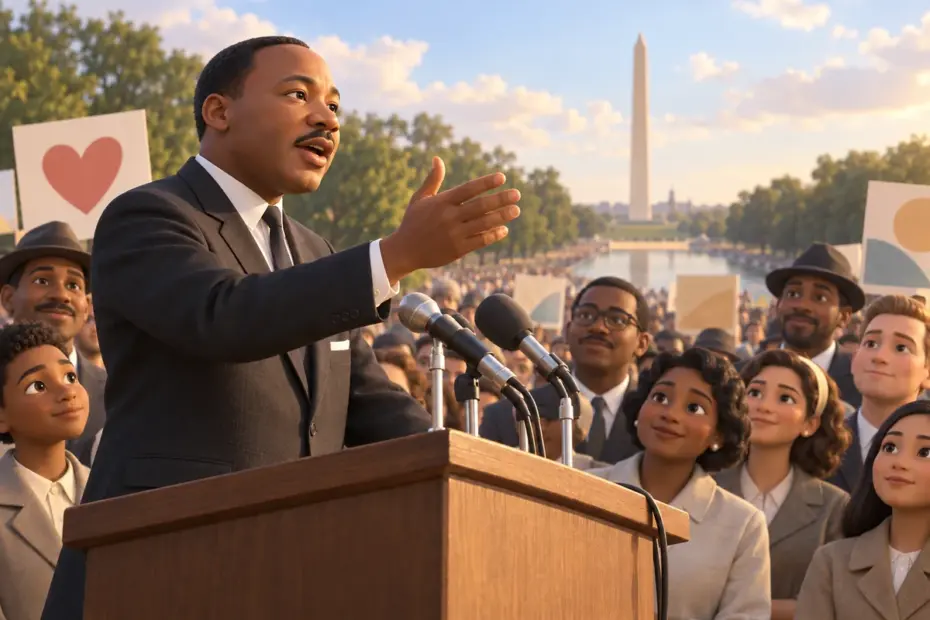
Words to Describe Martin Luther King Jr.
Words to describe Martin Luther King Jr. should connect to documented parts of his work, writing, and public leadership. Principled, eloquent, and influential are useful choices when explained with context; no short adjective list can represent King or the wider civil rights movement on its own.
Key facts at a glance
- King received the 1964 Nobel Peace Prize for his nonviolent struggle for civil rights.
- The Nobel organization describes the award as recognizing nonviolent struggle for civil rights.
- The Southern Christian Leadership Conference formed in 1957 as a coalition of local organizations.
- Adjectives such as eloquent or courageous are interpretations; give the evidence behind them.
- King’s public leadership was part of a broader movement involving many organizers and communities.
Which words describe Martin Luther King Jr. accurately?
Useful words to describe Martin Luther King Jr. include principled, eloquent, influential, persistent, and courageous, when the writer explains what supports each description. These adjectives interpret documented actions and ideas; they should not replace historical evidence or the work of the many people in the civil rights movement.
The Nobel Prize organization says King received the 1964 Peace Prize for his nonviolent struggle for civil rights. Stanford’s King Institute introduction places his leadership within the broader organizing history. King was a prominent leader, while local organizers, participants, and allied groups also shaped the movement.
Core Adjectives and What They Mean
Choose an adjective according to the evidence it summarizes. The examples below connect the word to a documented aspect of King’s public work rather than treating praise as a substitute for explanation.
| Adjective | Meaning | Context for using it |
|---|---|---|
| principled | Guided by stated moral or political commitments | His advocacy of nonviolent direct action reflects a clearly articulated strategy. |
| eloquent | Expressing ideas with force and clarity | Use it when discussing the language and delivery of a particular speech or writing. |
| influential | Having an effect on people or events | His leadership and public arguments shaped national civil rights discussions. |
| persistent | Continuing despite difficulty or opposition | Connect the word to sustained organizing and advocacy across campaigns. |
| courageous | Willing to face danger or difficulty for a purpose | Frame this as an interpretation grounded in documented threats and continued public advocacy. |
| visionary | Imagining a different or future social condition | Explain the specific ideals or proposals that make the description apt. |
| inspiring | Encouraging others through example or ideas | Use when describing the effect his speeches or example had on audiences. |
How can you support an adjective with historical evidence?
Name the action, source, or idea that warrants the adjective. For instance, principled is more useful when tied to King’s stated commitment to nonviolent protest; eloquent becomes clearer when a writer analyzes a specific passage rather than simply praising his speaking ability.
For factual writing, distinguish what a source documents from what the writer infers. The Stanford King Institute’s account of King’s nonviolence philosophy explains that nonviolence was an active social and political method, not simply passivity. This context makes principled or strategic more precise than a generic compliment.

Why should descriptions include the wider movement?
Martin Luther King Jr. was an important leader, but descriptions should not imply that one person alone achieved civil rights advances. The King Institute describes the Southern Christian Leadership Conference as established in 1957 and organized through local affiliates; its work depended on a wider network of leaders and participants.
When writing a short school description, pair an individual quality with collective context: “King was an influential advocate whose public leadership worked alongside local organizers and community campaigns.” That sentence names his role without erasing people whose work was less nationally visible.

Check Adjectives Against Part of Speech
A descriptive word list should identify part of speech as well as meaning. Some entries commonly placed in word banks—such as defeat, debate, encouragement, leadership, sacrifice, and freedom—are nouns or can function as verbs; they are not adjectives in those forms.
| Entry or form | What to check | Adjective option when relevant |
|---|---|---|
| decisice | Misspelling | decisive |
| faithless | Negative meaning; usually not a respectful description | faithful, if supported by the specific context |
| defeat / sacrifice | Nouns; “defeat” can also be a verb | determined, selfless, or sacrificial, depending on evidence |
| leadership / freedom | Nouns naming a role or condition | influential, liberating, or freedom-seeking, where accurate |
| hard work | Noun phrase rather than adjective | hardworking describes a person; demanding describes the work |
Grammar matters because a sentence needs the right form: “King showed determination” uses a noun, while “King was determined” uses an adjective. Do not treat a plausible adjective as automatically accurate history; the replacement should fit a documented action or stated idea.
Conclusion: choose words to describe Martin Luther King Jr. with care
The strongest words to describe Martin Luther King Jr. are specific, supported, and historically contextualized. Use principled for documented commitments, eloquent for the craft of particular speeches, and influential for his public role. Connect every adjective to evidence and acknowledge the broader movement.
Frequently asked questions
What are three positive words to describe Martin Luther King Jr.?
Principled, eloquent, and influential are three useful choices when supported with context. His advocacy drew on a stated commitment to nonviolence, his speeches and writing used persuasive language, and his public leadership shaped national debate. Explain the evidence instead of presenting adjectives as self-proving facts.
Is “courageous” an objective historical fact?
Courageous is an evaluative adjective rather than a measurable fact. A writer can support that interpretation by pointing to documented threats and King’s continued public advocacy, while making clear that the conclusion is an interpretation of evidence. That distinction keeps praise thoughtful and historically responsible.
Was Martin Luther King Jr. the only leader of the civil rights movement?
No. King was a major national leader, but the civil rights movement included many organizers, local groups, churches, students, and community members. The Southern Christian Leadership Conference itself connected local affiliates. A balanced description recognizes King’s importance without making him stand in for the entire movement.
What word describes King’s approach to protest?
Nonviolent directly describes his approach to protest and social change. Principled can describe his commitment to that approach, and strategic can describe its use as organized direct action. These words name different aspects, so select one that matches the point your sentence makes.
When it comes to words that describe Martin Luther King Jr, there are so many to choose from! He was an inspirational leader, a powerful speaker, and a tireless champion of civil rights. His words still echo in our hearts and minds today, inspiring us to stand up for what we believe in.
In honor of his legacy, let’s take a look at some of the words that best describe this great man.
Words to Describe Martin Luthar King Jr.
Martin Luther King Jr. was a wordsmith. His gift with words helped him to become one of the most influential leaders of the Civil Rights Movement. When it comes to describing King, there are a few words that immediately come to mind: passionate, eloquent, brave, and visionary. However, there are many other words that can be used to describe him as well. Here are just a few:
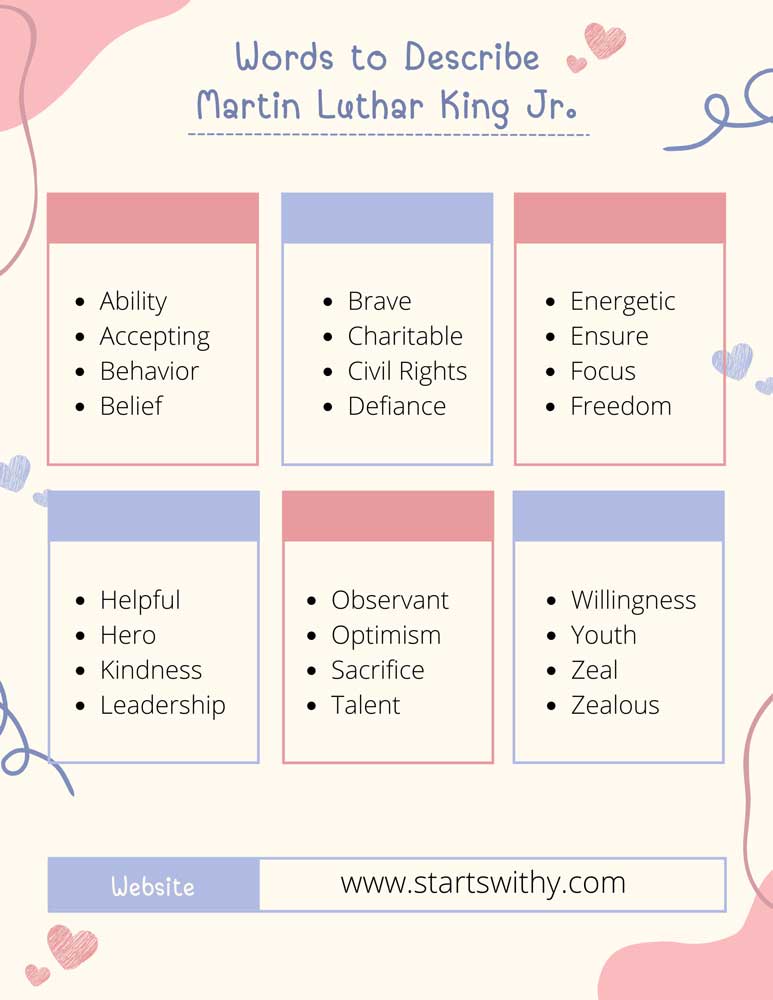
- Determined: King was always determined to achieve his goals, no matter how difficult they may have seemed.
- Persistent: even when faced with opposition or setbacks, King never gave up on his quest for justice and equality.
- Charismatic: King had a way of captivating an audience and inspiring others to stand up for what they believe in.
- Compassionate: King always showed compassion for those who were suffering, regardless of their race or background.
These are just a few of the words that can be used to describe Martin Luther King Jr. As we remember him today, let us not forget the countless ways in which he made our world a better place.
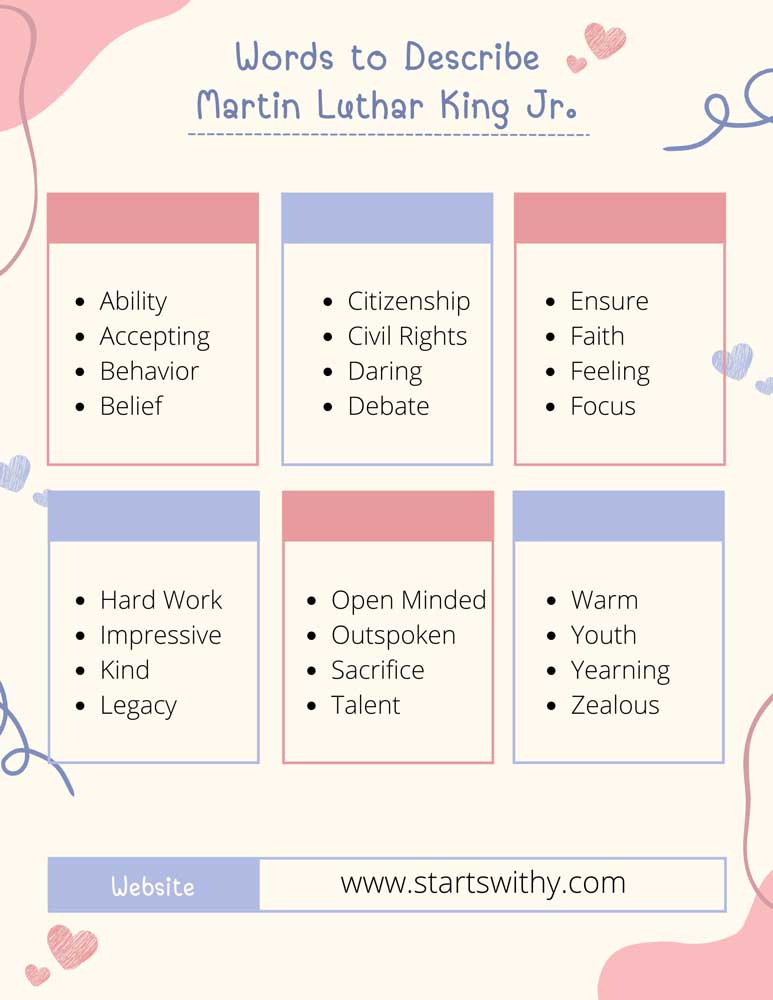
A | B | C
| ability | benevolent | charm |
| absorb | bold | church |
| accepting | bond | citizenship |
| accommodating | brave | civil rights |
| behavior | charismatic | civility |
| belief | charitable | clout |
C | D | E | F
| coherent | defeat | faith |
| daring | defiance | faithless |
| debate | empathetic | feeling |
| decent | encouragement | focus |
| decisice | energetic | forgiving |
| deed | ensure | forsake |
F | H | I | K | L | O | S
| freedom | impressive | open minded |
| hard work | kind | optimism |
| harmony | kindness | orderly |
| healing | leadership | oriented |
| helpful | legacy | outspoken |
| hero | observant | sacrifice |
S | T | W | Y | Z
| sage | warm | youth |
| talent | willingness | zeal |
| teamwork | yearning | zealous |
Final words
While there are many words that could be used to describe Martin Luther King Jr., some of the most commonly used words include brave, inspirational, and determined. Brave, because he stood up for what he believed in despite the risk to his own safety. Inspirational, because his words and actions motivated others to fight for their own rights. Determined, because he never gave up, even when the odds were against him. Martin Luther King Jr. was all of these things and more, and his legacy continues to inspire people all over the world.