Xanthic vs yellow is a choice between a technical colour term and the everyday word it names. Use xanthic in botany, biology and colour science, where it means yellowish or tending to yellow, and use yellow in ordinary speech and writing for the colour itself. The two rarely compete, because almost no everyday sentence needs xanthic.
Xanthic vs yellow at a glance
- Xanthic is an adjective from scientific vocabulary; yellow is both an adjective and a noun.
- Xanthic describes a colour tendency, while yellow names a colour directly.
- Xanthic appears in botany, zoology and histology; yellow appears everywhere.
- Yellow also means cowardly in informal speech, a sense xanthic never carries.
- The commonest error is using xanthic for ordinary things, where it sounds deliberately obscure.
Xanthic vs yellow: the master comparison
The table below weighs the two words on the criteria that decide real usage. Read it as a map of where each term belongs rather than a score, because the winner changes with the subject.
| Criterion | xanthic | yellow |
|---|---|---|
| Core meaning | Of a yellow colour or tending to yellow | The colour of ripe lemons and sunflowers |
| Part of speech | Adjective only | Adjective and noun |
| Register | Technical and scientific | Everyday, neutral to informal |
| Typical subject | Petals, algae, feathers, tissue stains | Clothes, paint, signs, taxis |
| What it names | A slight or comparative yellow tendency | The full, named colour |
| Figurative sense | None in general use | Cowardly, as in a yellow streak |
| Frequency | Rare outside specialist writing | One of the commonest colour words |
| Best partner word | Flora, thallus, hue, tinge | Bright, pale, warm, paint |
The verdict is simple. Reach for xanthic only when a reader already knows botanical or biological vocabulary, and reach for yellow in every other sentence. The rest of this page shows both words in parallel so the boundary becomes easy to hold.
What do xanthic and yellow mean?
Xanthic is an adjective meaning yellowish, especially in plants and animals, and it comes from the Greek word for yellow that also gives us xanthophyll and xanthium. Yellow is the name of the colour between green and orange in the spectrum, and it works as both an adjective and a noun. The Cambridge entry for xanthic confines the word to colour description, and the entry for yellow records the colour plus the informal sense of cowardly. For more scientific examples, the dedicated page on xanthic gathers further uses, and the page on yellow follows the colour through ordinary writing.
| Sense | Plain meaning | Example sentence |
|---|---|---|
| Xanthic, botanical | Of a plant part, yellow or yellowish | The xanthic petals marked this species at once. |
| Xanthic, scientific | Tinged with yellow in a specimen | A xanthic strain appeared in the cultures. |
| Yellow, colour | The colour itself, as adjective or noun | The walls were painted a warm yellow. |
| Yellow, informal | Cowardly or easily frightened | He called the refusal a yellow streak. |
One honest limitation applies to both directions. Xanthic cannot be used of ordinary objects without sounding affected, so a yellow coat is never a xanthic coat. Yellow, on the other hand, is vague where a scientist needs precision, so a paper describing a faint tinge is better served by xanthic or pale yellow than by the bare noun.
How do you use xanthic and yellow in a sentence?
The two words take different grammatical company, and the table sets the patterns side by side. Xanthic prefers technical nouns, while yellow works with almost any concrete noun.
| Pattern | Example | What it signals |
|---|---|---|
| xanthic + technical noun | xanthic florets | A specialist description of colour tendency. |
| be + xanthic | The stain was xanthic. | A laboratory observation about a specimen. |
| yellow + everyday noun | a yellow umbrella | The plain colour of a common object. |
| the + yellow + of + noun | the yellow of ripe corn | The noun form names a particular shade. |
| be + yellow | The leaves were yellow. | A neutral colour description in any context. |
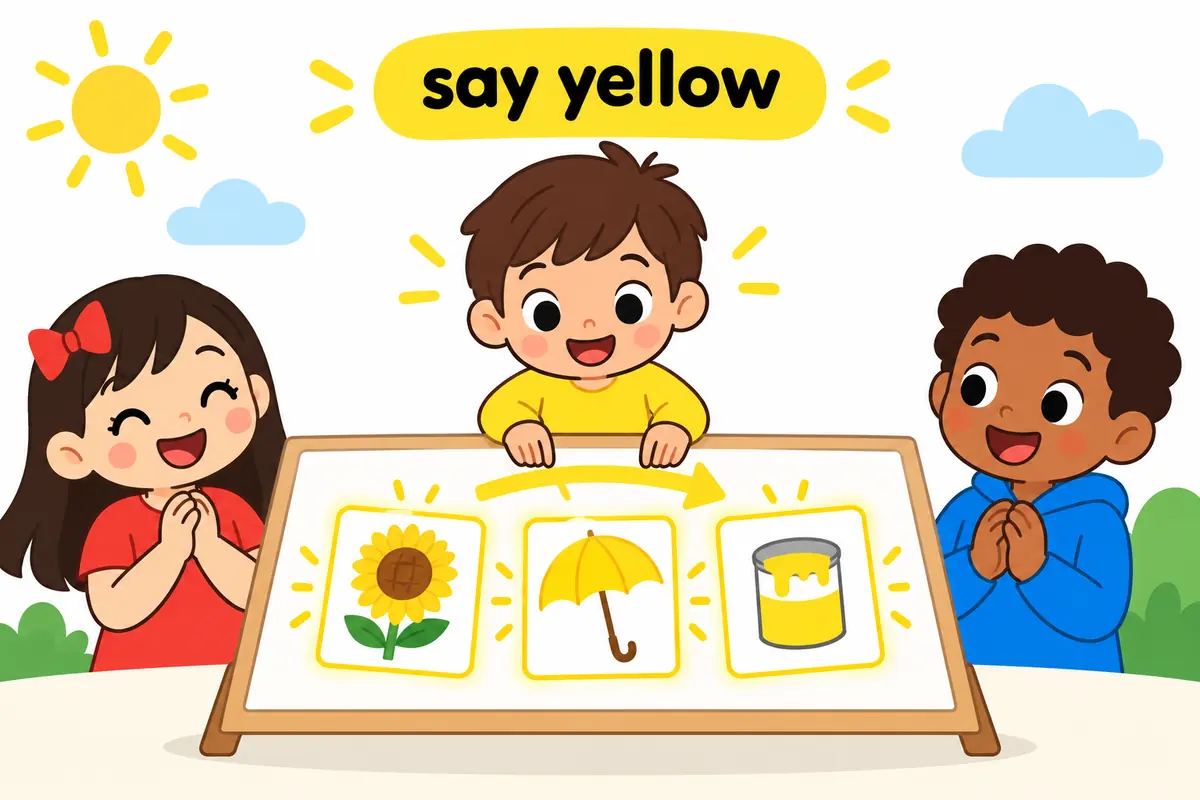
Note that xanthic is descriptive and comparative: it says a thing tends towards yellow, which is why it pairs with words such as tinge and hue. For the full colour, English keeps golden for a warm, glowing shade and amber for a brownish yellow, so xanthic has no monopoly on the middle of the range.
Xanthic and yellow in a sentence: examples across contexts
The two words belong to different worlds, and the nine sentences below show the border. Each one names the field, so the choice of word explains itself.
| Context | Example sentence | Why this works |
|---|---|---|
| Botany | The xanthic margins of the leaf identify the variety. | A technical field expects the specialist adjective. |
| Zoology | A xanthic form of the songbird appears on one island. | Xanthic marks a colour morph in a scientific register. |
| Laboratory notes | The reagent turned the sample a faint xanthic shade. | Precision about a slight tinge suits the word. |
| Everyday description | She wore a bright yellow raincoat to the match. | Ordinary speech uses the plain colour word. |
| News report | Yellow warning signs lined the closed road. | Public writing prefers the common noun and adjective. |
| Art writing | The painter used yellow to lift the grey foreground. | Art criticism names colours directly. |
| Gardening | Plant yellow tulips where the sun reaches them. | Instructions use the everyday word for a shade. |
| Interior design | A pale yellow wall made the small room feel larger. | The noun and adjective forms both appear naturally. |
| Informal speech | Calling him yellow was an unfair jibe. | The figurative sense belongs to yellow alone. |
Only the first three sentences would survive a swap to xanthic in the other direction; replacing the everyday yellow in the remaining six with xanthic would sound like a joke. When a writer wants a middle shade, sallow covers an unhealthy yellow and pigment names the substance that carries the colour.
Which should you use?
The choice maps onto the reader and the subject, and five situations cover most of them.
| Your situation | Use | Why |
|---|---|---|
| A scientific paper on plant colour | xanthic | The readership expects the precise technical term. |
| A field guide for specialists | xanthic | It distinguishes a colour tendency from a full colour. |
| A message, story or news report | yellow | Readers understand the plain colour at once. |
| A poem or an advert | yellow | Its sound and familiarity carry more feeling than a rare synonym. |
| A translation of a Latin or Greek source | yellow | The natural English equivalent keeps the meaning clear. |
If you are unsure, choose yellow. A clear sentence with the common word is better than an impressive sentence that sends a reader to a dictionary, and xanthic earns its place only when the surrounding vocabulary is already technical.
Word forms and grammar of xanthic and yellow
Both words form related parts of speech, and the table shows how the families run in parallel. The forms matter because xanthic is only ever an adjective.
| Form | Part of speech | Example |
|---|---|---|
| xanthic | adjective | The colony had a xanthic tint. |
| xanthous | adjective, rare variant | xanthous hair appears in some descriptions. |
| yellow | adjective | A yellow flag marked the detour. |
| yellow | noun | The yellow of the sunset filled the room. |
| yellowish | adjective | The paper had a yellowish tinge. |
| yellow | verb, informal | The pages had yellowed with age. |
Xanthic has no verb and no common noun, so it cannot be turned into a colour name the way yellow can. The related page on xanthium shows the same root in a plant name, and yellowish is the ordinary word closest in meaning to xanthic. That pairing is the quickest way to remember the boundary.
Common mistakes with xanthic and yellow
- Incorrect:
She bought a xanthic dress for the party.Correct: She bought a yellow dress for the party. Rule: Everyday objects take the common colour word, not the technical term. - Incorrect:
The taxi was a bright xanthic.Correct: The taxi was a bright yellow. Rule: Xanthic is an adjective and cannot stand as a noun. - Incorrect:
He was too xanthic to object.Correct: He was too yellow to object. Rule: The cowardly sense belongs to yellow alone. - Incorrect:
The petals were xanthic yellow colour.Correct: The petals were xanthic, a faint yellow. Rule: Do not stack the technical adjective with the plain noun and the word colour. - Incorrect:
The lab reported a yellow tendency.Correct: The lab reported a xanthic tendency. Rule: A slight colour tendency is exactly what the technical adjective is for.
Practice using xanthic and yellow
Work through the six items, then read the reasoning with each answer so the boundary between the two words stays clear.
- Fill the gap: The botanist noted the ______ hairs on the stem.
- Choose the better word: The children painted the sun (yellow / xanthic).
- Correct the error: The field guide describes a xanthic bird for beginners.
- Build a sentence: use yellow about a warning sign at a building site.
- Spot the register: which belongs in a research note — a xanthic strain, or a kind of yellowy one?
- Rewrite for a general reader: The specimen showed a xanthic tinge. Use yellowish instead.
Answers
- xanthic — a botanical description of colour tendency uses the technical adjective.
- yellow — children and paint belong to everyday speech.
- The field guide describes a yellow bird for beginners — a general reader needs the common word.
- Model answer: A yellow warning sign stood at the edge of the building site.
- A xanthic strain — a research note expects the precise term.
- The specimen showed a yellowish tinge — yellowish is the ordinary equivalent of xanthic.
The bottom line
Use xanthic vs yellow as a test of audience rather than meaning: xanthic is the technical adjective for a yellowish tendency, and yellow is the everyday word for the colour, working as both adjective and noun. The two nuances that decide most sentences are these: yellow carries a figurative sense that xanthic never has, and xanthic cannot name a colour on its own. When in doubt, write yellow.
Frequently asked questions about xanthic vs yellow
Is xanthic just a fancy word for yellow?
Not quite. Xanthic means yellowish or tending to yellow, so it describes a colour tendency rather than the full colour. Yellow names the colour itself and works as a noun as well as an adjective. That difference is why a botanist may write xanthic petals but a shopper buys yellow shoes.
When should I use xanthic?
Use xanthic in scientific and technical writing, especially botany, zoology and colour science, where a precise description of a yellow tendency matters. Outside those fields it sounds affected, so a general reader is better served by yellow or yellowish. The surrounding vocabulary is the best guide.
Can xanthic mean cowardly?
No. The informal sense of cowardly belongs only to yellow, as in a yellow streak. Xanthic is a colour description with no figurative meaning in general use. Reaching for xanthic to insult someone would mislead the reader rather than make the point.
What is the everyday equivalent of xanthic?
Yellowish is the closest ordinary word. It carries the same idea of a partial or faint yellow, but it belongs to everyday speech, while xanthic sits in technical writing. A scientist may write xanthic, and the same observation in plain English becomes a yellowish tinge. The pairing is a useful memory hook.