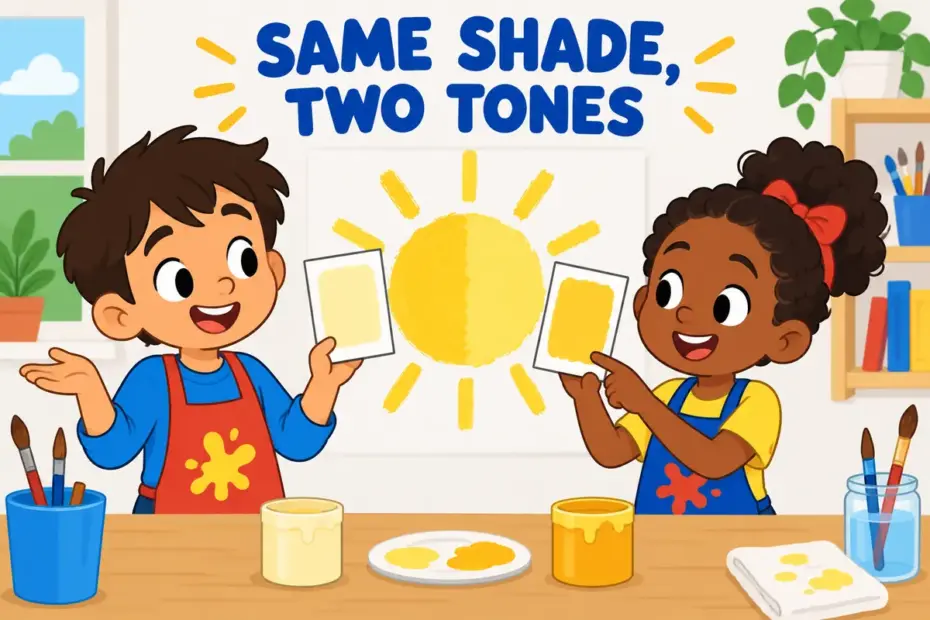
Choose yellowish for formal and technical writing and yellowy for relaxed description, because yellowy vs yellowish is mainly a difference of register rather than shade. Both words mean somewhat yellow, and both describe a colour that leans toward yellow without being pure yellow. Match the word to the setting before the shade.
Yellowy and yellowish at a glance
- Yellowy and yellowish are both adjectives meaning somewhat yellow.
- Yellowish is the neutral, established form and suits formal, technical and academic writing.
- Yellowy is informal and appears in relaxed descriptions of light, food and skin.
- Both accept a degree phrase: rather yellowish, slightly yellowy.
- Neither takes -er or -est; use more yellowish and most yellowish.
- The commonest error is treating them as different colours when the split is really register.
What do yellowy and yellowish mean?
Yellowy and yellowish are adjectives meaning somewhat yellow, or tinged with yellow. The Cambridge entry for yellowy and the Cambridge entry for yellowish define both as a shade near yellow, so the choice between them rests on sound and setting rather than on meaning.
| Sense | Plain meaning | Example sentence |
|---|---|---|
| yellowy (colour) | Slightly yellow, often off-yellow | The old paper had a yellowy edge. |
| yellowish (colour) | Somewhat yellow; tending to yellow | The leaves turned a yellowish brown. |
| yellowish (colour + colour) | Leaning toward yellow within a named hue | She chose a yellowish green scarf. |
One limitation is worth stating. Neither word names a colour. If a reader needs an exact shade, use a standard term such as amber, ochre or cream; yellowy and yellowish only say the colour leans toward yellow, and in a technical document that vagueness can be a fault. They also cannot carry the diagnostic force of words such as sallow skin or jaundiced, which describe a specific, unhealthy tint.
Yellowy vs yellowish: the comparison
The two words overlap almost completely in meaning, so the deciding factors are register, sound and the kind of writing you are producing. Neither carries a meaning the other lacks, which is why usage guidance focuses almost entirely on where each word appears.
| Criterion | yellowy | yellowish |
|---|---|---|
| Core meaning | Somewhat yellow, often off-yellow | Somewhat yellow; tending toward yellow |
| Standard form | Less common, marked by many dictionaries as informal | The established default form |
| Register | Informal and conversational | Neutral to formal |
| Best setting | Stories, blogs, spoken description | Reports, product copy, science |
| Typical subjects | Light, food, skin, autumn leaves | Colour samples, paper, liquids, photographs |
| Tone | Warmer and more personal | Cooler and more measured |
| Comparison form | more yellowy | more yellowish |
Verdict: write yellowish when you need to sound neutral or precise, and reserve yellowy for description that wants warmth. Readers almost never misunderstand either word; they simply notice a change of tone, which is why the register rule matters more than the shade. When the yellow is bright and warm rather than faint, golden or amber replaces both words.
How do you use yellowy and yellowish in a sentence?
Both adjectives follow the same patterns, so the grammar is never the deciding factor. Each can sit before a noun or after a linking verb such as be, look or turn. Because the patterns are identical, swapping one word for the other never breaks a sentence; only the tone shifts.
| Pattern | Example | What it signals |
|---|---|---|
| yellowish + noun | a yellowish stain on the page | The default neutral attributive use. |
| be + yellowish | The sky was yellowish before the storm. | A predicative description. |
| rather or slightly + yellowish | slightly yellowish paper | A softened degree in formal prose. |
| yellowy + noun | a yellowy light in the kitchen | An informal, warmer description. |
| more + yellowish | more yellowish than cream | Comparison without the -er suffix. |
| yellowish + colour noun | a yellowish green wall | Names the hue the colour leans toward. |
Yellowy and yellowish in a sentence: examples across contexts
The ten sentences below switch between the two words while keeping the same meaning, so the change you hear is register, not colour.
| Context | Example sentence | Why this works |
|---|---|---|
| Science report | The solution turned a yellowish brown on heating. | The neutral form suits a measured observation. |
| Fiction | A yellowy lamp glowed in the window. | The informal form adds warmth to the scene. |
| Product copy | The finish is a soft yellowish cream. | Shoppers expect the standard form on a label. |
| Weather report | The sky looked yellowish before the storm. | A neutral public description. |
| Food writing | The sauce took on a yellowy sheen. | Relaxed sensory description in a blog. |
| Academic writing | The sample showed a slightly yellowish tint. | A hedged, formal observation. |
| Text to a friend | My old photos have gone all yellowy. | Spoken register in a message. |
| Art critique | The artist used a yellowish grey for the sky. | A precise compound colour term. |
| Gardening note | These pear leaves always look yellowy in autumn. | Informal, habitual description. |
| Medical note | The skin appeared mildly yellowish. | The standard form keeps the note clinical. |
| Blog post | The lanterns gave the whole street a yellowy glow. | Informal atmosphere in a personal post. |
| Instruction manual | A yellowish warning stripe runs along the edge. | A neutral, technical colour description. |
| Art supply review | The marker dried to a dull yellowish shade. | A neutral, consumer-facing description. |
Which should you use?
Four situations cover most choices. If the setting is not listed, ask whether the page wants to sound like a report or like a story.
| Situation | Use | Why |
|---|---|---|
| A school science report | yellowish | Neutral and measurable in tone. |
| A short story about autumn | yellowy | Warmer and more personal. |
| A paint or product description | yellowish | Standard in commercial copy. |
| A text to a friend | yellowy | Matches relaxed spoken register. |
| A news report | yellowish | Keeps the register factual. |
Only one recommendation is firm enough to memorise: when in doubt in writing that will be published, use a yellowish tint, because it passes unnoticed in both formal and informal prose. A second safe habit is to keep one form per document; switching between yellowy and yellowish in the same paragraph reads as an accident rather than a choice.
Word forms and grammar of yellowy and yellowish
Neither adjective changes form, and both resist the -er and -est suffixes. The table also lists the spelling details that trip up learners.
| Form | Part of speech | Example |
|---|---|---|
| yellowy | adjective | The kitchen light turned yellowy at dusk. |
| yellowish | adjective | The paper had gone a yellowish grey. |
| yellowish + colour | compound colour term | She wore a yellowish green scarf. |
| more yellowy, more yellowish | comparative phrase | This paint is more yellowish than cream. |
| yellowier | non-standard -er form | Avoid it; write more yellowy. |
| yellowy-ish | double suffix, non-standard | Avoid it; choose one suffix. |
The plain root the colour yellow sits behind both words, and each simply softens it: -ish marks an approximation, while -y leans the colour toward yellow. The related nouns yellowishness and yellowiness exist but are rare, so writers normally keep the adjective and add a noun such as tint or tinge instead.
Common mistakes with yellowy and yellowish
- Incorrect:
The two words mean different colours.Correct: The two words mean the same thing but differ in register. Rule: Choose by setting, not by shade. - Incorrect:
a yellowish-green wall with a yellowy-ish tintCorrect: a yellowish green wall. Rule: Do not stack suffixes; one is enough. - Incorrect:
Use yellowy in a laboratory report.Correct: Use yellowish in a laboratory report. Rule: The neutral form belongs in technical writing; yellowy sounds informal. - Incorrect:
This sample is yellowisher than the last.Correct: This sample is more yellowish than the last. Rule: These adjectives take more, not -er. - Incorrect:
The sky was yellowy-ish grey.Correct: The sky was a yellowish grey. Rule: A colour term takes one suffix, not two.
Practice using yellowy and yellowish
The seven exercises mix gap-filling, error repair, register choices and rewriting. Check the reasoning in the answer list, not only the key.
- Fill the gap: The faded curtain had a ______ tint near the hem.
- Fill the gap: In her diary she wrote that the evening light was ______.
- Choose the better word: For the science fair poster, the ink looked (yellowy / yellowish).
- Choose the better word: In the bedtime story, a (yellowy / yellowish) moon hung over the town.
- Correct the error: The leaves were more yellowyish than last year.
- Build a sentence: use yellowish + colour noun about paint on a windowsill.
- Spot the register: which belongs in a lab notebook — a slightly yellowish residue, or a kind of yellowy goo?
- Rewrite for a formal report: the moon looked yellowy over the fields.
Answers
- yellowish — a neutral, written description of a stain.
- yellowy — a personal diary suits the warmer, informal form.
- yellowish — a formal poster favours the neutral form.
- yellowy — a story wants the warmer, informal word.
- The leaves were more yellowish than last year — use more and a single suffix.
- Model answer: The windowsill was painted a pale yellowish white.
- A slightly yellowish residue — a lab notebook keeps the neutral, hedged form.
- The moon appeared yellowish over the fields — a report prefers the neutral form and a measured verb.
The bottom line
Yellowy and yellowish mean the same thing, so let register decide: yellowish for neutral, formal and technical prose, yellowy for warm and conversational description. No rule of meaning separates them, and neither takes -er or -est, so use more with either. When a colour must be exact, reach past both words and name the shade, because yellowy vs yellowish only signals an approximate yellow leaning.
Frequently asked questions about yellowy vs yellowish
Is yellowy a real word?
Yes. Yellowy is a standard adjective meaning somewhat yellow, and dictionaries list it. It is simply less common and more informal than yellowish, which is the form most writers reach for. In careful or technical writing, yellowish is the safer choice, but yellowy is entirely correct in relaxed description.
Do yellowish and yellowy need a hyphen?
No. Both are written as single unhyphenated words. A hyphen appears only when the adjective joins another colour, as in a yellowish green scarf. The suffix itself never takes a hyphen, so yellow-ish and yellowy-ish are both non-standard spellings. Choose one suffix and leave it attached.
Does yellowish suggest illness?
Not by itself. Yellowish is a neutral colour word, so a yellowish wall is simply off-yellow. When skin looks unwell, writers reach for sallow or jaundiced, which carry a specific, unhealthy tint and a medical hint. Yellowish could describe a sickly colour, but the medical meaning comes from context, not from the word.
Can yellowish be compared with -er?
No. Yellowish and yellowy both take more and most rather than the -er and -est suffixes. Write more yellowish, not yellowisher, and most yellowish, not yellowishest. The suffix -ish already marks an approximation, so adding a comparative ending on top of it sounds awkward and is not standard English.