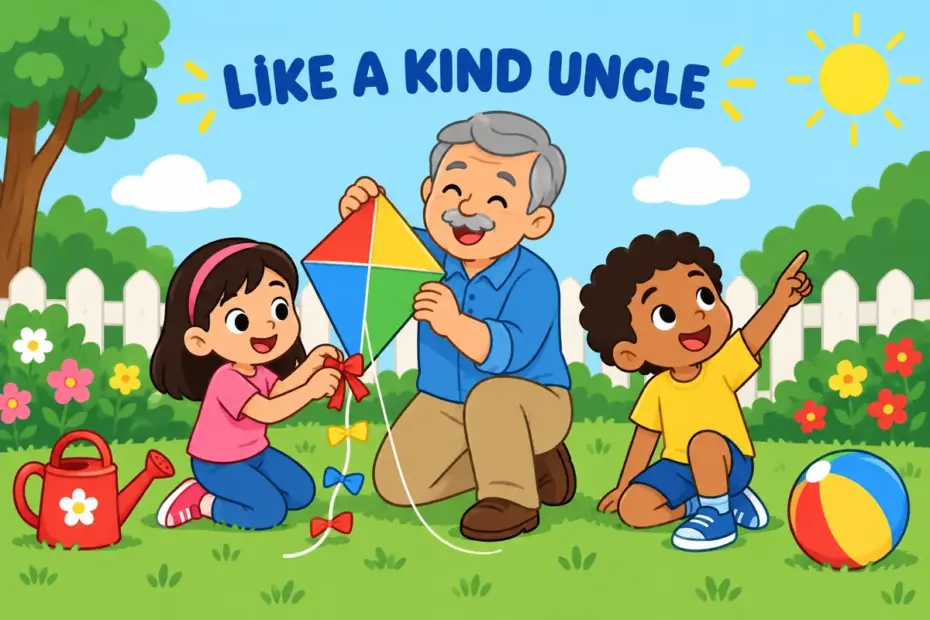
Avuncular describes a man who is kind, warm and gently helpful toward younger people, the way a favourite uncle behaves. To use avuncular in a sentence, place it before the noun or after a linking verb: an avuncular teacher, or the coach was avuncular. It praises warmth with authority, and it almost always describes an older man.
Avuncular at a glance
- Avuncular is an adjective meaning kind and warmly helpful, in the manner of a good uncle.
- It conventionally describes an older man, especially a teacher, coach, colleague or relative.
- The usual patterns are attributive, as in an avuncular figure, and predicative, as in he seemed avuncular.
- Avuncular is a mild compliment: it signals warmth together with a little authority.
- The commonest error is treating it as a noun, or using it to mean a father rather than an uncle.
What does avuncular mean?
Avuncular is an adjective meaning kind, friendly and gently helpful toward people younger than the speaker, in the way a favourite uncle treats a niece or nephew. The Cambridge entry for avuncular records both the warm manner and the literal relation to an uncle, and the warm sense is the one readers meet almost every time. Where the kindness is simply pleasant and carries no hint of age or guidance, affable is the closer adjective.
| Sense | Plain meaning | Example sentence |
|---|---|---|
| Warm and kindly | Friendly in an uncle-like way | An avuncular neighbour helped the boys mend the chain. |
| Mildly indulgent | Generous and a little permissive | His avuncular grin softened a firm rule. |
| Of an uncle | Relating to an uncle literally | The story gives the avuncular duties to the eldest brother. |
How do you use avuncular in a sentence?
Avuncular behaves like most descriptive adjectives, but it keeps a strong preference for the slot before a noun and for subjects that are older men.
| Pattern | Example | What it signals |
|---|---|---|
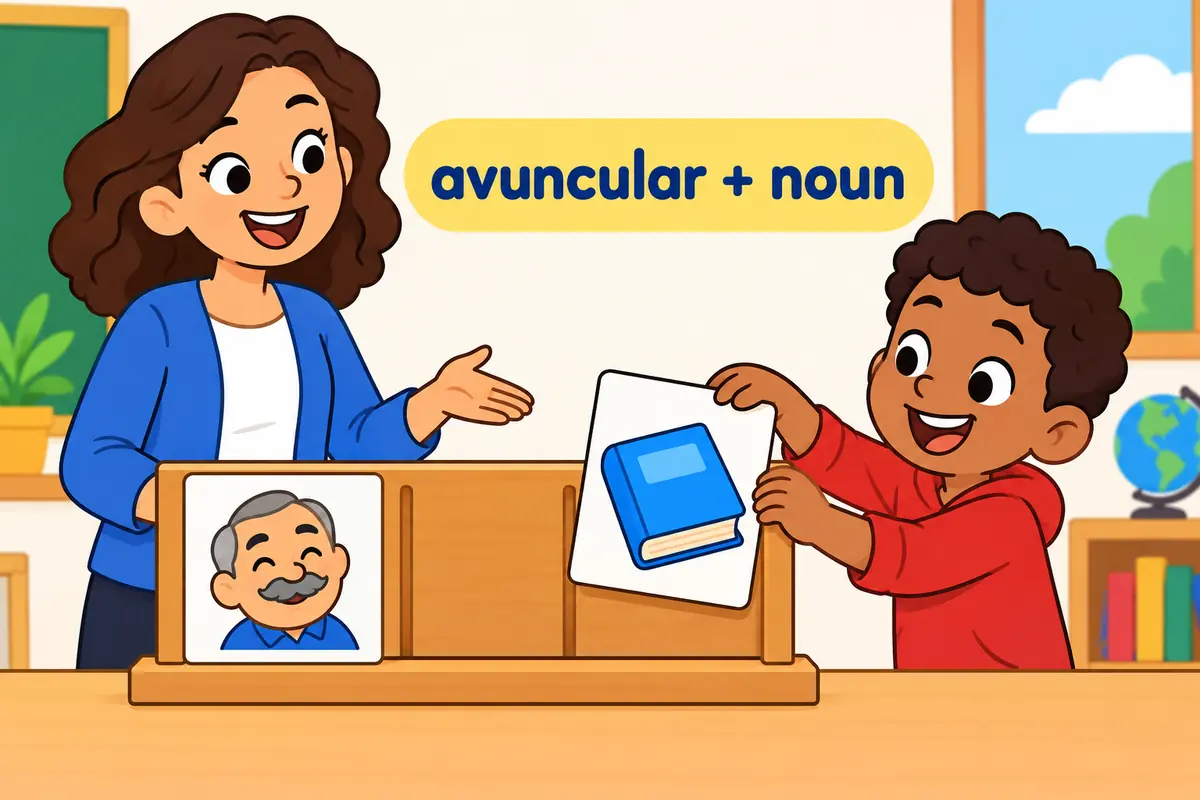
| avuncular + noun | The avuncular headmaster opened the door himself. | The commonest position, describing a person’s manner. |
| linking verb + avuncular | Their new neighbour seemed avuncular. | Predicative use after seem, be or become. |
| with avuncular + noun | He spoke with avuncular warmth. | Makes the manner, not the man, the subject. |
| avuncular toward / to | She was avuncular toward the youngest recruits. | Names the people who receive the warmth. |
| an avuncular figure | An avuncular figure greeted every guest. | A set phrase common in profiles and reviews. |
Avuncular in a sentence: examples across contexts
Avuncular appears where a writer wants to praise an older man without making him sentimental. The ten sentences below move from a classroom to a book review, and each one keeps the warmth tied to guidance.
| Context | Example sentence | Why this works |
|---|---|---|
| Classroom | The avuncular science teacher let the class retry the experiment. | Pairs gentle authority with a second chance. |
| Workplace | An avuncular mentor walked the interns through the report. | Shows experience offered without pressure. |
| News profile | The retiring conductor was remembered as an avuncular figure. | A set phrase that suits a warm summary. |
| Sports writing | The avuncular groundsman taught the juniors to roll the pitch. | Places kindness in a practical setting. |
| Fiction | An avuncular stranger offered the children a lift home. | Signals safety and a hint of age. |
| Memoir | My avuncular uncle taught me to whistle on long walks. | The rare overlap of the literal and warm senses. |
| Book review | The novel’s avuncular narrator guides the reader gently. | Describes a voice rather than a person. |
| Conversation | He has that avuncular way of making everyone feel welcome. | Names a manner rather than a fact. |
| Public speaking | The mayor’s avuncular tone calmed a restless hall. | A single adjective carries the mood. |
| Academic writing | The essay describes the editor as an avuncular patron of young poets. | Fits a formal appraisal of influence. |
Only the memoir sentence uses the word of a real uncle; everywhere else it borrows the uncle’s manner rather than his family tree.
Avuncular vs paternal
Avuncular and paternal both describe a warm older man, and the difference lies in the relation rather than the kindness.
| Attribute | avuncular | paternal |
|---|---|---|
| Relation | Uncle-like | Father-like |
| Warmth | Friendly and encouraging | Protective and responsible |
| Authority | Gentle and informal | Stronger and more dutiful |
| Typical figure | An older man outside the family | A father or father figure |
| Connotation | Charming and approachable | Caring but often controlling |
| Best place | Profiles, reviews, classrooms | Family and formal duty |
Choose avuncular when the warmth feels light and chosen; choose paternal when duty and protection come first. A genial host may be neither, because genial describes good humour alone.
Word forms and grammar of avuncular
Avuncular has almost no working family of forms, which is one reason writers reach for it as a single, precise adjective.
| Form | Part of speech | Example |
|---|---|---|
| avuncular | adjective | An avuncular tutor marked the essays. |
| avuncularly | adverb, rare | He smiled avuncularly at the newcomers. |
| avuncularity | noun, very rare | The host’s avuncularity put everyone at ease. |
| uncle | noun, plain word | Her uncle drove them to the match. |
| paternal | adjective, different relation | His paternal grandparents lived nearby. |
| maternal | adjective, different relation | Her maternal aunt taught at the school. |
The adverb and the noun exist but sound stilted, and a careful writer keeps the plain kindly on hand for sentences that need simplicity.
Collocations that sound natural with avuncular
Avuncular keeps a small set of partners, and the table below shows the phrases a fluent writer actually uses. A sentence that pairs the adjective with one of these nouns reads native; one that attaches it to a random noun reads translated.
| Collocation | What it suggests | Example |
|---|---|---|
| an avuncular figure | A warm, older presence in any setting | An avuncular figure ran the youth club for years. |
| avuncular charm | Easy warmth that wins people over | His avuncular charm disarmed the interview panel. |
| avuncular manner | Consistent behaviour rather than one act | Her avuncular manner put the recruits at ease. |
| avuncular advice | Guidance offered kindly and at length | He offered avuncular advice about saving early. |
| an avuncular presence | Reassurance carried by age and calm | The new director brought an avuncular presence. |
| avuncular tone | A voice pitched to encourage, not command | He answered in an avuncular tone. |
Notice that every partner is abstract: figure, charm, manner, advice, presence, tone. Avuncular rarely attaches to a physical object, which is a useful test when a sentence feels wrong.
Common mistakes with avuncular
- Incorrect:
My avuncular drove me to school.Correct: My uncle drove me to school. Rule: avuncular is an adjective, never a noun. - Incorrect:
The avuncular woman welcomed the students.Correct: The kindly woman welcomed the students. Rule: avuncular conventionally describes a man. - Incorrect:
The villain was avuncular and cruel.Correct: The villain was smooth and cruel. Rule: avuncular is warmly positive and cannot carry cruelty. - Incorrect:
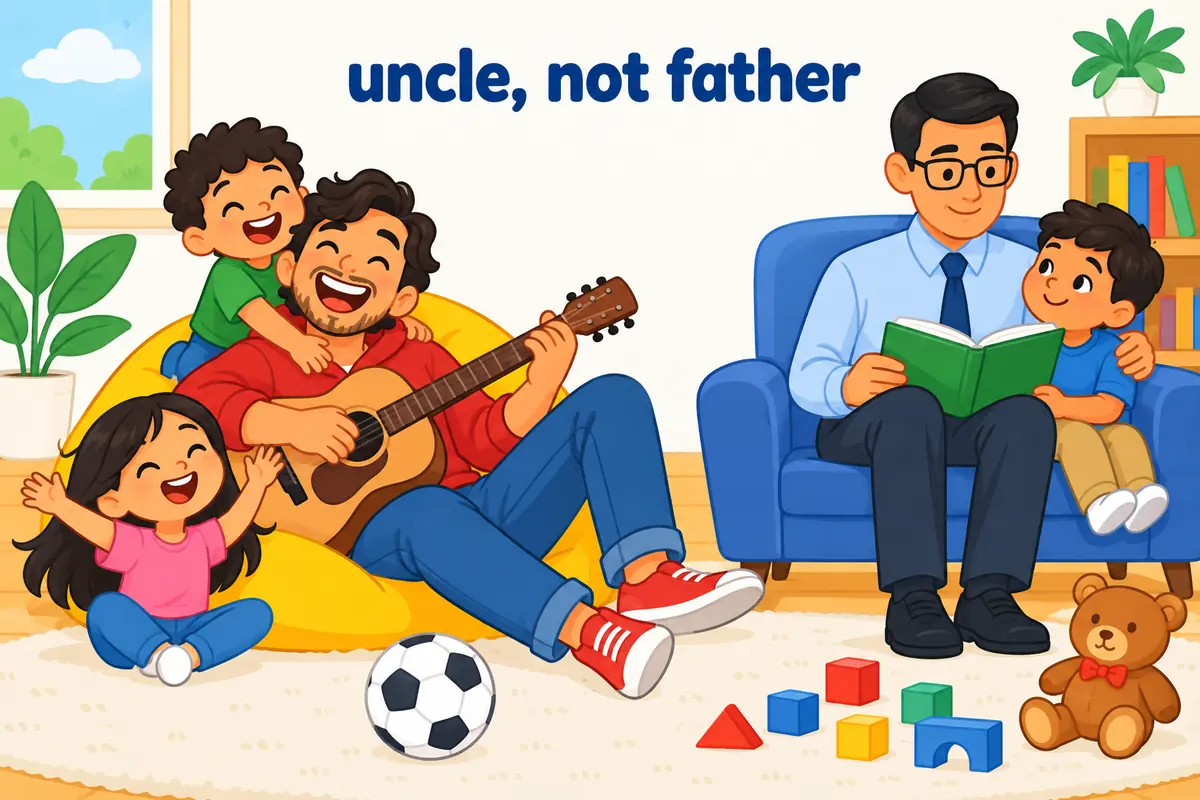
He was avuncular to his own son.Correct: He was paternal toward his own son. Rule: avuncular implies an uncle-like, not fatherly, relation. - Incorrect:
She treated the interns avuncular.Correct: She treated the interns in an avuncular way. Rule: an adjective cannot modify a verb directly.
Is avuncular a compliment?
Avuncular is a compliment, but a measured one. It praises an older man for warmth, patience and generosity toward younger people, and it never suggests weakness. In a profile it can carry a faintly patronising edge, because calling a colleague avuncular places him a generation above the room. The word flatters most when the guidance is genuinely wanted.
Avuncular in formal and everyday writing
Avuncular belongs to journalism, profiles, fiction and formal appraisal, and it sounds studied in casual speech. In conversation a speaker who means the same thing usually says kind, friendly, or like an uncle. The adjective survives because no plainer word combines warmth with the idea of a slightly older man guiding the young.
Practice using avuncular
Work through the seven items, then check the reasoning rather than only the key.
- Fill the gap: The ______ coach handed each player a bottle of water.
- Choose the better word: After the retirement speech, colleagues described him as (avuncular / paternal) toward the whole office.
- Correct the error: The avuncular gave the children a bag of apples.
- Build a sentence: use an avuncular figure about a retired teacher at a school fair.
- Spot the register: which belongs in a book review — the avuncular narrator guides us gently, or the narrator is like a nice uncle?
- Rewrite with a linking verb: An avuncular librarian helped the children find the atlas.
- Replace the adjective: The coach was avuncular and encouraging. Use a plainer word without losing the warmth.
Answers
- avuncular — it describes the coach’s warm manner before the noun.
- avuncular — the warmth reaches the whole office, not a father and child.
- The uncle gave the children a bag of apples — avuncular cannot stand alone as a noun.
- Model answer: A retired teacher stood at the gate as an avuncular figure, greeting every family.
- The avuncular narrator guides us gently — a review keeps the precise adjective.
- The librarian was avuncular as she helped the children — the adjective moves after the linking verb.
- The coach was kindly and encouraging — kindly keeps the warmth and drops the uncle image.
The bottom line
Use avuncular in a sentence when an older man is kind and gently guiding, and let the word sit before a noun or after a linking verb. Two nuances decide most sentences: it praises warmth with authority rather than mere friendliness, and it points to an uncle-like relation, so amiable covers simple pleasantness while warm drops the age and guidance. For a father, paternal is the exact word.
Frequently asked questions about avuncular
Can avuncular describe a woman?
The word conventionally describes a man, because it is built from the Latin word for uncle. Writers who apply it to a woman usually mean a warm, protective older figure, and readers often notice the mismatch. Kindly, warm or mentor-like avoids the problem without losing the sense.
What is the noun form of avuncular?
Avuncularity exists but is very rare, and most dictionaries still list only the adjective. A sentence such as her avuncularity reassured the newcomers reads as deliberately formal. In ordinary writing the quality is expressed with warmth, kindness or a manner, not with a noun built from avuncular.
How is avuncular pronounced?
The stress falls on the second syllable: avun-cu-lar, with a short u and a light final syllable. The first syllable is unstressed and the r at the end is soft in British English. It is never pronounced to rhyme with particular, though the endings look similar.
Where does avuncular appear most often?
Avuncular appears most often in journalism, book reviews, profiles and fiction, where a writer needs one adjective for warm, older, male authority. It is rare in everyday conversation, where people say kind or like an uncle. Its scarcity is part of its value: it compresses a whole manner into four syllables.