
Choke up is a phrasal verb that describes losing your voice to feeling, or blocking something until it cannot flow. To use choke up in a sentence, first choose the sense, because one is about emotion and the other about clogged channels: “She choked up during the farewell speech.”
Choke up at a glance
- Choke up is a phrasal verb built from choke plus the particle up.
- The emotional sense can be intransitive, as in she choked up, or transitive, as in the film choked him up.
- The blocking sense is transitive and means to clog: leaves choked up the drain.
- The verb is separable, so a pronoun object sits between choke and up.
- A sports sense means to grip higher on a bat or club, as in choke up on the handle.
What does choke up mean?
Choke up is a phrasal verb meaning to become unable to speak because of strong feeling, or to block something so that it cannot pass through. The Cambridge entry for choke up records the emotional sense first, and the clogging sense follows the same shape. The two live in different registers: the feeling is intimate and spoken, while the clogging is practical, as in a cry that catches in the throat.
| Sense | Plain meaning | Example sentence |
|---|---|---|
| Become emotional | Lose the voice because feeling rises | He choked up when the choir began to sing. |
| Make someone emotional | Cause a person to struggle for words | The surprise video choked her up completely. |
| Clog a channel | Block a pipe, drain or passage | Fallen leaves choked up the gutter overnight. |
| Grip higher | Move the hands up a bat or club | She choked up on the bat to control the swing. |
One limitation is worth stating. Choke up does not mean the same as choke on, and it does not mean to stop talking on purpose. When a person chokes, something is physically lodged or the throat closes; when a person chokes up, feeling interrupts the voice and nothing is stuck. Choke up is emotional in the first sense and mechanical in the second, so the context must decide which one you mean.
How do you use choke up in a sentence?
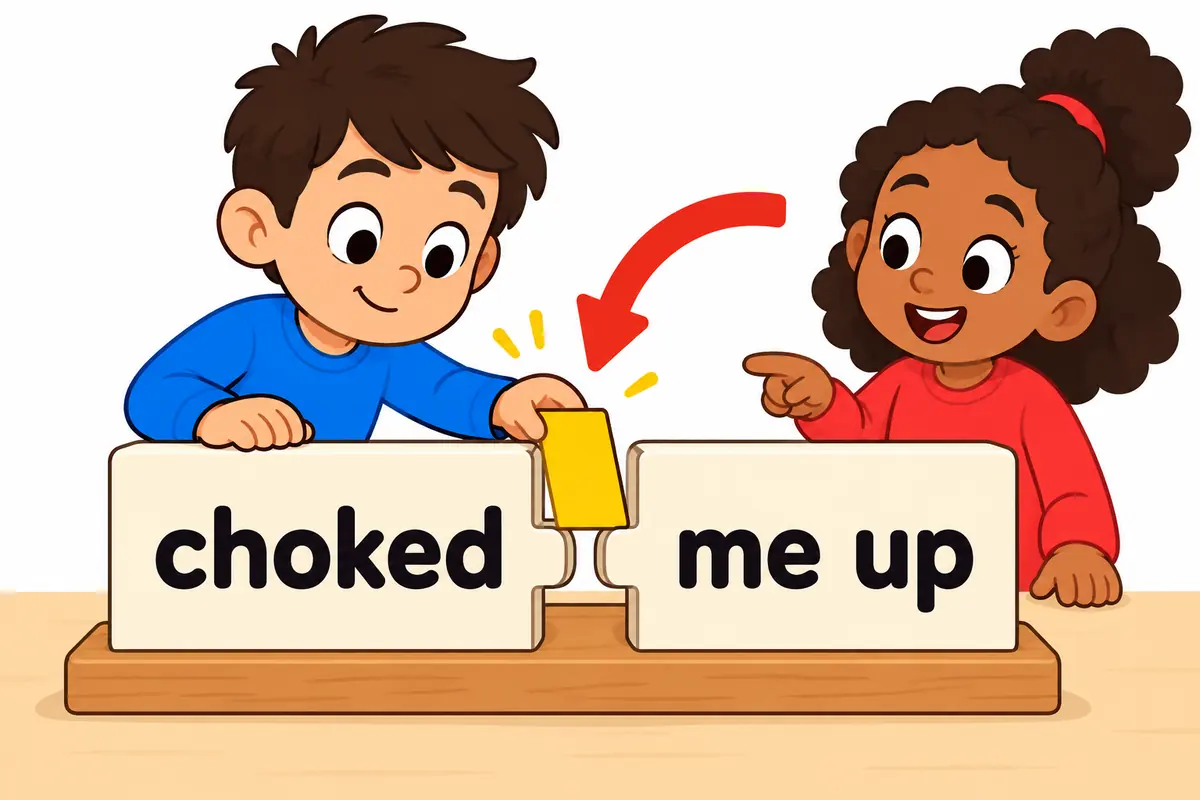
Choke up is a separable phrasal verb, which is the single fact that decides most sentences. A pronoun object must sit between the verb and the particle, so the tribute choked her up is right and the tribute choked up her is not. A full noun object may follow the particle, so the tribute choked up the whole room also works, and the particle never strands away on its own.
The verb is intransitive in the self-directed sense, as in I choked up at the end, and transitive when something causes the feeling or blocks a channel. Keep the object close, and choose the emotional sense or the clogging sense before you write, because the same words point in two directions.
| Pattern | Example | What it signals |
|---|---|---|
| subject + choke up (no object) | The bride choked up halfway through her vows. | Intransitive: the feeling happens inside one person. |
| choke + pronoun + up | The farewell song choked me up. | Separated form, forced with pronouns. |
| choke up + full noun | The last scene choked up the whole cinema. | The object may follow the particle when it is a full noun. |
| be / get choked up | He got choked up reading the letter aloud. | Participial adjective describing a state. |
| choke up + a channel | Silt choked up the harbour mouth. | The blocking sense, always with a physical passage. |
The same particle does quiet work in bear up and back up, where up again turns a plain verb into a new idea rather than adding a direction.
Choke up in a sentence: examples across contexts
Choke up changes company more than it changes form. The ten sentences below move from a kitchen table to a sports column, and each keeps the same phrasal verb while shifting between feeling and blockage. Watch how often the emotional sense appears as the participial adjective choked up rather than as a plain past tense.
| Context | Example sentence | Why this works |
|---|---|---|
| Family conversation | Dad choked up when he tried to thank everyone. | The intransitive form catches a real moment without naming a cause. |
| Wedding speech | The groom choked up during the first line of his speech. | A public occasion makes the interrupted voice easy to picture. |
| News report | The veteran choked up as the names were read aloud. | Reporting uses the participial state to stay restrained. |
| Workplace email | The team was choked up after the surprise send-off. | The passive keeps the focus on the people who felt it. |
| Sports writing | She choked up on the bat and drove the ball down the line. | The grip sense is fixed to a specific piece of equipment. |
| Home repairs | Dry leaves choked up the drainpipe again. | The blocking sense keeps a physical passage as the object. |
| Music review | The final verse choked up even the seasoned critics. | Shows the transitive form with a full noun object. |
| Memoir | He still chokes up when he drives past the old school. | The present tense makes an old feeling feel current. |
| School assembly | The head teacher got choked up announcing her retirement. | Get plus the participle is the commonest spoken frame. |
| Gardening guide | Roots had choked up the narrow bed by midsummer. | Extends the blocking sense to plants crowding a space. |
Choke up vs tear up
Choke up and tear up both describe a surge of feeling, but choke up points at the voice and the throat, while tear up points at the eyes. Only choke up has a blocking sense, and only tear up is used for paper.
| Attribute | choke up | tear up |
|---|---|---|
| Where the feeling shows | The voice catches and speech stops | The eyes fill with tears |
| Cause | Joy, grief, pride or nerves | Sadness, pain or something in the eye |
| Blocking sense | Yes: to clog a passage | Yes but different: to rip paper |
| Transitive use | The film choked him up | The film made him tear up |
| Register | Spoken and journalistic | Spoken and neutral |
| Typical subject | A person who wants to speak | A person who is watching |
Verdict: use choke up when a person cannot get the words out, and sob or cry when the tears themselves are the point.
Word forms and grammar of choke up
Choke up behaves like a regular phrasal verb, and its most useful shape in writing is the participial adjective choked up. That form lets you describe a state, as in she was too choked up to answer, and it pairs naturally with get and feel.
| Form | Part of speech | Example |
|---|---|---|
| choke up | phrasal verb, base form | She will choke up at the reunion. |
| chokes up | phrasal verb, third person singular | He chokes up every time he tells the story. |
| choked up | phrasal verb, past and past participle | The audience choked up as one. |
| choked up | participial adjective | They were too choked up to clap. |
| choking up | present participle | She kept choking up during the reading. |
| choke something up | separable pattern | Damp leaves choke a drain up fast. |
Common mistakes with choke up
- Incorrect:
She was choke up during the speech.Correct: She was choked up during the speech. Rule: after was, use the participle choked, which acts as an adjective. - Incorrect:
The video choked up me.Correct: The video choked me up. Rule: a pronoun object must sit between the verb and the particle. - Incorrect:
He choked up on his words.Correct: He choked up while he was speaking. Rule: choke up takes no on; choke on is a different verb about something stuck in the throat. - Incorrect:
I felt choke up at the end.Correct: I felt choked up at the end. Rule: feel takes the participial adjective, not the base verb. - Incorrect:
The speech choked up the audience with laughter.Risk: the object is people being blocked. Better: The speech left the audience choked up with laughter. Rule: in the emotional sense the affected people are the object, so keep the meaning unambiguous.
Practice using choke up
Work through the eight items, then check the reasoning rather than only the answer.
- Fill the gap: She ______ ______ when the choir sang her favourite hymn.
- Choose the better word: After the long climb, the hikers were (choked up / tear up) with emotion.
- Correct the error: The goodbye speech choked up me.
- Build a sentence: use get choked up about reading a letter from a friend.
- Spot the register: which suits a spoken toast — I might choke up a bit, or I may experience lachrymal interference?
- Rewrite with a pronoun: The surprise choked up the whole family. Use them.
- Use the blocking sense: write a sentence about autumn leaves and a drain.
- Turn it into a participial adjective: The film made Daniel emotional. Use choked up.
Answers
- choked up — the intransitive past tense needs no object because the feeling happens inside her.
- choked up — the hikers are struggling for words, which is the voice sense rather than tears.
- The goodbye speech choked me up — the pronoun me slides between the verb and the particle.
- Model answer: I get choked up whenever I reread the letter she wrote.
- I might choke up a bit — a toast is warm and plain, while the second version is needlessly clinical.
- The surprise choked them up — the pronoun object goes between choked and up.
- Model answer: Damp leaves choked up the drain before the first frost.
- Daniel was choked up by the film — the participle describes his state.
The bottom line
Use choke up in a sentence when feeling stops the voice or when something clogs a channel, and let the object follow the separable rule. Three points decide most lines: a pronoun object sits between choke and up, the emotional self-sense takes no object at all, and get choked up is the everyday way to describe the state. Where tears rather than words are the subject, moved and cry say it more plainly.
Frequently asked questions about choke up
Is choke up one word or two?
It is two words, choke and up, because it is a phrasal verb and the particle stays separate. When a pronoun is the object, more words slip in between, as in it choked me up, so the phrase should never be written as one solid word in standard English.
What is the difference between choke and choke up?
Choke describes a physical blockage of the airway or a channel, and it can be dangerous. Choke up usually means to become emotional and lose your voice, which is not dangerous at all, and its blocking sense applies to pipes and drains rather than people. The particle up turns a physical verb into a feeling.
Can choke up be positive?
Yes. Choke up is often warm and positive, triggered by pride, gratitude or joy as readily as by sadness. A parent might choke up at a graduation, and a coach might choke up thanking a team, so the phrase signals strong feeling rather than distress.
Why do people choke up when they speak?
Strong emotion tightens the muscles around the throat and can interrupt the breath that speech needs, so the voice wavers and pauses. Writers describe the result rather than the cause, which is why choke up points at the moment a speaker stops rather than at any medical explanation.