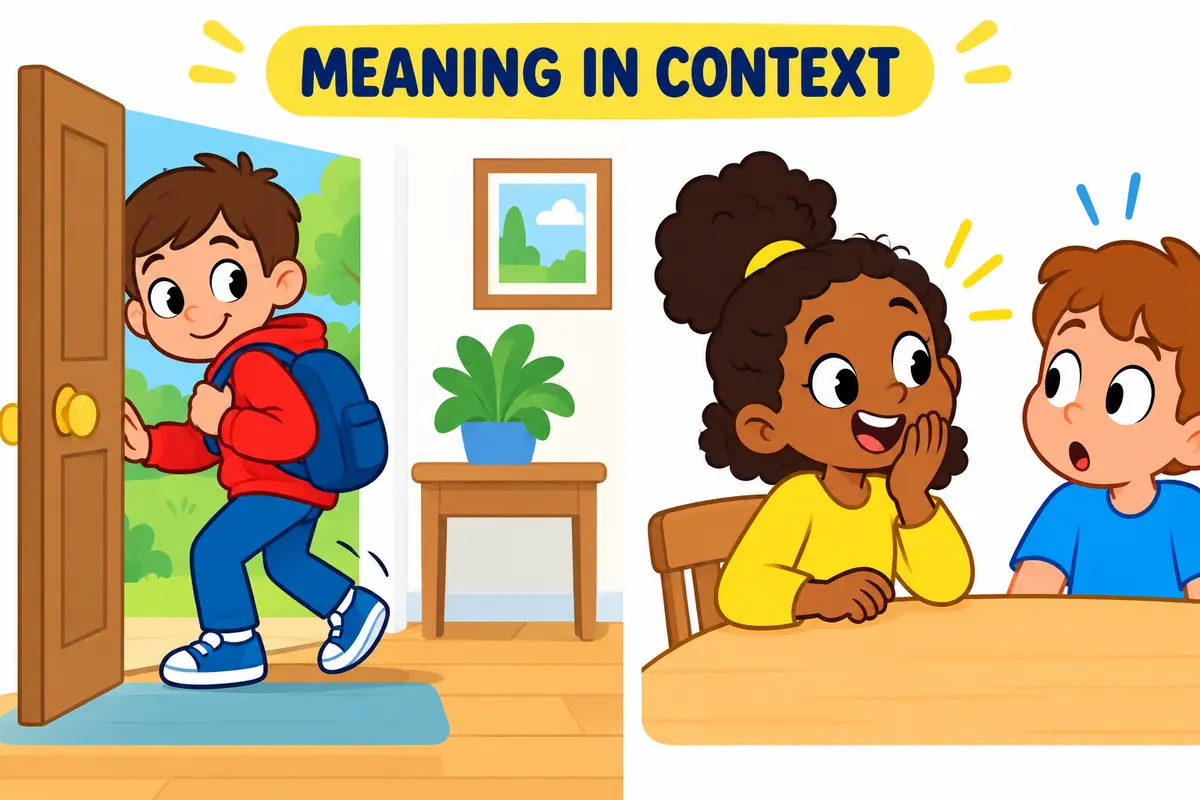
Run this by you is a phrase that means to show someone an idea or plan so they can give an opinion before you act. To use run this by you in a sentence, name the thing and the person in that order: “Let me run this by you before I send it.”
Run this by you at a glance
- Run this by you is a fixed spoken phrase built from run, an object, by and a person.
- It means to check an idea or plan with someone before going ahead.
- The words this and you change with the situation: run it by her, run that by me.
- It belongs to conversation, email and office speech rather than formal reports.
- The commonest error is putting to or with after by, as in run this by to you.
What does run this by you mean?
Run this by you means to present an idea, plan or piece of work to someone so they can react to it before you commit. The Cambridge entry for run this by you treats it as a set expression for seeking an opinion, and the verb keeps a light, provisional feel: nothing is decided yet. When the aim is simply to ask, ask is plainer, and when the aim is genuine professional advice, consult is stronger.
| Sense | Plain meaning | Example sentence |
|---|---|---|
| Show for an opinion | Let someone see a plan before you act | I’ll run this by you before the meeting. |
| Ask for approval | Check that a decision is acceptable | Run it by the finance team first. |
| Repeat for clarity | Say something again so it is understood | Run that by me again, slowly. |
One honest limitation belongs here. The phrase has become a mild cliché of office speech, and a writer who uses it three times in one email sounds evasive. Because it only asks for a view, it can also hide the fact that no decision has been made, so a clear ask or a direct question is often kinder to the reader.
How do you use run this by you in a sentence?
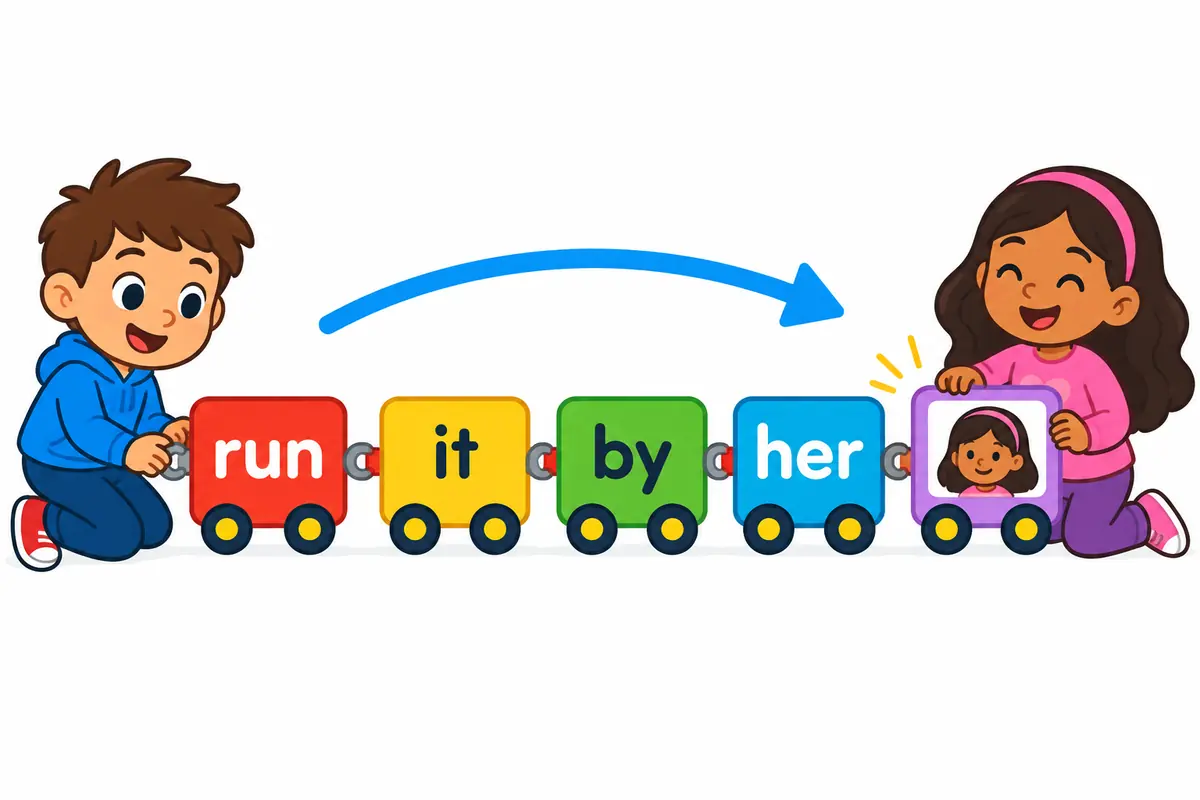
The pattern is fixed in its bones: run, then the thing, then by, then the person. The object sits between the verb and by, so a pronoun is forced into that slot, and by never takes to or with after it. The phrase works in the past as ran it by her, in the passive as it was run by the board, and in the continuous as I am running it by the team.
The person at the end is usually a colleague, a manager, a friend or a family member, and the tone is collaborative rather than submissive. Choose run this by you when the idea is still open and you want a reaction; choose propose when you are formally putting a plan on the table.
| Pattern | Example | What it signals |
|---|---|---|
| run + this / that / it + by + person | Can I run this by you quickly? | The standard form for a tentative check. |
| run + noun phrase + by + person | She ran the figures by her manager. | A full noun object may sit after run. |
| run it past + person | Let me run it past you first. | A common variant with the same meaning. |
| be run by + person | The plan was run by the whole committee. | Passive form for a formal process. |
| run something by someone again | Could you run that by me again? | The repeat sense, asking for a second hearing. |
Run this by you in a sentence: examples across contexts
The phrase keeps one meaning wherever it appears, but its setting changes how formal it sounds. The nine sentences below move from a kitchen to a boardroom, and each places the object before by and the person after it. Notice that the phrase rarely stands alone; it usually introduces a concrete document, number or choice.
| Context | Example sentence | Why this works |
|---|---|---|
| Family conversation | Let me run this by you: we could visit on Sunday instead. | The plain sense of floating an idea at home. |
| Workplace email | I’d like to run this by you before I reply to the client. | A polite buffer before an irreversible step. |
| Team meeting | Can I run this by the group before we vote? | Shows the collaborative, pre-decision moment. |
| Job interview | May I run this by you and get your reaction? | Signals openness and respect for experience. |
| Project update | We ran the schedule by the suppliers last week. | Past tense reporting a completed check. |
| Startup pitch | Let me run the numbers by you one more time. | Ties the phrase to concrete evidence. |
| Academic supervision | I ran this chapter past my supervisor before submitting. | The shorthand variant, common in study settings. |
| Everyday conversation | Run that by me again; I missed the last part. | The repeat sense, asking for a second hearing. |
| Customer service | Let me run this by my colleague and call you back. | Buys time without promising an outcome. |
Run this by you vs sound out
Run this by you and sound out both involve another person’s view, but run this by you presents a finished idea for a reaction, while sound out probes for opinion without showing anything fixed.
| Attribute | run this by you | sound out |
|---|---|---|
| What is shown | A specific plan or document | Nothing fixed, only a subject |
| Purpose | Check before acting | Discover likely support |
| Timing | Just before a decision | Early, while ideas are vague |
| Typical object | it, this, a plan, the figures | A person or a group |
| Register | Conversational and office | Neutral to formal |
Verdict: run this by you when you have something concrete to check, and sound out when you are only testing the temperature.
Word forms and grammar of run this by you
The expression is a phrase rather than a single verb, so most of it may change while the frame stays. The verbs run and ran never take a preposition after by, and the little words this, that and it are the parts that move from situation to situation.
| Form | Part of speech | Example |
|---|---|---|
| run it by me | phrase, base form | Run it by me before lunch. |
| ran it by her | phrase, past tense | He ran it by her on Friday. |
| running it by the team | phrase, continuous | She is running it by the team now. |
| was run by the board | phrase, passive | The budget was run by the board. |
| run this by you | phrase, set order | Let me run this by you. |
| run it past you | phrase, variant particle | I’ll run it past you tomorrow. |
What may not vary is the order: the thing comes before by and the person after it. Where the same idea wants a softer, more general verb, discuss and suggest cover ground the phrase cannot.
Common mistakes with run this by you
- Incorrect:
Let me run by you this idea.Correct: Let me run this idea by you. Rule: the object goes between run and by, never after you. - Incorrect:
I will run this by to you later.Correct: I will run this by you later. Rule: by is the only link word; adding to is a common slip. - Incorrect:
Let me run this passed you.Correct: Let me run this past you. Rule: the preposition is past, not the verb passed. - Incorrect:
Can I run this by yourself?Correct: Can I run this by you? Rule: the person after by is a plain pronoun, not a reflexive one. - Incorrect:
We run this by with the manager yesterday.Correct: We ran this by the manager yesterday. Rule: use the past tense ran for a finished event, and drop with.
Practice using run this by you
Work through the eight items, then check the reasoning rather than only the answer.
- Fill the gap: Before I book the room, let me ______ ______ ______ you.
- Choose the better word: At this early stage we should (run it by / sound out) the whole department.
- Correct the error: She ran by her boss the proposal.
- Build a sentence: use run it by about a holiday plan and a friend.
- Spot the register: which suits an email to a director — I’d like to run this by you, or Wanna run this past ya?
- Rewrite in the passive: The committee ran the plan by the lawyers. Start with The plan.
- Use the repeat sense: write a sentence asking someone to explain again.
- Change one word: rewrite run this by you so the person is a woman.
Answers
- run this by — the object this sits between the verb run and the preposition by.
- sound out — nothing is fixed yet, so the vaguer verb fits the early stage.
- She ran the proposal by her boss — the object moves before by and the person follows.
- Model answer: Can I run my holiday plan by you before I book?
- I’d like to run this by you — a director gets the complete, polite form.
- The plan was run by the lawyers — the passive keeps the plan as the subject.
- Model answer: Could you run that by me again? I missed the last part.
- Run this by her — only the pronoun changes; the order stays the same.
The bottom line
Use run this by you in a sentence when you want someone’s reaction to an idea before you act, and keep the thing before by and the person after it. Three points decide most lines: the phrase is spoken and collaborative, a pronoun object is forced between run and by, and the variant run it past you means exactly the same. When you are only testing opinion, sound out is the better verb, and float captures the same tentative mood.
Frequently asked questions about run this by you
Is run this by you formal or informal?
It sits in the middle, at home in a friendly email or a meeting but too casual for a legal document. Run this by you sounds collaborative and slightly polite, which is why it appears so often in office speech; a formal report would instead say review or seek approval.
What does run that by me again mean?
It is a separate, fixed use meaning say that again, usually because the listener missed or doubted something. The structure is identical to the checking sense, but the context and the word again signal a request to repeat rather than a request for approval.
Can I say run it past you instead?
Yes. Run it past you and run this by you mean the same thing, and both keep the object between the verb and the preposition. Past is common in British speech and by in American speech, but neither is wrong in either variety, and the choice is a matter of habit.
Who can you run something by?
Anyone whose opinion you value before deciding: a manager, a colleague, a partner, a friend or a client. The phrase implies a light check rather than formal permission, so you can run an idea by a peer, but you ask a regulator for approval.