Round up means to gather people, animals or things into one group, and separately to raise a number to the nearest whole or higher figure. To use round up in a sentence, name the group: “They rounded up the stray dogs.” The verb is separable, so a pronoun goes between the two words.
Round up at a glance
- Round up is a separable phrasal verb built from round plus the particle up.
- Its two main senses are to gather living things into a group and to raise a number.
- With a pronoun the object must sit in the middle: round them up, never round up them.
- The noun is written round-up or roundup, as in a news round-up.
- The subject is often a farmer, the police, a teacher or a spreadsheet formula.
- The commonest error is confusing gather-for-a-purpose with the gentle, neutral verb gather.
What does round up mean?
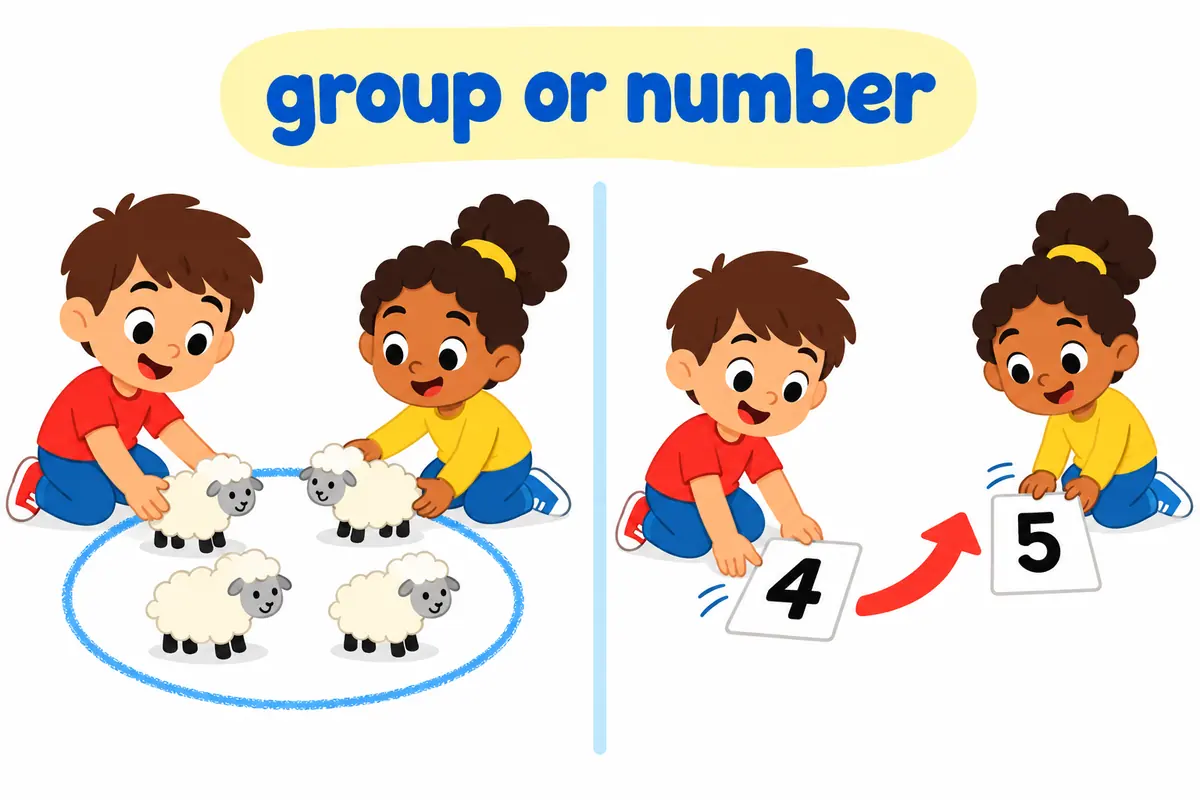
Round up is a phrasal verb with two large families of meaning. In the physical sense it means to bring people or animals together into one place, usually by searching over an area; in the numerical sense it means to raise a figure to the nearest whole number or to the next unit. The Cambridge entry for round up records the gathering use, and the maths use follows the same idea of moving upward. Because the two families are far apart, the object of the verb settles the meaning at once.
| Sense | Plain meaning | Example sentence |
|---|---|---|
| Gather animals | Bring livestock or strays into one place | The farmer rounded up the sheep before the storm. |
| Gather people | Bring a group together, often by authority | Police rounded up witnesses after the crash. |
| Raise a number | Move a figure up to the nearest whole number | Round up the total to the nearest pound. |
| Collect into one place | Gather scattered items for a single purpose | She rounded up all the spare chairs for the concert. |
One limitation is worth stating plainly. Round up always moves something toward a group or a higher figure, so it cannot describe sorting things apart or lowering a value; that is round down or disperse. In the everyday sense of collecting loose objects, collect the papers is milder and needs no search.
How do you use round up in a sentence?
Round up is separable, so the object may follow the particle or sit between round and up. The pronoun rule is strict, and the ordering choice is the one that separates confident users from cautious ones. The six patterns below cover the physical and the numerical senses together.
| Pattern | Example | What it signals |
|---|---|---|
| round up + object | The farmer rounded up the sheep. | Particle first; the natural order with a longer object. |
| round + object + up | The farmer rounded the sheep up. | Object first; equally correct and slightly more informal. |
| round + pronoun + up | The police rounded them up at dawn. | Pronoun objects can never follow the particle. |
| round up + object + for | They rounded up volunteers for the search. | Names the purpose the group is gathered for. |
| round + number + up | Round 4.2 up to the next whole number. | The numerical sense, with an object between the parts. |
| round up + to + figure | Round the total up to the nearest ten. | Adds the target value with the preposition to. |
Notice that the numerical sense keeps the same grammar as the physical one, which is why a single pattern table can teach both. The word to is the only signal that a target figure will follow.
Round up in a sentence: examples across contexts
Round up works in a barn, a courtroom, a classroom and a spreadsheet without changing its shape. Each row below shows which sense is at work, and in farming contexts the specific verb to herd the cattle often replaces it.
| Context | Example sentence | Why this works |
|---|---|---|
| Farm | The shepherd rounded up the flock before the storm arrived. | Concrete animals make the gathering sense obvious. |
| Police report | Officers rounded up the suspects within an hour of the theft. | Authority plus speed is the reported pattern. |
| Military | The captain rounded up every available volunteer for the night watch. | Names a purpose for the group. |
| Sport | The coach rounded up the substitutes for an extra training session. | Everyday register keeps the verb natural. |
| Classroom | The teacher rounded up the loose pencils and returned them to the pot. | Objects sense, with a tidy consequence. |
| Workplace | We rounded up a dozen volunteers to run the charity stall. | Links the gathered group to a task. |
| Restaurant | The cafe rounds up every bill to the nearest pound for charity. | Numerical sense with a regular habit. |
| Travel | Please round up your luggage so nobody trips on the stairs. | Gathers scattered items into one spot. |
| Finance | Round up the monthly saving to the next ten pounds. | Numerical sense in personal finance. |
| Spreadsheet | The formula rounds up each figure to the nearest whole unit. | Technical register, numerical sense. |
| Charity | Shoppers can round up their payment to support the food bank. | Common charitable framing of the maths sense. |
| Journalism | The weekend round-up gathers the week’s local stories in one page. | Uses the hyphenated noun, not the verb. |
The hedge worth remembering is that only the physical sense suggests effort over an area; the numerical sense is instant and mechanical. Mixing the two in one paragraph sounds careless.
Round up vs gather
Round up and gather overlap, but round up adds a search and often a measure of control. Gather simply brings things or people together, while round up implies going out to find them, which is why it fits animals and suspects so well. The opposite of gathering a crowd is not rounding it up but disperse the crowd.
| Attribute | round up | gather |
|---|---|---|
| Core idea | Search for scattered members and bring them in | Bring things or people together |
| Effort implied | Active searching over an area | Little or none; assembling is enough |
| Typical object | Animals, suspects, volunteers, strays | Friends, evidence, facts, a crowd |
| Tone | Can imply control or authority | Neutral and often gentle |
| Common pairing | round up the sheep, round up a team | gather information, gather round |
| Opposite | Release or let out | Scatter or disperse |
Verdict: use round up when the members are scattered and someone has to go and find them, and gather when they simply come together. A teacher gathers the class for a story but rounds up the children who wandered off to the far corner of the field.
Word forms and grammar of round up
Round up is a phrase, so round inflects and up stays fixed. The noun is the tricky form, because it takes a hyphen or closes up, and it carries a different, softer meaning. Where you want the arithmetic idea inside a longer process, the related verb add up shares the same particle but means to total figures.
| Form | Part of speech | Example |
|---|---|---|
| round up | verb, base form | We must round up the whole team by noon. |
| rounds up | verb, third person singular | The app rounds up every purchase. |
| rounded up | verb, past and past participle | They rounded up the last of the cattle. |
| rounding up | verb, present participle | She is rounding up support for the petition. |
| round … up | verb with a separated particle | Round the strays up before nightfall. |
| round-up | noun or adjective | a sports round-up; a round-up of the week |
| roundup | noun, one-word style | The paper printed a roundup of local events. |
The noun never takes the object of the verb, so you write a round-up of the news, not a round-up the news. Keeping that distinction is the clearest sign that a writer controls the word.
Common mistakes with round up
- Incorrect:
Round up them before it gets dark.Correct: Round them up before it gets dark. Rule: A pronoun object must sit between the verb and its particle. - Incorrect:
The teacher gathered the class with a whistle.Wrong word here: The teacher gathered the class works for a calm assembly, but to collect children who wandered off you round them up. Rule: Use round up only when members are scattered and must be sought. - Incorrect:
They rounded up the news into one page.Correct: They wrote a round-up of the news on one page. Rule: The summary meaning belongs to the hyphenated noun, not the verb. - Incorrect:
Round up 3.9 down to 3.Correct: Round 3.9 up to 4. Rule: Up and down point in opposite directions, so they cannot share a sentence about one figure. - Incorrect:
Please round up your prices to be cheaper.Correct: Please round your prices down to be cheaper. Rule: Rounding up raises a figure, so it cannot make something cheaper. - Incorrect:
We need to round up the numbers together.Correct: We need to add up the numbers together. Rule: Add up totals figures; round up only changes a single figure to the next unit.
Practice using round up
Work through the seven items, deciding first whether the sense is physical or numerical.
- Fill the gap: The ranger ______ the stray horses before the road reopened.
- Choose the better word: At dusk the volunteers (gathered / rounded up) the children who had wandered into the woods.
- Correct the error: Round up it to the nearest ten.
- Build a sentence: use round up with a number about a shop that raises each bill to the next pound.
- Spot the register: which belongs in a police report — Officers rounded up the suspects, or The cops grabbed a bunch of suspects?
- Rewrite with a separated particle: The team rounded up the volunteers. Put the object first.
- Rewrite with the noun: They collected the week’s news on one page. Use round-up instead.
Answers
- rounded up — the horses are scattered animals, so the gathering sense fits.
- rounded up — the children had to be searched for in the woods, which is exactly what round up adds.
- Round it up to the nearest ten — the pronoun must sit between round and up.
- Model answer: The cafe rounds up each bill to the next whole pound for the food bank.
- Officers rounded up the suspects — a report keeps neutral, precise wording.
- The team rounded the volunteers up — the object moves before the particle.
- The page carries a round-up of the week’s news — the summary is the hyphenated noun.
The bottom line
Use round up in a sentence to gather scattered people or animals into one place, or to raise a number to the next whole unit. The two nuances that decide most sentences are separability, since a pronoun must sit between round and up, and sense, since the physical and numerical uses share their grammar but not their meaning. When the members come together willingly, gather the group is the fairer verb.
Frequently asked questions about round up
Is round up one word or two?
As a verb it is always two words, as in the farmer rounded up the sheep. The noun is written with a hyphen or closed up: a round-up of the news, or a roundup of results. Keeping the verb open and the noun joined separates the two jobs cleanly.
Does round up mean the same in maths and in farming?
The two senses share one core idea: moving something upward toward a group or a higher value. On a farm you round up animals into one place; in arithmetic you round a number up to the next whole unit. The grammar is identical, and only the object tells a reader which world you are in.
Is round up separable?
Yes. Round up is a separable phrasal verb, so the object may follow the particle or sit between the two words. The choice is not free with a pronoun: round them up is correct, and round up them is not. Longer objects, such as all the volunteers from the village, usually follow the particle for clarity.
What is a round-up?
A round-up is a noun meaning a summary or a collection, as in a weekly news round-up. It is written with a hyphen or as one word, and it never takes the direct object of the verb. The related meaning of a round-up of cattle, describing the gathering itself, keeps the same spelling and the same connection to the action.