To disperse means to spread people or things over an area or move them apart. Intransitive: “The crowd dispersed” has no direct object; transitive: “The wind dispersed the seeds” acts on one. To disburse means to pay out money. The original protest sentence is a vocabulary example, not a description of any required method.
At a glance
- Use disperse intransitively when people or things move apart: “The crowd dispersed.”
- Use it transitively when a person or force spreads something: “The wind dispersed the seeds.”
- Use divide into groups or split into teams when people are being organized into planned groups.
- Disperse means scatter or spread; disburse means pay out money, often from a fund.
- Adverbs modify verbs (“spread widely”); adjectives modify nouns (“widely dispersed seeds” or “colorful seeds”).
- The opening protest reference is included only to discuss word meaning; disperse does not name or endorse a particular method.
What Does “Disperse” Mean?
Disperse means to spread across an area, move away in different directions, or cause people or things to do so. The Cambridge Dictionary labels it both intransitive and transitive; the Oxford Learner’s Dictionaries separates the “move apart” and “spread over an area” senses. The meaning is about movement or distribution; by itself, the verb does not explain why something moved or how a person caused it.
| Verb pattern | What happens | Example sentence |
|---|---|---|
| Intransitive: subject + disperse | The subject itself moves or spreads apart; no direct object follows. | “After the lecture, the students dispersed across campus.” |
| Transitive: subject + disperse + object | The subject causes people or things to spread. | “A light wind dispersed the seeds across the field.” |
| Passive: object + be dispersed | The thing moved or spread is the sentence subject. | “The seeds were dispersed by the wind.” |

Choose the subject according to what moves or causes movement. A crowd can disperse; a breeze can disperse seeds; smoke can disperse through a room. The ending changes with tense and subject: “the crowd disperses” (present), “the crowd dispersed” (past), and “the crowd is dispersing” (ongoing action).

When Is “Divide Into Groups” Clearer Than “Disperse”?
Disperse often suggests that people or things spread out or move away from one another. If a teacher assigns people to organized teams, divide into groups or split into groups is usually clearer. For example, “The students split into groups before setting off for the picnic” describes planned organization more directly than “the students dispersed in groups.”
Likewise, “Students were asked to disperse to their assigned classrooms” can sound as if they were scattered. If the intended meaning is orderly travel to known destinations, write “Students were asked to go to their assigned classrooms” or “return to their classrooms.” Keep disperse when movement apart or spreading out is actually the point.
What Is the Difference Between “Disperse” and “Disburse”?
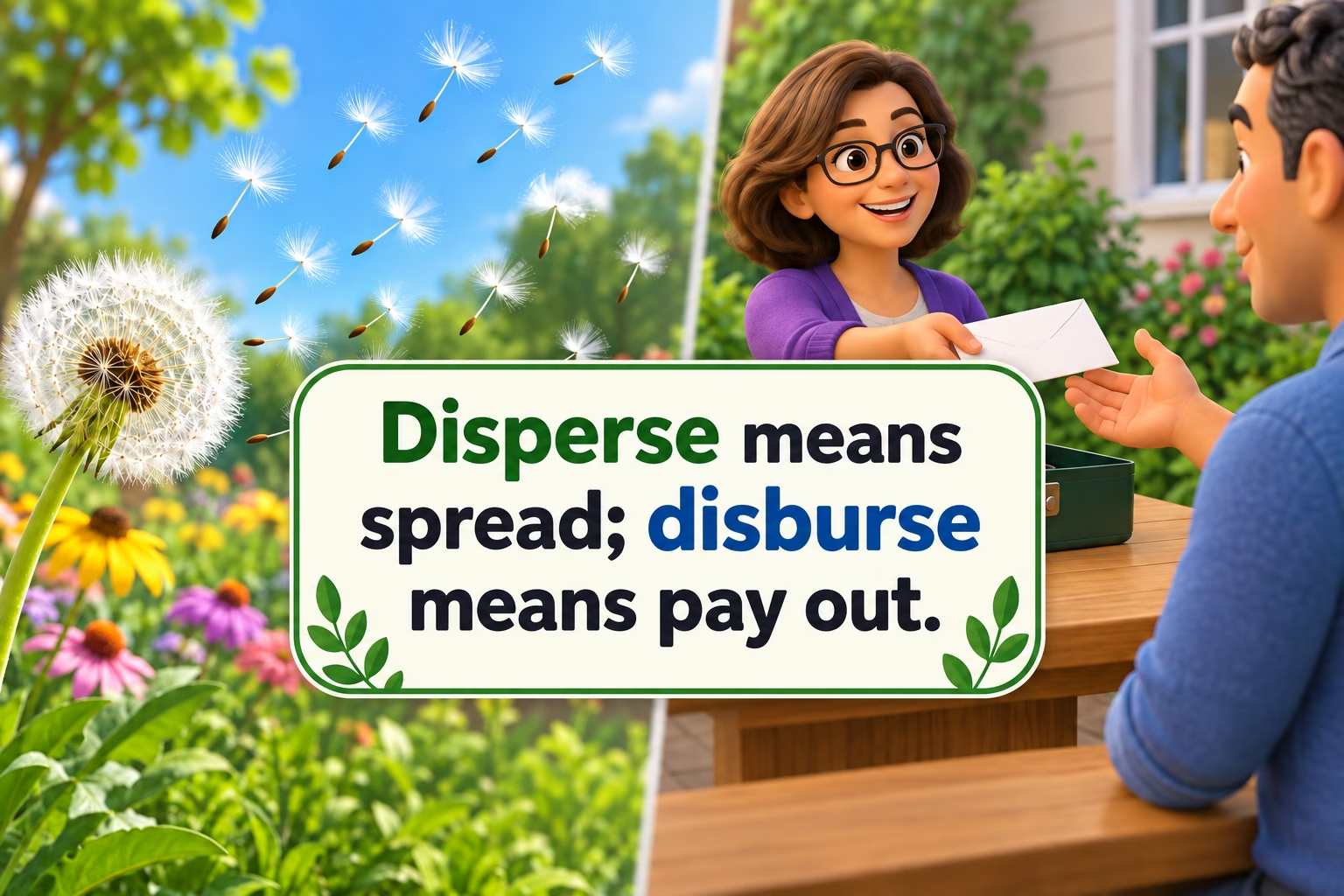
The verbs look and sound similar, but their meanings differ. Disperse means scatter, spread, or move apart. Disburse means pay out money, commonly from an amount collected for a purpose. Cambridge defines disburse as paying out money, often from a fund.
| Word | Meaning | Example |
|---|---|---|
| disperse | Scatter or spread people or things across an area. | “The wind dispersed the seeds.” |
| disburse | Pay out money, usually from a fund or collected amount. | “The nonprofit disbursed the grant funds.” |
A quick check: if the sentence is about seeds, people, smoke, notices, or particles spreading, use disperse. If an organization pays money out, use disburse.
Should You Use an Adjective or an Adverb With “Disperse”?
Adverbs modify verbs, adjectives modify nouns. In “The seeds dispersed widely,” widely is an adverb describing how they dispersed. In “The widely dispersed seeds sprouted,” widely dispersed describes the seeds. In “colorful seeds dispersed,” colorful is an adjective modifying seeds; it does not explain how they moved.
How Should You Read the Protest Example?
The original opening mentions dispersing a protest crowd. That is one context in which the verb can appear, not a full definition or a guide to crowd management. Disperse describes people moving apart or someone causing that movement; the word alone does not specify a method, consent, legality, or safety. The vocabulary examples below are retained intact.
Have you ever wondered how to effectively disperse a crowd during a protest or event? Dispersing a crowd means breaking it up and causing its members to move away in different directions.
This can be done using various methods such as communication, barriers, or non-lethal weapons. The goal is to maintain order and prevent potential escalation of conflicts.
7 Examples Of Disperse Used In a Sentence For Kids
- The teacher asked the students to disperse and go play outside.
- Birds will disperse when they hear loud noises.
- Please wait for the crowd to disperse before crossing the street.
- The wind helped disperse the clouds, revealing the sun.
- Bees will disperse when you move slowly around their hive.
- The seeds from the dandelion plant will disperse in the wind.
- The students will disperse into smaller groups for their project.
14 Sentences with Disperse Examples
- Students gathered in the campus courtyard for a spontaneous game of frisbee, only to quickly disperse when the rain started.
- After the lecture, the students began to slowly disperse as they made their way to their respective departments.
- The study group decided to disperse after a long session at the library, feeling exhausted but accomplished.
- As soon as the professor announced the end of the exam, the students began to disperse from the examination hall.
- The students were asked to disperse to their assigned classrooms for the guest lecture on entrepreneurship.
- The crowd at the college fair began to disperse as the evening came to an end, with students heading back to their hostels.
- The protest on campus quickly escalated, leading to the police asking the students to disperse peacefully.
- The students were excited to disperse for the annual college fest, where they would participate in various competitions and performances.
- During the fire drill, the students were instructed to disperse calmly and quickly to the designated assembly points.
- The students from different departments decided to disperse and explore the nearby market for some street food after the classes ended.
- As the sports meet came to an end, the athletes and spectators slowly disperse to head home or to celebrate their victories.
- The student council meeting concluded with the members agreeing to disperse and work on their individual tasks to prepare for the upcoming cultural fest.
- The students were delighted to disperse in groups for the college picnic, excited to spend a day away from the campus.
- The film club members were asked to disperse after the screening, with plans to regroup for a discussion about the movie the following week.
How To Use Disperse in Sentences?
Disperse means to scatter or spread over an area.
When using Disperse in a sentence, remember to place it before the action being described. For example, “The wind caused the leaves to disperse across the yard.” In this sentence, Disperse is used to explain what the leaves are doing.
You can also use Disperse with different subjects and objects to describe how something is spreading out. For instance, “The teacher asked the students to disperse into groups for their project.” Here, Disperse is used to indicate that the students are separating and spreading into different groups.
To make your sentence more detailed, you can include adverbs or adjectives before or after the Disperse. For example, “The fireworks exploded in the sky, causing colorful sparks to disperse gently.” In this sentence, the adverb “gently” gives more information about how the sparks are spreading.
Remember to use Disperse when you want to describe the action of spreading out or scattering something. By following these tips and examples, you can effectively incorporate Disperse into your sentences to convey your ideas clearly and accurately.
Conclusion
In summary, the examples provided showcase how sentences with the word “disperse” illustrate the idea of spreading or scattering things in various contexts. Whether referring to dispersing a crowd, dispersing essential oils for aromatherapy, or dispersing seeds for planting, the concept of spreading out evenly or widely is highlighted. These sentences demonstrate the versatility of the word “disperse” in describing actions that involve distribution or scattering in different scenarios.
Through these examples, it becomes apparent that “disperse” is a word that can be used to depict a wide range of activities where things are distributed, spread, or scattered. Its use helps to convey the idea of dispersion in a clear and precise manner, making it a useful term for describing processes that involve spreading out or scattering items.
Frequently Asked Questions About “Disperse”
What is an intransitive sentence with “disperse”?
“The crowd dispersed after the event” is intransitive: the crowd moved apart, and no direct object follows the verb. Other examples include “The fog dispersed” and “Students dispersed across campus.” The subject is the thing that spreads or moves away.
What is a transitive sentence with “disperse”?
“The wind dispersed the seeds” is transitive because the wind causes an object—the seeds—to spread. A transitive sentence follows the pattern subject + disperse + object. In the passive form, you can write “The seeds were dispersed by the wind.”
Does “disperse into groups” mean the same as “divide into groups”?
Not always. Disperse emphasizes people moving apart or spreading out, while divide into groups clearly describes organized assignment to teams. If students are intentionally arranged for a project or picnic, “split into groups” is usually the more direct choice.
What is the difference between “disperse” and “disburse”?
Disperse means scatter, spread, or move apart. Disburse means pay out money, often from a fund. These are different verbs. For example, “The wind dispersed the seeds” describes spreading; “The nonprofit disbursed the grant funds” describes a payment.
Does “disperse” describe a specific way to break up a crowd?
No. It names movement apart or the act of causing people or things to spread; the verb alone does not say how, whether a particular method is lawful or safe, or why the movement happened. In a vocabulary sentence about a protest, read it as a use of the word rather than practical crowd-management instruction.
Use disperse for movement or spreading, and check whether its subject acts alone or on an object. Use disburse for paying money out. Those two checks clarify both grammar and meaning.