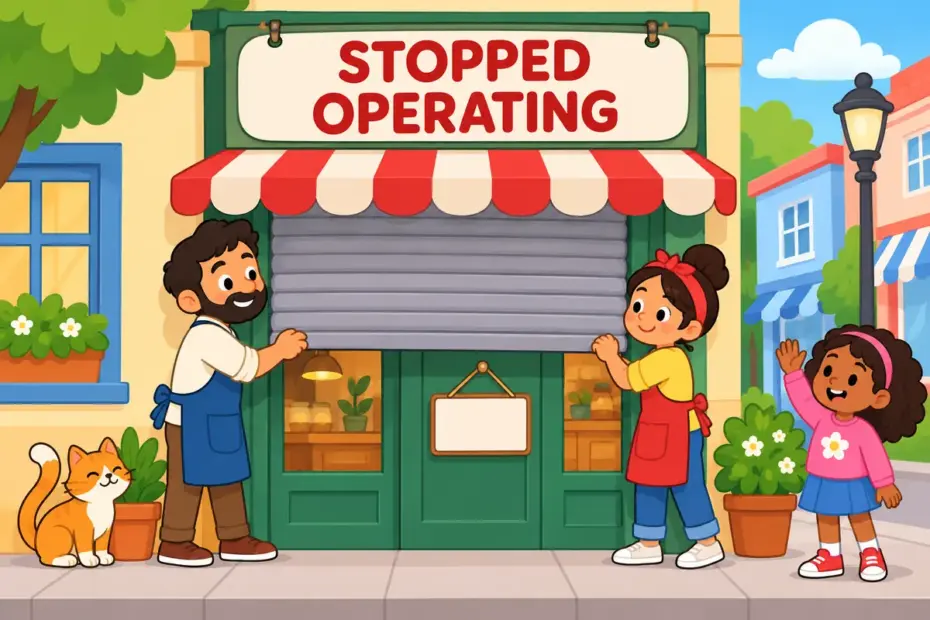
Close down means to stop operating, whether a business ends trading or a machine is switched off for the night. To use close down in a sentence, name what stops and let the verb follow: “The factory closed down in June.” The phrasal verb works with or without an object, and the particle can move.
Close down at a glance
- Close down is a phrasal verb meaning to stop operating or to switch something off.
- It is both transitive and intransitive: close down the shop, or the shop closed down.
- It is separable: a noun object may sit after close or after down.
- A pronoun object must sit in the middle: close it down, never close down it.
- The commonest error is using it for a short break, when close alone is enough.
What does close down mean?
Close down is a phrasal verb meaning to stop operating or to bring something to a stop. The Cambridge entry for close down covers the business and the machine senses, and the two differ in how permanent the stop is.
| Sense | Plain meaning | Example sentence |
|---|---|---|
| A business stops trading | Cease operating for good | The bookshop closed down after forty years. |
| A machine is switched off | Shut a device or engine down | Close the engine down before refuelling. |
| A broadcaster ends for the day | Stop transmission until the next scheduled time | The station closes down at midnight. |
| An authority ends a service | Order an operation to stop | Inspectors closed the kitchen down. |
One limitation is worth stating plainly. Close down is not always permanent. A shop that has closed down is usually finished, but a factory can close down for maintenance and reopen on Monday. When the pause is planned, shut down briefly or power down is more exact. Nor is close down the same as close: you close a door or a meeting, but you close down a business or a machine. In formal filings, where the stopping is gradual and official, people often write that a company will cease trading.
How do you use close down in a sentence?
Close down is a phrasal verb, so the particle can move. In most transitive sentences both orders work: the council closed down the market and the council closed the market down are equally correct. A pronoun, however, must sit between the verb and the particle: close it down, never close down it. Without an object the verb still works: the mine closed down in 1990.
| Pattern | Example | What it signals |
|---|---|---|
| close down + object | They closed down the old cinema. | The thing being stopped follows the full verb. |
| close + object + down | They closed the old cinema down. | The same meaning with the particle stranded after the object. |
| close + pronoun + down | They closed it down last year. | A pronoun object must go in the middle. |
| close down (no object) | The bakery closed down at noon. | The subject stops by itself. |
| be closed down | The kitchen was closed down by inspectors. | Passive; the authority may go unstated. |
| close down + for / at + time | The pool closes down for repairs in June. | Names the reason or the schedule. |
The passive is the form official notices favour, because it reports the closure without naming the inspector or the order.
A useful test runs in one direction only: if the object is a pronoun such as it or them, it must sit in the middle, so close it down is right and close down it is wrong. Machines can also break down on their own, which is a failure rather than a decision, so keep the two verbs apart.
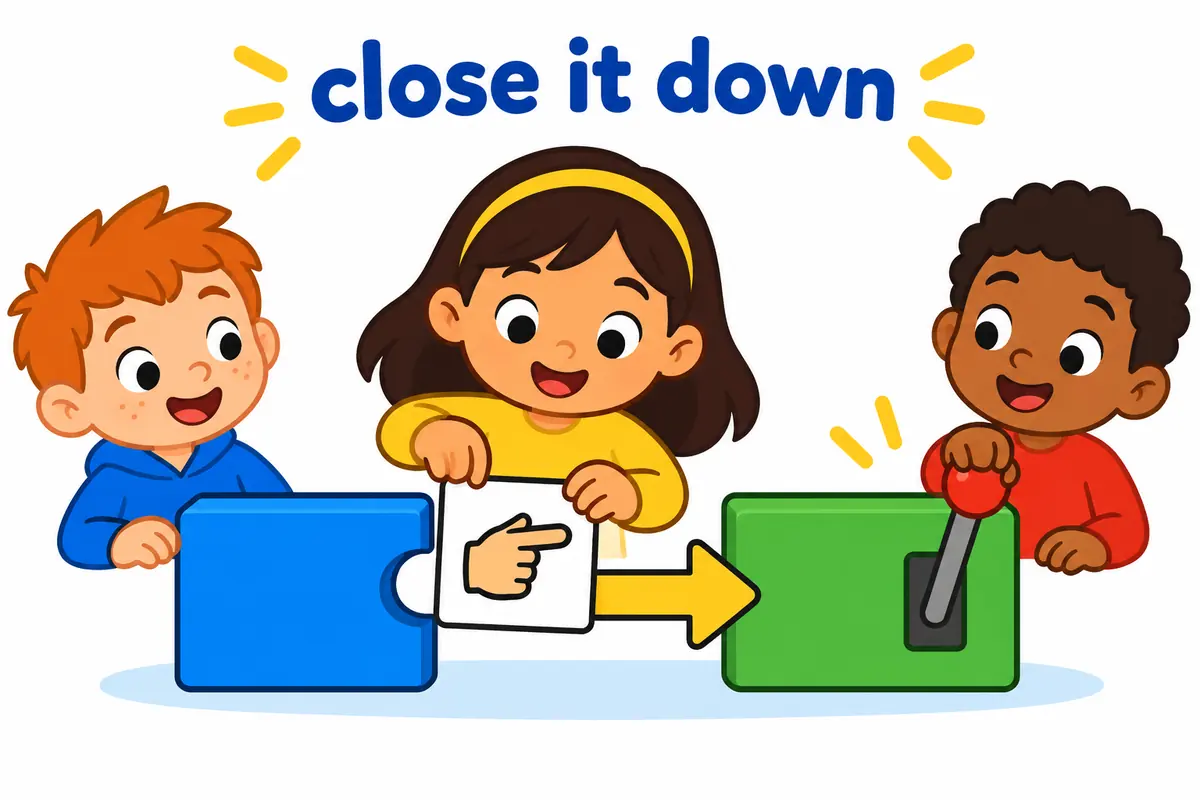
Close down in a sentence: examples across contexts
Close down keeps one meaning while the reason for the stop changes, from a lost lease to a routine power cut.
| Context | Example sentence | Why this works |
|---|---|---|
| Business news | The chain launched twelve stores, then closed down eight. | Contrasts opening with closing in one sentence. |
| Small business notice | After thirty years, the grocers will close down on Friday. | Uses the intransitive form for a farewell. |
| Manufacturing | The plant closed down for two weeks for maintenance. | Shows the temporary sense clearly. |
| IT operations | Engineers closed the server down before the upgrade. | Strands the particle after a noun object. |
| Broadcasting | The local radio station closes down at midnight. | Uses the scheduled sense with a time. |
| Regulation | Inspectors closed the takeaway down over hygiene. | Names an authority ending a service. |
| Conversation | The cafe we liked has closed down. | The intransitive form is natural in speech. |
| Local government | The council voted to close the library down. | Shows a formal decision in the stranded order. |
| Sports | The club closed down its youth academy. | Applies the verb to a programme, not a building. |
| Retail email | The outlet is closing down and everything is reduced. | Uses the present participle for an event in progress. |
| History | The shipyard closed down when the orders stopped. | Links the closure to an economic cause. |
| Finance | The fund closed down after heavy losses. | Extends the verb to an abstract operation. |
The manufacturing and IT rows use the temporary sense, so a reader who assumes close down always means permanent closure will misread them.
Close down vs shut down
Close down and shut down are close enough that dictionaries treat them as variants, but usage leans different ways. Shut down is the more common choice in American English and is the standard verb for machines, computers and power; close down is the more common choice in British English for a business that stops trading. Both are separable, so close the shop down and shut the shop down are equally correct. Where the ending is formal and technical, terminate is the word lawyers reach for; where a small business simply stops, people often say it folded.
| Attribute | close down | shut down |
|---|---|---|
| Core meaning | Stop operating | Stop operating |
| Business ending | Common in British English | Also used, especially in American English |
| Machines and power | Less common | Standard choice |
| Separability | Both orders, pronoun in the middle | Both orders, pronoun in the middle |
| Register | Business and news | Technical, IT and general American |
Verdict: either verb works for a business, but shut down is the safer choice for machines and computers.
Word forms and grammar of close down
Close down inflects through the verb, and it has a noun form that many writers miss.
| Form | Part of speech | Example |
|---|---|---|
| close down | base phrasal verb | They will close down the annexe. |
| closed down | past and past participle | The mill closed down in 1987. |
| closing down | present participle | The shop is closing down next month. |
| closes down | third person singular | The kiosk closes down at four. |
| close-down | noun, chiefly British | The close-down of the pit took two years. |
| closedown | noun, one word | The closedown left a hundred people jobless. |
| closure | related noun | The closure was announced in March. |
The noun forms close-down and closedown name the event itself, and they work best with of: the closedown of the pit, not the closedown the pit.
Common mistakes with close down
- Incorrect:
They closed down it last year.Correct: They closed it down last year. Rule: A pronoun object must sit between the verb and the particle. - Incorrect:
The shop closed down the door at six.Correct: The shop closed the door at six. Rule: Close down is for operations and machines, not for single objects like doors. - Incorrect:
He closed down his laptop and left.Correct: He shut down his laptop and left. Rule: For computers and devices, shut down is the usual choice. - Incorrect:
The meeting closed down at noon.Correct: The meeting ended at noon. Rule: Close down is for businesses, services and machines, not meetings. - Incorrect:
They are closing down for a lunch break.Correct: They are closing for a lunch break. Rule: A short daily break takes close, since close down suggests ending operations. - Incorrect:
The factory close down last year.Correct: The factory closed down last year. Rule: The past tense adds -ed to close, giving closed down.
Practice using close down
Seven items move from gap-filling to correction and register choice; check the reason with each answer.
- Fill the gap: The old mill ______ in 1987 and never reopened.
- Rewrite with the pronoun: They closed down the workshop. Use it.
- Choose the better word: The technician will (close down / shut down) the server for the upgrade.
- Correct the error: The bakery closed down it after the flood.
- Build a sentence: use close down about a family shop ending after many years.
- Spot the register: which fits a maintenance log — the pump was shut down at 6 p.m., or the pump folded at 6 p.m.?
- Rewrite in the passive: Inspectors closed the kitchen down.
Answers
- closed down — the mill stopped operating, and no object is needed.
- They closed it down — a pronoun must go between close and down.
- shut down — machines and computers take shut down as the usual choice.
- The bakery closed it down after the flood — the pronoun cannot follow down.
- Model answer: The family shop closed down after sixty years when the owner retired.
- The pump was shut down at 6 p.m. — a maintenance log is technical, and shut down is the standard term.
- The kitchen was closed down by inspectors — the place becomes the passive subject.
The bottom line
Use close down in a sentence to say that a business, service or machine has stopped operating, and remember that the particle can move to either side of a noun object. Two details decide most sentences: a pronoun must sit in the middle, as in close it down, and the verb can be transitive or intransitive. When something starts again, open or reopen is the opposite.
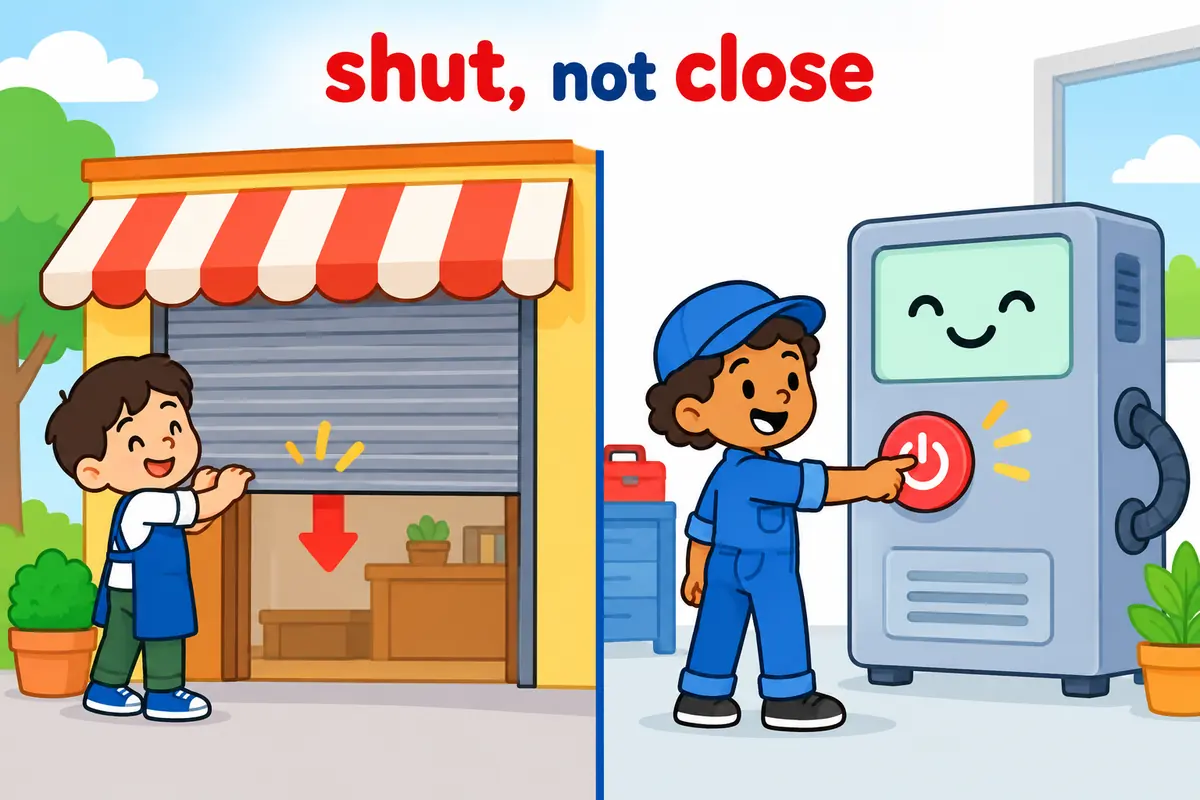
Frequently asked questions about close down
Is close down one word or two?
As a verb it is two words, close down, as in the shop will close down. As a noun it is usually written as one word with a hyphen, close-down, or as a single word, closedown, as in the closedown of the factory. The verb form is far more common.
Can you close down a computer?
You can, but shut down is the usual choice for computers and devices. Close down tends to suggest ending a business, a service or a scheduled operation, while shut down covers machines, power and IT. Both take a pronoun in the middle, so write shut it down.
What is the difference between close and close down?
Close means to shut a door, finish a meeting or end a single session, and it is often temporary. Close down means to stop an operation, a business or a machine, and it suggests something more lasting. You close a shop at six, but a shop closes down when it stops trading.
Is close down permanent?
Not always. A business that closes down is usually finished, but a factory or a pool can close down for maintenance and reopen later. When the pause is planned and short, shut down briefly or close is clearer than close down. The word leaves permanence unstated.