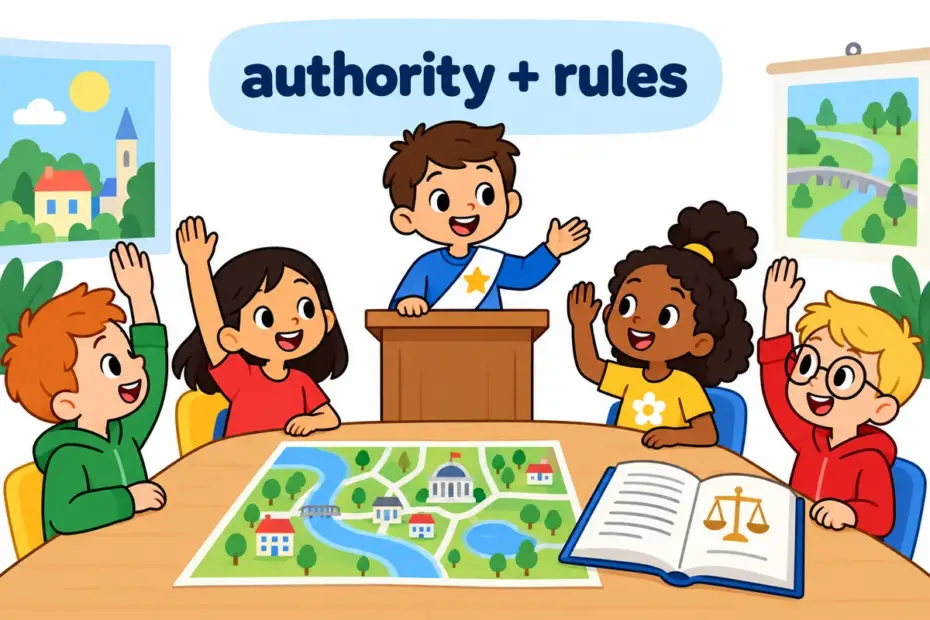
Govern means to control or direct a country, a system or a person’s behaviour, and it appears in a sentence as a plain transitive verb. To use govern correctly, name what is being controlled: “The board governs the school’s budget.” The verb never takes a preposition, so govern over is wrong.
Govern at a glance
- Govern is a regular transitive verb; its forms are governs, governed and governing.
- The dominant pattern is subject + govern + institution, system or behaviour.
- Typical subjects are governments, boards, laws and rules.
- The word is neutral to formal and appears in politics, law and science.
- The commonest error is adding over, as in govern over a country.
What does govern mean?
Govern is a verb meaning to hold authority over a state or group, to determine how something works, and to restrain a person’s conduct. The Cambridge entry for govern records all three senses. The political sense names people, the causal sense names systems, and the restraint sense names feelings, which is why the object tells you which meaning is active.
| Sense | Plain meaning | Example sentence |
|---|---|---|
| Rule a state or group | Hold authority and make decisions | An elected council governs the city. |
| Determine how something works | Be the rule that controls an outcome | Simple laws govern the swing of a pendulum. |
| Restrain conduct | Keep a feeling or action under control | He struggled to govern his temper. |
One limitation is worth stating. Govern implies authority and rules, so it is too strong for a casual arrangement: a person governs a nation, but a person manages a small team. Where no rules or authority are involved, manage or run is the plainer choice.
The three senses differ in what they promise. Ruling a state implies lawful authority; determining an outcome implies a rule that acts on its own; restraining conduct implies effort against resistance. A single sentence rarely mixes them, so once you name the object the meaning is fixed.
How do you use govern in a sentence?
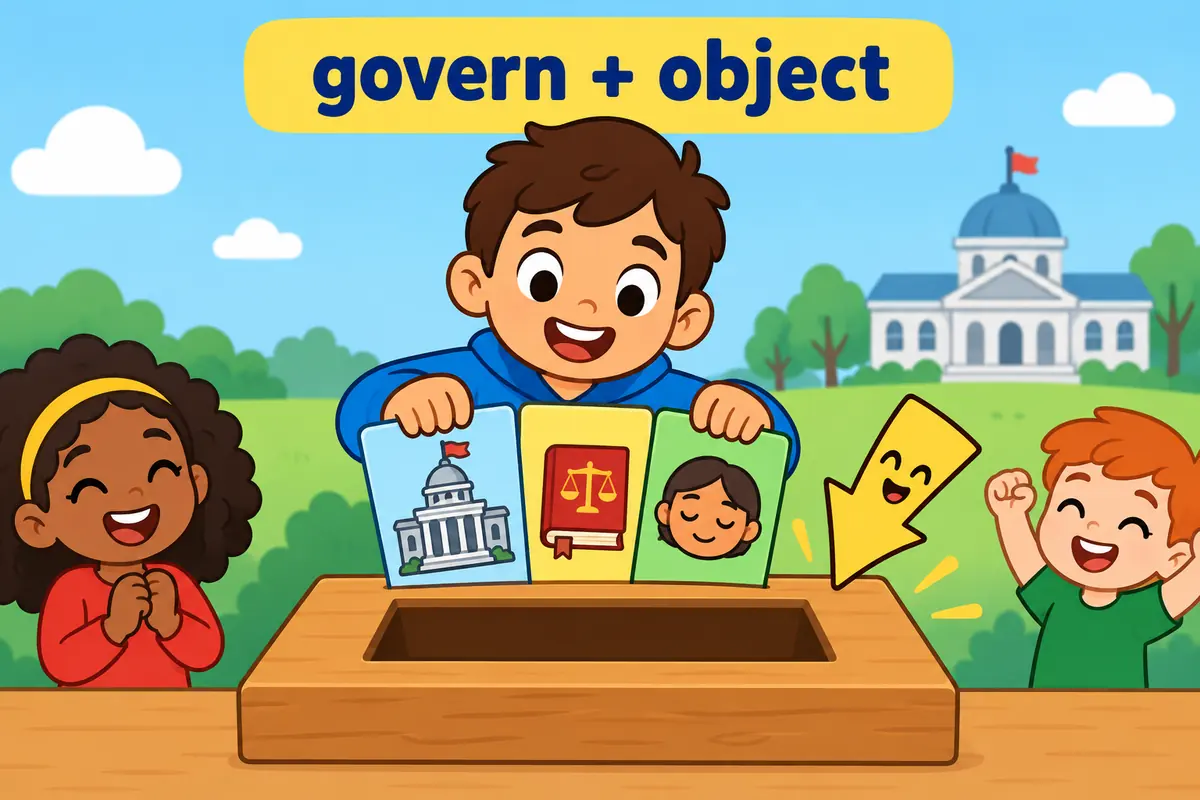
Put the authority or rule first and the thing controlled second, as in the law governs the process. Govern is transitive, so it always needs an object and never a preposition. Five patterns cover nearly every real sentence.
| Pattern | Example | What it signals |
|---|---|---|
| govern + institution or place | The council governs the region. | Direct political authority over people. |
| rules or laws + govern + behaviour | Strict rules govern the contest. | A set of rules controls an activity. |
| be governed by | Prices are governed by supply. | Passive; names the controlling force. |
| govern + oneself or a feeling | She learned to govern her temper. | The restraint sense, often reflexive or about emotions. |
| governing + noun | The governing body met at noon. | Adjectival use before a noun. |
To control something is to have power over it, while to administer a system is to run it day to day; govern sits between them and adds the idea of lawful authority.
The passive, be governed by, is the scientist’s favourite because it hides the agent and keeps attention on the rule: prices are governed by supply says less about who sets the price and more about what controls it. In political writing the active voice returns, because voters want to know who governs. Note too that govern almost never takes a bare infinitive; a purpose clause needs a separate verb, as in the rules govern the process and keep it safe.
Govern in a sentence: examples across contexts
Govern shifts from constitutions to laboratory reports. Each sentence below names the controlling force and the thing controlled, which is what makes the verb precise.
| Context | Example sentence | Why this works |
|---|---|---|
| Civics class | A parliament governs the country through written laws. | The political sense names both authority and method. |
| Workplace email | A short policy governs how expenses are approved. | A written rule controls a routine process. |
| News report | The mayor governs a city of two million people. | Names the office and the population governed. |
| Legal writing | The 1998 act governs the disposal of the land. | A statute is the controlling authority. |
| Science writing | The same equations govern the flow of heat and current. | The causal sense uses a system as subject. |
| Academic prose | Local customs governed the choice of crop. | A social force controls a practice. |
| Parenting advice | Children slowly learn to govern their own impulses. | The restraint sense with a reflexive object. |
| Sports report | Discipline governs the way the side defends. | An abstract quality controls a whole style. |
| Conversation | One strict teacher governed the whole timetable. | A person as subject in everyday speech. |
| Election coverage | Whoever wins will govern a divided parliament. | Names the future authority and the body it controls. |
| History essay | A single family governed the duchy for centuries. | Shows long-running political authority. |
| Engineering note | Two constants govern the strength of the joint. | The causal sense with technical subjects. |
| Religious writing | A written rule governed the monastery for years. | A document acts as the controlling authority. |
Only the last sentence makes a person its sole subject in speech; every other row keeps an institution, a rule or an equation in charge.
Notice that the political rows keep a human or institutional subject, while the scientific rows let a rule or an equation do the governing. That split follows the sense rather than the writer’s taste: when people govern, the sentence is about authority and legitimacy, and when a law or a mechanism governs, the sentence is about cause and effect. Choosing the wrong kind of subject is the fastest way to make the verb sound odd.
Govern vs regulate
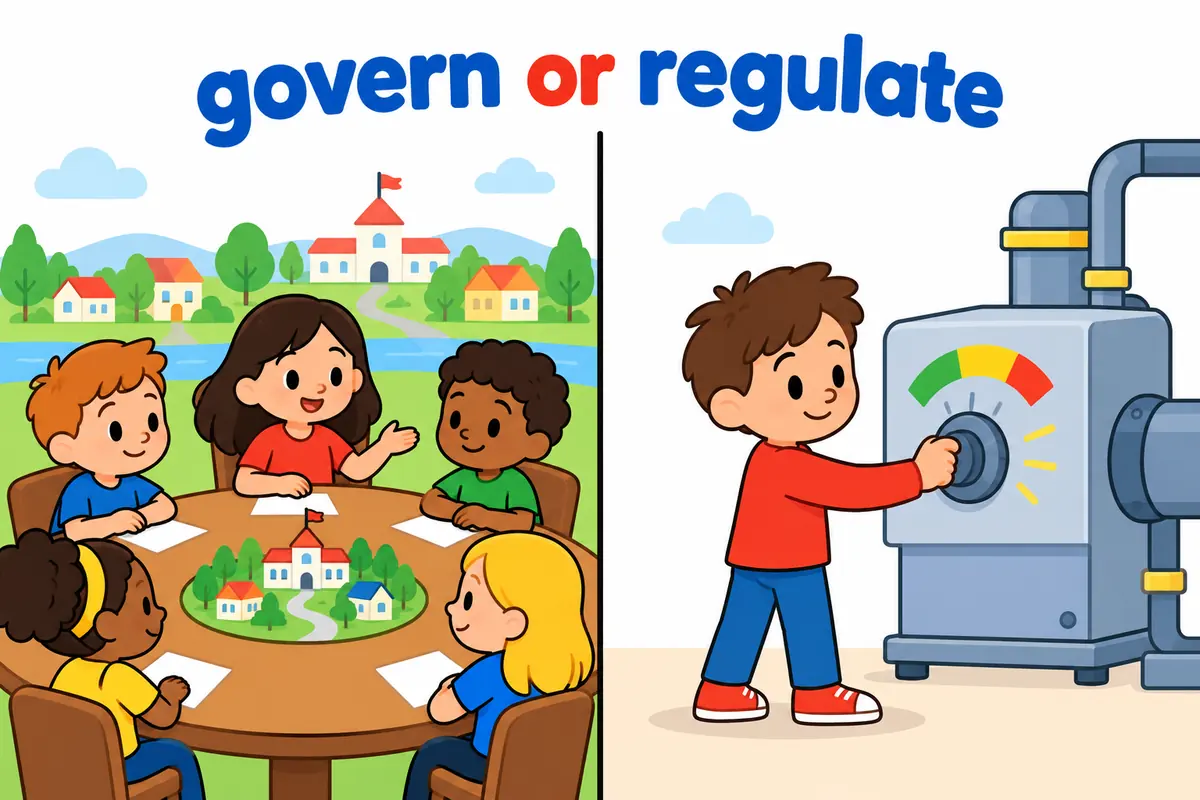
Govern and regulate overlap in the sense of control, but their subjects differ. A body governs; a rule or agency regulates a specific activity.
| Attribute | govern | regulate |
|---|---|---|
| Core job | Exercise authority over a group or system | Control an activity by rules or limits |
| Typical subject | A government, council, board or law | An agency, a rule or a mechanism |
| Typical object | A country, a process, behaviour | An industry, a price, a temperature |
| Implies | Legitimate authority and order | Adjustment and enforcement |
| Register | Formal and political | Neutral and technical |
Verdict: choose govern for authority over a whole body and regulate for controlling one activity through rules.
A useful test asks who is in charge. If a body makes the rules for everyone, it governs; if a rule or an agency controls one activity within limits, it regulates. Governments govern, while safety boards and utility commissions regulate.
Word forms and grammar of govern
Govern inflects regularly, and its family is large. The noun government is the one learners meet first, while governance names the act of governing itself.
| Form | Part of speech | Example |
|---|---|---|
| govern | verb, base form | They will govern for four more years. |
| governs | verb, third person singular | A single code governs every branch. |
| governed | verb, past and past participle | The island was governed for decades. |
| governing | verb, present participle | The rules governing trade changed. |
| government | noun | The government announced new funding. |
| governor | noun, a person | The governor signed the bill. |
| governance | noun, the act | Good governance builds trust. |
| governmental | adjective | A governmental review followed. |
Keep government for the body and governance for the process; the verb governs whichever noun you choose.
The family is wide because the act is central to public life. A governor holds office, a government holds power, and governance names how well that holding is done. Keep the verb for the act itself, and the nouns for the people and the process. To lead a group is to guide it, which is a softer idea than holding authority over it.
Common mistakes with govern
- Incorrect:
The council governs over the region.Correct: The council governs the region. Rule: Govern is transitive and takes no preposition. - Incorrect:
The rules govern.Correct: The rules govern the process. Rule: An object must follow the verb. - Incorrect:
She governs to make decisions.Correct: She governs the department. Rule: Govern takes a noun phrase, not an infinitive of purpose. - Incorrect:
He govern the team well.Correct: He governs the team well. Rule: Third person singular adds -s. - Incorrect:
The governor governs.Correct: The governor governs the province. Rule: The noun subject still needs an object.
Practice using govern
Work through the six items, then check the reasoning rather than only the answer.
- Fill the gap: A strict code ______ how the laboratory handles samples.
- Choose the better word: An independent agency (governs / regulates) food safety.
- Correct the error: The queen governed over the islands for years.
- Build a sentence: use be governed by about prices and demand.
- Spot the register: which belongs in a constitution — A parliament governs the state, or We govern stuff?
- Rewrite with the noun: The board governs the trust. Use governance instead.
Answers
- governs — the code is the subject and the -s marks third person singular.
- regulates — an agency controls one activity through rules, which is regulate.
- The queen governed the islands for years — govern takes a direct object and no over.
- Model answer: Prices are governed by supply and demand.
- A parliament governs the state — a constitution uses formal, transitive govern.
- The trust has good governance — the noun names the process, not the act of ruling.
The bottom line
Use govern in a sentence for authority over a state, a system or a person’s conduct, and always name the thing controlled. Two details decide the wording: the verb is transitive, so an object must follow, and it never takes over. Where the subject is a rule controlling one activity, regulate is the more exact verb.
Frequently asked questions about govern
Is govern a transitive verb?
Yes. Govern is transitive, so it always takes an object such as a country, a process or a temper. You write the council governs the city, not the council governs. The reflexive phrase govern oneself is the one case where the object points back to the subject.
What is the difference between govern and government?
Govern is the verb meaning to rule or control, while government is the noun for the body that rules or the system of rule. You can govern a country, and the government is the group that does it. The same root produces both, but only the noun ends in -ment.
Can govern be used for things, not people?
Yes. Besides ruling people, govern describes what determines an outcome, as in the same laws govern the tides. This causal sense is common in science and academic writing, where a rule or equation is the subject and a natural process is the object.
Does govern take the preposition over?
No. Govern is transitive and needs no preposition, so the council governs the region rather than governs over it. The preposition over belongs with rule, as in rule over a region. Adding over after govern is the most frequent mistake learners make.