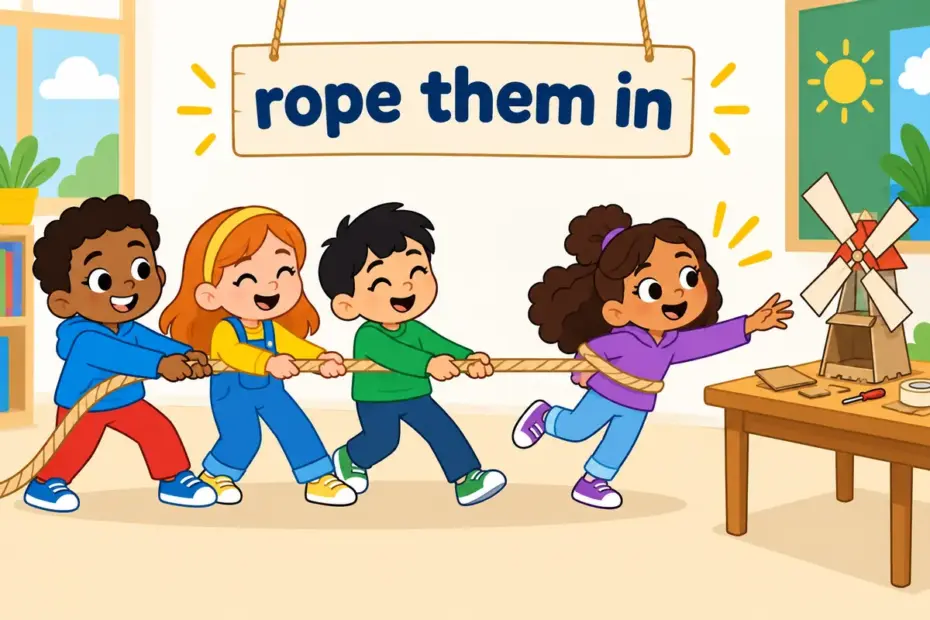
Rope in means to persuade someone to join a task or group, especially when they need convincing. To use rope in in a sentence, put the person after the verb and name the activity: “We roped in two parents to run the stall.” The phrase is informal, and the passive pattern be roped into something is just as common.
Rope in at a glance
- Rope in is a transitive phrasal verb; its forms are ropes in, roped in and roping in.
- It means to enlist a person for a task, usually after some persuasion.
- The particle can follow the object, so rope her in sounds more natural than rope in her.
- The phrase is informal and spoken; formal writing prefers recruit or engage.
- The commonest error is placing a pronoun after the particle instead of before it.
What does rope in mean?
Rope in is a phrasal verb meaning to persuade someone to join an activity or group, often when they are reluctant. The Cambridge entry for rope in treats it as informal and connects it with enlisting help, and that flavour of gentle pressure separates it from a plain invitation.
| Sense | Plain meaning | Example sentence |
|---|---|---|
| Enlist for help | Persuade someone to do a task with you | We roped in two neighbours to move the piano. |
| Draw into a group | Bring a person into a scheme or team | The club roped in every newcomer as a marshal. |
| Persuade against reluctance | Talk someone round until they agree | She roped her brother in after twenty minutes of asking. |
One limitation is worth stating plainly. Rope in takes a person as its object, never a thing, and it suggests the helper did not volunteer. When somebody offered freely, joined is the better verb, and when the task is paid work, hired is more accurate still.
How do you use rope in in a sentence?
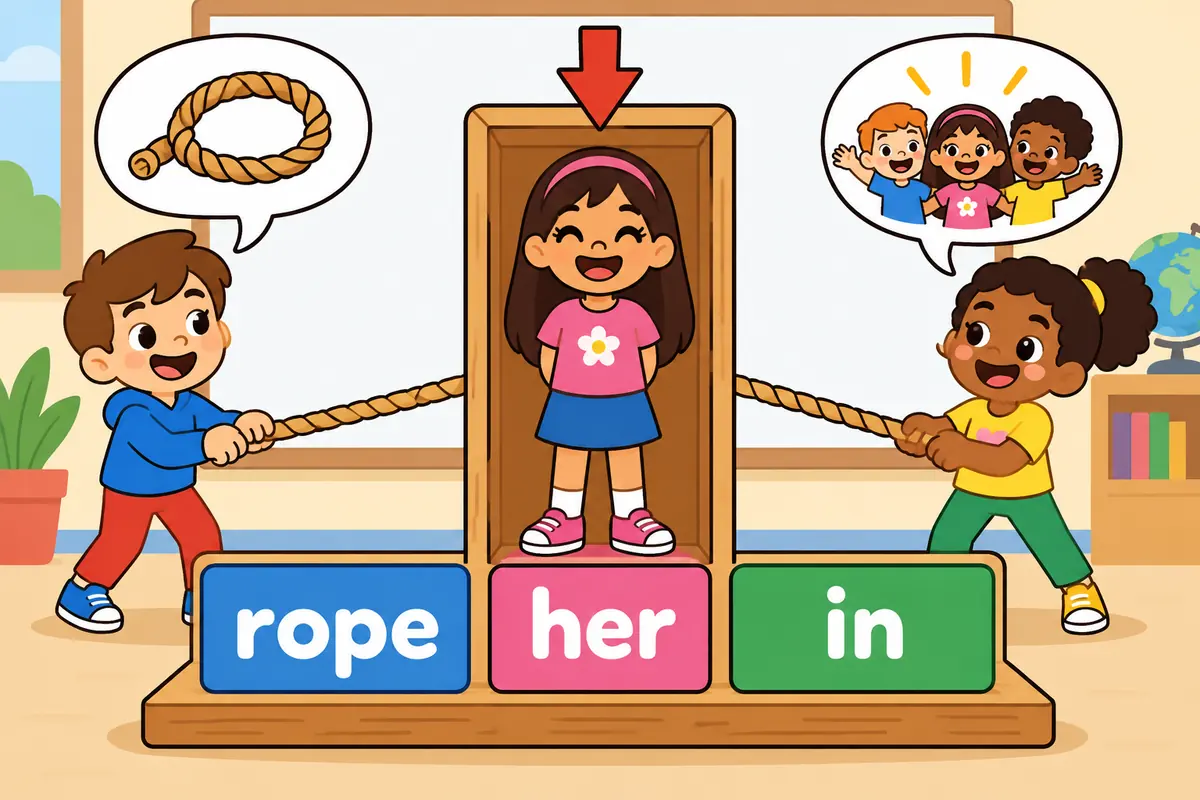
Rope in is transitive and separable: the particle can follow the object, as in rope her in. Five patterns cover almost every natural sentence, and the split form is the one that sounds native. You can involve the neighbours and rope them in with the same construction.
| Pattern | Example | What it signals |
|---|---|---|
| rope + object + in | They roped the new teacher in to judge the contest. | The object sits between verb and particle, the natural spoken order. |
| rope in + object | Organisers roped in a whole class of volunteers. | Particle first, used when the object is long or new to the reader. |
| rope + object + in + to + verb | He roped his brother in to help. | Names the task the person is brought in to do. |
| rope + object + into + noun | She roped me into organising the fair. | Signals reluctant or unexpected involvement. |
| be or get roped in | I got roped in at the last minute. | Passive pattern that makes the recruit the subject. |
A pronoun must sit between the verb and the particle, so rope her in is correct and rope in her is not. The related pattern be roped into something keeps the same idea but adds a preposition before a noun or a gerund.
Rope in in a sentence: examples across contexts
Rope in keeps its meaning while the setting changes. The ten sentences below move from a classroom to a community stall, and each one names both the person recruited and the job they agreed to do. Where the helpers are paid, recruit helpers is the formal verb; organisers who include everyone usually find the roping easier.
| Context | Example sentence | Why this works |
|---|---|---|
| Classroom | The teacher roped in three parents to run the science stall. | Names who is recruited and the job, which suits a school notice. |
| Workplace email | We roped in the design team to check the labels before printing. | A team is the object, and a to-clause supplies the purpose. |
| News report | Organisers roped in local businesses to fund the parade. | A plural object and a funding aim give a civic tone. |
| Sports | The coach roped in a former player to train the keepers. | The to-clause names a specialist task. |
| Community | Volunteers roped in their neighbours to plant the verge. | Shows the person-to-person chain the phrase implies. |
| Family | Mum roped Dad into baking forty cupcakes for the fair. | The into pattern signals good-humoured reluctance. |
| Academic | The study roped in two hundred students to test the new schedule. | A number makes the recruitment concrete and countable. |
| Conversation | I roped in my cousin to drive us to the airport. | First person and a favour mark the everyday use. |
| Fundraising | The charity roped in a comedian to host the auction. | A named draw card is brought in to attract an audience. |
| Volunteer day | They roped in the whole street to clean the pond. | A collective object shows the phrase scaling up. |
Notice how often a to-clause names the task, and how the into pattern appears whenever the helper grumbled. That small grammatical difference is what marks the sentence as real speech.
Rope in vs draw in
Rope in and draw in both bring a person into something, but they differ in who did the work. To entice a volunteer sits even closer to attraction, while rope in leans on persuasion.
| Attribute | rope in | draw in |
|---|---|---|
| Core idea | Persuade someone to join a task | Attract someone into an activity or group |
| Strength | Stronger, and it hints at pressure | Gentler, and it suggests real interest |
| Typical object | A person who needs convincing | A person, a crowd or an audience |
| Usual pattern | rope someone in to do something | draw someone in with something |
| Register | Informal and conversational | Neutral, leaning slightly formal |
| What it implies | They might not have chosen it themselves | They were pulled in by appeal |
Verdict: choose rope in when the person needed persuading, and draw in when the attraction itself did the work. To call in a favour is a third route, and it is more direct than either.
Word forms and grammar of rope in
Rope in follows the regular pattern of a separable phrasal verb. The table also shows the related preposition pattern that learners often mix up with the base form.
| Form | Part of speech | Example |
|---|---|---|
| rope in | phrasal verb, base | We can rope in a few more helpers. |
| ropes in | phrasal verb, third person singular | She ropes in her flatmates every weekend. |
| roped in | phrasal verb, past and past participle | They roped in the whole department. |
| roping in | phrasal verb, present participle | He is roping in anyone who passes. |
| rope someone in | split form with a pronoun | Rope her in before the meeting. |
| be roped into | passive pattern with a preposition | I was roped into selling tickets. |
The base verb rope also appears in the unrelated phrase rope off, which means to fence an area, and in butt in, which means to interrupt. Keep both out of sentences about recruiting people.
Common mistakes with rope in
- Incorrect:
We roped in her to help.Correct: We roped her in to help. Rule: A pronoun sits between the verb and the particle, never after the particle. - Incorrect:
They roped in the projector for the show.Correct: They roped in a technician to run the projector. Rule: Rope in takes a person or a group, never a thing. - Incorrect:
She roped me in the committee.Correct: She roped me into the committee. Rule: Use into before a noun; in on its own takes no following noun. - Incorrect:
The fans roped in.Correct: The fans roped in their friends. Rule: Meaning to enlist, rope in is transitive and needs an object. - Incorrect:
We roped in help from Dad.Correct: We roped Dad in to help. Rule: The helper is the object, and help is the task, not the person.
Practice using rope in
Work through the six items, then read the answers for the reasoning rather than only the key.
- Fill the gap: The organisers ______ two chefs in to run the food stand.
- Choose the better word: We (roped in / drew in) my uncle, who grumbled but agreed.
- Correct the error: They roped in she to paint the set.
- Build a sentence: use rope someone in to about a school play.
- Spot the register: which belongs in a message to a friend, we roped in a ringer for the quiz or we enlisted additional personnel?
- Rewrite with the passive: The team roped in two new helpers. Use the pattern be roped in.
Answers
- roped — the past form matches organisers and a job already done.
- roped in — he grumbled, so he needed persuading rather than attracting.
- They roped her in to paint the set — a pronoun sits between verb and particle.
- Model answer: Miss Lane roped Sam in to paint the backdrops for the play.
- We roped in a ringer for the quiz — it is casual, while the second sentence is stiff and formal.
- Two new helpers were roped in by the team — the recruits move to the front.
The bottom line
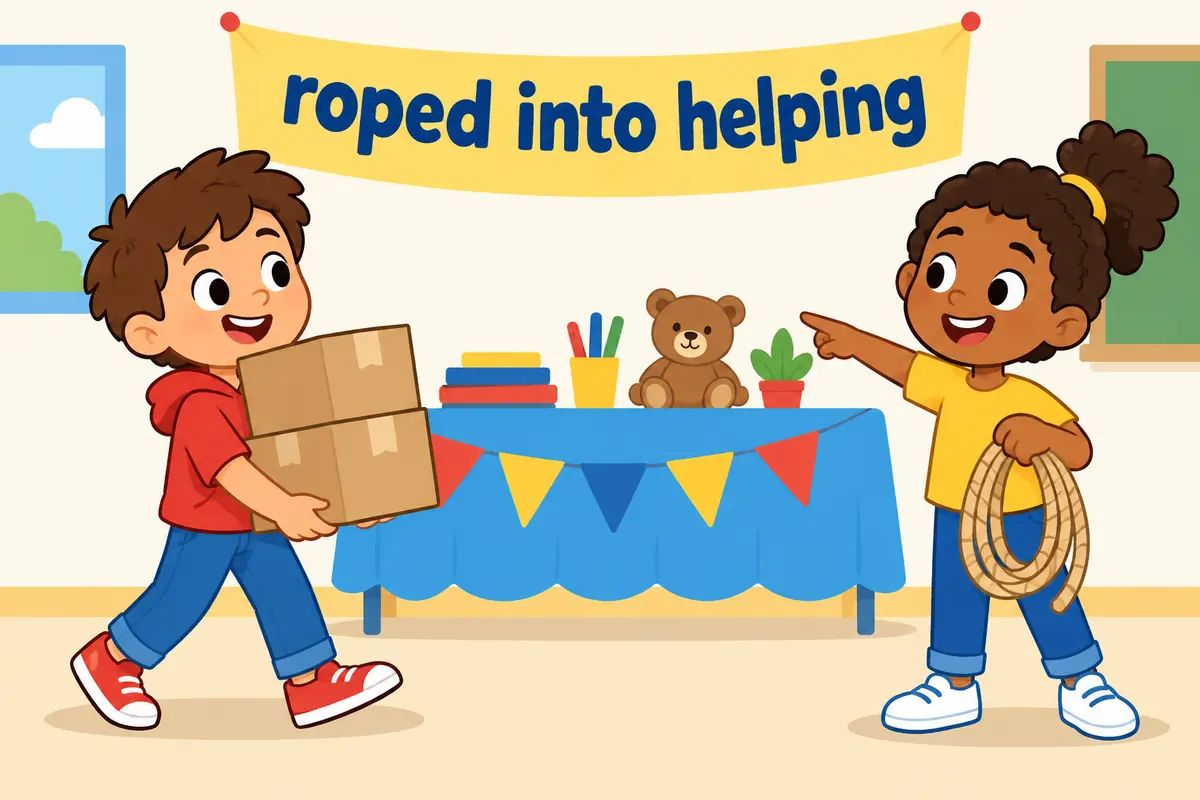
Use rope in in a sentence when you persuade someone to join a task they did not choose, and keep a short object between the verb and its particle. The two details that decide most sentences are these: rope in takes a person rather than a thing, and the into pattern signals reluctance while the to pattern names the job.
Frequently asked questions about rope in
Is rope in informal?
Rope in belongs to spontaneous, spoken and friendly writing rather than formal reports. A manager might say we roped in two temps, but a formal report would say two temporary staff were engaged. The phrase is not rude, yet it does imply the helper was persuaded rather than choosing freely.
Can you say rope in someone?
You can, and the order rope in someone is grammatical, but it sounds less natural than rope someone in. English speakers usually keep a short object, especially a pronoun, between the verb and the particle. Use rope in someone only when the object is long, as in they roped in everyone from the night shift.
What preposition goes with roped in?
Two patterns share the phrase. Roped in to do something names the task, as in she was roped in to coach the juniors. Roped into something, or into doing something, names the activity and hints at reluctance, as in he was roped into baking. Choose to for the job and into for the situation.
What does rope someone into something mean?
It means to persuade someone to take part in an activity they did not plan to join, usually with a hint of reluctance. The idiom keeps the picture of a rope pulling a person towards a group. It carries the same force as rope in, but the into pattern always adds a noun or a gerund.