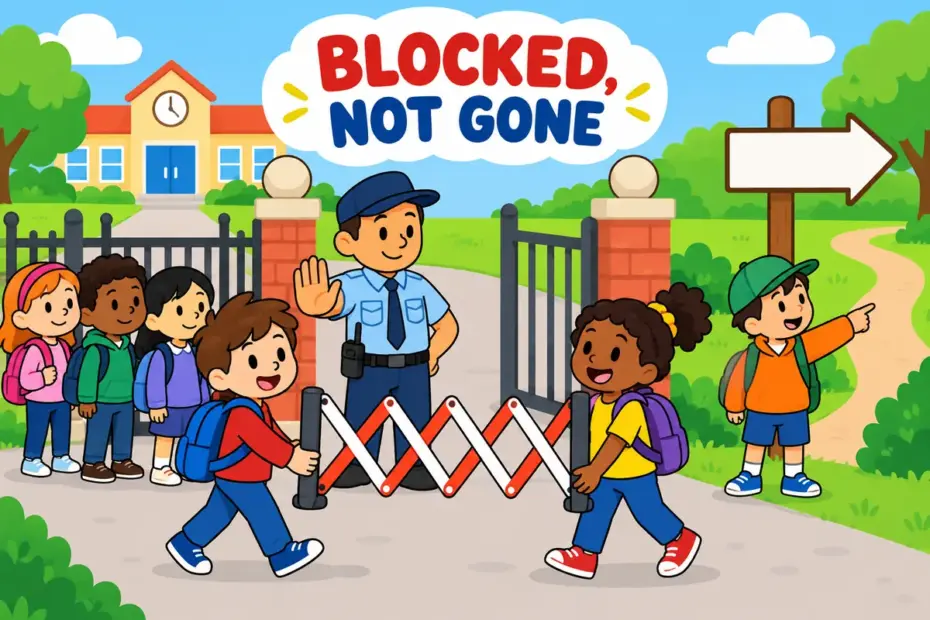
Close off means to block or seal an area so that nothing can pass into it, or to separate yourself from other people. To use close off in a sentence, name what is blocked: “Police closed off the square.” The phrasal verb is transitive and separable, so the object can sit after or between its two words.
Close off at a glance
- Close off is a transitive phrasal verb; its forms are closes off, closed off and closing off.
- The particle off may follow the object or sit before it: close off the road and close the road off are both correct.
- The commonest sense is blocking an entrance, a route or an area so that people cannot enter.
- The second sense is relational: people close themselves off from friends, family or the world.
- Close off is neutral in register, while shut off is its closer everyday twin for machines and supplies.
What does close off mean?
Close off is a transitive phrasal verb meaning to block or seal an area so that people or things cannot enter it, or to cut a person or place off from contact. The Cambridge entry for close off treats the physical sense as primary and the emotional sense as an extension of it. Both senses share one idea: a boundary that was open is now shut.
| Sense | Plain meaning | Example sentence |
|---|---|---|
| Physical block | Seal an entrance, route or area so nobody can pass | Police closed off the square before the parade. |
| Relational separation | Cut a person or place off from contact | He closed himself off from his old friends. |
| Conclude something | Bring a period or a discussion to an end | The chair closed off the debate after an hour. |
One limitation is worth stating plainly. Close off rarely means permanent removal, and it says nothing about why the barrier exists. When an opening is shut for good, seal the entrance carries a sense of permanence that close off does not, so a demolished building is never merely closed off.
How do you use close off in a sentence?
Put the place or person after close and keep off as the particle: close off the road, close the road off, or close yourself off. The choice between the two physical orders is a matter of rhythm and of whether the object is a pronoun. Five patterns cover almost every real sentence.
| Pattern | Example | What it signals |
|---|---|---|
| close off + place | Police closed off the street. | Blocks entry to a route or an area. |
| close + place + off | Workers closed the lane off. | Same meaning, but the object sits before the particle. |
| close off + place + to + noun | The council closed the path off to cyclists. | Names the group that is now excluded. |
| close oneself off from + person | She closed herself off from her brother. | Emotional withdrawal, not a physical barrier. |
| be closed off | The east wing was closed off for repairs. | Passive form that keeps attention on the place. |
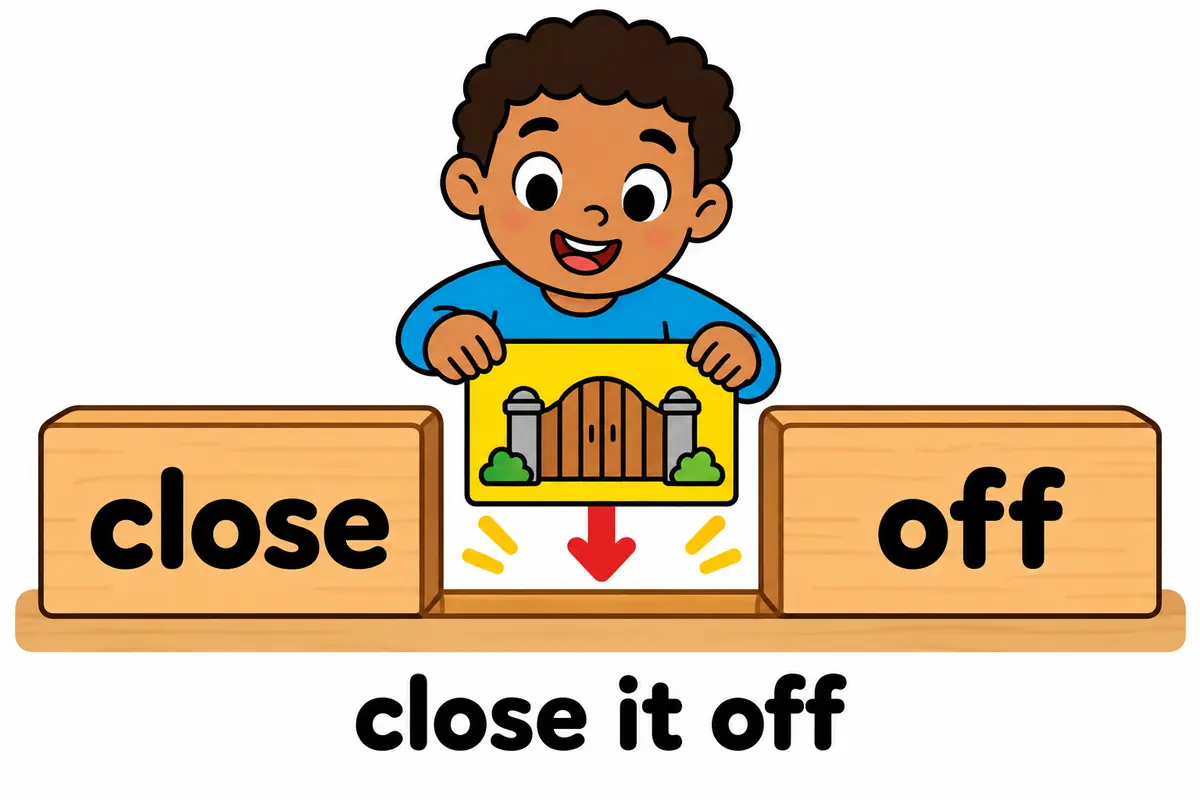
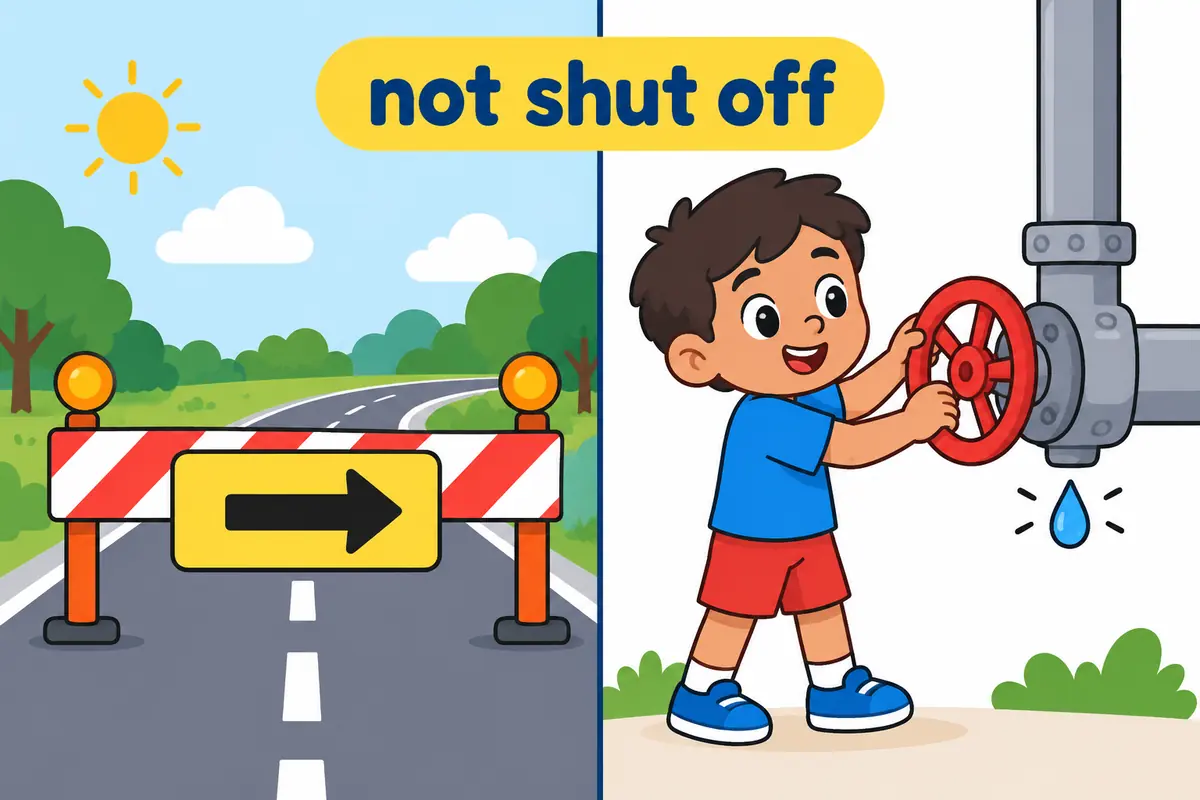
Where the block is about machinery, a tap or a power supply, shut off the valve is the idiom English prefers. The separator rule is the one learners miss: a pronoun must sit between the two parts, so close it off is correct and close off it is not.
Close off in a sentence: examples across contexts
Close off changes its subject more than its meaning. The nine sentences below move from a school corridor to a news report, and each one names the boundary that was shut and the reason it mattered.
| Context | Example sentence | Why this works |
|---|---|---|
| Classroom | The teacher closed off the wet corridor until the mop arrived. | A small safety reason makes the temporary block obvious. |
| Workplace email | We have closed off the north stairwell while the alarm is tested. | The passive keeps the message about the building, not the staff. |
| News report | Officers closed off three streets around the depot after the spill. | Names the authority, the area and the trigger in one line. |
| Legal writing | The order closed off the disputed strip to public access. | Uses the physical sense to describe a formal restriction. |
| Technical writing | A faulty sensor closed off the coolant line automatically. | The subject is a device, which suits a procedural register. |
| Travel guide | The park closes off the upper trail in heavy snow. | Present tense reports a recurring seasonal pattern. |
| Sports commentary | The defender closed off the near post before the cross arrived. | Transfers the meaning to space that is blocked, not a fence. |
| Conversation | He closed himself off after the move and stopped calling. | The reflexive sense is the one that survives in speech. |
| History essay | The regime closed off the border with wire and watchtowers. | Pairs a concrete barrier with a political decision. |
Only the relational sentence uses a reflexive pronoun, and only that one describes a person rather than a place. That split between the physical and the personal is the clearest guide to which sense a sentence carries.
Close off vs shut off and seal
Close off overlaps with two near neighbours and is interchangeable with neither. Where a whole district is ringed by controls, isolate a village describes the wider effect; where a gap is filled for good, seal describes the finished job.
| Attribute | close off | shut off | seal |
|---|---|---|---|
| Core job | Block entry to a place or a person | Stop a flow or a supply | Close a gap completely |
| Typical object | A road, room, path or person | A tap, valve, power or engine | An opening, crack or entrance |
| Duration | Usually temporary | As long as the switch is off | Often permanent |
| Typical subject | Police, staff, a barrier | A person or an automatic system | A builder or a material |
| Register | Neutral, used in news and speech | Neutral to technical | Neutral to formal |
| What it implies | Entry is prevented | Movement is stopped | Airtight or watertight closure |
Verdict: choose close off when people or traffic are kept out of an area, shut off when a flow or supply is stopped, and seal when the closure is meant to last. Where a barrier is later lifted, open the route is the natural opposite of close off.
Word forms and grammar of close off
Close off inflects by changing the verb, never the particle: off stays exactly the same in every form. Only verbs change, so the phrase keeps its shape through a whole paragraph. Do not confuse this particle with the idiom back off, which means to retreat rather than to block.
| Form | Part of speech | Example |
|---|---|---|
| close off | phrasal verb, base form | Crews will close off the bridge tonight. |
| closes off | phrasal verb, third person singular | The scheme closes off the alley at dusk. |
| closed off | phrasal verb, past and past participle | They closed off the wing last winter. |
| closing off | phrasal verb, present participle | Crews are closing off the far lane. |
| closed-off | adjective, hyphenated | She grew up in a closed-off community. |
The hyphenated adjective closed-off is the form learners most often miss, and it behaves like any other adjective: it comes before the noun it describes and never takes an object.
Common mistakes with close off
- Incorrect:
Police closed the square before the parade.Correct: Police closed off the square before the parade. Rule: Close alone means to shut a door or end a meeting; close off means to block an area. - Incorrect:
The council closed off the path for cyclists.Correct: The council closed off the path to cyclists. Rule: The group that is excluded follows to, not for. - Incorrect:
They closed off it after the accident.Correct: They closed it off after the accident. Rule: A pronoun object must sit between close and off. - Incorrect:
He closed off the engine before the repair.Correct: He shut off the engine before the repair. Rule: Machines and supplies are shut off, not closed off. - Incorrect:
The village was closed off of the mainland.Correct: The village was separated from the mainland. Rule: Close off takes from in the relational sense, and of is never used here.
Practice using close off
Work through the six items, then read the reasoning as well as the answers, because the rule is what transfers to the next sentence.
- Fill the gap: The marshals ______ the finishing straight so the runners could pass safely.
- Choose the better word: Before the inspection, the technician (closed off / shut off) the main gas line.
- Correct the error: The ushers closed off the hall for latecomers.
- Build a sentence: use close oneself off about a boy who stops talking to his teammates.
- Spot the register: which belongs in a council notice — the footpath will be closed off for three days, or they closed the footpath off and it was a total pain?
- Rewrite in the passive: Workers closed off the east entrance. Begin with the entrance.
Answers
- closed off — the marshals block an area, and the object follows the phrase in the natural order.
- shut off — a gas line is a supply, so shut off is the precise verb.
- The ushers closed off the hall to latecomers — the excluded group takes to, not for.
- Model answer: Sam closed himself off from his teammates after the loss.
- The footpath will be closed off for three days — a notice uses the passive and avoids the casual phrase totally.
- The east entrance was closed off by workers — the passive keeps the entrance as the subject.
The bottom line
Use close off in a sentence when a place, route or person is blocked from entry or contact, and keep the particle off beside its verb. Two nuances settle most sentences: the verb is separable, so a pronoun goes in the middle, and it describes a temporary block rather than a permanent seal. For a supply or a machine, shut off is the better fit.
Frequently asked questions about close off
Is close off separable?
Close off is separable, which means the object may follow the particle or sit between close and off. Both close off the road and close the road off are correct. The one fixed rule is that a pronoun must go in the middle, giving close it off rather than close off it.
What is the difference between close off and shut off?
Close off blocks an area, a route or a person, as in police closed off the square. Shut off stops the flow of something, such as water, power or an engine. A street is closed off, but a tap is shut off, so the two verbs are not interchangeable.
Can you close yourself off from people?
Yes, close yourself off from someone is a standard pattern for emotional withdrawal. It means you stop sharing and stop letting others in. The phrase usually describes a lasting mood rather than one act, so writers often add a period of time such as for months.
Does close off always mean physically blocking?
No. The physical sense blocks a place, but the verb also covers abstract separation, as when a chair closes off a debate. Close off can mean bringing discussion or contact to an end. Context decides, so check whether the object is a place, a person or something abstract.