
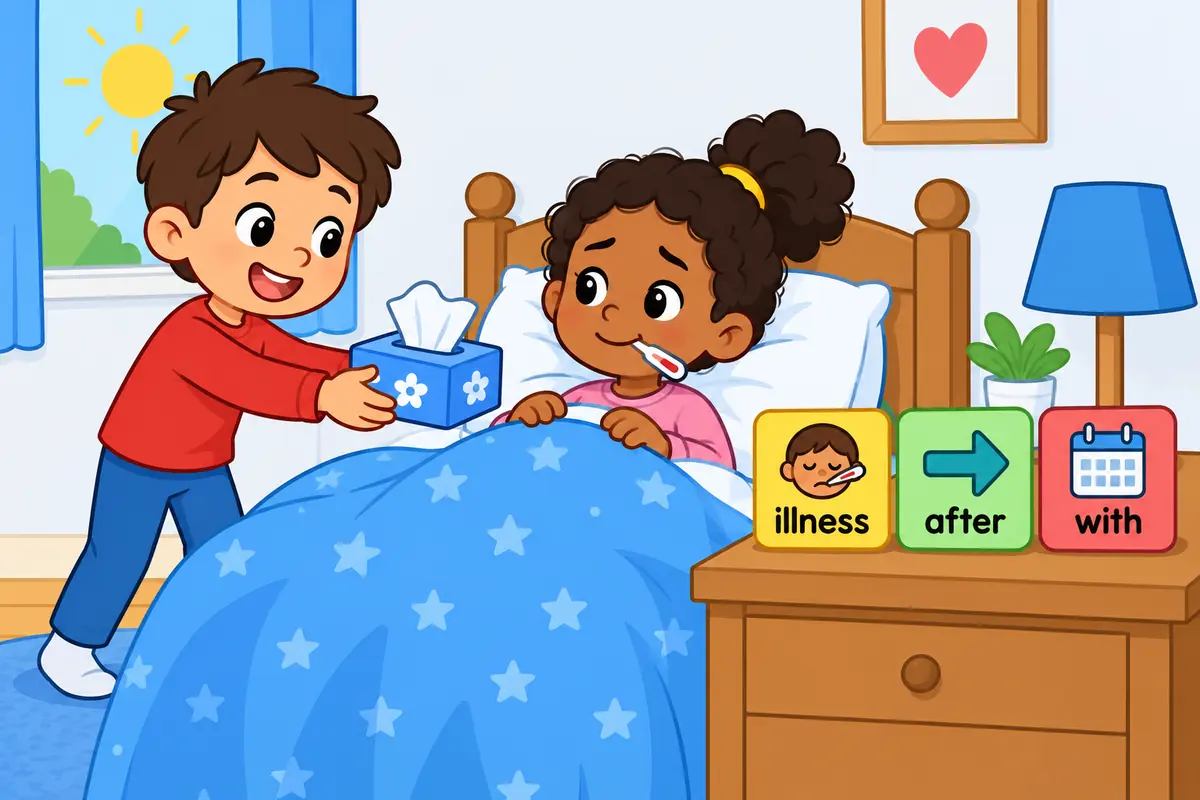
Come down with is a fixed phrase meaning to begin to be ill with something, usually a minor infection. To use come down with in a sentence, name the illness after with: “She came down with a cold.” The phrase never means to travel downward.
Come down with at a glance
- Come down with is a fixed three-word phrase, not a verb plus a free preposition.
- It is always followed by the name of an illness: come down with a cold, the flu or a fever.
- The verb changes with tense while the rest of the phrase stays put: came down with, has come down with.
- It is neutral in register and common in speech, news and health writing.
- The commonest error is splitting the phrase or using it for a downward movement.
What does come down with mean?
Come down with is a phrasal expression meaning to fall ill with a named complaint. The Cambridge entry for come down with gives that sense, and the phrase always points to the start of an illness rather than to a long condition. One limitation is worth stating: it suits a cold, the flu or a fever, but a lasting disease is usually something you develop, not something you come down with. People often hope to shake an illness before it settles.
| Sense | Plain meaning | Example sentence |
|---|---|---|
| Fall ill with | Begin to have an illness, usually a minor one | She came down with a cold on Friday. |
| Catch what is going round | Contract an infection other people have | Half the class came down with the flu. |
| Have a condition begin | Develop an illness after feeling well | He came down with a fever overnight. |
What can you come down with?
The word after with is almost always an illness noun, and the article in front of it changes with the noun. The table lists the pairings that sound native.
| Thing it names | Example sentence | Note |
|---|---|---|
| a cold | I came down with a cold and stayed home. | The most common pairing in everyday English. |
| the flu | Several colleagues came down with the flu. | Uses the definite article because the illness is familiar. |
| a fever | The child came down with a fever by evening. | Names a symptom that is treated like an illness. |
| a bug | We all came down with a stomach bug. | Informal and chiefly spoken. |
| a cough | She came down with a cough that lasted a week. | A mild complaint rather than a diagnosis. |
| an infection | He came down with an ear infection. | Steps up to a medical register. |
How do you use come down with in a sentence?
The phrase is fixed, so the only part that changes is the verb. Tense and person move; the words down with and the illness stay in place. The table shows the working forms.
| Pattern | Example | What it signals |
|---|---|---|
| subject + come down with + illness | They come down with colds every winter. | The basic form, with the illness as a noun. |
| came down with + illness | She came down with the flu last week. | Past tense of the same fixed phrase. |
| has come down with + illness | He has come down with a nasty bug. | Recent news whose effect is still present. |
| is coming down with + illness | You are coming down with something. | Symptoms are starting but not settled. |
| come down with + illness + time phrase | I came down with a fever on holiday. | Adds when the illness began. |
Come down with in a sentence: examples across contexts
The phrase keeps its meaning but changes in formality with the text. The sentences below move from a sick note to a news report, and each one shows which words a writer reaches for alongside it.
| Context | Example sentence | Why this works |
|---|---|---|
| Everyday conversation | I came down with a cold just before the trip. | Explains an absence in plain, familiar words. |
| Sick note email | Our son has come down with the flu and cannot attend. | Reports an illness politely to a school or office. |
| News report | Hundreds of residents came down with a fever after the flood. | Ties an outbreak to a cause and a time. |
| Health article | Children who come down with chickenpox usually recover quickly. | Uses the phrase in a measured medical register. |
| Workplace message | Half the team has come down with a bug this week. | Frames an outbreak as a practical staffing problem. |
| Travel writing | Travellers often come down with a cough in winter. | Names a common risk in a light, readable way. |
| School newsletter | Several pupils came down with a stomach bug on Monday. | Warns parents without alarm. |
| Diary entry | I came down with a headache after the long drive. | Extends the phrase to a symptom in private writing. |
| Sports report | The captain came down with the flu before the final. | Explains an absence that affected the result. |
Notice how the informal examples shorten the illness to a bug, while the medical examples name a specific condition. The phrase itself stays identical in both. Where the focus moves to how the illness spread, catch is the better verb, and the clinical term contract belongs in a report rather than a text message.
Come down with vs catch
Come down with and catch both describe illness, so the choice rests on which detail the sentence needs. The table sets out the difference.
| Attribute | come down with | catch |
|---|---|---|
| Core meaning | Begin to be ill with a named illness | Acquire an illness from someone or something |
| Focus | The onset of the illness | The moment of transmission |
| Typical object | a cold, the flu, a fever | a cold, a virus, an infection |
| Register | Neutral, slightly softer | Neutral and very common |
| Typical use | Explaining that someone is now ill | Saying where or how it was picked up |
Where the day of onset matters, choose come down with; where the source of the infection matters, choose catch. A sentence can even use both, catching a cold from a colleague and coming down with it two days later. Once the illness is over, the natural next words are recover or, less cheerfully, succumb.
Verdict: use come down with for the moment an illness begins, and catch when the sentence explains how it was picked up.
Word forms and grammar of come down with
The phrase is fixed, so what may and may not vary is easy to state. The table shows the permitted changes and the one split that never happens.
| Form | What changes | Example |
|---|---|---|
| come down with | base form, present plural | They come down with colds each year. |
| comes down with | third person singular | He comes down with a cough every winter. |
| came down with | past simple | She came down with the flu yesterday. |
| coming down with | continuous form | I think I am coming down with something. |
| has come down with | present perfect | The team has come down with a bug. |
| come down with (split) | not allowed | Come a cold down with is non-standard. |
Only the first word inflects, exactly as with any simple verb, which is why comes down with and came down with are correct and the other words never change. This is the chief difference from a free combination such as come down a mountain, where down carries its ordinary meaning. To develop a condition and to avoid an illness are the surrounding ideas most writers need.
Common mistakes with come down with
- Incorrect:
She came down a cold with.Correct: She came down with a cold. Rule: The three words are fixed in order, with the illness always after with. - Incorrect:
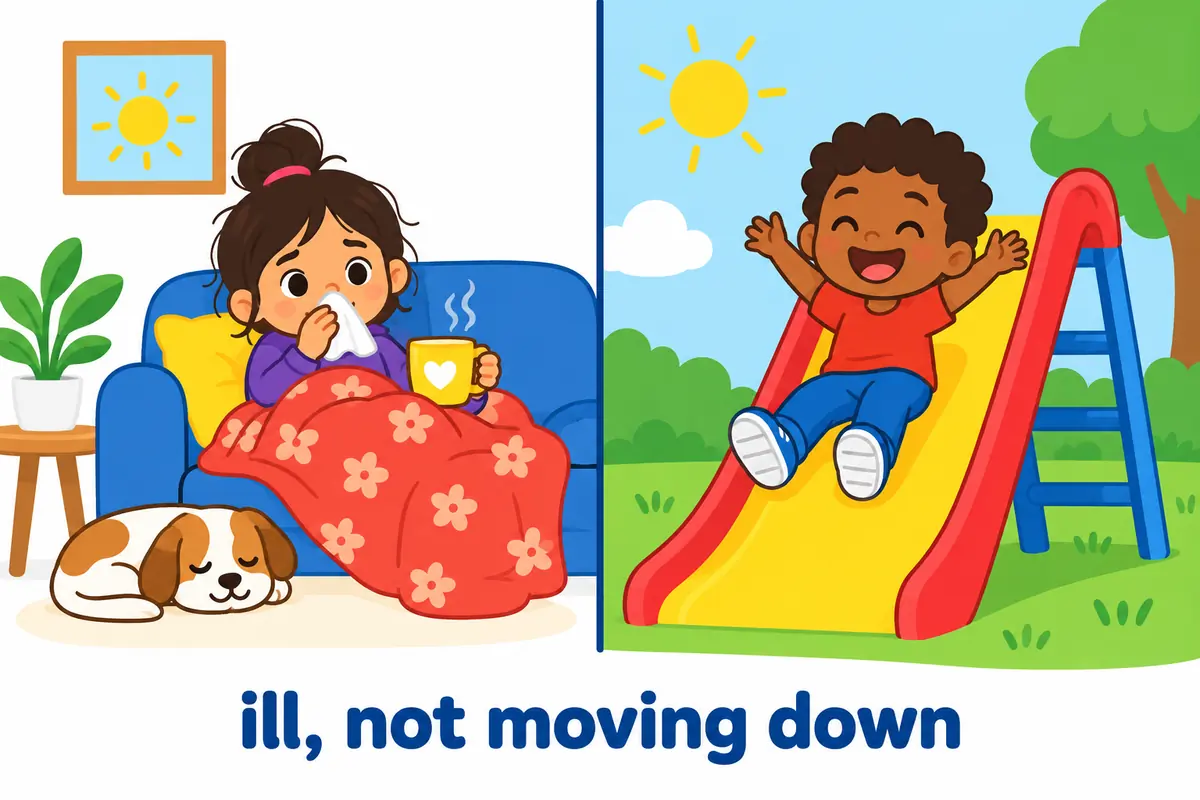
We come down with the mountain slowly.Correct: We came down the mountain slowly. Rule: Without with, come down means to descend; the illness sense needs the whole phrase. - Incorrect:
He was come down with the flu.Correct: He came down with the flu. Rule: Come down with is used in the active voice and is not put into the passive. - Incorrect:
She comed down with a cold.Correct: She came down with a cold. Rule: The past form of come is came, never comed. - Incorrect:
The office come down with new rules.Correct: The office adopted new rules. Rule: Come down with names illness only, so a policy change needs a different verb.
Practice using come down with
Work through the six items, then read the reasoning rather than only the key, because the fixed structure is what the task tests.
- Fill the gap: He ______ a fever the night before the exam.
- Choose the better word: She (came down with / caught) the flu from her brother.
- Correct the error: The children came down with ill after the trip.
- Build a sentence: use has come down with about a teacher who is absent.
- Spot the register: which belongs in a school newsletter? Several pupils came down with a bug, or the pupils got a bug thing.
- Change to the present continuous: I come down with a cold.
Answers
- came down with, because the illness follows with in the fixed phrase.
- caught, because the sentence explains where the illness came from, which is the transmission sense.
- The children came down with an illness after the trip, because with must be followed by a noun.
- Model answer: Our history teacher has come down with the flu and will be away.
- Several pupils came down with a bug, because a newsletter keeps a plain but complete sentence.
- I am coming down with a cold, because the continuous form uses coming.
The bottom line
Use come down with in a sentence when you want to say that someone has begun to be ill with a named complaint. The two points that decide most sentences are structure and scope: the three words are fixed, so the illness always follows with, and the verb tenses while the rest stays put. It means falling ill, never travelling downward, so the plain verb catch fits when the focus is how the illness spread.
Frequently asked questions about come down with
Is come down with formal or informal?
It sits in the middle. The phrase is neutral and common in speech, in news writing and in health articles, so it fits a sick note as easily as a conversation. It is not slang, but it is also not the clinical term contract, which belongs in medical writing.
Can come down with take any illness?
It usually names a minor, passing illness such as a cold, the flu or a fever. Using it for a long-term condition sounds odd, because the phrase points to a sudden onset. For serious or lasting diseases, develop or be diagnosed with is more accurate.
What is the difference between come down with and catch?
Catch focuses on how an illness was picked up, while come down with focuses on the moment it began. You catch a cold from someone, but you come down with a cold on a particular day. Both are correct, and the choice depends on which detail matters.
Can come down with be split?
No. The three words are fixed, so nothing goes between them. You cannot come a cold down with or come down a cold with. Only the main verb changes, giving comes down with, came down with and has come down with.