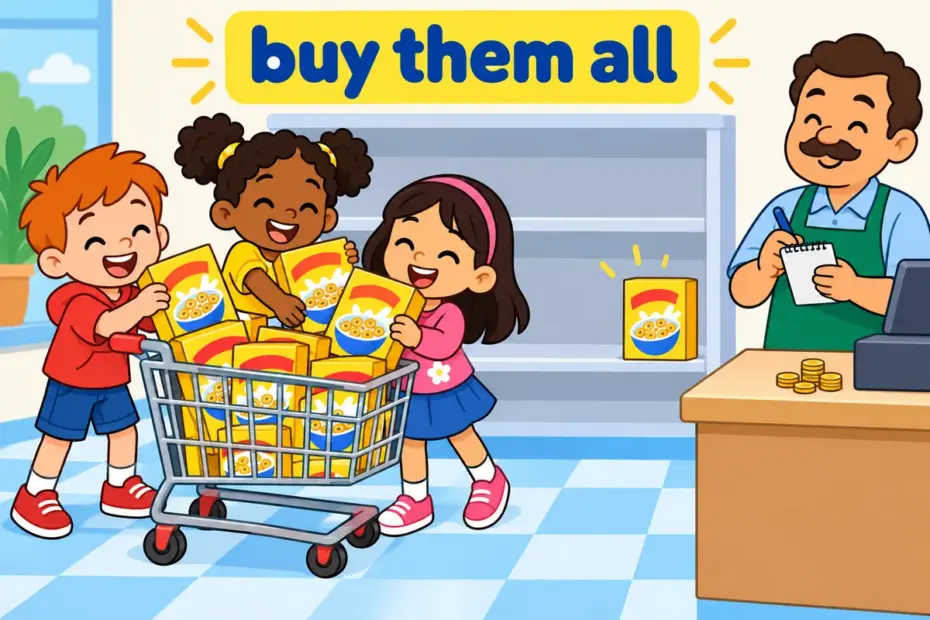
Buy up is a phrasal verb meaning to buy large amounts of something, often all that is available. To use buy up in a sentence, put the thing being bought after buy or between buy and up: “investors bought up the land”. The verb is transitive and separable, so a pronoun must sit in the middle.
Buy up at a glance
- Buy up is a separable, transitive phrasal verb; its forms are buys up, bought up and buying up.
- It means to buy most or all of a supply, often to control it.
- The object may follow up or sit between buy and up.
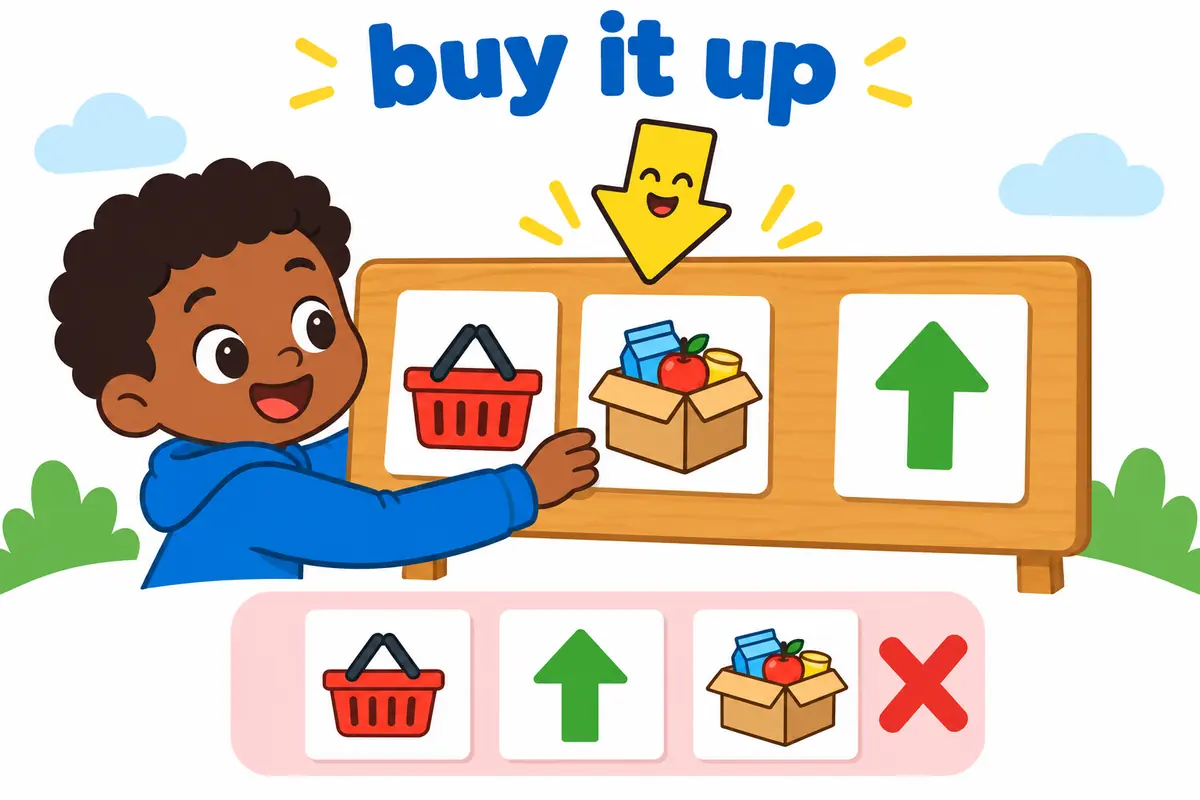
- A pronoun must split the verb and particle: buy it up, never buy up it.
- The register is business and news, slightly formal but not technical.
- The commonest confusion is with buy out, which means acquiring a company or a stake.
What does buy up mean?
Buy up is a phrasal verb meaning to buy large quantities of something, often clearing the available supply. The Cambridge entry for buy up records the sense of buying all of something, and the verb usually signals a deliberate plan rather than a casual purchase. An investor who acquires a handful of shares is not buying them up, because the phrasal verb implies scale.
| Sense | Plain meaning | Example sentence |
|---|---|---|
| Buy in bulk | Purchase most or all of a scarce supply | Fans bought up every ticket in an hour. |
| Acquire to control | Absorb many properties, stores or shares | The chain bought up its rivals one by one. |
| Clear the shelves | Take all available stock of an item | Shoppers bought up the bottled water before the storm. |
One limitation is worth stating plainly. Buy up is not the same as buy, and it is not buy out. A single purchase is just a purchase; buying up means taking a large share of a supply, and buying out means taking over a whole company or another person’s stake. Where the aim is control of a market rather than a pile of goods, a firm may try to corner it.
How do you use buy up in a sentence?
The verb is separable and transitive, so the object may follow the particle or sit between buy and up. A pronoun must take the middle position, because up is a particle that cannot accept a pronoun after it. The passive is common in news reports about land and shares.
| Pattern | Example | What it signals |
|---|---|---|
| buy up + object | They bought up the old factory. | Object after the particle; a very common order. |
| buy + object + up | They bought the old factory up. | Object in the middle; equally standard. |
| buy + pronoun + up | Investors bought it up quickly. | A pronoun must split the verb and particle. |
| buy up + amount or share | The fund bought up thirty per cent of the shares. | An amount shows the scale of the purchase. |
| be bought up | The land was bought up by a developer. | Passive, common in news writing. |
The rule to remember is that up is a particle, not a preposition, so the object never becomes an object of up, and buy up it is impossible.
Buy up in a sentence: examples across contexts
Buy up belongs to business pages, ticket queues and panic buying, and the ten sentences below keep the verb transitive with a clear object. Each row names what was bought up and by whom.
| Context | Example sentence | Why this works |
|---|---|---|
| Classroom | The club bought up all the second-hand books at the fair. | Everyday subject with a clear object after up. |
| Business news | A private fund bought up the empty shops on the high street. | Shows scale and a deliberate plan. |
| Finance | Traders bought up the shares within minutes of the announcement. | An amount of stock and a sharp time frame. |
| Property | The developer bought up three farms to build one estate. | Names the purpose, which sharpens the sentence. |
| Retail | Collectors bought up every first edition in the shop. | Every signals the supply was cleared. |
| Consumer advice | Do not buy it up in a panic; wait for the restock. | A pronoun splits the verb and particle. |
| Sports | The league bought up the broadcast rights for five years. | Shows a large, planned acquisition. |
| Agriculture | Wholesalers stockpiled and bought up the grain harvest. | Pairs the phrasal verb with a synonym of hoarding. |
| Fashion | Resellers snapped up and bought up the limited trainers in seconds. | A limited supply explains the urgency. |
| Media | One group has bought up most of the local newspapers. | Most signals near-total control. |
Notice how often a number, the word every or the word most appears. Buy up rarely describes one item; it describes a sweep of the market or the shelves. The scale is the whole point, so a single casual purchase is never described as a buy-up.
Buy up vs buy out
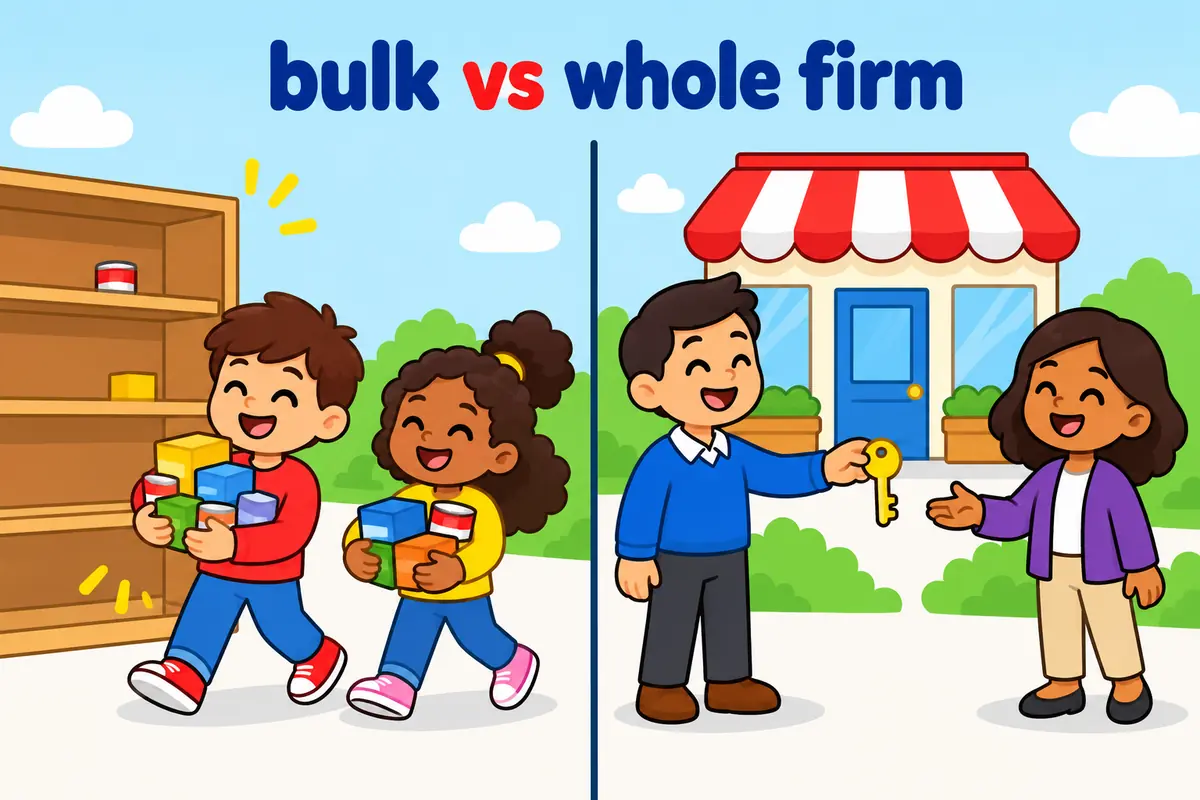
Buy up and buy out are close in sound and far apart in meaning. Buy up gathers many units of something; buy out takes over a company or buys another person’s entire share.
| Attribute | buy up | buy out |
|---|---|---|
| Meaning | Buy large amounts of a supply | Acquire a company or a stake |
| Typical object | Goods, tickets, land, shares in bulk | A firm, a partner or a contract |
| Implies scale | Many units over time | One complete takeover |
| Result | A supply is cleared or controlled | Ownership changes hands |
| Register | Business and news | Business and legal |
| Example | They bought up the whole crop. | They bought out their partner. |
Verdict: use buy up when the point is the quantity of goods or assets, and buy out when the point is taking control of a company or ending a partner’s stake, because only the second changes who owns the business. A takeover changes ownership, while a buying spree only changes who holds the stock.
Word forms and grammar of buy up
Buy up inflects through buy, whose past tense is irregular. The table also lists a noun formed from a different particle and a related verb of monopolising.
| Form | Part of speech | Example |
|---|---|---|
| buy up | phrasal verb, base | Funds buy up cheap land in a slump. |
| buys up | phrasal verb, third person singular | She buys up old postcards at fairs. |
| bought up | phrasal verb, past and participle | They bought up the remaining stock. |
| buying up | phrasal verb, present participle | The chain is buying up small rivals. |
| buyout | noun, from buy out | The buyout surprised the whole industry. |
| monopolize | verb | One firm monopolized the trade. |
The particle up also builds add up, so a single particle can suggest a total in one verb and an accumulation in another. The base verb buy keeps its everyday meaning, so the particle up is what adds the idea of quantity.
Common mistakes with buy up
- Incorrect:
They bought up it last week.Correct: They bought it up last week. Rule: A pronoun object must sit between buy and the particle up. - Incorrect:
The company bought out all the spare parts.Correct: The company bought up all the spare parts. Rule: Buy out means taking over a firm; buy up means acquiring goods in bulk. - Incorrect:
He bought up to control the market.Correct: He bought up shares to control the market. Rule: Buy up is transitive and needs an object before it makes sense. - Incorrect:
She bought up for the tickets early.Correct: She bought up the tickets early. Rule: Buy up takes a direct object, not the preposition for. - Incorrect:
We buy up lots of them last year.Correct: We bought up lots of them last year. Rule: The past tense is bought, not buy.
Practice using buy up
Work through the seven items, then read the reasoning rather than only the answer.
- Fill the gap: Fans ______ the front-row seats within minutes.
- Choose the better word: A rival group (bought up / bought out) the family bakery and kept the name.
- Correct the error: She bought up it before the prices rose.
- Build a sentence: use buy up about a company that acquires many small farms.
- Rewrite in the passive: A developer bought up the riverside land.
- Spot the register: which belongs in a business report, the fund bought up a controlling stake, or the fund totally bought up, like, everything?
- Change the particle: The chain took over its main competitor. Rewrite it with buy out.
Answers
- bought — the past tense matches the time phrase and the object follows up.
- bought out — a whole company changed hands, which is buy out, not buy up.
- She bought it up before the prices rose — the pronoun must come before up.
- Model answer: The company bought up twelve small farms across the valley.
- The riverside land was bought up by a developer — the passive keeps be plus bought up together.
- The fund bought up a controlling stake — a report keeps a measured, formal tone.
- The chain bought out its main competitor — the takeover sense takes the particle out.
The bottom line
Use buy up in a sentence when the point is buying a large amount of something, and keep the object either after up or between buy and up. Two details decide most sentences: a pronoun must split the verb and particle, and the meaning is quantity rather than takeover. Where a company or a partner is being taken over, buy out is the correct phrasal verb.
Frequently asked questions about buy up
Is buy up one word or two?
The verb is written as two words, buy up, and the noun buy-up is rare and hyphenated when it appears. You would write investors bought up the shares for the verb. The related noun buyout, without a hyphen, comes from buy out instead, so the spelling depends on the particle.
Does buy up need an object?
Yes. Buy up is transitive, so it needs something bought, as in the chain bought up fifteen shops. A sentence such as the investors bought up does not work, because a reader still asks what was purchased. Add a noun or a pronoun to complete the verb.
Is buy up used in business writing?
Buy up appears in business and news writing without sounding technical. A financial report might prefer acquired or purchased for a formal tone, but buy up is standard in headlines because it carries the idea of scale in two short words. Conversation uses it less often than plain buy.
What is the past tense of buy up?
The past tense is bought up, and the past participle is identical. You would write the fund bought up the land last spring. The present participle is buying up, as in the chain is buying up rivals, which stresses an ongoing campaign of purchases rather than a single deal.