Muddle Through in a Sentence: Meaning & Examples
Muddle through means to reach the end of a difficult task by improvising instead of planning, and muddle through in a sentence names the ordeal that was survived: “We missed the last bus and muddled through the walk home.” The phrase usually stands alone, though it often takes the challenge itself as its object.
Muddle through at a glance
- Muddle through is an inseparable phrasal verb; the particle through never moves.
- It means to cope or finish by improvisation rather than method.
- It can stand alone or take the difficulty as its object: muddle through the inspection.
- The usual subjects are people, small teams and institutions, not the tools they use.
- The commonest error is splitting the phrase or confusing it with muddle up.
- It belongs to everyday English, at home in conversation and in measured news copy.
What does muddle through mean?
Muddle through is a phrasal verb meaning to manage or finish something despite confusion, poor preparation or too few resources. The Cambridge entry for muddle through places the emphasis on coping without a clear plan, and that is the sense almost every real sentence carries: the result is acceptable, but the process was improvised. The phrase assumes difficulty, and it never claims the solution was elegant.
| Sense | Plain meaning | Example sentence |
|---|---|---|
| Cope by improvisation | Finish a task with no plan or proper method | We had no recipe, so we muddled through dinner. |
| Survive a hard spell | Get through a difficult period by stubborn effort | The village muddled through the flood on borrowed boats. |
| Reach an acceptable result | Succeed despite a messy, confused process | The choir muddled through the anthem and still earned applause. |
One limitation is worth stating plainly. Muddle through is neither a compliment nor a synonym for succeed. It describes effort that merely gets by, so a project that muddled through is judged on survival rather than quality. Where a writer wants to praise a tidy outcome, a plainer verb such as manage or settle serves better.
How do you use muddle through in a sentence?
Put the person first and the difficulty second, and never push through away from muddle. The phrase covers five everyday shapes, and the object is always the thing survived rather than the person surviving it.
| Pattern | Example | What it signals |
|---|---|---|
| muddle through | Don’t panic; we’ll muddle through. | The difficulty is clear from context, so nothing is named. |
| muddle through + thing | They muddled through the inspection. | Names the ordeal that is being survived. |
| be muddling through + thing | She is muddling through her first term. | An ongoing, unfinished struggle. |
| muddle through on + resource | The club muddled through on donations. | Names the inadequate means doing the work. |
| muddle through + adverb | We muddled through somehow. | Stresses luck and stubbornness over skill. |
| muddle through with + means | The pupils muddled through with borrowed pencils. | Names the improvised tools that stood in for the proper ones. |
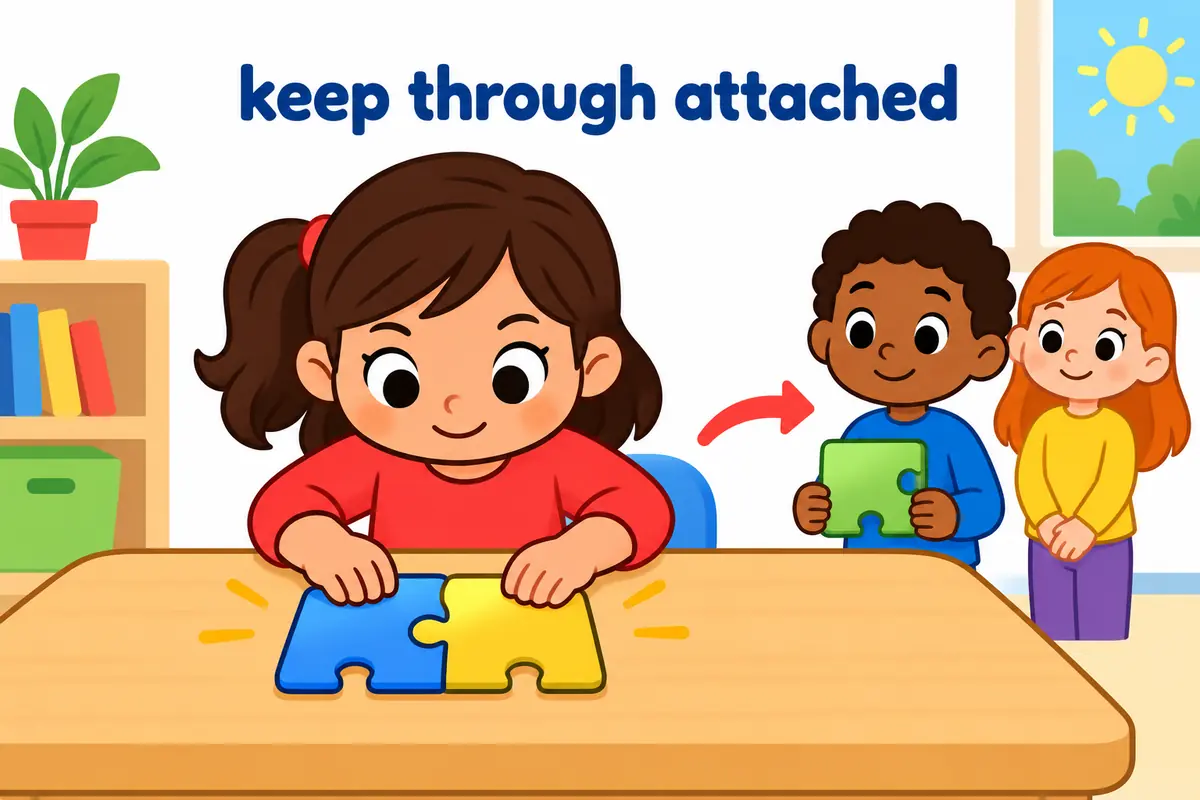
Through never leaves muddle: say we muddled through the storm, never we muddled the storm through. The phrase is intransitive when the difficulty is obvious and transitive when a noun follows, and it never takes a person as its object. This fixed shape is one reason the phrase survives so easily in speech: a speaker never has to decide where the object goes. For a contrast that stresses deliberate completion, writers reach for follow through on a plan, which names the follow-up rather than the scramble.
Muddle through in a sentence: examples across contexts
Muddle through changes register more than it changes meaning. The ten sentences below keep the same phrase while moving from a classroom to a news report, and each one names the difficulty doing the work.
| Context | Example sentence | Why this works |
|---|---|---|
| Classroom | The substitute teacher muddled through the lesson with no notes. | A shared coping effort, with the missing plan named. |
| Workplace email | We muddled through the audit and closed it on Friday. | Confirms the job is done without claiming it was tidy. |
| News report | The border town muddled through a week without power. | A collective subject and a measured time span suit reporting. |
| Conversation | I forgot half the words and just muddled through the speech. | First person and plain wording, natural in speech. |
| Travel diary | With the map soaked, we muddled through to the hostel. | Names a destination, not just the difficulty. |
| Business writing | The startup muddled through its first year on savings. | On plus resource shows how survival was funded. |
| Sports report | The reserves muddled through the second half. | Frames a weak but survivable performance. |
| Academic prose | Early clinics muddled through outbreaks without antibiotics. | A dated, factual subject keeps the tone measured. |
| Family talk | We muddled through the move, one box at a time. | Breaks a large task into improvised steps. |
| Community project | The committee muddled through the fundraising year. | A group can be the subject when it acts as one. |
| Everyday logistics | The kitchen muddled through the lunch rush with one working oven. | Names the shortage that forced the improvisation. |
| Diary entry | I muddled through the week on coffee and late buses. | Places the phrase between small concrete details. |
No example treats muddling through as a triumph, and that is deliberate. The phrase is reserved for situations that were hard and are now over, so it reports endurance rather than excellence. Notice too that the tense does real work: the past form usually marks a difficulty already survived, while the present continuous keeps the struggle open and unfinished.
Muddle through vs muddle along
The phrase readers confuse it with most is muddle along, which sounds almost identical and points the other way.
| Attribute | muddle through | muddle along |
|---|---|---|
| Core meaning | Cope until a difficult task or period ends | Continue without purpose or progress |
| Endpoint | Reaches a finish or a solved problem | Has no clear endpoint at all |
| Typical subject | People facing a specific ordeal | People drifting through an ordinary routine |
| Connotation | Grim endurance that pays off | Quiet aimlessness that does not |
| Register | Neutral, common in speech and news | Slightly literary, often a mild criticism |
| Replace with | get by, cope | drift, plod on |
Verdict: choose muddle through when a named difficulty ends, and muddle along when nothing is being finished; the first implies a survivor, the second a wanderer.
Word forms and grammar of muddle through
The phrase inflects on the verb only, and the particle stays put. The table also lists the plain words from the same root that learners mix into the sentence by mistake.
| Form | Part of speech | Example |
|---|---|---|
| muddle through | phrasal verb, base form | We will muddle through somehow. |
| muddles through | phrasal verb, third person | She muddles through every deadline. |
| muddled through | phrasal verb, past | They muddled through the blackout. |
| muddling through | phrasal verb, present participle | He is muddling through the training. |
| muddled | adjective | The muddled notes still helped. |
| run through | phrasal verb, different sense | Let me run through the steps first. |
Keep muddled as an adjective describing confused things, and use run through the details when the meaning is a quick review rather than survival.
Common mistakes with muddle through
- Incorrect:
We muddled the storm through.Correct: We muddled through the storm. Rule: Through is a fixed particle and cannot be moved. - Incorrect:
He muddled up through the timetable.Correct: He muddled through the timetable. Rule: Muddle up means to confuse, not to cope. - Incorrect:
The recipe muddled through the dinner.Correct: We muddled through the dinner with the recipe. Rule: The subject is the person coping, not the tool they used. - Incorrect:
She muddled through and solved it carefully.Correct: She solved it carefully. Rule: Muddle through reports survival, not method, so it clashes with an adverb of skill. - Incorrect:
We muddled through the picnic because it was fun.Correct: We muddled through the picnic because nothing was ready. Rule: The phrase needs difficulty, not enjoyment.
Practice using muddle through
Work through the six items below, then check the reasoning rather than only the answer.
- Fill the gap: With no rehearsal, the band ______ the second song.
- Choose the better word: The trip felt endless, but we (muddled through / muddled up) it.
- Correct the error: We muddled the exam through.
- Build a sentence: use muddle through about a family moving house in one weekend.
- Spot the register: which fits a news report — the town muddled through the storm, or the town did okay I guess?
- Rewrite with a resource: The team survived on old equipment. Use muddle through on.
Answers
- muddled through — through stays attached and the song is the thing survived.
- muddled through — muddle up means confuse, which does not fit finishing a trip.
- We muddled through the exam — the particle cannot move away from muddle.
- Model answer: The family muddled through the move when the van broke down.
- The town muddled through the storm — reporting keeps the full phrase and avoids vague praise.
- The team muddled through on old equipment — on plus the resource shows the inadequate means.
The bottom line
Use muddle through in a sentence when people reach the end of a named difficulty by improvising, and keep through fixed to muddle. Two nuances decide most sentences: the phrase reports survival rather than quality, and the object, when there is one, is always the ordeal survived. Where nothing is being finished, muddle along or drift is the better choice.
Frequently asked questions about muddle through
Is muddle through informal?
Muddle through sits in the neutral middle: relaxed enough for conversation and standard enough for news copy. A colleague can write that we muddled through the audit, and a newspaper can report that the town muddled through the storm. Only the most formal reporting prefers a plainer verb such as coped.
What is a synonym for muddle through?
Cope, get by and manage all overlap, but each loses something. Cope does not promise a finish, get by stresses bare survival, and manage implies more competence than muddling allows. The closest phrase is scrape through, though it usually implies barely passing a test rather than enduring a hard spell.
Is muddle through separable?
No. Through is a fixed particle that never separates from muddle, so we muddled through the storm is correct while we muddled the storm through is not. That makes the phrase easy to punctuate: the two words stay together, and any noun that follows is simply the difficulty being survived.
Does muddle through mean someone failed?
It does not. Muddle through means the difficulty was handled well enough to continue, so failure is not implied. What it withholds is praise: the job was done, but clumsily. When a writer wants to admit real failure, fall through fits, but muddling through always leaves a survivor.