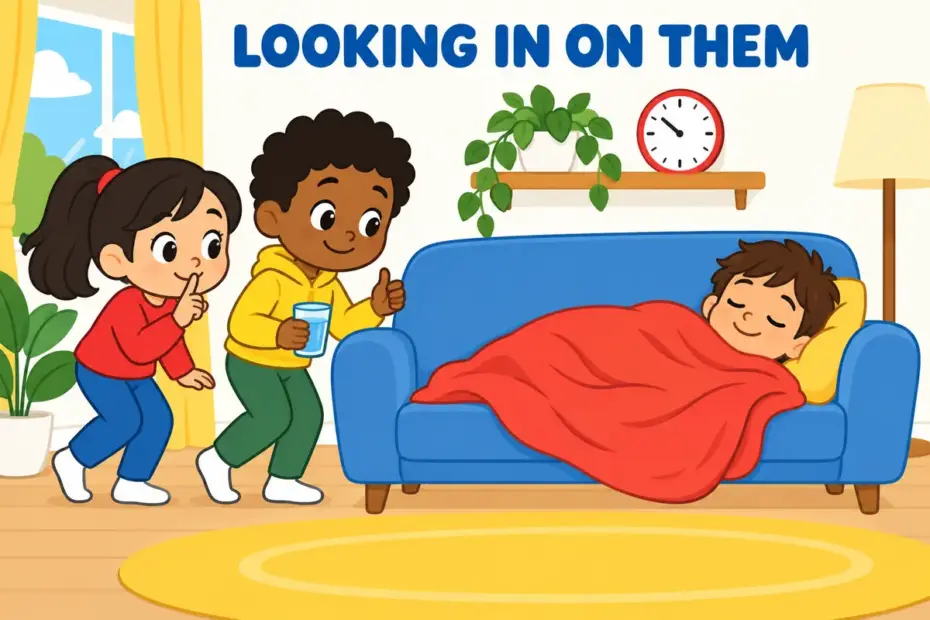
Check on means to look at someone or something to make sure they are safe, well or working. To use check on in a sentence, keep the object after the whole phrase: “I will check on Grandma after lunch.” The verb is inseparable, so the words on and the object never swap places.
Check on at a glance
- Check on is an inseparable phrasal verb; its forms are check on, checks on, checked on and checking on.
- It means to look at someone or something to see that they are safe, well or working.
- The usual pattern is check on plus a person or thing: check on the baby.
- The verb belongs to everyday, caring and professional speech rather than formal prose.
- The commonest error is confusing check on with check in, which means register your arrival.
What does check on mean?
Check on is a phrasal verb meaning to look at a person or thing to confirm that nothing is wrong. The Cambridge entry for check on gives this sense of watching over someone’s welfare or condition, and the phrase implies care rather than suspicion. Where the task is to follow something over time, a manager may monitor progress, which is the continuous version of the same idea.
| Sense | Plain meaning | Example sentence |
|---|---|---|
| See that someone is well | Visit or look at a person to make sure they are safe | I will check on Grandma after lunch. |
| See that something works | Examine a thing to confirm its condition | The guard checks on the boiler every hour. |
| Follow progress | Ask about a task to see how it is going | The editor checked on the report before the deadline. |
One limitation is worth stating plainly. Check on is not the traveller’s verb for registering at a desk; that is check in. Nor is it the formal word for a full examination, where engineers would inspect the equipment. Use check on when a quick, caring look is what the sentence means.
How do you use check on in a sentence?
The phrase is inseparable, so the object always follows it. Five patterns cover almost every real sentence, and the choice turns on whether you are watching a person, a thing or a piece of work.
| Pattern | Example | What it signals |
|---|---|---|
| check on + person | The nurse checked on the patient at midnight. | Names the person whose welfare is being watched. |
| check on + thing | Engineers check on the pumps each morning. | Names equipment being monitored. |
| check on + object + to see | She checked on the children to see they were asleep. | Adds the purpose of the visit. |
| check on + progress noun | The manager checked on progress after an hour. | The task sense, about work rather than people. |
| go and check on | He went to check on the noise upstairs. | Shows movement towards the thing being watched. |
Check on in a sentence: examples across contexts
The verb keeps its caring sense but shifts its company depending on the text. The twelve sentences below move from family life to emergency planning, and each one shows which words a writer reaches for alongside it.
| Context | Example sentence | Why this works |
|---|---|---|
| Family life | I will check on the baby before I go to bed. | A small, caring action that suits the verb exactly. |
| Workplace email | Could you check on the delivery while I am out? | A polite request that names the task to be watched. |
| Care work | The carer checks on each resident twice a night. | Shows routine welfare monitoring. |
| Building management | The janitor checked on the heating after the storm. | Names equipment and a trigger for the visit. |
| News report | Officials checked on the dam as river levels rose. | An official action tied to a real risk. |
| Classroom | The teacher checked on the group working in the garden. | Keeps the object as a group of pupils. |
| Travel writing | We stopped to check on the cyclists at the summit. | Marks a pause in a journey to look after others. |
| Academic writing | Supervisors check on progress at the end of each term. | The progress sense, about a project rather than a person. |
| Conversation | Will you check on the oven while I answer the door? | An everyday request with a clear object. |
| Emergency planning | Teams check on isolated homes after a power cut. | Shows a systematic welfare check. |
| Pet care | He checks on the hens every morning before school. | Names an animal being monitored. |
| Security work | The guard checks on the gates through the night. | Routine inspection of a fixed object. |
Notice how each example implies responsibility: the person who checks on something has taken on the job of watching it. That quiet duty is why the verb sounds warmer than inspect, and why it appears so often in care work and family writing.
Check on vs check in
Check on and check in share the verb check and nothing else, because the particle changes both the meaning and the direction of responsibility. The table sets out the contrast.
| Attribute | check on | check in |
|---|---|---|
| Core meaning | Look at someone or something to confirm they are well | Register your arrival at a place |
| Typical object | A person, an animal or equipment | Yourself, at a hotel or a desk |
| Who acts | Someone watching over another | A traveller or a guest |
| Register | Caring and everyday | Travel and hospitality |
| What it implies | Continued responsibility | A single completed act |
| Grammar | Inseparable: check on him | Inseparable: check in at noon |
Where the watching continues over weeks, a supervisor might supervise a team, and where a fact must be confirmed outright, the right verb is verify a detail. A manager can also review the figures at the end of a project, having checked on them along the way.
Verdict: choose check on to watch over someone or something, and check in only when the meaning is registering an arrival; the two phrases never substitute for each other.
Word forms and grammar of check on
Check on inflects regularly through the verb check, and its fixed order is what learners must remember. The table lists the forms and marks the arrangement that is not standard.
| Form | Part of speech | Example |
|---|---|---|
| check on | phrasal verb, base form | We should check on the kitten. |
| checks on | phrasal verb, third person singular | She checks on the store each evening. |
| checked on | phrasal verb, past and past participle | The nurse checked on him at dawn. |
| checking on | phrasal verb, present participle | He is checking on the greenhouse. |
| check on him | standard order | Keep the object after on, never before it. |
| check him on | non-standard | Avoid this order; check on is inseparable. |
The related check into a claim is also inseparable, which shows how firmly this verb keeps its particle in place. Confusing the pair with check in is the single most common error, because both phrases sound almost the same at speed.
Common mistakes with check on
- Incorrect:
The nurse checked the patient on.Correct: The nurse checked on the patient. Rule: Check on is inseparable, so the object always follows the whole phrase. - Incorrect:
We checked on at the hotel at noon.Correct: We checked in at the hotel at noon. Rule: Registering your arrival is check in, not check on. - Incorrect:
She checked on if the door was locked.Correct: She checked that the door was locked. Rule: Before a clause use check that or check whether, not check on. - Incorrect:
He checked on the report to finish it.Correct: He checked on the report, which was nearly finished. Rule: Check on means observe welfare or condition, not complete a task. - Incorrect:
They checked on him to be well.Correct: They checked on him to make sure he was well. Rule: The purpose needs a full phrase, such as to make sure, after the object.
Practice using check on
Work through the six items, then check the reasoning rather than only the answer.
- Fill the gap: The carer will ______ the residents again before midnight.
- Choose the better word: Guests must (check on / check in) at the desk before collecting a key.
- Correct the error: The guard checked the gates on every hour.
- Build a sentence: use check on about a neighbour after a storm.
- Spot the register: which belongs in a care note — staff checked on the resident hourly, or staff had a quick look at the resident hourly?
- Rewrite with a purpose clause: The nurse checked on the patient. Add to make sure.
Answers
- check on — the carer is confirming the residents are well, which is the welfare sense.
- check in — arriving and registering at a desk is check in, not check on.
- The guard checked on the gates every hour — the inseparability rule keeps the object after on.
- Model answer: We checked on the neighbour once the wind had dropped.
- Staff checked on the resident hourly — a care note keeps the clear verb rather than a vague look.
- The nurse checked on the patient to make sure the dressing was clean — the purpose phrase completes the sentence.
The bottom line
Use check on in a sentence when you look at a person or thing to confirm they are well or working, and keep the object after the whole phrase. The two nuances that decide most sentences are these: the verb is inseparable, and it is not check in, which is the traveller’s act of registering arrival.
Frequently asked questions about check on
Is check on one word or two?
Check on is a phrasal verb written as two words. The base verb check means to examine, but adding on gives the phrase its special sense of looking after someone or watching over something. Do not merge the words into checkon or hyphenate them.
Can check on be separated?
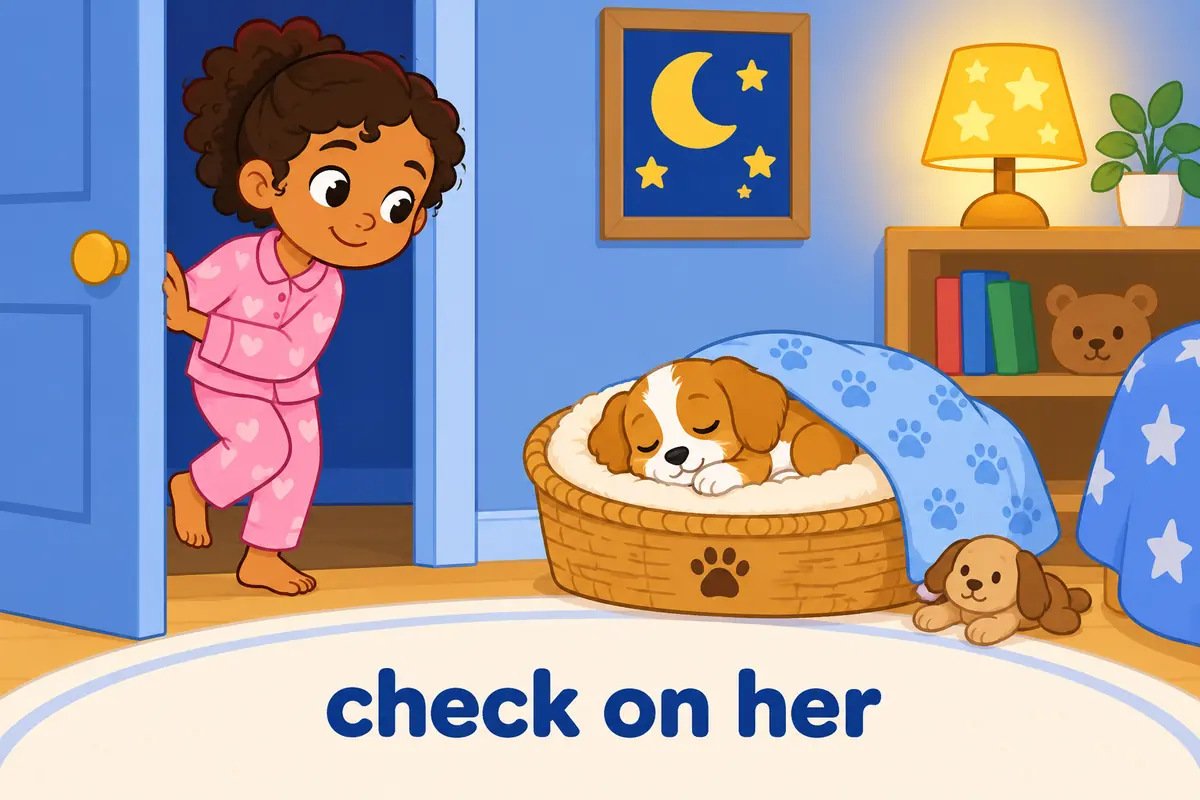
No. Check on is inseparable, so the object must follow the whole phrase: you check on the baby, never check the baby on. A pronoun goes after on as well, giving check on her. That fixed order is what marks an inseparable phrasal verb.
What is the difference between check on and check in?
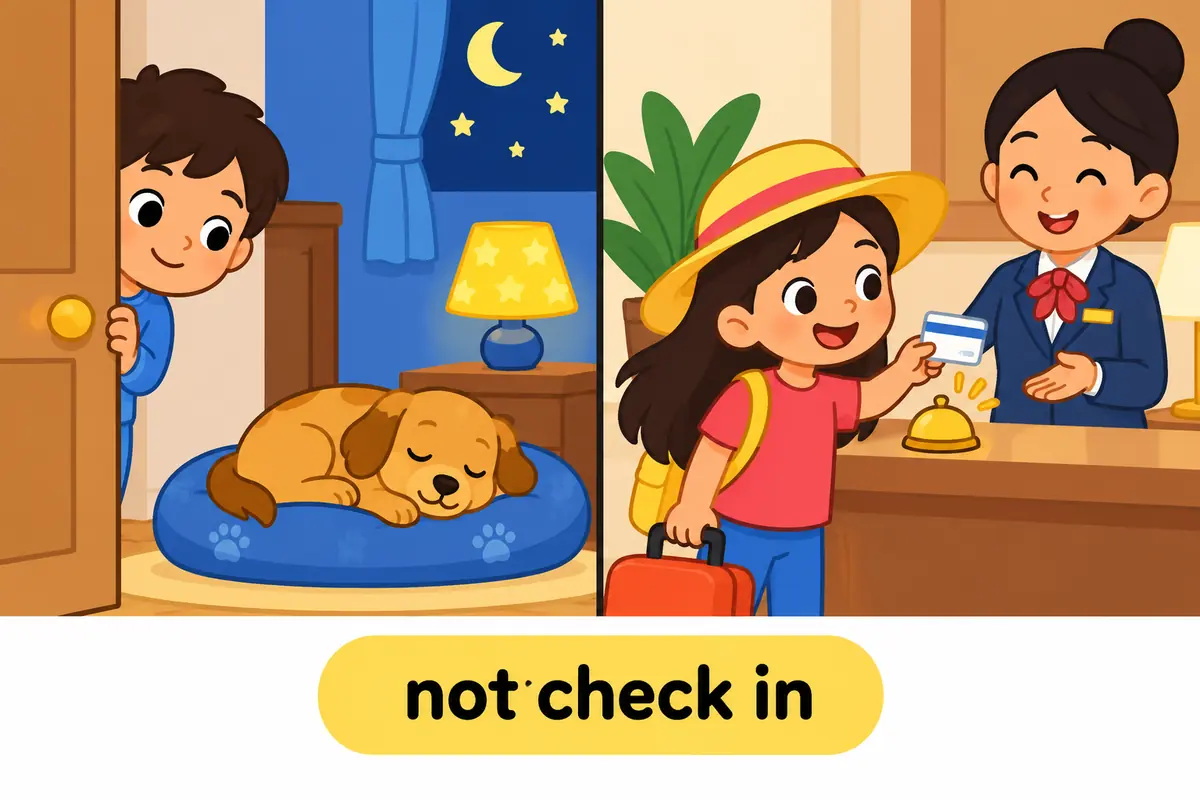
Check on means to look at someone or something to see that they are safe or working, and it implies care or monitoring. Check in means to register your arrival at a hotel, an airport or an office, and it is a single completed act by the traveller. The particle changes the whole meaning.
Can you check on a thing rather than a person?
Yes. You can check on a boiler, a greenhouse or a delivery, because the phrase covers anything whose condition or progress needs watching. The caring sense stays even when the object is equipment, which is why the verb sounds warmer than inspect or monitor.