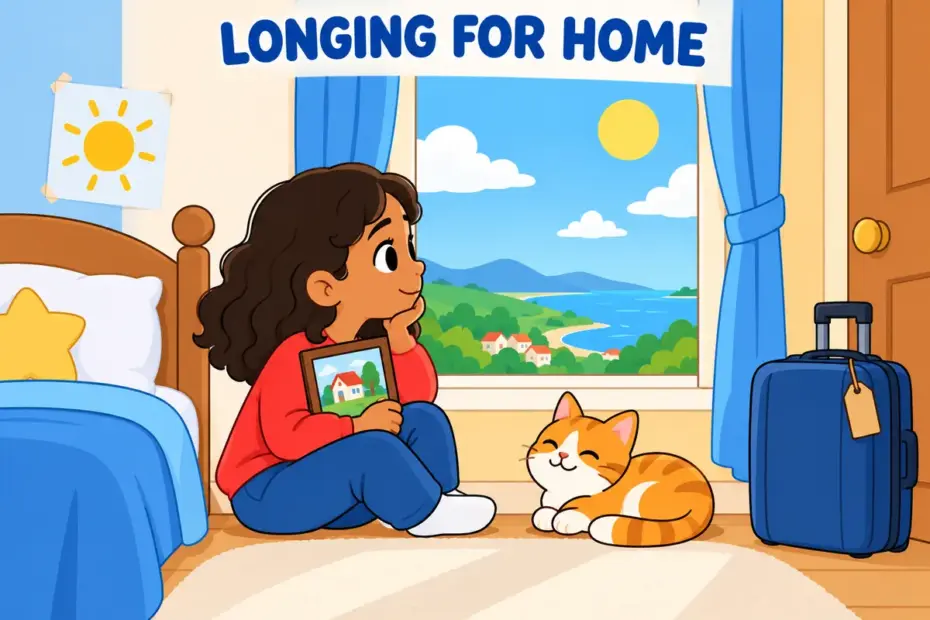
Pine for means to long for someone or something with a quiet, often painful sadness. To use pine for in a sentence, put the person or thing straight after for: She pined for her childhood home. The verb is inseparable, so the two words stay together.
Pine for at a glance
- Pine for is an inseparable phrasal verb: the object always follows for.
- Its forms are pines for, pined for and pining for.
- It means a deep, wistful longing for a person, place or time that is absent.
- The tone is literary and emotional, so it suits memoir and description more than a text message.
- The separate phrase pine away adds a slow decline in health, and pine the tree is an unrelated word.
What does pine for mean?
Pine for is a phrasal verb meaning to long for someone or something with sadness and a sense of loss. The Cambridge entry for pine for records this yearning sense. The verb pictures the longing as slow and enduring rather than a sudden wish, which is why it fits absent people and lost places so well.
| Sense | Plain meaning | Example sentence |
|---|---|---|
| Long for a person | Miss someone who is away or gone | She pined for her brother all winter. |
| Long for a place | Feel the pull of a home or landscape | He pined for the village he left behind. |
| Long for a past time | Wish a vanished era would return | They pined for the quiet of before. |
One limitation matters. Pine for describes emotional longing, not physical need or a polite request. A garden that lacks water is not pining for rain, and a customer does not pine for a receipt. Where the sense is plain absence, miss an old friend is the quieter, everyday choice.
How do you use pine for in a sentence?
Pine for is a prepositional phrasal verb, which means the particle for never separates from pine. You cannot say pine him for or pine for he; the object follows for, and a pronoun takes its object form: pine for him. The one exception is a relative clause, where for may be stranded at the end. The table sets out the working patterns.
| Pattern | Example | What it signals |
|---|---|---|
| pine for + person | She pined for her brother all winter. | Inseparable; the object follows for directly. |
| pine for + place or time | He pined for the village he left. | Longing for something absent and out of reach. |
| pine for + abstract state | They pined for the quiet of before. | An abstract object, often a lost era. |
| relative clause with stranding | The home she pined for no longer stood. | For may end the clause when a relative pronoun leads. |
| pine away (different phrase) | He pined away after the loss. | Adds a slow decline in health, not just longing. |
The practitioner rule is simple: keep the two words together and let for carry the object. To yearn for a homeland uses the same grammar, although yearn sounds more earnest and less melancholy.
Grammatically, pine for behaves like a prepositional verb rather than a separable one: the object cannot move, and the phrase resists the passive. That fixed shape is useful, because it forces the writer to name what is missing instead of leaving it implied. In practice the subject is almost always a person, or a group treated as a person, and the tense is usually simple past or past continuous, since the longing is understood to last rather than to flare and fade.
Pine for in a sentence: examples across contexts
Pine for changes register more than it changes meaning. The ten sentences below move from a diary to an obituary, and each one names the absent person, place or time that the longing fastens onto.
| Context | Example sentence | Why this works |
|---|---|---|
| Diary | I pined for the sea all through that dry inland summer. | Names the absent place and the season that sharpened the longing. |
| Memoir | He pined for the kitchen table of his childhood. | A concrete object carries the emotion better than an abstraction. |
| Song lyric | She pines for a town that never knew her name. | The unresolved note suits a lyric’s wistful tone. |
| Novel | They pined for the years before the factory closed. | Ties private longing to a public change. |
| News feature | Villagers pined for the market that moved away. | Uses a group subject to show shared longing. |
| Letter | Your father pines for the garden every winter. | Present tense keeps the longing current and ongoing. |
| Travel writing | Even the guides seemed to pine for the quiet season. | Hedges gently, matching the verb’s soft tone. |
| Obituary | She never stopped pining for the city she fled. | The past continuous signals a lifelong condition. |
| Counselling notes | He was pining for a friendship he had let slip. | Makes the object something the subject lost by choice. |
| Poetry | The hills pine for the rain, and the rain for the sea. | Personifies landscape to extend the longing. |
Only the poetry sentence personifies a landscape. Everywhere else the verb keeps a human subject longing for something genuinely absent.
Pine for vs yearn for and long for
Pine for belongs with two near-synonyms that differ mainly in tone. Long for summer is the most neutral of the three; yearn for is earnest and slightly formal; pine for adds melancholy and a sense of slow ache.
| Attribute | pine for | yearn for | long for |
|---|---|---|---|
| Core feeling | Wistful, sad longing | Earnest, heartfelt longing | Strong but neutral desire |
| Tone | Melancholy and literary | Serious and formal | Everyday to formal |
| Typical object | A person, home, past | Freedom, knowledge, peace | Summer, a break, a return |
| Duration | Often prolonged | Can be brief but intense | Neutral |
| Implies absence | Strongly | Strongly | Strongly |
| Register | Literary and emotional | Formal and emotional | Neutral |
Verdict: choose pine for when the longing has a sad, drawn-out quality, yearn for when the wish is earnest and formal, and long for for the plainest statement. To crave a lost routine pushes the same feeling toward appetite, which is a different pull again. To mourn a lost era names the grief that pine for only implies.
Word forms and grammar of pine for
Pine for inflects only on the verb, and the particle for never changes. The table also separates the unrelated noun pine, the tree, which shares the spelling but nothing else.
| Form | Part of speech | Example |
|---|---|---|
| pine for | phrasal verb, base | They pine for the coast each spring. |
| pines for | verb, third person | He pines for his old team. |
| pined for | verb, past | She pined for the city for years. |
| pining for | verb, present participle | He is pining for home tonight. |
| pining | noun or adjective | A quiet pining filled the letters. |
| pine away | phrasal verb | He pined away in the empty house. |
| pine | noun, different word | A tall pine shaded the yard. |
The related phrase pine away changes the meaning, not just the grammar: it adds a slow decline in body or spirit, so it belongs in descriptions of grief rather than of ordinary missing.
Common mistakes with pine for
- Incorrect:
She pined him for years.Correct: She pined for him for years. Rule: Pine for is inseparable, so the object follows for. - Incorrect:
He was pining to his old school.Correct: He was pining for his old school. Rule: The particle is for, not to. - Incorrect:
They pine for that the summer returns.Correct: They pine for the summer. Rule: Pine for takes a noun phrase, never a that-clause. - Incorrect:
I pine for to see her again.Correct: I long to see her again. Rule: Pine for needs a noun; before a verb, long to is the correct pattern. - Incorrect:
The garden pines for water.Correct: The garden is desperate for water. Rule: Pine for is emotional longing, not physical need.
Practice using pine for
Work through the six items, then check the reasoning rather than only the answer.
- Fill the gap: After the move, the twins ______ their old playground.
- Choose the better word: In the eulogy, the family said she never stopped (pining for / needing) the town she grew up in.
- Correct the error: He pined his grandfather during the long winter.
- Build a sentence: use pine for + a past time about a quiet summer before the crowds came.
- Spot the register: which belongs in a novel — she pined for the hills, or she really wanted the hills back?
- Rewrite with a stranding relative clause: The village was gone. She had pined for it.
Answers
- pined for — the past tense adds -ed and for stays attached before the object.
- pining for — the wistful, lifelong tone suits the eulogy; needing would describe want, not longing.
- He pined for his grandfather during the long winter — the object must follow for.
- Model answer: They pined for the quiet summers before the crowds arrived.
- She pined for the hills — a novel keeps the literary verb and avoids the flat paraphrase.
- The village she had pined for was gone — for may strand at the end of a relative clause.
The bottom line
Use pine for in a sentence when the longing is sad, slow and directed at someone or something absent, and keep the two words together. The two details that decide most sentences are form and tone: the object always follows for, and pine for carries a melancholy that long for does not. Where the feeling is plain missing, miss is warmer; where it is a decline in health, pine away is the phrase you want.
Frequently asked questions about pine for
Is pine for formal or literary?
Pine for leans literary and emotional, so it suits memoir, fiction and feature writing more than everyday speech. People rarely say it out loud in casual conversation; they say miss instead. The verb still appears in journalism when a writer wants to capture a slow, wistful longing that the plainer miss would flatten.
Is pine for separable?
No. Pine for is inseparable, which means the object always follows for: she pined for him, never she pined him for. The only place for moves is a relative clause, where it may strand at the end, as in the home she pined for. The two words otherwise travel as a single unit.
Can you pine for a place?
Yes, and places are among its most common objects. People pine for a hometown, a coastline or a house they left, and the longing often mixes memory with loss. The verb also takes past times and abstract states, so pining for the quiet of before is perfectly standard.
Is pine ever a noun?
Yes, but it is a different word with a different meaning: a pine is an evergreen tree. The verb meaning to long and the tree noun are homographs that happen to share a spelling. Context decides which one you have, so a sentence about a tall pine by the road has nothing to do with longing.