Canny means clever, careful and showing good judgement, especially about money or practical matters. To use canny in a sentence, place it before the noun it describes or after a linking verb: “A canny buyer waits for the winter sale.” The adjective praises sharp judgement, not trickery, which is why it rarely insults anyone.
Canny at a glance
- Canny is an adjective; it has no verb and no plural form.
- The comparative is cannier and the superlative is canniest.
- It means shrewd, careful and practical, with a strong association with money and advantage.
- It usually praises someone, unlike its near neighbour cunning.
- The commonest error is confusing canny with cunning or with the unrelated noun canon.
What does canny mean?
Canny is an adjective meaning shrewd, careful and good at judging practical situations, particularly where money is involved. The Cambridge entry for canny links the shrewd sense with a second sense of cautious and wary, so the word praises both cleverness and care. An astute reader spots a trick at once, and canny adds a practical, money-minded edge to that sharpness.
| Sense | Plain meaning | Example sentence |
|---|---|---|
| Shrewd and practical | Clever about money or advantage | A canny trader bought the shop before prices rose. |
| Careful and wary | Cautious and not easily fooled | The canny driver checked the tyres twice. |
One limitation is worth stating plainly. Canny is not a general word for intelligence, and it is not a compliment for deceit. Calling a scheme canny says only that it was well judged; if the plan tricks people, the right word is cunning, which carries the accusation that canny avoids. Use canny where care and practical sense are the point.
The word carries a quiet note of scarcity, as though the person has learned to protect what they have. A canny saver counts the cost before the pleasure; a canny trader watches the market before speaking. That practical streak is why the adjective fits budgets, bargains and careful plans far better than it fits abstract ideas.
How do you use canny in a sentence?
The adjective behaves like most adjectives, but its meaning shifts a little with position. Before a noun it names a quality; after a linking verb it makes a judgement about the subject. Five patterns cover most real sentences.
| Pattern | Example | What it signals |
|---|---|---|
| canny + noun | A canny shopper compares the unit price. | The adjective sits directly before the person it praises. |
| linking verb + canny | The deal looked canny to everyone at the table. | Makes a judgement about the whole situation. |
| too canny | He is too canny to sign the first offer. | Adds a hint of calculation, sometimes mocking. |
| canny + about / with | She is canny with money and even cannier with time. | Names the area where the judgement shows. |
| comparative and superlative | He grew cannier after losing a deposit. | Shows judgement increasing with experience. |
The adjective takes -er and -est rather than more and most in careful writing, so cannier and canniest are preferred to more canny, though the longer forms appear in casual speech.
Position also decides whether the sentence judges a person or an act. Before a noun the adjective labels someone, as in a canny investor. After a linking verb it judges a choice, as in the offer seemed canny. Both are common, but the second often sounds more tentative, because it reports an opinion rather than a settled reputation.
Canny in a sentence: examples across contexts
Canny moves easily between registers because it judges practical sense. The ten sentences below travel from a classroom to a trading floor, and each one shows the judgement being praised.
| Context | Example sentence | Why this works |
|---|---|---|
| Classroom | A canny student reads the question twice before writing. | A small, concrete habit shows practical care. |
| Workplace email | It would be canny to confirm the budget before we book the venue. | Makes the adjective a judgement about a decision. |
| News report | The canny mayor secured the grant before the deadline. | Pairs the adjective with a shrewd public action. |
| Market trading | A canny buyer never shows how much she wants an item. | The bargaining setting brings out the money sense. |
| Household budget | He is canny with the weekly shop. | The with-phrase names the practical area. |
| Sports report | The canny captain slowed the game to protect the lead. | Shows clever judgement under pressure. |
| Travel | Canny travellers book midweek flights and save the difference. | Names a practical money-saving habit. |
| Farm and trade | Her canny eye for a fair price earned respect. | The noun phrase canny eye treats judgement as a skill. |
| Conversation | That was a canny move, waiting for the sale. | The informal tone still carries approval. |
| Advice column | A cautious person waits; a canny one waits and negotiates. | The contrast sharpens the difference between care and advantage. |
| Budget meeting | A canny manager trims the small costs nobody notices. | Shows judgement applied to a routine decision. |
| Fable and storytelling | The canny fox listened instead of boasting. | Uses the adjective for a wise character, not a sly one. |
Canny vs cunning
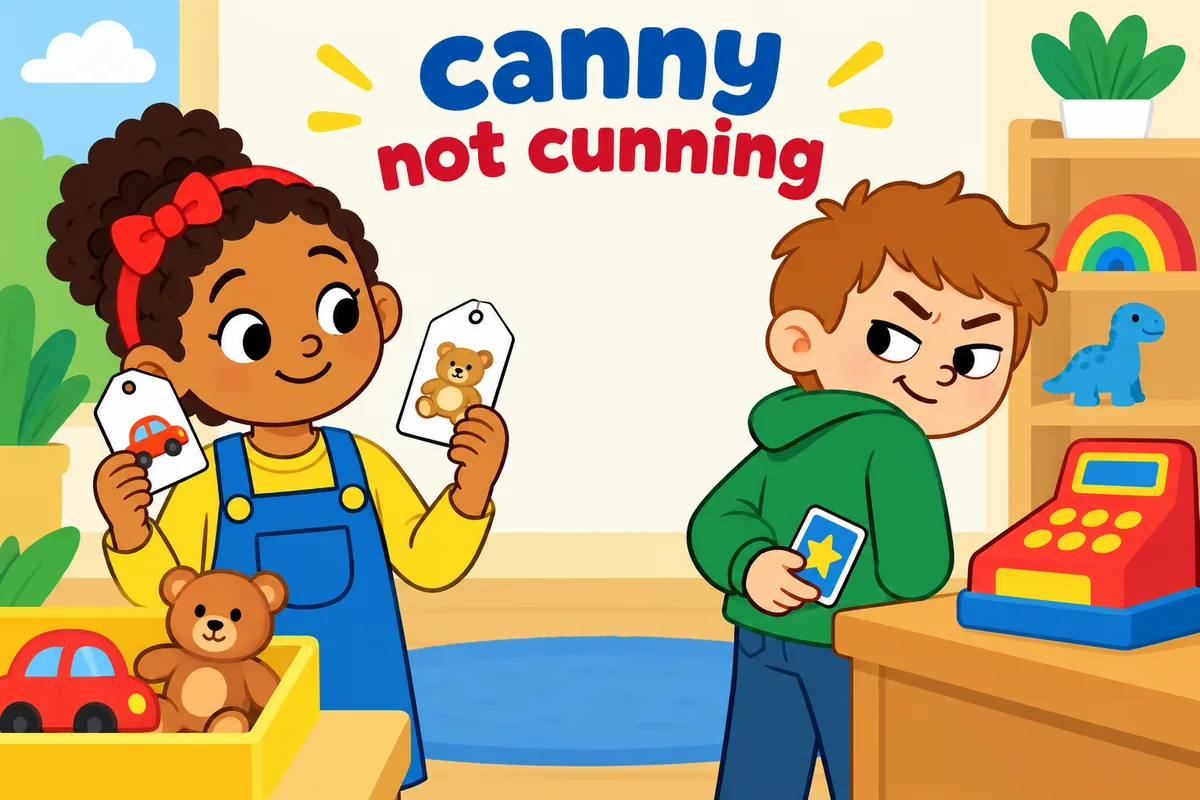
These two adjectives sound alike and describe sharpness, but only one of them is a compliment. A cunning plan traps someone, while a canny plan simply avoids a loss, and the older synonym shrewd sits close to canny though it sounds a little more formal.
| Attribute | canny | cunning |
|---|---|---|
| Core meaning | Shrewd, careful, practical | Deceitful and sly |
| Attitude | Admiring | Disapproving |
| What it implies | Good judgement that avoids loss | A trick played on someone |
| Typical subject | A buyer, investor, captain, shopper | A schemer, plot or animal in a fable |
| Example | She made a canny choice and saved a fortune. | He won by cunning and lost every friend. |
Verdict: choose canny for fair, careful judgement and cunning only when someone is being deceived, and remember that the true opposite of canny is gullible, which describes a person easily fooled.
Word forms and grammar of canny
Canny inflects with -er and -est and has a full adverb and noun family. The table also lists the form learners build by mistake.
| Form | Part of speech | Example |
|---|---|---|
| canny | adjective | She is a canny negotiator. |
| cannier | comparative adjective | He grew cannier with every deal. |
| canniest | superlative adjective | That was the canniest move of the season. |
| cannily | adverb | She cannily waited for the price to fall. |
| canniness | noun | His canniness saved the firm. |
| more canny | non-standard in careful writing | Prefer cannier; the adjective takes -er and -est. |
Keep the spelling with a double n before the ending, so cannier and canniest each carry two n’s, which is the detail learners miss most often. The noun canniness follows the same pattern, while the adverb cannily shows the same double n before the ending.
Common mistakes with canny
- Incorrect:
He is a canny liar.Correct: He is a cunning liar. Rule: Canny praises judgement; cunning accuses deceit. - Incorrect:
She is more canny than her brother.Correct: She is cannier than her brother. Rule: The adjective takes -er, so cannier is the standard comparative. - Incorrect:
The canny is open to new members.Correct: The canon is open to new members. Rule: Canon is a noun for a body of accepted works; canny is an adjective. - Incorrect:
That was very canny of him to cheat.Correct: That was very canny of him to wait. Rule: The adverb very is fine, but the example must show fair judgement, not a trick. - Incorrect:
She cannied the customers.Correct: She treated the customers cannily. Rule: Canny has no verb form; use the adverb cannily. - Incorrect:
He was canny to have been cheated.Correct: He was gullible to have been cheated. Rule: A canny person avoids being fooled, so the sentence describes the opposite quality.
Practice using canny
Work through the six items, then check the reasoning rather than only the answer.
- Fill the gap: A ______ shopper checks the unit price before buying in bulk.
- Choose the better word: The scheme tricked the whole village, so it was (canny / cunning), not clever.
- Correct the error: She is the most canny of the two traders.
- Build a sentence: use canny with + noun about spending money.
- Spot the register: which belongs in a business report — a canny use of the budget, or that was dead canny?
- Rewrite with the adverb: He made a canny choice and waited. Replace canny with its adverb.
Answers
- canny — the adjective sits before the noun it praises.
- cunning — a plan that tricks people is cunning; canny would be a compliment.
- She is the cannier of the two traders — use the comparative for two people.
- Model answer: He is canny with money and rarely wastes a coin.
- A canny use of the budget — a report favours the measured adjective.
- He chose cannily and waited — the adverb modifies the verb.
The bottom line
Use canny in a sentence to praise careful, practical judgement about money or a decision. The two nuances that decide most sentences are these: the comparative is cannier, not more canny, and the word describes fairness rather than deceit, so cunning is its accusing twin. A prudent choice avoids risk, while a canny one quietly turns a situation to advantage. The word rewards restraint above all, because the buyer who waits patiently almost always pays less in the end.
Frequently asked questions about canny
Is canny a positive word?
Yes. Canny praises someone for being shrewd, careful and practical, especially about money. It suggests that the person has made a well-judged choice rather than a foolish one. In everyday use it is a mild compliment, and it almost never carries the sting that the similar-sounding word cunning does.
What is the difference between canny and cunning?
Canny means shrewd and careful in a fair, practical way. Cunning means sly and deceitful, and it implies that someone is being tricked. Both words describe sharpness, but only cunning accuses. A canny buyer gets a good price; a cunning seller hides a fault in the goods and avoids the question.
What is the comparative form of canny?
The comparative is cannier and the superlative is canniest, with the final consonant doubled before the ending. Careful writing prefers these short forms to more canny and most canny, which appear in casual speech. The adverb is cannily and the noun is canniness, all carrying the doubled n.
Can canny describe a cautious person?
Yes. One of the two main senses of canny is careful and wary, so a cautious driver who checks the tyres twice can be called canny. The word still carries a note of judgement, though, so it describes sensible care rather than fear. A timid person waits; a canny one waits and plans.