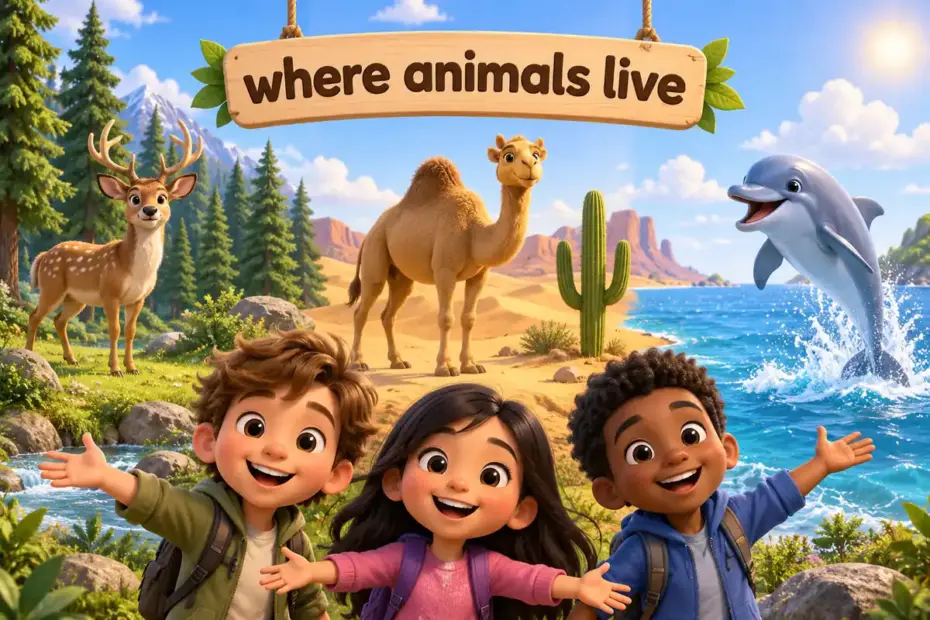
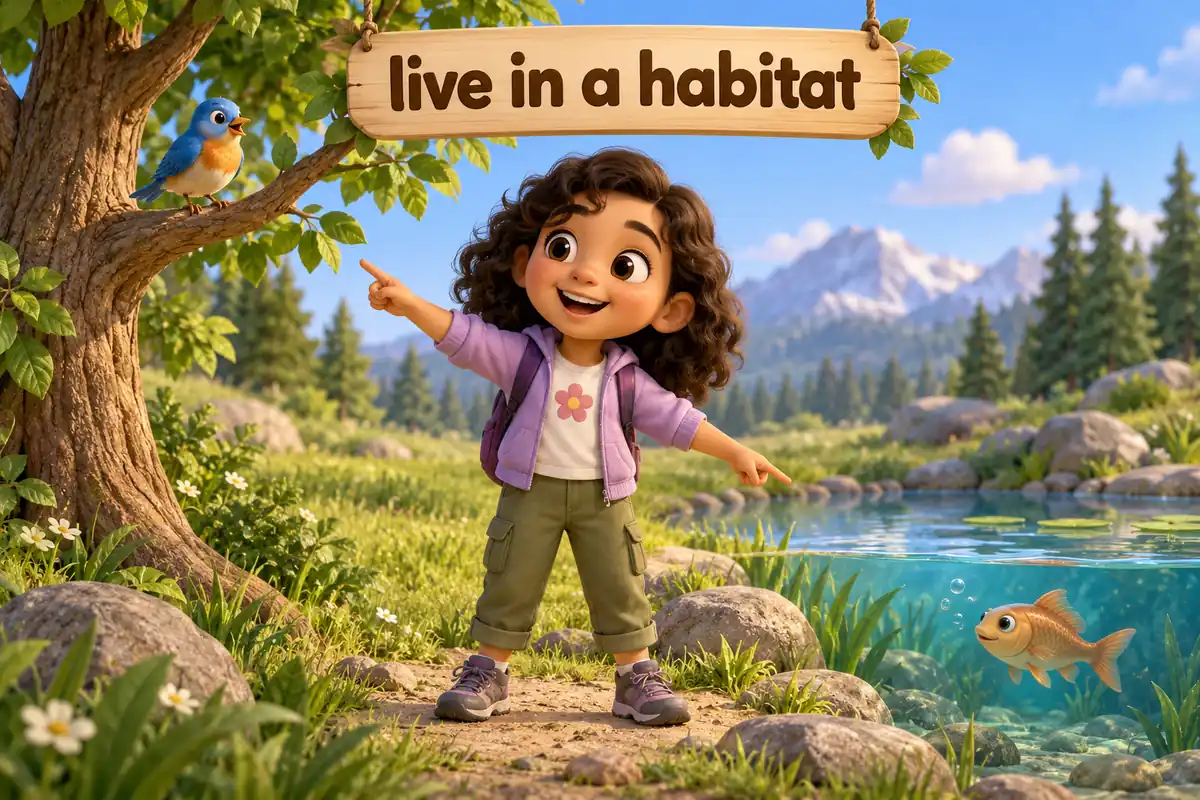
Animal habitats are the natural places where wild animals find food, water and shelter, and the name of each habitat describes its climate and its ground. A forest, a desert, an ocean and a wetland are habitats, and the animals inside each one share the same survival needs.
Animal habitats at a glance
- A habitat is the natural home of a plant or animal.
- Habitat names describe climate, water and ground cover.
- Land habitats include forest, grassland, desert and tundra.
- Water habitats include ocean, river, lake and wetland.
- The commonest error is treating habitat and ecosystem as synonyms.
What is an animal habitat?
An animal habitat is the place where a species naturally lives, and it supplies everything the animal needs to survive: food, water, cover and a safe place to raise young. English sorts habitats by where they are, so land, fresh water and salt water supply three large families of names. Simple frames for the creatures themselves appear in animal in a sentence, which pairs naturally with the habitat names above.
| Habitat | Main feature | Typical animals |
|---|---|---|
| Forest | dense trees and shade | deer, owls, squirrels, bears |
| Grassland | open plains of grass | zebras, bison, gazelles |
| Desert | dry ground, little rain | camels, lizards, fennec foxes |
| Rainforest | warm and very wet | monkeys, parrots, tree frogs |
| Ocean | salt water, deep zones | whales, sharks, tuna |
| Wetland | marshy ground and shallow water | herons, frogs, otters |
| Tundra | cold, treeless, frozen soil | reindeer, arctic foxes, lemmings |
Habitat is countable when it names one place and uncountable in the phrase habitat loss, where no article appears. That is why an article about conservation writes the animals lost their habitat, using the singular to mean the whole range. The word also takes the preposition in, never on.
How do we talk about animal habitats in a sentence?
Habitat nouns follow a small set of frames, and the preposition in particular signals whether you mean a place or a whole system.
| Pattern | Example | What it signals |
|---|---|---|
| live in + habitat | Camels live in the desert. | a permanent natural home |
| the + habitat + is home to | The reef is home to many fish. | the species found there |
| a habitat for + animal | The marsh is a habitat for herons. | suitability for one species |
| lose + habitat | Logging destroys animal habitat. | habitat used as an uncountable noun |
| natural habitat | The zoo copies their natural habitat. | the wild, not captivity |
| adapt to + habitat | The species adapted to a cold habitat. | a change over time |
Animal habitats in sentences across contexts
The word habitat appears in science writing, conservation news and simple classroom sentences, and each register uses it a little differently. The ocean examples connect to marine animal in a sentence, where the same in-frame appears.
| Context | Example sentence | Why this works |
|---|---|---|
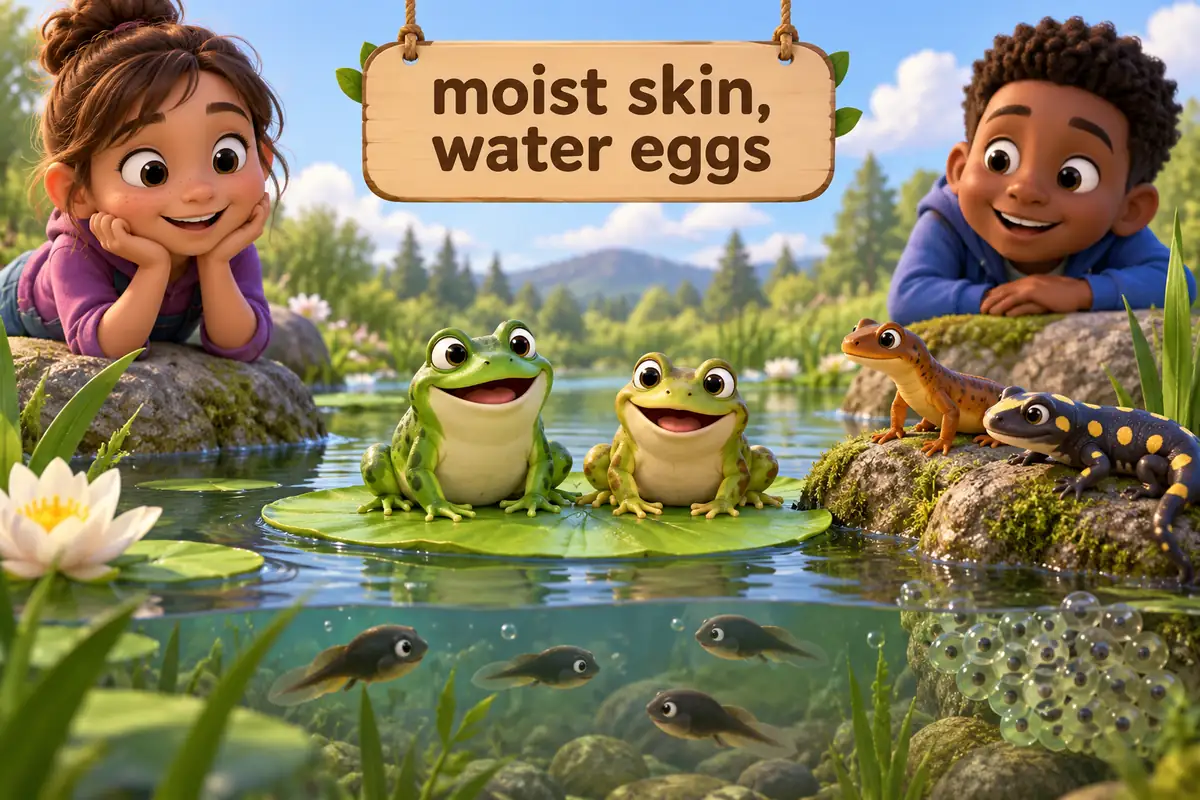
| Classroom | A pond is the habitat of frogs and newts. | names a small, familiar habitat |
| Science report | Deforestation removes habitat for many birds. | habitat as an uncountable noun |
| Conservation news | The wetland was restored as a bird habitat. | names a purpose-built place |
| Nature documentary | These grasslands support the largest herds on Earth. | links habitat to food supply |
| Everyday speech | We saw the animals in their natural habitat. | a fixed, common phrase |
| Travel writing | The coral reef is a habitat of dazzling colour. | a habitat used as scenery |
| Fact sheet | A desert habitat receives very little rain. | defines the habitat by climate |
| Zoo sign | This enclosure copies the polar habitat. | habitat in a managed setting |
| Academic writing | Habitat loss is the main threat to the species. | compound noun habitat loss |
| Story | The fox crept back to its forest habitat at dusk. | a single animal and its home |
| Gardening blog | A hedge creates habitat for small birds. | a man-made habitat |
| Geography lesson | Each climate zone has its own habitats. | habitats across a region |
Register decides how technical the sentence sounds. A classroom says a place to live, a textbook says a coastal habitat, and a report says critical habitat. The noun is the same, and the detail around it rises with the audience, so match the precision to the reader.
Which word: habitat, ecosystem, or biome?
The three words nest inside one another, so the size of the thing you mean decides the word. Habitat words can also describe tame creatures, as in domestic animal in a sentence.
| Question | habitat | ecosystem | biome |
|---|---|---|---|
| Scale | one species or place | a community and its surroundings | a whole climate region |
| Includes other species? | not necessarily | yes, living and non-living | yes, many ecosystems |
| Example | a hollow tree for an owl | a pond with its plants and soil | the tropical rainforest zone |
| Focus | where one animal lives | how living things interact | climate and vegetation |
| Everyday word? | yes | fairly common | more technical |
| Typical phrase | natural habitat | a balanced ecosystem | the desert biome |
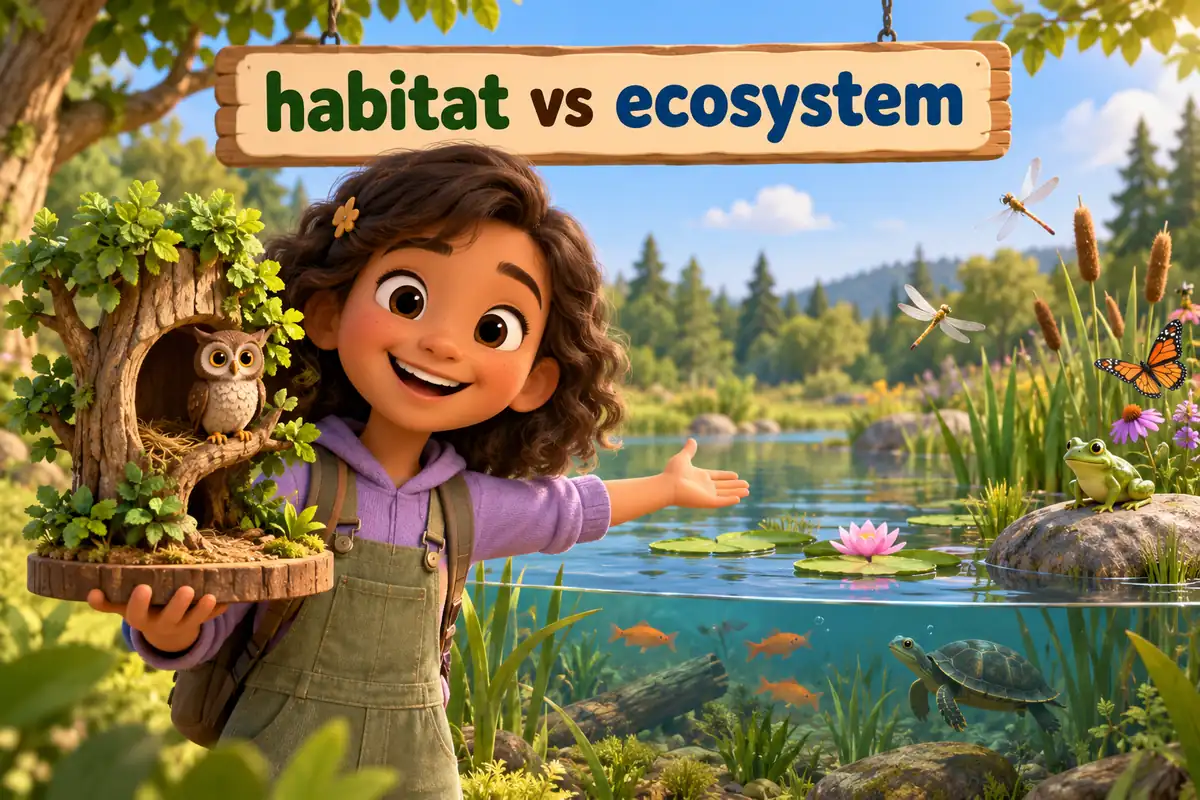
Size is the deciding factor between these three words. A habitat holds one species or one small place, an ecosystem adds the soil, water and air around it, and a biome gathers whole climate regions. Choose the smallest word that still fits the sentence and move up only when the scale demands it.
Word forms and grammar of habitat
The noun habitat has a matching verb and noun for its residents, and the forms appear in ecology writing as well as ordinary sentences. The related noun inhabit is used for people and animals alike, and farm animal in a sentence shows the everyday register.
| Form | Part of speech | Example |
|---|---|---|
| habitat | noun | The lake is their habitat. |
| habitats | noun, plural | Wetlands are rich habitats. |
| inhabit | verb | Fish inhabit the deeper water. |
| inhabitant | noun | The fox is a shy inhabitant of the wood. |
| inhabited | adjective | The cave is inhabited by bats. |
| uninhabited | adjective | Few areas are left uninhabited. |
| habitation | noun, formal | The hut is unfit for habitation. |
The verb inhabit is regular, so it becomes inhabits, inhabited and inhabiting without a change of spelling. The adjective inhabited describes a place with residents, and uninhabited describes one without. Keep habitation for formal writing about whether a building can be lived in.
Common mistakes with animal habitats
Mistake 1: habitat for the animal itself. Incorrect: The Correct: The bear sleeps in a den in winter. Rule: a habitat is the place, not the animal.habitat sleeps in a den in winter.
Mistake 2: ecosystem for a single place. Incorrect: The owl hunted all night in its Correct: The owl hunted all night in its habitat. Rule: habitat names one place; ecosystem is far broader.ecosystem.
Mistake 3: wrong preposition. Incorrect: Fish live Correct: Fish live in the ocean. Rule: animals live in a habitat, not on it.on the ocean.
Mistake 4: plural article clash. Incorrect: The Correct: The habitat is home to many birds. Rule: a singular noun needs a singular verb.habitats is home to many birds.
Mistake 5: habitat as a countable thing for one animal. Incorrect: The zoo built a new Correct: The zoo built a shared habitat for the frogs and fish. Rule: habitat usually covers a species or a group, not one animal.habitat for each frog and each fish.
Practice using animal habitats
- Fill in the blank: Camels are suited to a dry desert ___.
- Choose the better word: A pond is the (habitat / inhabitant) of many frogs.
- Correct the error: Whales live on the ocean.
- Build a sentence: use the frame is home to about a coral reef.
- Spot the register: which suits a conservation report, (a) The birds lost their spot, or (b) The birds lost their breeding habitat?
- Fill in the blank: A ___ is the coldest of the land habitats.
Answers
- habitat, because the sentence names the place, not the animal.
- habitat, because a pond is the place where frogs live.
- Whales live in the ocean; animals live in a habitat, not on it.
- The coral reef is home to hundreds of species of fish.
- (b), because breeding habitat is the precise term a report would use.
- tundra, because the tundra is cold, treeless and frozen.
The bottom line
Animal habitats are the natural places where species find food, water and shelter, and their names describe climate and ground rather than size. Keep habitat for one place, ecosystem for a whole community and biome for a climate region, and the three words stay neatly apart. The right preposition is always in a habitat.
Frequently asked questions about animal habitats
What is the difference between a habitat and an ecosystem?
A habitat is the specific place where one species lives, such as a hollow tree for an owl, while an ecosystem is the whole community of living things together with the air, water and soil around them. Every habitat sits inside an ecosystem, so the second word is always the larger idea.
How many main animal habitats are there?
Common lists name around eight broad habitats: forest, grassland, desert, tundra, freshwater, ocean, wetland and the polar ice. Many schemes split these further, so a rainforest is a kind of forest and a river is a kind of freshwater habitat rather than a separate class.
Why is habitat loss a serious problem?
When a habitat disappears, the animals that depend on it lose their food, shelter and breeding sites all at once. Unlike a change of weather, which animals can often survive, the removal of the place itself leaves nowhere to return to, so species decline quickly and some vanish.
Is a zoo enclosure a habitat?
A zoo enclosure can be called a habitat when it copies the animal natural conditions closely, and keepers often use the phrase natural habitat to describe the wild version. For accuracy, describe the enclosure as a habitat and the wild place as the natural habitat, so the two are not confused.